CO/Tech MJ10250IV-UK Manual de usuario

ENGLISH
SVENSKANORSKSUOMI
DEUTSCH
Important!
Read the entire instruction manual carefully
and make sure that you fully understand
it before you use the equipment. Keep the
manual for future reference.
Viktig information:
Läs hela bruksanvisningen noggrant och
försäkra dig om att du har förstått den innan
du använder utrustningen. Spara manualen
för framtida bruk.
Viktig informasjon:
Les disse anvisningene nøye og forsikre deg
om at du forstår dem før du tar produktet i bruk.
Ta vare på anvisningene for seinere bruk.
Tärkeää tietoa:
Lue nämä ohjeet huolellisesti ja varmista
että olet ymmärtänyt ne, ennen kuin alat
käyttää laitetta. Säilytä ohjeet myöhempää
tarvetta varten.
Wichtiger Hinweis:
Vor Inbetriebnahme die komplette
Bedienungsanleitung durchlesen und
aufbewahren.
Ver. 20130927
Original instructions
Bruksanvisning i original
Original bruksanvisning
Alkuperäinen käyttöohje
Original Bedienungsanleitung
Art.no Model
18-3266 MJ10250IV-UK
40-8309 MJ10250IV
Table Saw
Bordscirkelsåg
Bordsirkelsag
Pöytäpyörösaha
Tischkreissäge

2

3
ENGLISH
Table Saw
Art.no 18-3266 Model MJ10250IV-UK
40-8309 MJ10250IV
Please read the entire instruction manual before using the product and save it for future reference.
We reserve the right for any errors in text or images and any necessary changes made to technical data.
If you have any questions regarding technical problems please contact our customer services.
Contents
1. Safety................................................................................................................ 4
1.1 Things to consider .................................................................................................................4
1.2 General safety instructions for your safety and the safety of others ....................................4
1.3 Specific Safety Instructions for Table Mounted Circular Saws and Mitre Saws .....................5
2. Product safety symbols and their meaning .......................................................7
3. Parts ..................................................................................................................7
4. Package contents.............................................................................................. 8
5. Assembly .........................................................................................................10
5.1 Removing the packing material........................................................................................... 10
5.2 Attaching the push stick holders ........................................................................................ 10
5.3 Attaching the rear and two side table extensions ............................................................... 10
5.4 Attaching the blade height adjuster.....................................................................................11
5.5 Attaching the riving knife.....................................................................................................11
5.6 Attaching and removing the blade guard............................................................................ 12
6. Operation.........................................................................................................12
6.1 Starting and stopping the machine ..................................................................................... 12
6.2 Setting the cutting depth.................................................................................................... 12
6.3 Rip fence............................................................................................................................. 13
6.4 Mitre guide ......................................................................................................................... 13
6.5 Setting the blade tilt........................................................................................................... 13
6.6 Rip cutting .......................................................................................................................... 13
6.7 Rip cutting narrow workpieces............................................................................................ 14
6.8 Sawing with a tilted blade ................................................................................................. 14
6.9 Crosscutting........................................................................................................................ 14
7. Changing the blade .........................................................................................14
8. Troubleshooting...............................................................................................16
9. Technical specifications ...................................................................................16

4
ENGLISH
1. Safety
1.1 Things to consider
• Working with wood can be dangerous if the correct procedures are not observed.
• Using the saw with common sense and caution will greatly reduce the risk of personal injury.
• Safety devices such as guards, push-sticks, clamps, safety goggles, dust masks and ear defenders can
never make up for bad judgement, carelessness or inattentiveness.
• N.B: you are responsible for your own safety. The saw has been designed to perform certain tasks.
We strongly recommend that the saw is not altered in any way and that it is not used for performing any task
for which it was not designed.
• Do not use the saw if you are unsure whether the saw can or should be used to perform the task you intend
to use it for.
1.2 General safety instructions for your safety and the safety of others
Always disconnect the product from the mains power supply before performing any service or adjustment.
Warning: When you are using electric hand tools the included safety instructions should be followed to avoid
risk of fire, electric shock, and personal injury.
1. Keep the work area clean and well lit. Cluttered surfaces and benches invite accidents.
2. Do not use the machine in a dangerous environment. Electrical power tools should not be used on moist
or wet surfaces or in the rain. Make sure that the work area is well lit. When working in dusty atmospheres,
make sure that the air is adequately circulated. Do not operate electrical power tools in explosive
atmospheres, such as in the presence of flammable liquids, gases or dust.
3. Avoid electric shocks. Avoid body contact with earthed or grounded surfaces such as pipes, radiators,
ranges and refrigerators when using power tools.
4. Keep children and bystanders away. Keep children and visitors at a safe distance from electrical
machinery/tools and electric cables in the workplace.
5. Store power tools out of the reach of children. When not in use, power tools should be stored locked
away in a safe place, away from children.
6. Do not force the power tool. The correct feed rate makes the work better and safer.
7. Use the correct tool for the job. Do not force a tool to perform a task that it was not designed for.
8. Wear suitable clothing. Do not wear any loose-fitting clothing, gloves, necklaces, bracelets or other
jewellery that can get caught in moving parts. Non-slip footwear is recommended. Wear a hairnet or similar
if you have long hair.
9. Always use safety glasses. Normal glasses are not tough enough to withstand impacts. Use a dust mask
or dust filter when working in dusty environments.
10. Use a dust extractor. If the machine is equipped with dust extraction equipment, ensure that it is
connected and used properly. Make sure to empty the dust bag regularly. Warning: Dust and chippings
from certain kinds of wood/material can be hazardous to your health, even after a short exposure time.
11. Do not abuse the lead. Do not carry the machine by its mains lead. Do not yank the mains lead to turn
the power off, pull the plug out instead. Make sure that the mains lead does not come into contact with
heat, oil, or sharp edges.
12. Secure the workpiece firmly. Wherever possible, use clamps or a vice. You can then operate the tool using
two hands. This is much safer than holding the workpiece in one hand.
13. Do not overreach. Make sure that you stand steady and balanced all times.
14. Look after your tools. Keep blades sharp and clean for the best and safest performance. Follow the
manual’s recommendations regarding lubrication and replacement of accessories. Check all the mains leads
regularly. If it is damaged it should be replaced by a qualified service technician. If an extension lead is used,
it too should be checked and replaced if damaged. Make sure that the machine’s handles and controls are
clean, dry and free from oil and grease.
15. Turn the power off. Pull out the plug and push in the emergency stop button before servicing or changing
any blades, drill bits, cutters or sanding discs.
16. Remove all spanners and repair tools. Make a habit of checking to make sure that the machine is free of
all spanners and tools before turning the power on.
17. Avoid accidental starting. Do not walk around with your finger on the trigger of a power tool if it is plugged
in. Make sure that the ON/OFF switch is set to OFF before plugging in any power tool.

5
ENGLISH
18. Use the correct extension leads. If you use extension leads outdoors, only use those designed for outdoor
use. Only use extension leads with adequate wire core area and roll out the whole lead.
19. Use common sense and be careful. Think carefully before carrying out every action, so that it is carried
out safely. Never operate machines/power tools when you are tired or under the influence of medicine.
20. Inspect the tool for damage. Check the following before turning the tool on: that the guards and other
parts are undamaged and working properly, that moving parts can rotate freely and are correctly aligned,
that no moving parts can get caught, that there is no fault or defect that could affect the performance of the
machine. A safety guard or any other part that is damaged should be repaired by a tradesman or replaced.
Damaged power leads and switches must always be replaced by a tradesman. Never operate a tool if you
cannot stop or start the tool comfortably.
21. Use only recommended accessories. The use of non-recommended accessories can cause accidents
and personal injury.
22. Power tools should only be repaired by a qualified technician. This tool conforms to current
safety requirements. Repairs to the tool should only be carried out by a tradesman using original spares;
otherwise the tool could cause accidents and personal injury.
23. Use a Residual Current Device on all 230 V power tools. This can help minimise the risk of an electric
shock in the event of an earth fault or short circuit. The product must not be modified or used for any other
purpose than that for which it has been designed. Regularly check that all screws and nuts are tight.
1.3 Specific Safety Instructions for Table Mounted Circular Saws and Mitre Saws
Warning: Always unplug the machine before carrying out any maintenance or changing the blade.
Note: Make sure that all the parts are working properly and that the safety devices are in place before starting the saw.
1. Warning: Use only cross-cut saw blades. Make sure that TCT blades have negative rake. Do not use blades
with deep spacing between the teeth because the teeth might bend and come into contact with the blade
guard. A damaged blade should be replaced immediately.
2. Do not use the saw unless it has been completely assembled using the instructions in this manual.
Check that the motor and the blade are rotating the right way (see direction arrow on blade guard).
Make sure that the blade does not come into contact with the table in any of the settings.
Unplug the machine and manually tilt the blade to 45° and 90°. Adjust the saw head if necessary.
3. If you do not understand how the saw should be used, ask a knowledgeable person for advice.
4. Do not saw freehand. Make sure that the workpiece is firmly secured against the fence before you start
sawing. If the workpiece that you are sawing requires you to have one hand as close as 10 cm from
the blade, fix the workpiece to the table using a clamp, etc. before sawing.
5. Warning: Keep hands away from the saw blade. Never saw small objects. Use a push-stick.
6. Check that the blade is well-centred, sharp and that it rotates freely and without vibration.
7. Let the motor come up to speed before starting to cut.
8. Always keep the motor’s ventilation openings free of dust and debris.
9. Make sure that all clamps are tight before starting to saw, even if the table is locked at a fixed angle.
10. Make sure that the blade and flanges are clean and that the spindle nut is tight. Use only the blade flanges
belonging to your saw.
11. The riving knife should have a radius compatible with the diameter of the saw blade.
12. Use only saw blades having a diameter and speed rating complying with those in the technical specifications.
13. When sawing long objects, make sure that the ends are adequately supported.
14. Always check the blade for cracks and fractures before using it. Replace a damaged blade immediately.
15. Never use the saw if any part is missing, damaged or not functioning properly. Unplug the saw if it starts to
make unusual noises or vibrations. Get a professional to replace the missing or damaged part before you
use the saw again.
16. Never use the saw if the blade guard is not in place and working properly.
17. Never stretch round or over the blade when it is rotating. Maintain a steady stance and remain balanced at all times.
18. Make sure that the blade can rotate freely (especially after transportation/blade changes) before plugging in
and starting the saw.
19. Do not use high speed steel (HSS) blades if the saw is supplied with a tungsten carbide (TCT) blade.

6
ENGLISH
20. Turn the machine off and wait until the blade has stopped before moving the workpiece or adjusting any setting.
21. Do not remove any offcuts or jammed material from around the blade area until the blade has stopped.
22. Never saw into ferrous metals, brick or mortar.
23. Never use the saw near flammable fluids or gas.
24. Never clean the plastic parts of the saw using solvents. Solvents can dissolve or otherwise damage plastic;
use a soft, moist cloth only.
25. Unplug and clean the saw before leaving it. Always tidy the work area when you have finished working.
26. Keep this instruction manual safe for future reference. Make sure that everyone using the saw has read
these instructions.
27. Do not expose the saw to rain and do not use it in humid environments.
28. Ensure that the work area is well-lit.
29. Wear suitable clothing, loose clothing or jewellery can get caught in moving parts.
30. Operators of the saw must be at least 18 years old. Operators aged 16 must be supervised by an instructor
at all times. Keep children away from the saw when it is connected to the power supply.
31. Keep the work area tidy; do not leave offcuts or waste material around the saw unnecessarily. Make sure
that all offcuts can be removed from the saw blade; otherwise they might be ejected by the blade.
32. Do not distract the operator of the saw.
33. Do not try to stop the blade by pushing something against the side of the blade when the power has been turned off.
34. Never use saw blades that do not comply with the specifications in this manual.
35. Always make sure that the blade guard is in place and working properly.
36. Never lock the blade guard in the open position or alter any of the machines safety devices in any way.
Never use a faulty safety device, replace it immediately.
37. Always position your hands in such a way that they will not slip into the saw blade should you lose your
balance. Never saw workpieces that are too small to hold safely.
38. Use a table, roller stand, etc for support when working on long workpieces, to prevent the table from tipping over.
39. Secure round workpieces to the table using suitable clamps to stop them from rotating.
40. Never cut a workpiece with nails or screws in it. Inspect the workpiece before sawing.
41. Always stand to the side of the blade when using the saw so that you are not in its path in case it breaks.
42. Always ensure that the workpiece is securely pressed against the rip fence and surface of the table so that it
cannot twist whilst being sawed.
43. Never saw more than one workpiece at a time.
44. Never attempt to remove sawdust or offcuts trapped around the blade whilst the saw blade is rotating.
Always switch off the machine and unplug it before adjusting the machine or removing waste material.
45. Always switch off the machine and unplug it before cleaning the machine or measuring the workpiece.
46. Always switch off the machine and unplug it before leaving the work area.
47. Electrical installations, repairs or maintenance must be carried out by a qualified person.
48. All safety devices must be reattached to the machine immediately after any repairs or maintenance.
49. It is very important to observe the directions for the safety, operation and maintenance of the machine as
well adhering to the characteristics specified in Technical Data.
50. It is essential to follow all Health and Safety Executive regulations as well as general safety regulations.
51. Use only a machine with a dust extractor in a closed room if the room has an air inlet, to prevent the build-up
of a vacuum.
52. The saw must only be used with a 230 V plug protected by at least a 10 A fuse.
53. Faulty safety devices and damaged parts must be repaired or replaced by a qualified tradesman.
54. This machine conforms to all relevant safety standards. It must only be repaired by a qualified tradesman using
genuine spare parts. Failure to follow these rules could put the operator in danger or cause an accident.
55. Do not use saw blades that are thicker or thinner than the riving knife (applies to circular saws).
56. Always use a riving knife when rip cutting.
57. Make sure that the riving knife is adjusted so that the distance between the teeth of the blade and
the riving knife is no more than 5 mm.

7
ENGLISH
102
103
101
108
107
109
1010
1011
1013
1014
1012
105 106104
2. Product safety symbols and their meaning
The following warnings must be heeded to prevent accidents or damage to the machine.
Read the entire instruction manual.
Warning: Use safety glasses or a visor and wear a face mask.
Warning: Use hearing protection.
3. Parts
1. On/off - NVR switch
2. Reset button for motor
overload cut-out
3. Mitre guide
4. Side table extension (2 pcs)
5. Blade guard
6. Riving knife
7. Table insert
8. Rear table extension
9. Saw table
10. Rip fence
11. Rip fence scale
12. Rip fence locking lever
13. Support stand rail (4 pcs)
14. Rubber foot (4x)

8
ENGLISH
1015
1016
1017
1019
1020
1021
1018
1024
1025
1022
1023
15. Side table extension support (4 pcs)
16. Push stick holder spring clip (2 pcs)
17. Push stick
18. Saw blade
19. Rear table extension support (2 pcs)
20. Dust extractor port
21. Legs (4 pcs)
22. Blade tilt lock
23. Blade height adjustment wheel
24. Blade tilt adjuster
25. Index mark
4. Package contents
A) Circular saw with table and TCT blade B) 2 push stick holders with screws
C) Fasteners D) Mitre guide

9
ENGLISH
10I
10N
10O
10P 10Q
10J
E) Push stick F) Riving knife
G) Wheel, lock washer and cap nut for
adjusting the blade height
H) 4 legs
I) Table extension
J) Two side tables
K) Rip fence
L) 4 support stand rails M) Blade guard
N) 2 rear table extension supports
O) 4 side table extension supports
P) Allen key
Q) 2 blade spanners

10
ENGLISH
10B
10I
10J 10R
5. Assembly
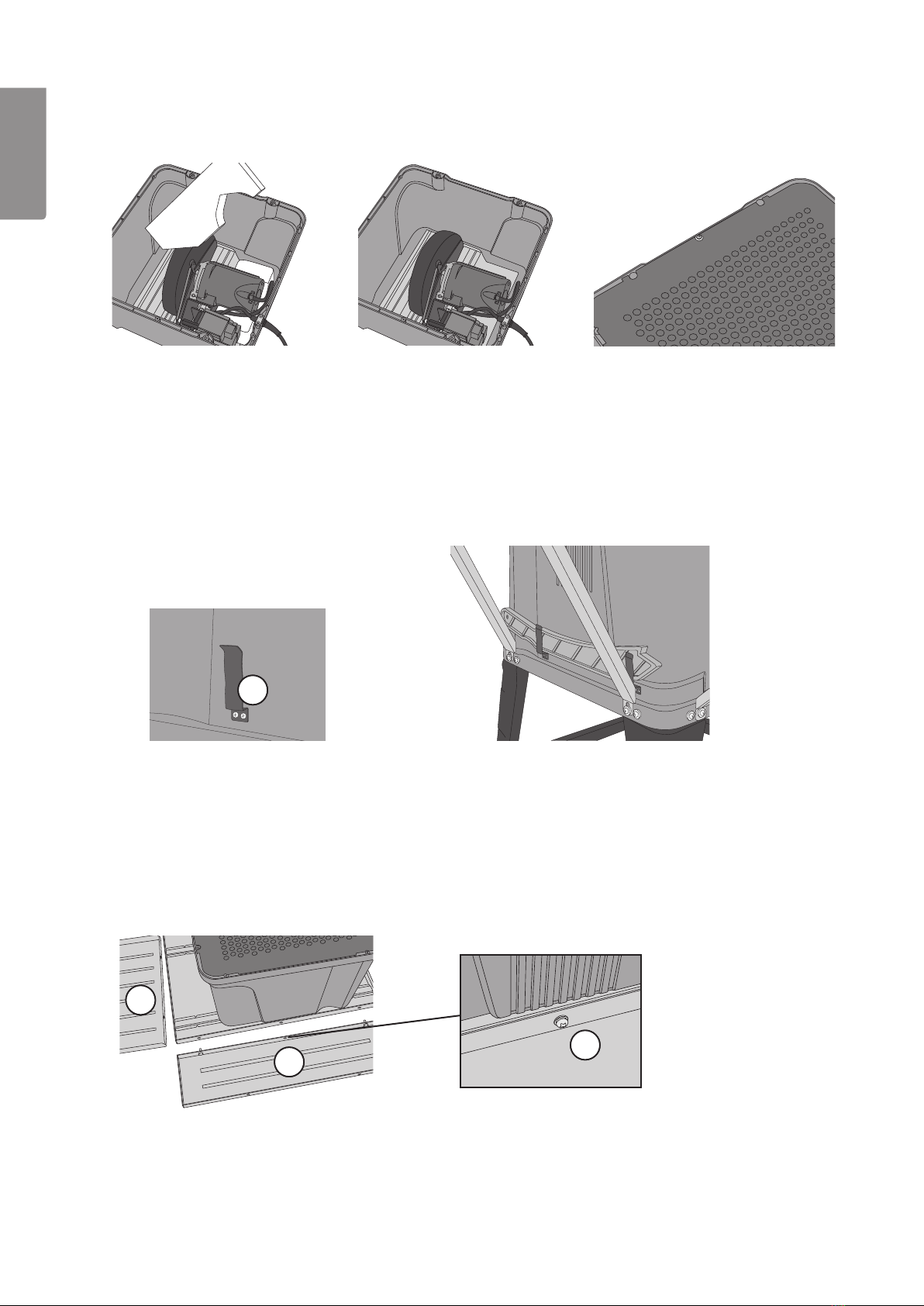
5.1 Removing the packing material
1. Lay the table saw upside down on a piece of cardboard (to protect the table).
2. Undo the screws holding the bottom plate and remove it.
3. Remove any packing material inside the bottom plate.
4. Screw the bottom plate back into place.
5.2 Attaching the push stick holders
Screw the spring clips (B) onto the left side of the table saw using the two supplied screws and the predrilled
holes. Always keep the push stick in the holder when it is not in use.
5.3 Attaching the rear and two side table extensions
The table saw has a rear table extension (I) and two side table extensions (J) for working on large workpieces.
Use dome head bolts with flat and spring washers to fasten the rear table extension.
1. Attach the side table extensions to the saw table by fastening flat washers, spring washers and nuts onto
the bolts which are welded to the side tables. Each side table should also be attached with a dome bolt in
the middle (R).
Este manual sirve para los siguientes modelos
1
Tabla de contenidos
Idiomas:
Otros manuales de Sierra de CO/Tech

CO/Tech
CO/Tech JFB10-UK Manual de usuario

CO/Tech
CO/Tech M1W-TD2-210E-UK Manual de usuario

CO/Tech
CO/Tech TC180I-UK Manual de usuario

CO/Tech
CO/Tech TC-RM-180E Manual de usuario

CO/Tech
CO/Tech J1x-JF2-210 Manual de usuario

CO/Tech
CO/Tech ST12 Manual de usuario

CO/Tech
CO/Tech RS 18 DMF008C-180 Manual de usuario

CO/Tech
CO/Tech J1X-KZ2-210-UK Manual de usuario

CO/Tech
CO/Tech 92107L-UK Manual de usuario

CO/Tech
CO/Tech HF-ZJ-0101 Manual de usuario