Page 2
Thank you for your purchase of a state of the art Reverse Osmosis (RO) water treatment system. Water quality concerns
are becoming more of a focus for the public. You may have heard about contaminants in the drinking water, such as Arsenic,
Chromium. There may also be some local water issues such as high levels of Lead and Copper. This water treatment system
has been designed and tested to provide you with high quality drinking water for years to come. The following is a brief
overview of the system.
Your Reverse Osmosis System:
Osmosis is the process of water passing through a semi permeable membrane in order to balance the concentration of
contaminants on each side of the membrane. A semi permeable membrane is a barrier that will pass some particles like clean
drinking water, but not other particles like arsenic and lead.
Reverse osmosis uses a semi permeable membrane; however, by applying pressure across the membrane, it concentrates
contaminants (like a strainer) on one side of the membrane, producing crystal clear water on the other. This is why RO
systems produce both clean drinking water and waste water that is ushed from the system. This reverse osmosis system also
utilizes carbon block ltration technology, and can therefore provide a higher quality drinking water than carbon ltration
systems alone.
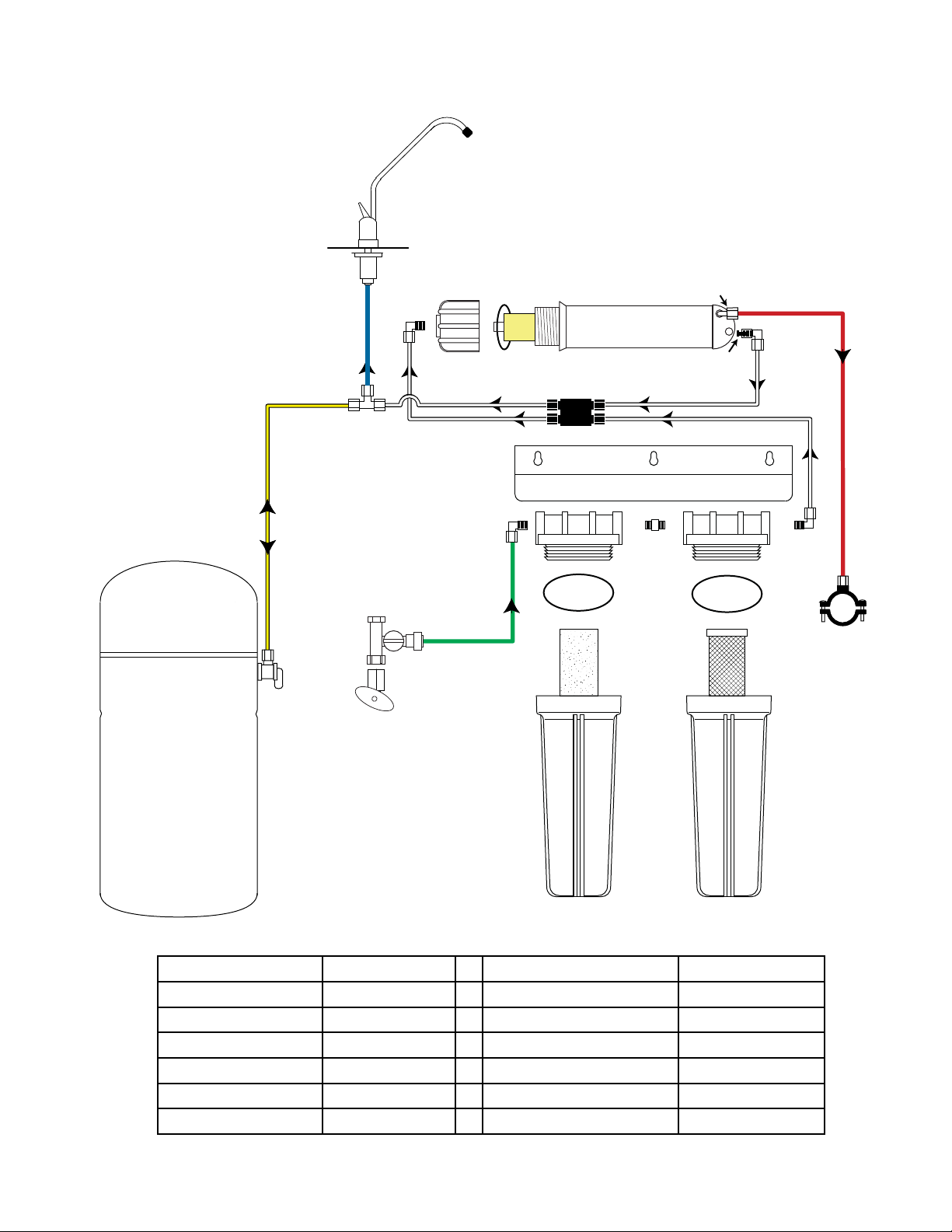
Your system is a three stage RO which is based upon separate treatment segments within the one complete water ltration
system. These stages are as follows:
Stage 1 – Sediment lter, recommended change 6 months.
The rst stage of your RO system is a ve micron sediment lter that traps sediment and other particulate matter
like dirt, silt and rust which affect the taste and appearance of your water.
Stage 2 - Carbon lter, recommended change 6 months.
The second stage contains a 5 micron carbon block lter. This helps ensure that chlorine, chloramines and other
materials that cause bad taste and odor are greatly reduced.
Stage 3- Membrane, recommended change 2-3 years.
Stage three is the heart of the reverse osmosis system, the RO membrane. This semi permeable membrane will
effectively take out TDS & Sodium and a wide range of contaminants such as Percholate, Chromium, Arsenic, Copper,
and Lead. Because the process of extracting this high quality drinking water takes time, your RO water treatment
system is equipped with a storage tank.
Note: Filter & Membrane life may vary based upon local water conditions and/or use patterns.
System Maintenance
Just because you can not taste it, does not mean that it is not there. Contaminants such as Lead, Chromium and Arsenic are
undetectable to the taste. Additionally, over time if you do not replace the lter elements, other bad tastes and odors will be
apparent in your drinking water. It is important to change out your lters at the recommended intervals as indicated in this
system manual. When replacing the lter elements, pay special attention to any cleaning instructions.
This manual is used for several variations of the same system. Your system may vary slightly
from the pictures or descriptions contained in this manual. It is the end users responsibility
to ensure that this system is installed according to all local codes and regulations.