PACIFIC CYCLE none Manual de usuario

CORRECT FITTING - MAKE
SURE YOUR HELMET COVERS
YOUR FOREHEAD.
INCORRECT FITTING. FOREHEAD
IS EXPOSED AND VULNERABLE
TO SERIOUS INJURY.
ALWAYS WEAR A PROPERLY
FITTED HELMET WHEN
YOU RIDE YOUR BICYCLE.
DO NOT RIDE AT NIGHT.
AVOID RIDING IN WET
CONDITIONS.
HELMETS
SAVE
LIVES !!!

P
Personal
ersonal C
Care
are
from Pacific Cycle
1.800.626.2811
Congratulations on your new bike!
Our Service Department is dedicated
to your satisfaction with Pacific Cycle.
We want to help with any questions
or comments you may have.
You can also reach us by email at:
DO NOT Return this Product to the Store.
Please Call Pacific Cycle for Assistance.
STOP

14
RIDING SAFELY
General Rules
When riding obey the same road laws as all other road vehicles, including giving way to
pedestrians, and stopping at red lights and stop signs.
For further information, contact the Road Traffic Authority in your State.
Ride predictably and in a straight line. Never ride against traffic.
Use correct hand signals to indicate turning or stopping.
Ride defensively. To other road users, you may be hard to see.
Concentrate on the path ahead. Avoid pot holes, gravel, wet road markings, oil, curbs, speed
bumps, drain grates and other obstacles.
Cross train tracks at a 90 degree angle or walk your bicycle across.
Expect the unexpected such as opening car doors or cars backing out of concealed driveways.
Be extra careful at intersections and when preparing to pass other vehicles.
Familiarize yourself with all the bicycle's features. Practice gear shifts, braking, and the use of
toe clips and straps, if fitted.
If you are wearing loose pants, use leg clips or elastic bands to prevent them from being caught
in the chain.
Don't carry packages or passengers that will interfere with your visibility or control of the bicycle.
Don't use items that may restrict your hearing.
When braking, always apply the rear brake first, then the front. The front brake is more powerful
and if it is not correctly applied, you may lose control and fall.
Maintain a comfortable stopping distance from all other riders, vehicles and objects.
Safe braking distances and forces are subject to the prevailing weather conditions.

15
Wet Weather
DO NOT RIDE IN WET WEATHER
- In wet weather you need to take extra care.
- Brake earlier, you will take a longer distance to stop.
- Decrease your riding speed, avoid sudden braking, and take corners with additional
caution.
- Be more visible on the road.
- Wear reflective clothing and use safety lights.
- Pot holes and slippery surfaces such as line markings and train tracks all become more
hazardous when wet.
Night Riding
- Ensure bicycle is equipped with a full set of correctly positioned and clean reflectors.
- Refer to p. 82 of this manual.
- Use a properly functioning lighting set comprising a white front lamp and a red rear lamp.
- If using battery powered lights, make sure batteries are well charged.
- Some rear lights available have a flashing mechanism which enhances visibility.
- Wear reflective and light colored clothing.
- Ride at night only if necessary. Slow down and use familiar roads with street lighting, if possible.
Pedaling Technique
- Position the ball of your foot on the center of the pedal.
- When pedaling, ensure your knees are parallel to the bicycle frame.
- To absorb shock, keep your elbows slightly bent.
- Learn to operate the gears properly. (Refer to p. 13-15)
Do not ride at night

16
Hill Technique
- Gear down before a climb and continue gearing down as required to maintain pedaling speed.
- If you reach the lowest gear and are struggling, stand up on your pedals. You will then obtain more power from
each pedal revolution.
- On the descent, use the high gears to avoid rapid pedaling.
- Do not exceed a comfortable speed, maintain control and take additional care.
Cornering Technique
Brake slightly before cornering and prepare to lean your body into the corner. Maintain the inside pedal at the 12 o'clock
position and slightly point the inside knee in the direction you are turning. Keep the other leg straight, don't pedal through
fast or tight corners.
Rules for Children
To avoid accidents, teach children good riding skills with an emphasis on safety from an early age.
1. Always wear a properly fitted helmet.
2. Do not play in driveways or the road.
3. Do not ride on busy streets.
4. Do not ride at night.
5. Obey all the traffic laws, especially stop signs and red lights.
6. Be aware of other road vehicles behind and nearby.
7. Before entering a street: Stop, look right, left, and right again for traffic.
If there's no traffic, proceed into the roadway.
8. If riding downhill, be extra careful. Slow down using the brakes and maintain control of the steering.
9. Never take your hands off the handlebars, or your feet off the pedals when riding downhill.
The Consumer Protection Safety Commission advises that the riding of small wheel diameter
bicycles at excessive speeds can lead to instability and is not recommended.
Children should be made aware of all possible riding hazards and correct riding behavior before they take to the streets
- Do not leave it up to trial and error.

17
GEARS - HOW TO OPERATE
Derailleur Gears
Most multi-speed bicycles today are equipped with what are known as
derailleur gears. They operate using a system of levers and mechanisms
to move the drive chain between different sized driving gears or cogs.
The purpose of gears is to let you maintain a constant, steady pedaling
pace under varying conditions. This means your riding will be less
tiring without unnecessary straining up hills or fast pedaling down hill.
Bicycles come with a variety of gear configurations from 5 to 27
speeds. A 5-6 speed bicycle will have a single front chainwheel, a
rear derailleur, and 5 or 6 cogs on the rear hub. Bicycles with more
gears will also have a front derailleur, a front chainwheel with
2-3 cogs, and up to 8 cogs on the rear hub.
Operating Principles
No matter how many gears, the operating principles are the same.
The front derailleur is operated by the left shift lever and the rear
derailleur by the right. To operate you must be pedaling forward. You
can not shift derailleur gears when you are stopped or when pedaling
backwards. Before shifting ease up on your pedaling pressure. For a
smooth gear change when approaching a hill, shift to a lower gear
BEFORE your pedaling speed slows down too much. When coming
to a stop, shift to a lower gear first so it will be easier when you start
riding again. If, after selecting a new gear position, you hear a slight
rubbing noise from the front or rear gears, gently adjust the appropriate
shifter using the barrel adjusters until the noise goes away. For opti-
mal performance and extended chain life, it is recommended that you
avoid using the extreme combinations of gear positions (diagram p.
14) for extended periods.
Drivetrain
Front Derailleur
Guide Pulley
Rear Derailleur
Front Chainwheels
Crank Arm
Pedal
Derailleur Control
Cable
Freewheel
Cogs

18
654321
654321
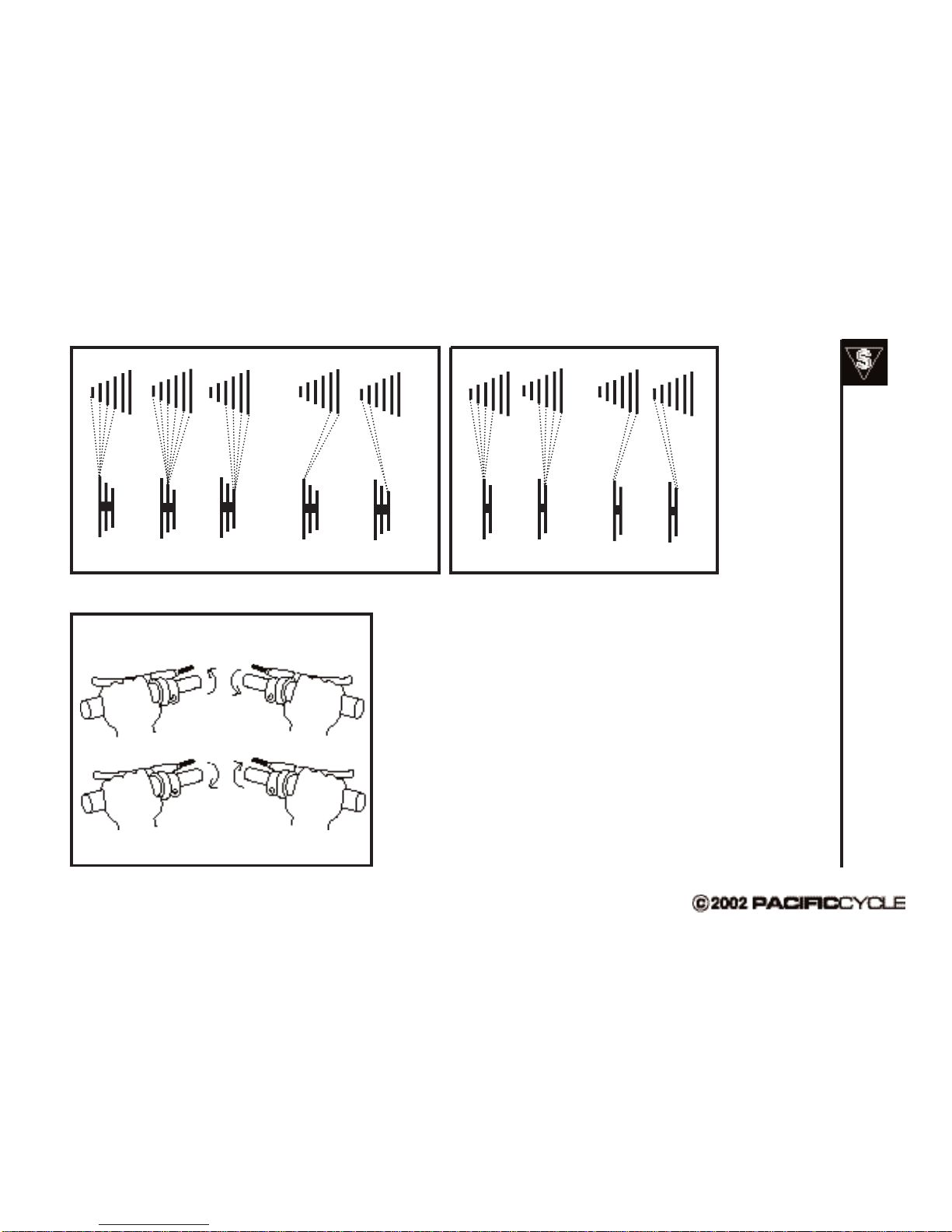
Recommended Chainwheel/Rear Sprocket Gear Combinations
Hand Grip Shifters
Some bicycles are now being equipped with a shifting
mechanism called Grip Shift, which is built into the handlebar grips
and does not make use of separate levers. The actuating mechanism
is built into the inside part of the grip that the web of the thumb and
index finger closes around. To select a lower gear, twist the right
shifter toward you to engage a larger rear cog. You can shift one gear
at a time by moving the Grip Shift one click, or through multiple gears
by continued twisting. By twisting the left shifter forward or away from
you, a smaller chainwheel can be selected. To select a higher gear,
twist the right shifter forward or away from you to engage a smaller
rear cog. To engage a larger front chainwheel, twist the left shifter
towards you. Single shifts can be achieved by twisting one click at a
time and multiple shifts by larger twists.
Front Low Gear Rear Low Gear
Front High Gear Rear High Gear
321
High Middle Low 2
High
1
Low
For optimal performance,
NOT RECOMMENDED For optimal performance,
NOT RECOMMENDED

Please Retain your Sales Receipt
as Proof of Purchase.
Notes:
_______________________________________________________________________
_______________________________________________________________________
_______________________________________________________________________
_______________________________________________________________________
_______________________________________________________________________
_______________________________________________________________________
_______________________________________________________________________

The following manual is only a guide to assist you and is not a complete or comprehensive manual of all aspects of
maintaining and repairing your bicycle. The bicycle you have purchased is a complex object. We recommend that you
consult a bicycle specialist if you have doubts or concerns as to your experience or ability to properly assemble, repair, or
maintain your bicycle. You will save time and the inconvenience of having to go back to the store if you choose to write or
call us concerning missing parts, service questions, operating advice, and/or assembly questions.
SERVICE
CALL TOLL FREE 1.800.626.2811
Monday - Friday 8:00 a.m. to 5:00 p.m. Central Time
Serial Number Location
Bottom View
Serial Number
PACIFICCYCLE
4902 Hammersley Road
Madison, WI 53711
Customer Service 1.800.626.2811
www.pacific-cycle.com

Thank You for purchasing your bicycle. Please take a moment to fill out this reply card, and
mail it back to us. We value your business and appreciate your feedback.
Name: ______________________________________________ Birthdate: ____________________
Address:__________________________________________________________________________
__________________________________________________________________________
E-mail Address: ____________________________Phone Number: ________________________
Bicycle Model purchased: __________________________________________________________
Store at which you purchased your bicycle: ____________________________________________
Serial Number ____________________________________________________________________
How did you hear about your bicycle?
Magazine Ad
Newspaper Ad
In Store Display
Friends
Web Site
Other (Please specify)
What was the most important factor in choosing your bicycle?
Color / Graphics
Price
Frame Style
Components
Gift
Other (Please specify)
Cut along dotted line before mailing
www.pacific-cycle.com
Tabla de contenidos
Manuales populares de Accesorios para motocicletas de otras marcas

SRC
SRC B-TRK502-01-01-SL Manual de usuario

3M
3M Speedglas 9100 MP Manual de usuario

hepco & becker
hepco & becker 6307520 00 01 Manual de usuario

HOMCOM
HOMCOM AA0-077 Manual de usuario

hepco & becker
hepco & becker 6307558 00 01 Manual de usuario

Wunderkind Custom
Wunderkind Custom 106503-F15 Guía del usuario