AmazonBasics B07WGNT4GG Manual de usuario

Folding Step Ladder - 3-Step, Aluminum with Wide Pedal
Escabeau Pliant - 3Marches, Aluminium avec Larges Marches
Klappbare Trittleiter - 3Stufen, Aluminium mit Breiter Trittfläche
Scala a Libretto Pieghevole - 3 Gradini, Alluminio con Pedata Larga
Taburete Plegable - 3 Peldaños, Aluminio con Peldaños Grandes
Huishoudtrap - 3 Treden, Aluminium met Brede Treden
B07WGNT4GG

English . . . . . . . . . . . . . . . . . . . . . . . . . . . . . . . . . 3
Français . . . . . . . . . . . . . . . . . . . . . . . . . . . . . . . 13
Deutsch . . . . . . . . . . . . . . . . . . . . . . . . . . . . . . . 23
Italiano . . . . . . . . . . . . . . . . . . . . . . . . . . . . . . . . 33
Español . . . . . . . . . . . . . . . . . . . . . . . . . . . . . . . 43
Nederlands . . . . . . . . . . . . . . . . . . . . . . . . . . . . 53

3
EN
IMPORTANT SAFEGUARDS
Read these instructions carefully and retain them for future use.
If this product is passed to a third party, then these instructions
must be included.
When using the product, basic safety precautions should always be
followed to reduce the risk of injury including the following:
For North American market:
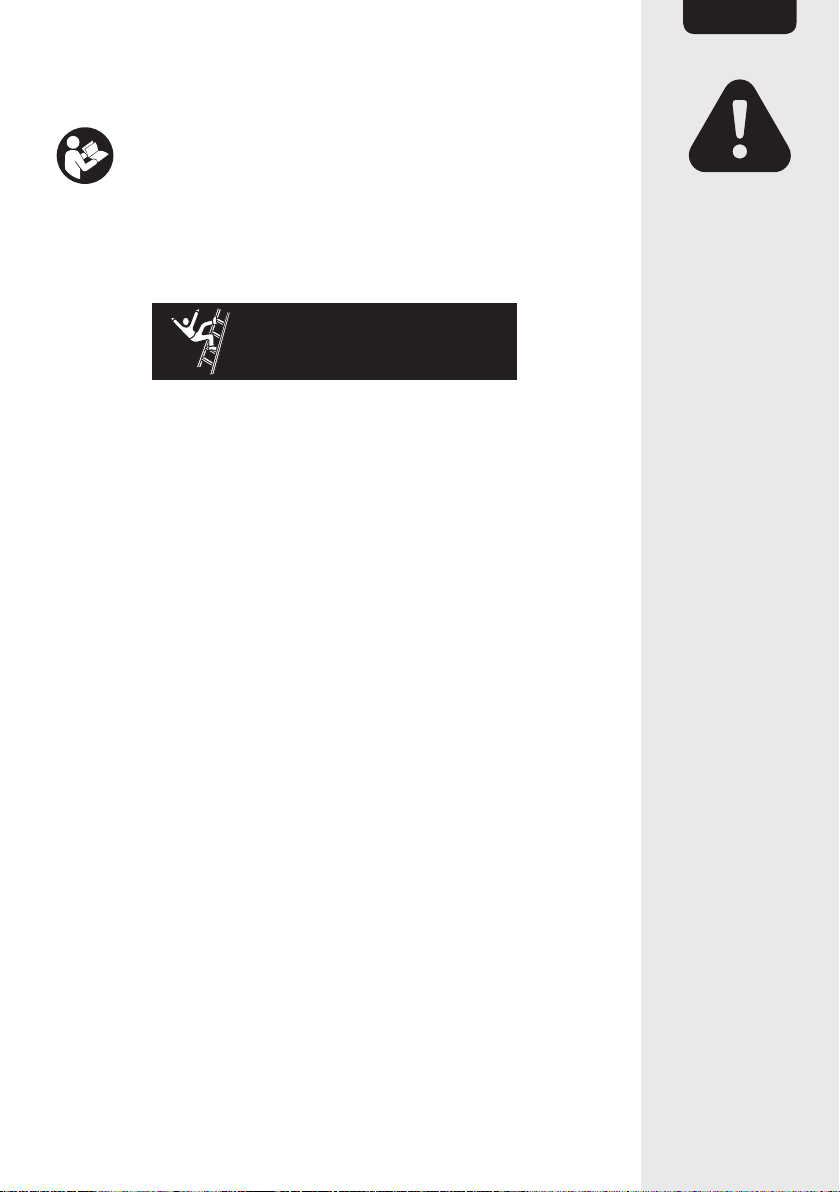
DANGER
Follow ALL instructions in this user manual.
Falling from ladder may result in injuries or death.
• This product is rated as light-duty for general household, industry,
utilities and contractors use as per ANSI-ASC A14.2 standard
classification (ladder type III).
• Do not exceed the maximum working load of 200 lbs (90 kg).
• Light duty ladders shall not be used with ladder jacks or scaffold
planks, or both.
• Ladders shall not be climbed by more than one person at a time.
• Self-supporting ladders shall not be used as single ladders or in the
partially closed position.
• The user shall climb or work with the body near the middle of the
step or rung.
• The user shall not step or stand on a ladder top cap or the rear
braces.
• The ladder base shall be placed with a secure footing on a firm, level
support surface. Ladder levelers may be used to achieve equal rail
support on uneven surfaces.
• Devices such as shoes, spurs, spikes, combinations thereof, or
similar devices of substantial design should be installed where
required for slip resistance and bearing area.
• Ladders shall not be used on ice, snow, or slippery surfaces unless
suitable means to prevent slipping are employed.

4
EN
• Ladders shall not be placed on boxes, barrels, or other unstable
bases to obtain additional height.
• Portable ladders are not designed for excessive side loading, and
such abuse of the ladder shall be avoided. The ladder shall be kept
close to the work. The user shall not overreach, but shall descend
and relocate the ladder instead. When using a ladder, the user shall
never push or pull unless the ladder is properly secured.
• When ascending or descending the ladder, the user shall face the
ladder and maintain a firm hold on the ladder. The user shall not climb
onto a ladder from the side, from one ladder to another, or from a
swingstage to a ladder, unless the ladder is secured against sideways
motion or has been tied to the structure. The user shall not climb a
broken or bent ladder.
• Take proper safety measures when ladders are used in areas
containing electrical circuits. Avoid contact or possible contact with
an energized, uninsulated circuit or conductor in order to avoid
electrical shock or short circuit. Metal ladders and wood ladders
with side-rail metal reinforcement wires shall not be used where they
would come in contact with exposed energized electric wires.
• Keep this ladder away from electric power lines. Be particularly
careful when manipulating any ladder around an overhead electrical
power line.
• A ladder shall not be used as a brace, skid, lever, guy or gin pole,
gangway, platform, scaffold plank, material hoist, or for any other
use for which it was not intended. Ladders shall not be erected on
scaffolds to gain additional height.
• Ladders and ladder sections, shall not be tied or fastened together to
provide a longer length. Ladders and ladder sections shall not have
their length increased by other means.
• Ladders shall not be placed in front of doors opening toward the
ladder unless the door is blocked open, locked, or guarded.
• The user shall ensure that the stepladder is fully opened, with
spreaders locked and all feet contacting a firm level support surface.
• A ladder shall not be relocated while anyone is on it.

5
EN
• The bracing on the rear rails of stepladders is designed solely for
increasing stability and not for climbing.
• Broken or bent ladders shall be marked and taken out of service until
they are repaired by a competent mechanic or destroyed in such
a manner as to render them useless. The user shall not attempt to
repair a defective side rail.
• Ladders, like any tool, must be handled with care and not be
subjected to dropping, jarring, or misuse. They are designed for
the purpose intended. Therefore, any variation from this purpose
constitutes a mishandling of the equipment.
• Ladders should be free of oil, grease, or slippery materials on
climbing or gripping surfaces.
• Do not let children climb on or play with the product.
• Regularly examine the product for wear and tear. Stop using the
product at first sign of damage or if parts become detached.
NOTICE For additional instructions on safe ladder use, see
www.laddersafetytraining.org
For European market:
Warning, fall from the ladder.
Refer to instruction manual/booklet.
Inspect the ladder after delivery. Before every use
visually check the ladder is not damaged and is safe
to use.
Do not use a damaged ladder.
Maximum total load.

6
EN
Do not use the ladder on a unlevel or unfirm base.
Do not overreach.
Do not erect ladder on contaminated ground.
max. 1
Maximum number of users.
Do not ascend or descend unless you are facing the
ladder.
Keep a secure grip on the ladder when ascending
and descending. Maintain a handhold whilst working
from a ladder or take additional safety precautions if
you cannot.
Avoid work that imposes a sideways load on ladders,
such as side-on drilling through solid materials.
Do not carry equipment which is heavy or difficult to
handle while using a ladder.

7
EN
Do not wear unsuitable footwear when climbing a
ladder.
Do not use the ladder if you are not fit enough.
Certain medical conditions or medication, alcohol or
drug abuse could make ladder use unsafe.
Warning, electricity hazard
Identify any electrical risks in the work area, such as
overhead lines or other exposed electrical equipment
and do not use the ladder where electrical risks
occur.
Do not use the ladder as a bridge.
Ladder for domestic use.
Do not step off the side of standing ladder onto
another surface.

8
EN
max.
Open the ladder fully before use.
Use the ladder with restraint devices engaged only.
Standing ladders shall not be used as a leaning
ladder unless it is designed to do so.
1
2
Do not stand on the top two steps/rungs of a
standing ladder without a platform and a hand/knee
rail.
Do not stand on any surface marked by this symbol.
• Do not spend long periods on a ladder without regular breaks
(tiredness is a risk).
• Prevent damage of the ladder when transporting e.g. by fastening
and, ensure they are suitably placed to prevent damage.
• Ensure the ladder is suitable for the task.
• Do not use the ladder if contaminated, e.g. with wet paint, mud, oil or
snow.
• Do not use the ladder outside in adverse weather conditions, such as
strong wind.
• For professional use a risk assessment shall be carried out respecting
the legislation in the country of use.

9
EN
• When positioning the ladder take into account risk of collision with the
ladder e.g. from pedestrians, vehicles or doors. Secure doors (not fire
exits) and windows where possible in the work area.
• Use non-conductive ladders for unavoidable live electrical work.
• Do not modify the ladder design.
• Do not move a ladder while standing on it.
• Ladders should only be used for light work of short duration.
Before First Use
DANGER Risk of suffocation! Keep any packaging materials
away from children – these materials are a potential source of danger,
e.g. suffocation.
• Check the product for transport damages.
• Remove all the packing materials.
• A thorough ladder inspection shall be made when the ladder is
originally purchased, received, and put into service.
• The ladder shall be inspected periodically, preferably before each use.
• Working parts and rung/step-to-side rail connections shall be
checked.
• Where structural damage or other hazardous defect is found, the
ladder shall be taken out of service and either discarded or repaired
by a competent mechanic.
• The ladder shall be inspected for side rail dents or bends, or
excessively dented rungs. All rung/step-to-side rail connections shall
be checked, as well as hardware connections, rivets (for shear), and
all other components.
• If ladders are exposed to excessive heat, as in the case of fire, their
strength may be reduced. After such exposure the ladder shall be
inspected visually for damage and tested for deflection and strength
characteristics.
• If ladders are subjected to certain acids or alkali materials, they may
experience chemical corrosion and a reduction in strength. Consult a
qualified person prior to use.

10
EN
For regular inspection, the following items shall be taken into
account:
• Check that the stiles/legs (uprights) are not bent, bowed, twisted,
dented, cracked, corroded or rotten.
• Check that the stiles/legs around the fixing points for other
components are in good condition.
• Check that fixings (usually rivets, screws or bolts) are not missing,
loose, or corroded.
• Check that rungs/steps are not missing, loose, excessively worn,
corroded or damaged.
• Check that the hinges between front and rear sections are not
damaged, loose or corroded.
• Check that the locking stays horizontal, back rails and corner braces
are not missing, bent, loose, corroded or damaged.
• Check that the rung hooks are not missing, damaged, loose or
corroded and engage properly on the; rungs.
• Check that guide brackets are not missing, damaged, loose or
corroded and engage properly on the mating stile.
• Check that ladder feet / end caps are not missing, loose, excessively
worn, corroded or damaged.
• Check that the entire ladder is free from contaminants (e.G. Dirt, mud,
paint, oil or grease).
• Check that locking catches (if fitted) are not damaged or corroded
and function correctly.
• Check that the platform (if fitted) has no missing parts or fixings and is
not damaged or corroded.
WARNING If any of the above checks cannot be fully satisfied, you
should NOT use the ladder.
Tabla de contenidos
Otros manuales de Escalera de AmazonBasics