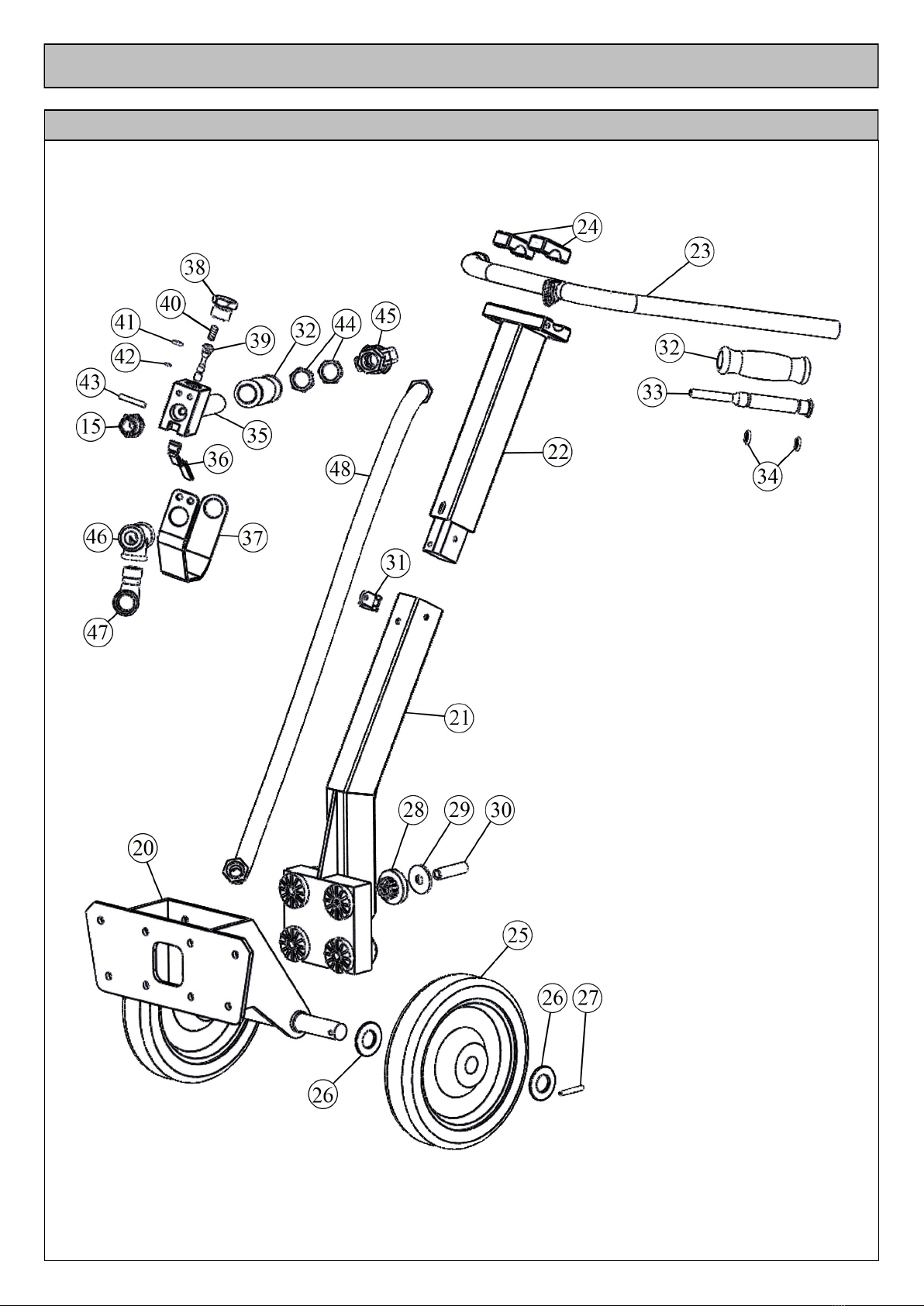
SERVICING
Safe use of this tool requires a solid
stance and secure foothold; the
operator must adopt a firm and
stable position at all times. To
operate the tool pull the lever on the
handle bar and immediately start to
move the tool back and forth.
Keeping the lever depressed,
continue until the desired finish is
achieved. Never run the tool
continuously in the same place, as
the cutterheads will dig into the
surface.
To switch off,
Simply release the lever on the
handle whilst continuing to move the
tool back and forth. Complete a
small area noting the performance;
stop the tool, inspect the finish
produced. Handled correctly the
MHS 5 Multi-headed Scabbler will
work quickly and efficiently.
Gloves and personal protective
equipment must be worn when
using this tool. The tool will ride
irregularities of up to 13mm (1/2”).
Anything greater will risk cutterhead
damage.
Care must be taken to avoid
damaging or tripping over the air
hose.
Servicing
Only a competent person, in a
suitably equipped workshop, must
carry out maintenance.
Always disconnect the tool from
the air supply before carrying out
any of the following operations.
Dismantling
After ensuring that the air supply is
turned off, remove the tool from the
airline. Thoroughly clean the outside
of the tool prior to dismantling.
Scabbler Head Removal
Remove the eyebolt (7) from the
block (1). Take extreme care against
trapping your fingers when lifting or
turning the tool over, Using the
handle, pull the tool over until it
rests on the handle bars and the
cylinder block top face; remove the
supplied punch (33) from the left
hand side handle bar by removing
the “blanking cap” part of the punch
with a small screw driver.
Follow next section if vacuum shroud
is fitted, then continue with:-
Using a medium hammer and the
supplied punch knock out the spiral
roll pin (14) from each cutterhead
(10).
Remove the cutterhead from the
piston, in some extreme cases it
may be necessary to warm the
cutterhead to ease removal from the
piston, especially if they have been
in situ for some time.
Exhaust Chamber & Vacuum
shroud removal
Remove the plastic caps protecting
the caphead bolts, unscrew the 5 x
bolts using a short extension and
8mm Allen key socket.
Remove the vacuum shroud (3) if
fitted and the exhaust chamber (2)
and clean out any dust that may
have accumulated inside the
chamber.
It is wise to replace the cylinder dust
seals (4) which are situated in
recesses in the exhaust chamber
and also replace if fitted, the rear
vacuum shroud seal (5) at this point
also.
Piston and Cylinder removal
Start with unscrewing the two outer
of the front three cylinders (9) using
a 54mm or 1 1/4” Witworth spanner,
followed by one of the back row and
then the centre front.
The cylinders are retained using a
thread locking adhesive and may
require a sharp blow on the spanner
to break the bond.
Once the cylinders have been
removed from the block (1), remove
the piston (8) from its cylinder.
Remove the wiper seal (13) from is
recess using a small screw driver
and remove both of the cylinders
O‟Rings (12) & (11). Inspect both the
piston and cylinder for any sign of
wear or grooving paying particular
attention to the small bore of the
cylinder. Replace the piston,
pushing it to the bottom of the
cylinder bore, if there is excessive
play between the piston and
cylinder, the cylinder and possibly
the piston will require replacing.
Pre-Start Check
The compressed air supply must be
free from water and dirt. The
installation of a filter/regulator/
lubricator air preparation set (with
moisture trap) adjacent to the tool is
strongly recommended. Always
clear the air hose before connection
to the tool. Ensure that no moisture
(condensation) is present in the air
hose. Ensure that a minimum 19mm
(3/4”) bore air hose is used and that
all couplings are secure; leak free
and in good condition. Limit the
length of air hose to 15M (50ft).
Where extra length is necessary, for
each additional 15M (50ft) of air
hose used, the pressure drop is
approximately 0.16bar (3psi).
Correct operating pressure is
6.2bar (90 psi).
Do not let the operating pressure fall
below 5.5bar (80p.s.i.) or rise above
6.9bar (100 psi) absolute maximum.
Preferably, the compressor should
be able to supply a minimum of
57L/s (120cfm) of free air.
Some compressor manufactures
give a displaced air figure which
generally produces a much lower air
output.
In particularly cold weather it is
recommended that a proprietary anti
-freeze lubricating oil be used.
Starting Work
Prior to operating the tool check: -
That all fittings are secure, free from
leaks and air hoses are in good
condition.
That all parts of the tool are fully
screwed together and secure, if
in any doubt ask your supervisor
before using this equipment.
That a liberal amount of lubricant
has been put into the air inlet of
the tool. (See recommended
lubricants)
Adjust the handle bar to a
comfortable working height for the
operator by slackening off the 4 x M8
caphead bolts on the handle bar
caps, and the single M8 caphead
bolt on the handle bar side quadrant.
Note that the handle bar will be
slightly lower when the tool is in use.
Adjust and retighten all bolts.