www.SteamPoweredRadio.Com
Safety Instructions
CAUTION:
• Read all of these Instructions.
• Save these Instructions for later use.
• Follow all Warnings and Instructions marked
on
the audio
equipment.
1)
Read instructions -All the safety
and
operating
in
structions
should be read before the product is operated.
2)
Retain instructions -
The
safety
and
operating
instructions
should be retained for future reference.
3)
Heed
Warnings
-
All
warnings
on
the
product
and
in
the
operating instructions should be adhered to.
4) Follow instructions -All operating and use instructions shoud
be followed.
5)
Cleaning
-
Unplug
this
product
from
the
wall
outlet
before
cleaning
. Do not use liquid
cleaners
or
aerosol cleaners. Use a
damp
cloth for cleaning.
6) Attachments -Do not use attachments not recommended by the
product manufacturer as they may cause hazards.
7) Water and Moisture -Do not use this product near water -for
example,
near
a bath tub, wash bowl, kitchen sink,
or
laundry tub;
in
a
wet basement;
or
near
a swimming pool; and the like.
8) Accessories -Do not
place
this
product
on an
unstable
cart,
stand, tripod, bracket,
or
table.
The
product may fall, causing serious
injury to a child
or
adult, and serious damage to the product. Use only
with
a
cart,
stand,
tripod,
bracket,
or
table
recommended
by
the
manufacturer,
or
sold with the product. Any mounting
of
the product
should
follow
the
manufacturer
's
instructions,
and
shou
ld
use
a
mounting accessory
recommended
by the manufacturer.
9) A product and cart combination should be moved with care. Quick
stops, excessive force, and uneven surfaces may cause the product and
cart combination to overturn.
~c,
~
10) Ventilation -Slots and openings
in
the cabinet are provided for
ventilation and to ensure reliable operation
of
the product and to protect
it
from
overheating,
and
these
openings
must
not
be
blocked
or
covered.
The
openings should
never
be blocked by placing the product
on a bed, sofa, rug,
or
other similar surface. This product should not be
placed
in
a built-in installation such as a bookcase
or
rack unless proper
ventilation
is
provided
or
the
manufacturer's
instructions
have
been
adhered to.
11}
Power Sources -
This
product
should
be operated only from
the type
of
power source indicated on the marking label.
If
you are not
sure
of
the type
of
power
supply to your home, consult
your
product
dealer
or
local
power
company.
For
products intended to operate from
battery power, or other sources, refer to the operating instructions.
12) Grounding or Polarization -This procuct may be equipped
with a polarized alternating-current line plug (a plug having one blade
wider than the other). This plug will fit into the
power
outlet only one
way. This
is
a safety feature. If you are unable to insert the plug fully
into the outlet, try reversing the plug.
If
the plug should sti
ll
fail to
fit
,
contact your electrician to replace your obsolete outlet. Do not defeat
the safety purpose
of
the polarized plug.
13) Power-Cord Protection -Power-supply cords shoud be routed
so that they are not likely to be walked on
or
pinched by items placed
upon
or
against
them
,
paying
particular
attention
to
cords
al
plugs
,
convenience receptacles, and the point where they exit from the product.
14) Outdoor Antenna Grounding -
If
an outside antenna
or
cable
system is connected to the product, be sure the antenna
or
cable system
is
grounded so as to provide
some
protection against voltage surges and
built-up
static
charges.
Article
810
of
the National Electrical
Code,
ANSI/NFPA 70, provides information with regard to proper grounding
of
the mast and support
in
g structure, grounding
of
the lead-in wire to an
antenna
discharge
unit
,
size
of
grounding
conductors,
location
of
antenna-discharge
unit,
connection
10
grounding
electrodes,
and
requirements for the grounding electrode.
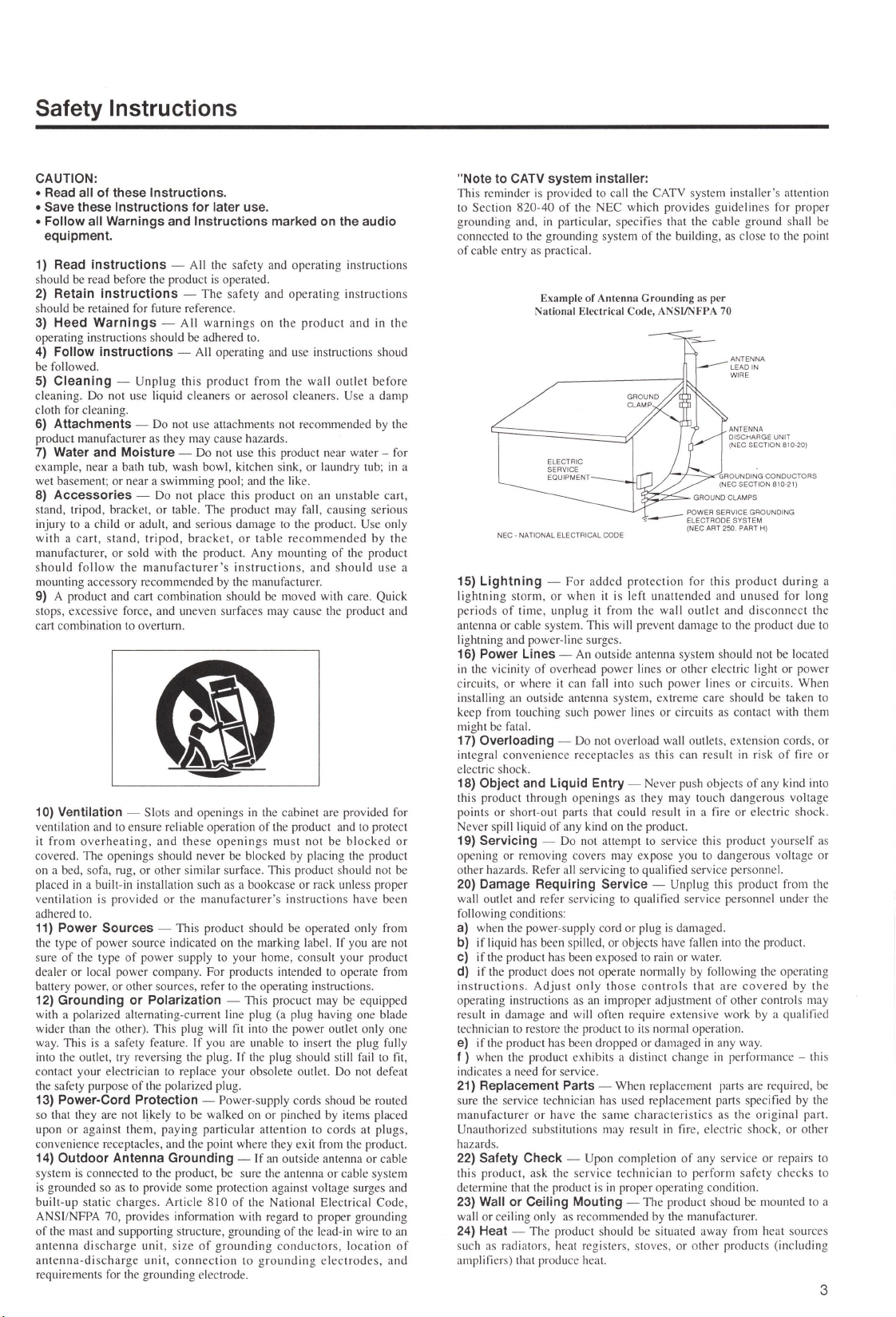
"Note
to
CATV system installer:
This reminder is provided to call the CATV system
in
staller's attention
to
Section
820-40
of
the
NEC
which provides
guidelines
for
proper
grounding
and,
in
particular
,
specifies
that the
cable
ground
shall
be
connected to the grounding system
of
the building, as close to the point
of
cable entry as practical.
Example
of
Antenna
Grounding
as per
National Electrical Code, ANSI/NFPA
70
NEC
-
NATIONAL
ELECTRICAL
CODE
ANTENNA
LEAD
IN
WIRE
ANTENNA
DISCHARGE
UNIT
(NEC
SECTION
810-20)
J--+-.
...:.:::::,...--1.GROUNDING
CONDUCTORS
(NEC
SECTION
810
-21)
15) Lightning -
For
added
protection
for
this
product
during
a
li
ghtning
storm,
or
when
ii is left
unattended
and
unused
for
long
periods
of
time
,
unplug
it
from the
wall
outlet
and
disconnect
the
antenna
or
cable system. This will prevent
damage
to the product due to
lightning and power-line surges.
16) Power Lines -An outside antenna system should not be located
in
the vicinity
of
overhead power lines
or
other electric light
or
power
circuits,
or
where
it
can
fall into such
power
lines
or
circuits.
When
installing an outside antenna system,
extreme
care should be taken to
keep from touching such
power
lines
or
circuits as contact with them
might be fatal.
17) Overloading -Do not
over
load wall outlets, extension cords, or
integral
convenience
r
ecep
tacles
as this
can
result
in
risk
of
fire
or
electric shock.
18) Object and Liquid Entry -Never push objects
of
any kind into
this
product
through
openings
as they
may
touch
dangerous
voltage
points
or
short-out parts that
could
result in a fire
or
electric
shock.
Never spill liquid
of
any kind on the product.
19) Servicing -Do not attempt to service this product
yourself
as
opening
or
removing covers may expose you to dangerous voltage
or
other
hazards. Refer all servicing to qualified service personnel.
20) Damage Requiring Service -
Unplug
this product from the
wall outlet and refer servicing to qualified service personnel under the
following conditions:
a) when the power-supply cord
or
plug
is
damaged.
b)
if
liquid has been spilled, or objects have fallen into the product.
c)
if
the product has been exposed to rain or water.
d)
if
the product does not operate
nom,ally
by following the operating
instructions.
Adjust
only
those
controls
that
are
covered
by
the
operating instructions as an improper adjustment
of
other
controls may
result
in
damage
and will often require extensive work by a qualified
technician to restore the product
10
its normal operation.
e)
if
the product has been dropped or damaged
in
any way.
f ) when the product exhibits a distinct change
in
performance -this
indicates a need for service.
21) Replacement Parts -When replacement parts are required, be
sure the service technician has used replacement parts specified by the
manufacturer
or
have
the
same
characteristics
as the
original
part.
Unauthorized substitutions may result
in
fire, electric shock,
or
other
hazards.
22) Safety Check -Upon completion
of
any service
or
repairs
10
this
product
, ask the
service
technician
10
perform
safety
checks
to
determine that the product is
in
proper operating condition.
23) Wall or Ceiling Mouting -
The
product
shoud
be mounted
10
a
wall
or
ceiling only as recommended by the manufacturer.
24) Heat -
The
product should
be
situated
away
from heal sources
such as radiators, heal registers, stoves,
or
other products (including
amplifiers) that produce heat.
3