Suresense Infrared Thermometer User Manual V1.1 (19/6/2020)
2.10 Replacing the Battery
The thermometer comes with two 1.5 V AAA alkaline batteries. The thermometer will alert you when the
power is getting low, please follow the steps below to replace new batteries immediately.
1. Remove the battery cover as the arrow direction accordingly.
2. Remove the old batteries and replace with two 1.5V AAA size
alkaline batteries. Taking care to match the Positive (+) and
Negative (-) indications
3. Close the battery cover as the arrow direction accordingly.
NOTE:
1 Although the thermometer works when the battery is low, we still recommend that you change the
batteries to obtain an accurate result.
2 Remove the batteries if stored for a long period of time.
3 The batteries should be kept away out of children’s reach.
If they are swallowed, promptly see a doctor for help.
Section 3 Detailed Information
3.1 About Normal Body Temperature & Fever
The temperature in the forehead and temple area differs from the internal temperature, which is taken orally
or rectally. Vasoconstriction, an effect which constricts the blood vessels and cools the skin, can occur during
the early stages of a fever. In this case, the temperature measured by the A202 Infrared thermometer may be
unusually low. If the measurement therefore does not match the patient’s own perception or is unusually
low, repeat the measurement every 15 minutes. As a reference, you can also measure the internal body
temperature using a conventional oral or rectal thermometer. Body temperature can vary from one
individual/person to next. It also varies by location on the body and time of day. Below show the statistical
normal ranges from different sites. Please keep in mind that temperatures measured from different sites, even
at the same time, should not be directly compared. Fever indicates that the body temperature is higher than
normal. This symptom may be caused by infection, overdressing or immunization. Some people may not
experience fever even when they are ill. These include, but are not limited to, infants younger than 3 months
old, persons with compromised immune systems, persons taking antibiotics, steroids or antipyretics (aspirin,
ibuprofen, acetaminophen), or persons with certain chronic illnesses. Please consult your physician when
you feel ill even if you do not have fever.
Table*1 Normal Temperature Range of various body sites
0.6°C (1°F) or more above or below 37°C (98.6°F)
0.3°C to 0.6°C (0.5°F to 1°F) higher than oral temperature
0.3°C to 0.6°C (0.5°F to 1°F) lower than oral temperature
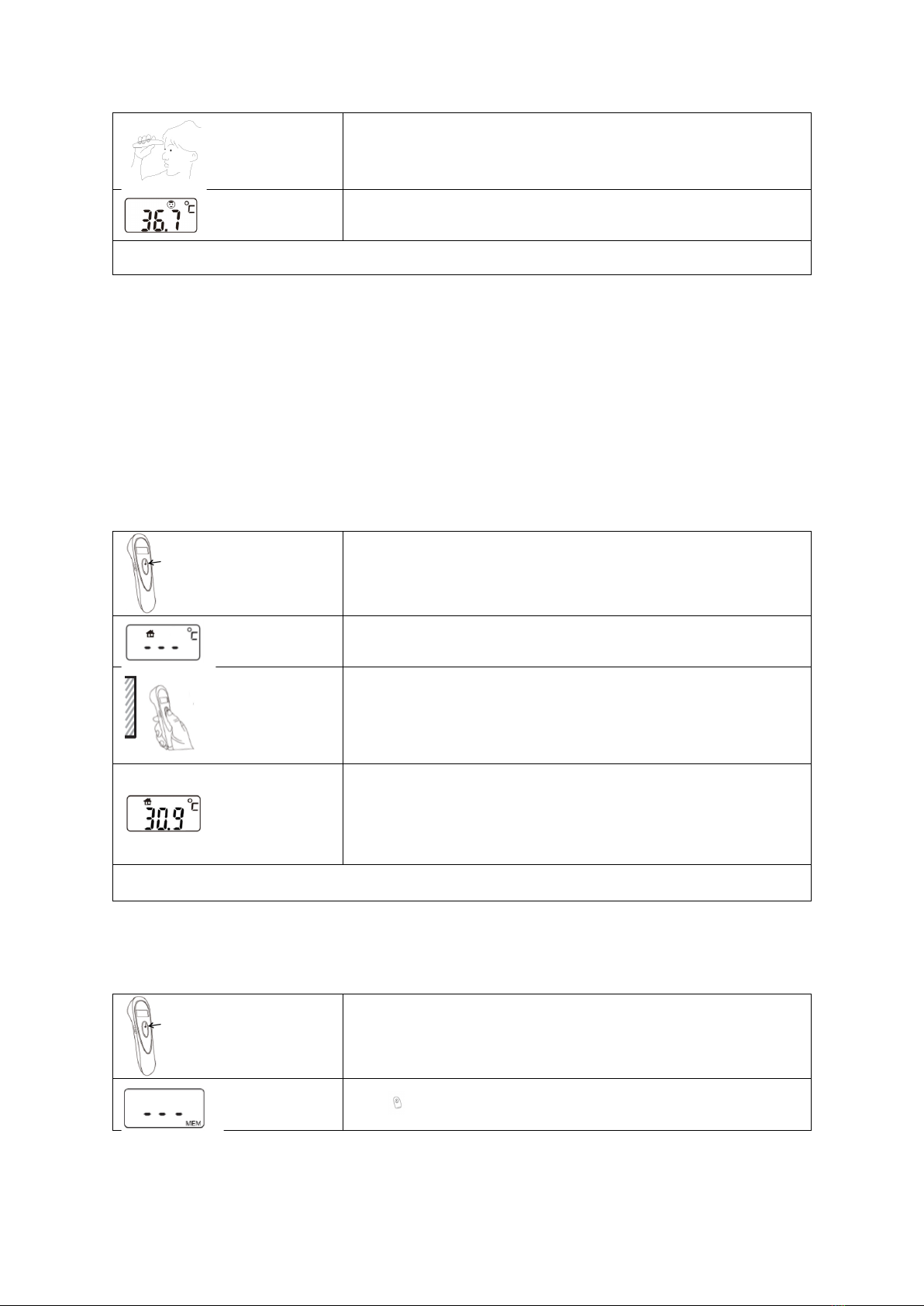
3.2 Perform the Test
Using the device
(As a body reading)
Press “ON” Button to turn on the thermometer first.
Push the Mode switch to select Body mode.
The device will make a short beep when turned on and the
temperature unit (°C or °F) flashes to confirms the readiness to
perform the measurement.