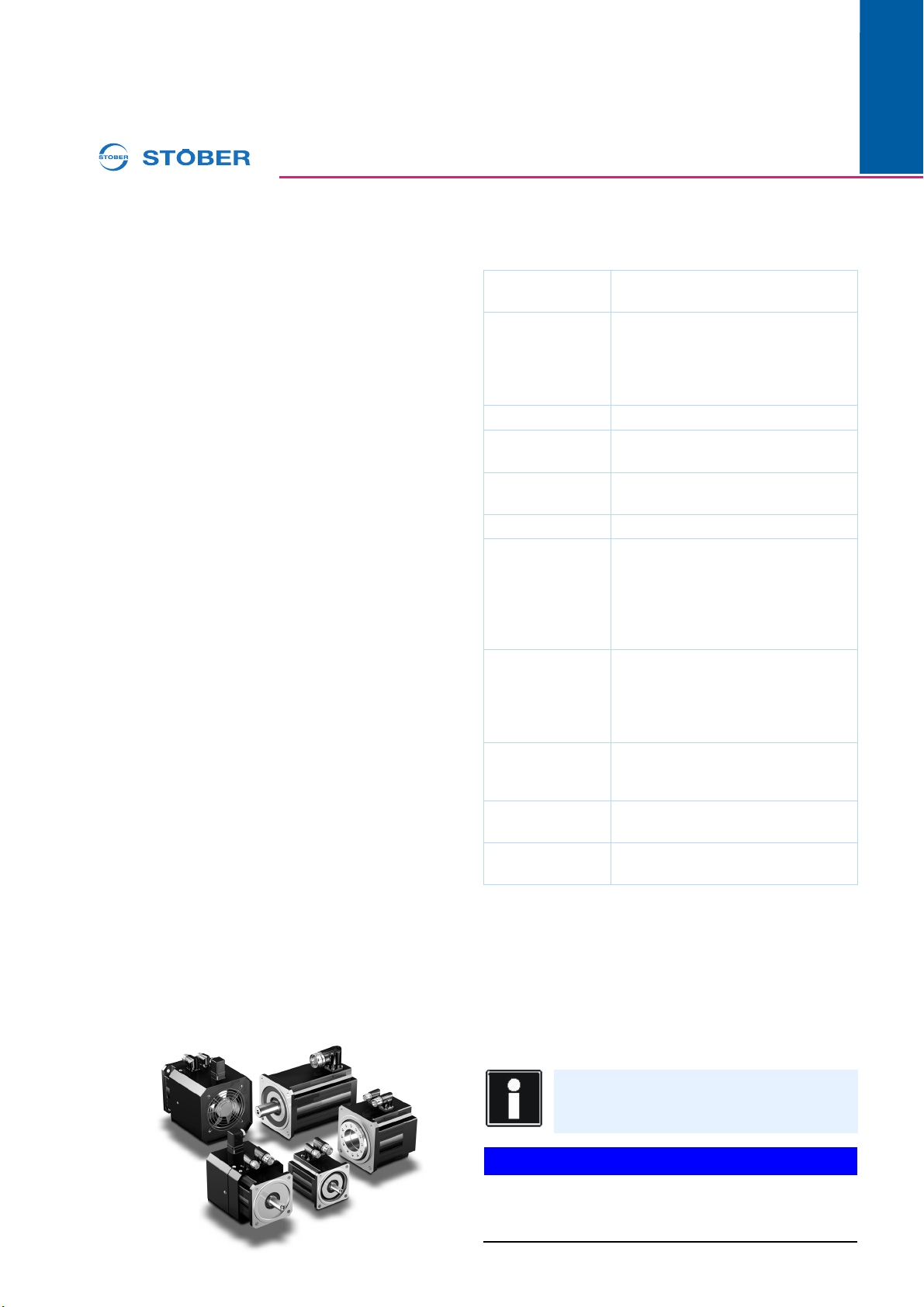
Operating manual
EZ, EZF, EZH, EZHD, EZHP synchronous servo motors / EZS, EZM synchronous servo
motors for screw drive
307/2015
WE KEEP THINGS MOVING
ID 442581_en.03
en
STÖBER ANTRIEBSTECHNIK GmbH & Co. KG
www.stober.com
GERMANY
Tel.: ++49 7231 582-0
2.3 Holding brake (optional)
A brake with permanent magnet excitation can be installed to
serve as a holding brake.
Power supply: 24 VDC ± 5 % smoothed.
The air gap of the brakes cannot be readjusted.
CAUTION!
An incorrect connection can cause the brake and motor
to be destroyed.
XPlease note when connecting the brake the associated
motor connection plan.
2.3.1 Brakes on gravity-loaded vertical axes
WARNING!
Unintentional lowering or falling of unsecured gravity-
loaded vertical axes can lead to serious personal injuries
or even death!
XThe holding brake of the motor does not provide
adequate safety for person in the hazardous area around
gravity-loaded vertical axes. Therefore the machine
manufacturer must take additional measures to minimize
risks (for example by providing a mechanical
substructure for maintenance work).
Check brake functionality for gravity-loaded vertical axes by
performing a cyclic brake test. To do this load the brake with
1.3 times the load torque. Make certain while doing this that
the suspended load of the vertical axis is already exerting
torque on the motor when it is at a standstill. Take this into
consideration when supplying power to the motor.
2.3.2 Testing holding brake
After making the connection check functionality and measure
the holding torque of the holding brake.
Please note, that the brake types are not defined as working
brakes. Therefore braking from full speed during emergency
stops (power failure or dangerous situations) and braking
while setup mode is active are only permitted within the
defined limits. For further details refer to catalog SMS-EZ.
To ensure that the brakes receive the full braking torque, they
are ground according to a special grinding cycles after final
assembly of the motors. If a brake is not required to exert any
friction over an extended period of time, the friction factor may
change as a result. This can occur due to accumulations of
flash rust or vapors resulting from the high motor
temperature. Slight material distortion may also occur as a
result of major fluctuations in temperature. All of these factors
affect the braking torque.
If the brake does not exhibit the required braking torque, it
must be reground.
To do this, drive the motor as well at max. 20 rpm. Release
and close the brake once per second so that the motor is
required to work against the closed brake for about 0.7
seconds. After about 20 cycles perform the process in the
reverse direction of rotation. In some circumstances you may
need to perform this process several times until the nominal
holding torque of the brake has been reestablished. If the
braking torque has not been reestablished after the grinding
process is repeated four times, other factors may also be
responsible (for example reaching the wear limit). Options for
automatically integrating a grinding routine, if available, are
described in the documentation for the relevant servo inverter
2.4 Motor cooling
CAUTION!
Overheating of the motor!
Reduced cooling, for example due to accumulation of dirt or
fan failure, will cause the motor to overheat, thereby resulting
in damage and/or destruction of the winding.
XTherefore check the functionality of the external fan
during commissioning and at regular intervals thereafter.
2.4.1 Forced-air cooling (optional)
External ventilation is optional and can also be retrofitted due
to the modular layout. This makes it possible to optimize
drives subsequently. Technical data can be found on the
nameplate and in the SMS-EZ catalog in the Motor section.
2.4.2 Water cooling (optional)
NOTICE
Material damage!
To prevent damage to the synchronous servo motor or your
machine, please observe the following:
XComply with the coolant specifications described in this
chapter.
XThe nominal data for synchronous servo motors with
water cooling refers to water as a coolant. If another
coolant is used, you will have to determine the nominal
data again.
XCoolant with fresh water from the public supply grid with
coolants, lubricants or cutting agents from the machining
process is not permitted.
XIf the temperature of the coolant is lower than the
surrounding temperature, interrupt the supply of coolant
when the motor is stopped for extended times to prevent
condensation water from forming.
Cooling circuit specification
Information
The brake must only be tested at a motor speed
of max. 20 rpm!
Feature Description
Coolant Water
Temperature at
inlet
+5 °C to +40 °C (max. 5 K below the
surrounding temperature)
Cooling circuit Closed, with recooling unit
Cleanliness Clear, with no suspended matter or dirt
(use particle filter ≤100 μm if necessary)
pH value 6.5 – 7.5
Hardness 1.43 – 2.5 mmol/l