sparkfun NEO-M8U Documento técnico

SparkFun GPS Dead Reckoning NEO-M8U Hookup Guide
Introduction
The u-blox NEO-M8U is a powerful GPS units that takes advantage of untethered dead reckoning (UDR)
technology for navigation. The module provides continuous positioning for vehicles in urban environments and
during complete signal loss (e.g. short tunnels and parking garages). We will quickly get you set up using the
Qwiic ecosystem and Arduino so that you can start reading the output!
SparkFun GPS Dead Reckoning Breakout - NEO-M8U
(Qwiic)
GPS-16329
Product Showcase: SparkFun Qwiic GPS Dead Reckoning BreakProduct Showcase: SparkFun Qwiic GPS Dead Reckoning Break……

Untethered Dead Reckoning GPS Wish List SparkFun Wish List
Required Materials
To follow along with this tutorial, you will need the following materials. You may not need everything though
depending on what you have. Add it to your cart, read through the guide, and adjust the cart as necessary.
USB micro-B Cable - 6 Foot
CAB-10215
USB 2.0 type A to micro USB 5-pin. This is a new, smaller connector for USB devices. Micro USB connectors are a…
Qwiic Cable - 100mm
PRT-14427
SparkFun RedBoard Qwiic
DEV-15123
SparkFun GPS Dead Reckoning Breakout - NEO-M8U (Qwiic)
GPS-16329
Interface Cable SMA to U.FL
WRL-09145
This is a 4" connector cable that interfaces U.FL RF connectors to regular SMA connectors. **Documents:*** [Data…
Microcontroller
One method of connecting to the GPS is using a Qwiic cable and microcontroller. We will use the RredBoard Qwiic
fo the scope of this tutorial.
USB micro-B Cable - 6 Foot
CAB-10215
SparkFun RedBoard Qwiic
DEV-15123

Additional GPS Antenna Options
Below are some other GPS Antenna options. Some of the options below have an SMA connector, so make sure to
get the u.FL to SMA cable if you decide to use those. Link for that is below in the GPS accessories. If you want to
try different chip antennas, then try the GNSS Antenna Evalutation Board listed below and make sure to get the
u.FL to u.FL connector in the accessories.
GPS Antenna Accessories
Qwiic Cable - 100mm
PRT-14427
GPS/GNSS Magnetic Mount Antenna - 3m
(SMA)
GPS-14986
GPS/GNSS Embedded Antenna - 1m (SMA)
GPS-14987
GPS Embedded Antenna SMA
GPS-00177
SparkFun GNSS Chip Antenna Evaluation
Board
GPS-15247


Heads up! If you are using the RedBoard without a Qwiic connector, we recommend getting the Qwiic
Shield for Arduino.
Suggested Reading
If you aren't familiar with the Qwiic system, we recommend reading here for an overview.
Qwiic Connect System
We would also recommend taking a look at the following tutorials if you aren't familiar with them.
PRT-14428 PRT-14426
SparkFun Qwiic Shield for Arduino
DEV-14352
GPS Basics
The Global Positioning System (GPS) is an
engineering marvel that we all have access to for a
relatively low cost and no subscription fee. With the
correct hardware and minimal effort, you can determine
your position and time almost anywhere on the globe.
Serial Peripheral Interface (SPI)
SPI is commonly used to connect microcontrollers to
peripherals such as sensors, shift registers, and SD
cards.

What is Dead Reckoning?
Dead Reckoning is the process of determining current position by combining previously determined positional data
with speed and heading. This process can also be applied to determine future positions as well! The NEO-M8U
uses what is called Untethered Dead Reckoning (UDR) which calculates speed and heading (amongst many
other points of data) through the use of an internal inertial measurement unit (IMU). The addition of an IMU
allows the M8U to produce more accurate readings in between GNSS data refreshes!
I2C
An introduction to I2C, one of the main embedded
communications protocols in use today.
How to Work with Jumper Pads and PCB Traces
Handling PCB jumper pads and traces is an essential
skill. Learn how to cut a PCB trace, add a solder
jumper between pads to reroute connections, and
repair a trace with the green wire method if a trace is
damaged.
Getting Started with U-Center for u-blox
Learn the tips and tricks to use the u-blox software tool
to configure your GPS receiver.
Three Quick Tips About Using U.FL
Quick tips regarding how to connect, protect, and
disconnect U.FL connectors.

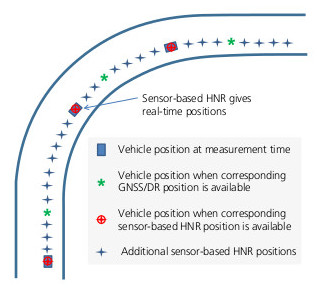
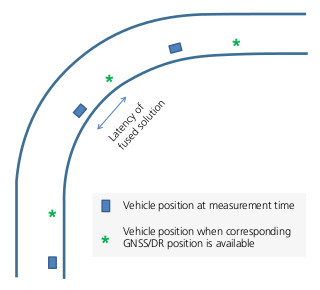
Illustration of Using an IMU with GNSS Data Illustration of Using only GNSS Data Only
Illustration of Refresh Rate to Accurately Determine Position. Image Courtesy of u-blox from the UDR Whitepaper.
In addition, the module can also give accurate and useful GNSS data in areas where satellite connections are
difficult to maintain: areas like the dense urban environments of major cities, long tunnels, parking garages, any
large UFO's that may descend from the sky, etc.
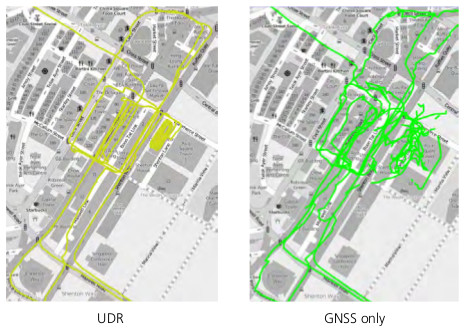
Untethered Dead Reckoning vs GNSS Only Comparison in an Urban Canyon. Image Courtesy of u-blox from the
UDR Whitepaper.
Hardware Overview
Power
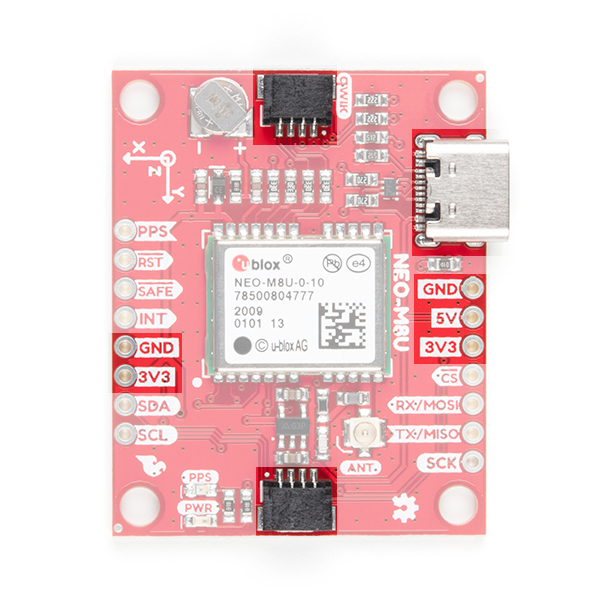
Power for this board is 3.3V and we have provided multiple power options. This first and most obvious is the USB-
C connector. Secondly, are the Qwiic Connectors on the top and bottom of the board. Thirdly, there is a 5V pin
on the PTH header along the side of the board that is regulated down to 3.3V. Make sure that power your provide
to this pin does not exceed 6 volts. Finally, just below the 5V pin is a 3.3V pin that should only be provided a clean
3.3V power signal.

Battery
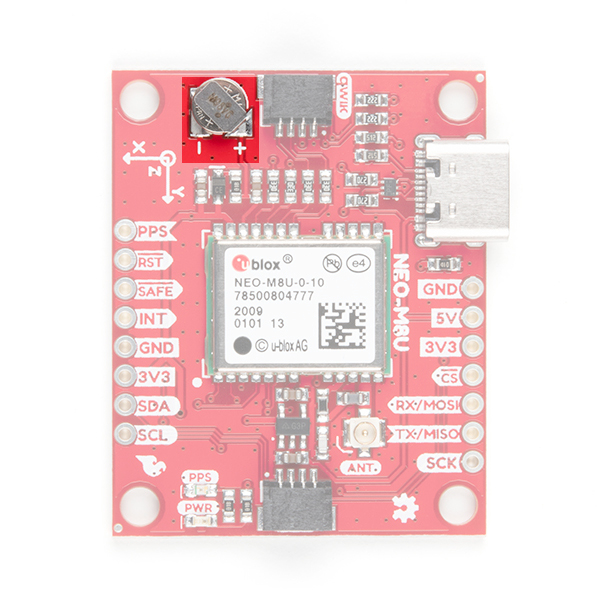
The small metal disk in the upper left corner is a small lithium battery. This battery does not provide power to the
IC like the 3.3V system does, but to relevant systems inside the IC that allow for a quick reconnection to satellites.
The time to first fix will about ~26 seconds, but after it has a lock, that battery will allow for about a 1.5 second
time to first fix. This is known as a hot start and lasts for four hours after the board is powered down. The battery
provides over a years worth of power to the backup system and charges slowly when the board is powered. To
charge it to full, leave your module plugged in for 48 hours.
LEDs
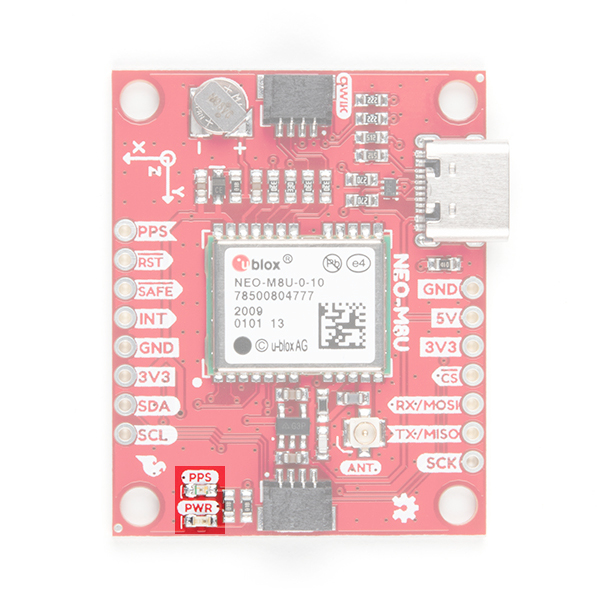
There's is a red power LED just to the left of the bottom Qwiic connector and near the board's edge to indicate that
the board is powered. There is another LED just above the power LED labeled PPS that is connected to the Pulse
Per Second line. When connected to a satellite, this line generates a pulse that is synchronized with a GPS or
UTC time grid. By default, you'll see one pulse a second.

Jumpers
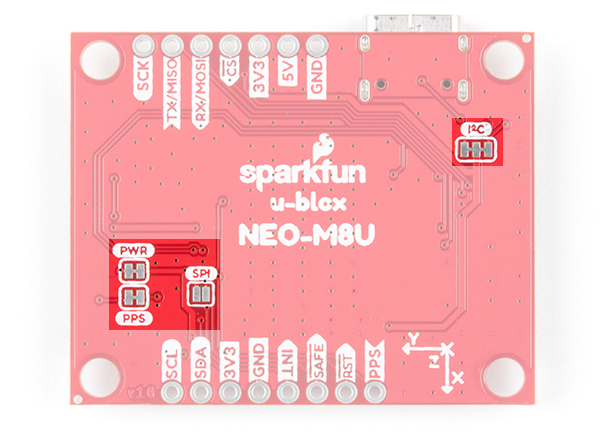
There are four jumpers on the underside of the product, each labeled with its function. At the upper right of the
picture is a three way jumper labeled I²C that connects two pull-up resistors to the I C data lines. If you have
many devices on your I C data lines, then you may consider cutting these. On the left side of the board is a jumper
labeled PWR . If you cut this trace it will disconnect the Power LED. Just below is the PPS jumper that when cut
disconnects the PPS LED. Finally, there's a jumper labeled SPI which enables the SPI data bus thus disabling the
UART functions on those lines. For more information, check out our tutorial on working with jumper pads and PCB
traces.
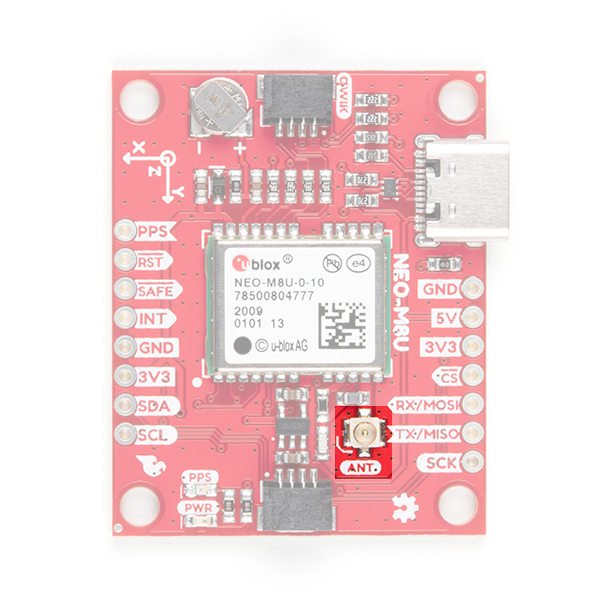
U.FL Connector
The SparkFun GPS NEO-M8U has a u.FL connector in which you can connect a patch antenna.
2
2

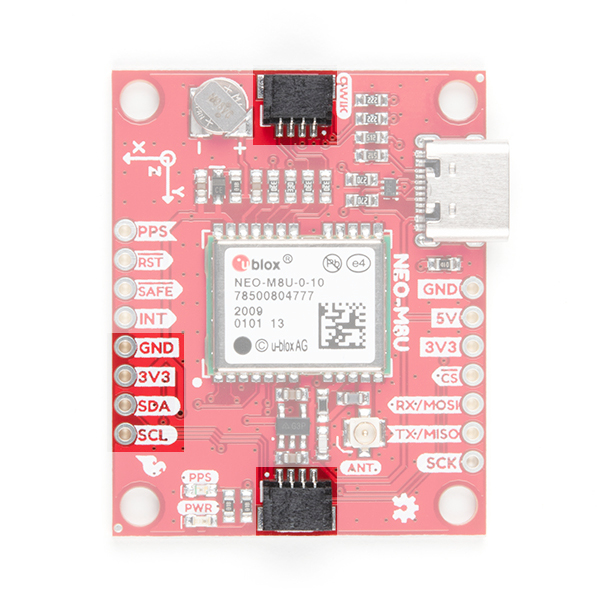
Qwiic and I C
There are two pins labeled SDA and SCL which indicates the I C data lines. Similarly, you can use either of the
Qwiic connectors to provide power and utilize I C. The Qwiic ecosystem is made for fast prototyping by removing
the need for soldering. All you need to do is plug a Qwiic cable into the Qwiic connector and voila!
The only I C address for this and all u-Blox GPS products is 0x42, though each can have their address
changed through software.
SPI
There are four pins on the right most header that are labeled with their corresponding SPI functionality. As
mentioned in the jumpers section, you'll need to close the SPI jumper on the underside to enable SPI.
2
2
2
2
Tabla de contenidos