Sensors
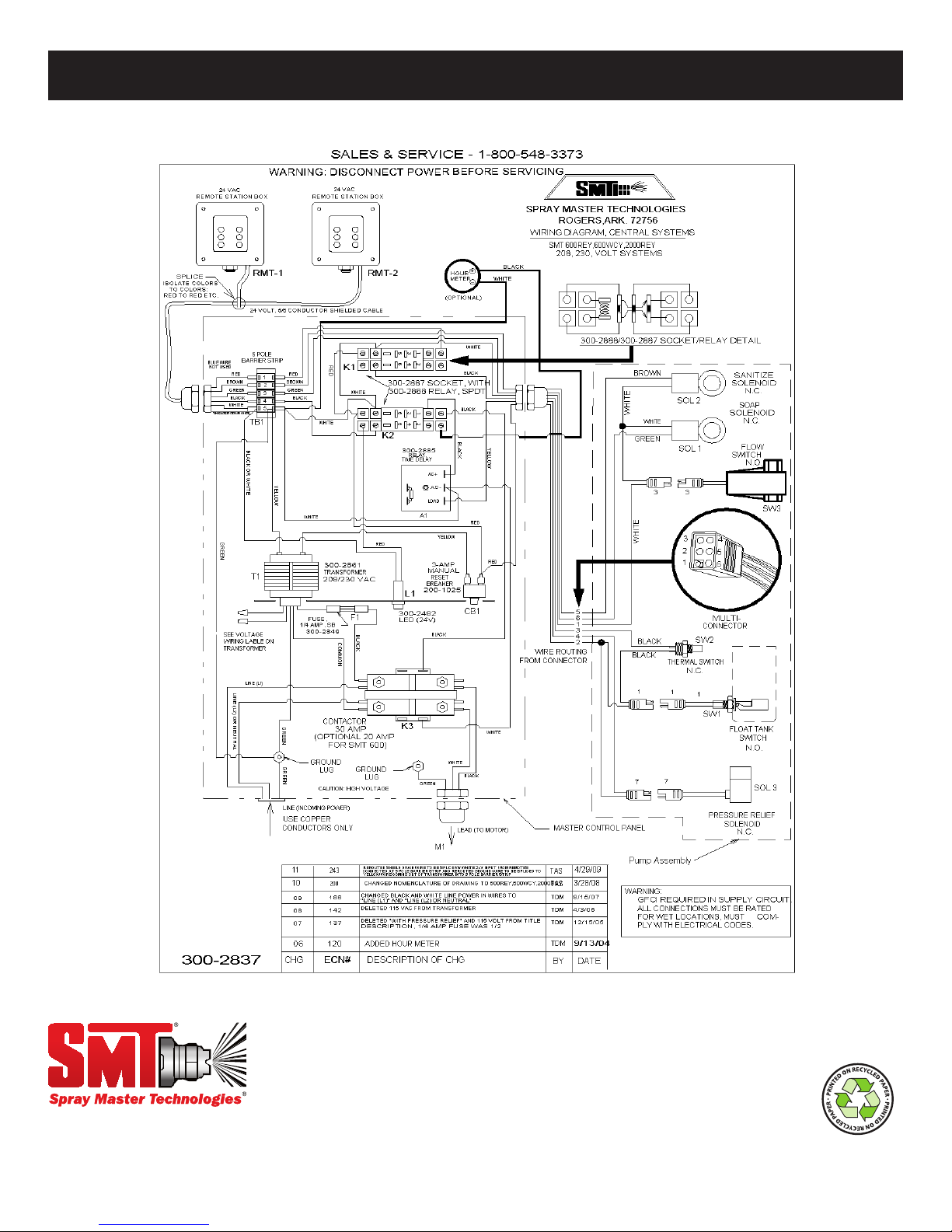
Water supply sensor (oat switch/pressure switch): SMT 600 and 2000
series pumps are equipped with a water supply oat switch in the tank
that will disable the system should the water supply to it be interrupted.
SMT 1100 series pumps are equipped with a water supply pressure switch
that will disable the system should the water supply be interrupted.
Water temperature sensor (thermal limit switch): This product is
equipped with a water supply sensor that will disable the system
should the water supply temperature exceed 120° F. Excessive water
temperature will reduce the life of the pump.
Chemical inhibit sensor (ow switch): All SMT 600 and 2000 series
central systems are equipped with a chemical inhibit ow switch that
disables the chemical injection solenoids when the spray gun is closed
and water is being recirculated back to the oat tank. This feature is
required to prevent chemical introduction into the tank.
Features
Anti-siphon/anti-backow: The oat tank and oat valves provide anti-
siphon/anti-back ow protection for the potable water supply system,
and is approved for use by the City of Los Angeles, California (one of the
strictest standards in the country).
Line pressure release: The line pressure release feature dumps the
pressure in the system any time the pump is turned o to allow hoses,
spray guns and other accessories to be connected and disconnected. It
also saves time and steps by eliminating the need to manually open the
bleeder valve to release pressure.
Bleeder valve: The bleeder valve provides a service port for the system
and manual system pressure release.
Unloader: The unloader feature removes the pressurized load from the
pump and motor when the user is not spraying with the spray gun. This
prolongs the life of the pump and motor.
Moving & Storage
Service
Operator troubleshooting - If your system does not operate correctly,
check the following items to ensure that the problem is not external to
the system.
• Main circuit breaker is reset and 24V AC lamp in Master Control Panel
is illuminated.
• Water supply to the system is fully open, hose is not kinked and lter
is clean.
• Water supply temperature to the pump is less than 120°F.
• Bleeder valve on wall next to pump is fully closed.
• Chemical pickup tubes are fully submersed in adequate chemical supply.
Technical Trouble shooting - If a problem occurs, please refer to the
"Diagnostic and Maintenance Chart" in the Express Service Manual.
If the problem is not resolved, then please call our toll free customer
service number 1-800-548-3373 or (479) 636-5776.
Spray Master Technologies® has a nationwide service network. If the
conditions listed above are correct and the system still does not operate
properly, call the SMT Service Department, 1-800-548-3373 or (479)
636-5776, for assistance.
Moving equipment and accessories: Avoid dragging hoses, guns and
accessories across the ground or oor during movement to prevent
damage and prolong the life of the equipment.
Storage:
• Flush the pump, gun and hose with rinse water to clean out any
chemical residue in the system.
• Wipe down your pressure washer and neatly store all hoses, cords
and accessories.
• If the pressure washer is to be stored for more than three months,
change the oil upon re-entry into service.
• Properly store equipment so that it does not present a falling or trip
hazard.
• Store equipment and accessories in an area that is protected from
freezing. Equipment and accessories could hold water after use and
may be damaged when it freezes.
Chemical Metering Instructions
One gallon equals 128 ounces
CHEMICAL DILUTION:
Ounces of Water per Ounce of Chemical
Note: Do not use bleach as the injected
chemical. Any such use of bleach will
void the warranty on your machine.
To calculate and adjust the chemical dilution for a Spray Master Technologies cleaning system, follow the steps below:
1. Find your pump GPM rating on the left-hand side of the chart.
2. Follow the row selected in Step 1 to the right and nd the column with the approximate “Dilution Ratio”specied for the chemical to be used. (If
the exact dilution ratio specied for your chemical is not listed, interpolate between the two nearest ratios on that row.)
3. From the mix ratio identied (or interpolated) in step 2, move to the top of the column to determine the“Chemical Injection: Ounces per Minute”
to be injected. EXAMPLE: A 3 gallon per minute (GPM) pump used to apply a chemical requiring a mix ratio of 128:1 (1 ounce per gallon) you
will need to inject 3 ounces of chemical during a period of 1 minute.
4. Fill a measuring cup (graduated in ounces) with the chemical to be injected and submerge the chemical pick-up tube with foot screen into the chemical.
5. Turn the pump on and set it to inject the chemical.
6. Adjust the chemical metering device so that the ounces of chemical calculated in Step 3 above is drawn from the measuring cup during a period
of one minute.
NOTE: Check chemical metering regularly to ensure accurate chemical dispensing.
6