Page 8
6.0 USING PASSIVE INFRARED SENSORS
Narrow Beam Passive Infrared sensing offers many advantages over other sensor types. When combined
with Auto- hreshold Sensing (A S) circuitry, this technology is the most advanced when used in an outdoor
environment. Its versatility, small size, long range, precise targeting, and target classifying allow it to be used
reliably in many diverse applications. However, having a fundamental understanding in how to use it is essential in
getting good results.
Since the IR900 senses at an extremely long range, it is important to have it aimed at a proper background.
here are some setups that cannot be compensated by the A S circuitry and will give you false alarms if you aren’t
aware of them. All setups involve maximizing what we call the signal to noise ratio. he signal corresponds to
whatever it is we are interested in detecting, be it a bird, a human, an automobile, or an airplane, which all have
different sizes, shapes, and travel at different speeds. As far as the IR900 is concerned, they will all result in a
different signal or infrared signature when the IR900 “see” them. his will involve placing the sensor at a certain
distance and orientation to the target so that the signal is maximized.
he thing we want to minimize is the noise, or whatever the IR900/901 sees when the target is not there.
his is the background such as bushes, trees or open terrain. Because of the sun’s radiation and the chilling effect
of the wind, the outdoor environment often appears to an infrared sensor as a moving thermal mass, much like the
target we want to measure. Minimizing this unwanted noise involves aiming the sensor at an appropriate
background. he safest backgrounds are open terrain (open distances up to 100 ft. an beyond) and solid ground.
6.1 Infrared Signal
he optimum signal produced by a human is at a distance of 100 feet for the IR900 and 30 feet for the
IR901, with the person walking at a casual pace (3 ft./sec). his is strictly a function of the sensor’s optics, which is
fixed and determines the devices beam spread (6 ft. @ 100 ft. for the IR900). At 100 feet, a person completely fills
the sensing region of each beam causing a maximum signal. Further away than 100 feet, the person only partially
fills the sensing region, thereby generating a smaller signal. Closer than 100 feet, the person passes through the
beams faster since they are closer together, likewise generating a smaller signal.
herefore a person running by the sensor at 10 feet may register the same as a person walking by at 300
feet, neither being sufficient to trip the sensor. Automobiles will likewise be difficult to detect when the sensor is
mounted close to the road and they are moving fast. o compensate, you can either move the sensor back from the
road (several hundred feet is OK) or you can aim the sensor upstream, which in effect causes the sensor beam
geometry to widen. his will give much better results, especially if the sensor is aimed upstream, since the target
will be detected sooner, allowing the video more time to power up and start recording. Also, the RF transmission
range between sensor and receiver can be kept short, which will improve the overall reliability.
Longer distances (600 ft.) can be used for larger vehicles (such as trucks or airplanes) since they better fill
the sensing region at that distance. In the special case of detecting aircraft, the sensor should be located at the end
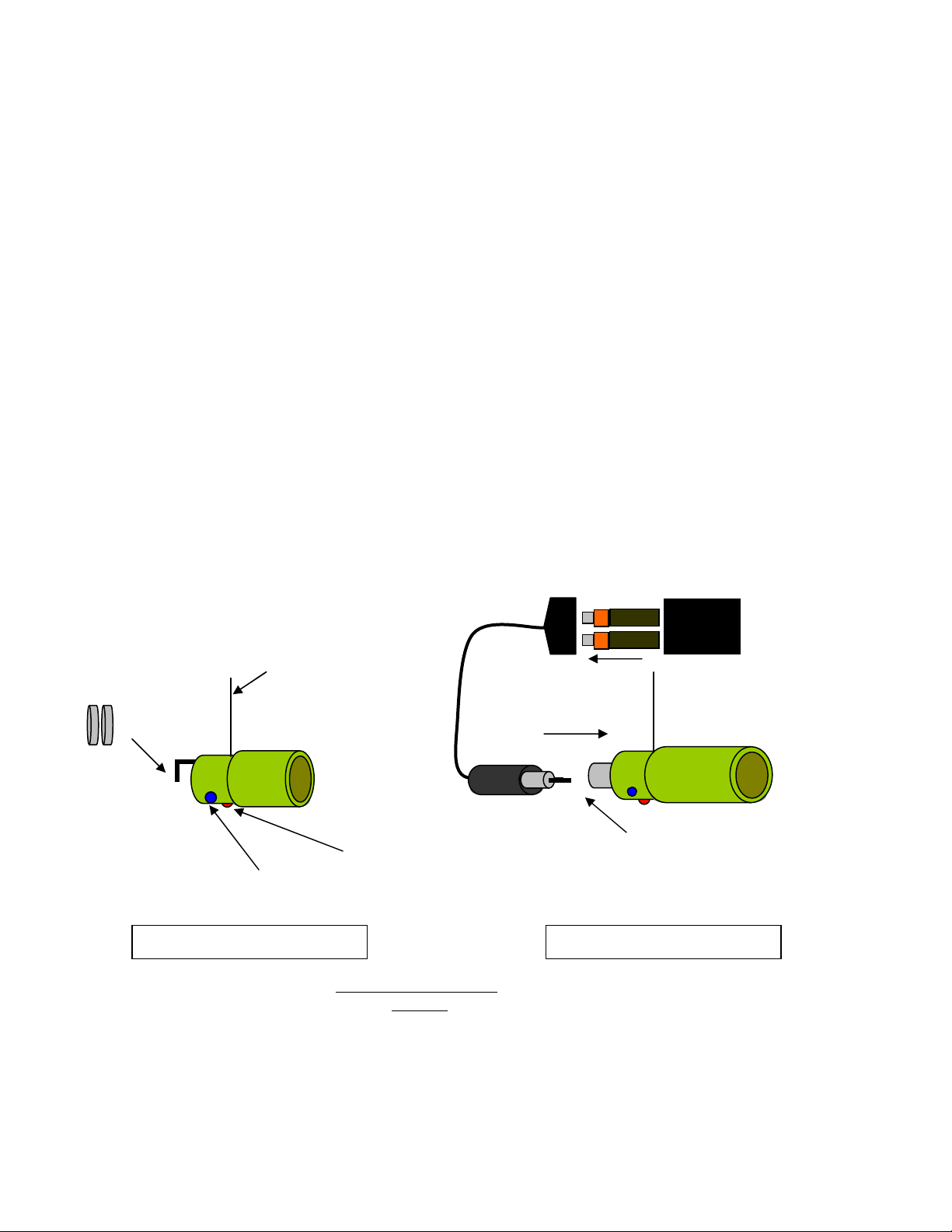
of the runway and aimed slightly above the horizon. It should also be turned 90 degrees (antenna oriented
horizontal) so that the infrared beams are oriented top and bottom instead of side by side. his will result in a much
better signal as the aircraft descends through the beams on landing approach.
6.2 Infrared Noise
As mentioned earlier, Infrared Noise includes all environmental disturbances that occur when the sensor is
not detecting a target, such as wind chill on stationary objects or blowing tree leaves on moving objects. Much of