
SENAO SL-2011 Manual de usuario

User Guid e
Before operating the unit, please read thismanual thoroughly,
and retain it for future reference.
WrelessLAN Card
PLUS

Contents
1. Introduction 1
1.1 Package Contents 1
1.2 PC Card Description 1
1.3 System Requirements 2
1.4 Features and Benefits 2
1.5 Applications 2
1.6 Network Configurations 3
2. Installing Driver and Utility 7
2.1 Installation for Windows 95/98/ME/2000 7
2.2 Checking after Installation 9
2.3 Wireless LAN Client Utility 11
2.4 Uninstalling Driver and Utility 16
3. Connecting to a Network 17
3.1 Checking and Adding Client for Microsoft Networks 17
3.2 Checking and Adding NetBEUI 18
3.3 Checking and Adding TCP/IP 19
3.4 Checking and Adding File and Printer Sharing for Microsoft Networks 20
3.5 Checking and Adding Computer Name and Workgroup Name 20
4. Troubleshooting 21
Appendix A Specifications 24
Appendix B Regulatory Compliance Information 26
Appendix C Limited Warranty 28

Chapter 1 Introduction
This chapter describes the package contents, PC Card
description, system requirements, features & benefits,
applications and network configurations of SL-2011 PLUS
wireless LAN products.
1-1 Package Contents
The PC Card package contains the following items as shown in
Figure 1-1
1. One PC Card
2. One Installation CD
3. One Quick Installation Guide
Figure 1-1
1- 2 PC Card Descriptions
The PC Card is a standard PC Card that fits into any PCMCIA Card
Type II slot. The PC Card has a LED indicator and a integrated built-in
diversity antenna as shown in Figure 1-2.
Figure 1-2
1. Integrated, with built-in diversityAntenna
2. Link LED
! 802.11 AdHoc mode – Blinking, no matter if the wireless LAN is connected
or not
! AdHoc mode – Solid GREEN, no matter the wireless is connected or not
! Infrastructure – Solid GREEN when the wireless is connected
! Off – No wireless activity 1
Wireless LAN PC Card
Quick Installation Guide
1
2
Insta llation CD
IEEE802.11b

1- 3 System Requirements
Installation of the PC Card requires:
1. PC/AT compatible computer with PCMCIA Type II slot.
2. Windows 95/98/ME/2000 or Windows NT4.0 operating system environment.
3. Minimum 1.3M bytes free disk space for installing the PC Card driver
and utility program.
1- 4 Features and Benefits
11Mbps data rate High-speed data transmission
IEEE802.11b compliant Fully interoperable with
IEEE802.11b compliant
products
Automatic data rate scaling at
11, 5.5, 2 and 1 Mbps Optimized throughput, range
and connectivity
64/128-bit WEP data
encryption/ decryption Powerful data security
Wide coverage range up to
400 meters in open space Wireless connectivity for all your
computers
Advanced Power Management Extended battery life
Plug and Play PC Card
interface Easy installation
1- 5 Applications
The SL-2011 PLUS LAN products are easy to install and highly efficient.
The following list describes some of the many applications made
possible through the power and flexibility of wireless LANs:
1. Difficult-to-wire environments
There are many situations where wires can not or can not easily be laid.
Historic buildings, older buildings, open areas and across busy streets make
the installation of LANs either impossible or very expensive.
2. Temporary workgroups
Consider situations in parks, athletic arenas, exhibitions, disaster-recovery,
temporary office and construction sites where one wants a temporary WLAN
established and removed.
3. The ability to access real-time information
2

Doctors/nurses, point-of-sale employees, and warehouse workers can
access real-time information while dealing with patients, serving customers
and processing information.
4. Frequently changed environments
Show rooms, meeting rooms, retail stores, and manufacturing sites where
the workplace is frequently rearranged.
5. Small Office and Home Office (SOHO) networks
SOHO users need a cost-effective, easy and quick installation of a small
network.
6. Wireless extensions to Ethernet networks
Network managers in dynamic environments can minimize the overhead
caused by moves, extensions to networks, and other changes with wireless
LANs.
7. Wired LAN backup
Network managers implement wireless LANs to provide backup for
mission-critical applications running on wired networks.
8. Training/Educational Facilities
Training sites at corporations and students at universities use wireless
connectivity to ease access to information, information exchanges, and
learning.
1- 6 Network Configurations
To better understand how the SL-2011 PLUS wireless LAN products
work together to create a wireless network, it might be helpful to depict a
few of the possible SL-2011 PLUS network configurations. The SL-2011
PLUS wireless LAN products can be configured as:
1. Ad-hoc (or peer-to-peer) for departmental or SOHO LANs.
2. Infrastructure for enterprise LANs.
3. IP Sharing for 56K/ISDN TA/Cable/DSL Modem – Connect Internet and your
SOHO network.
Ad-hoc (peer-to-peer) Mode
This is the simplest network configuration that several computers
equipped with the PC cards that form a wireless network whenever they
are within range of one another (Figure 1-3). In ad-hoc mode, each
client, is peer-to-peer, would only have access to the resources of the
other client and requires no the access point. This is the easiest and
least expensive way for the SOHO to set up a wireless network.
3
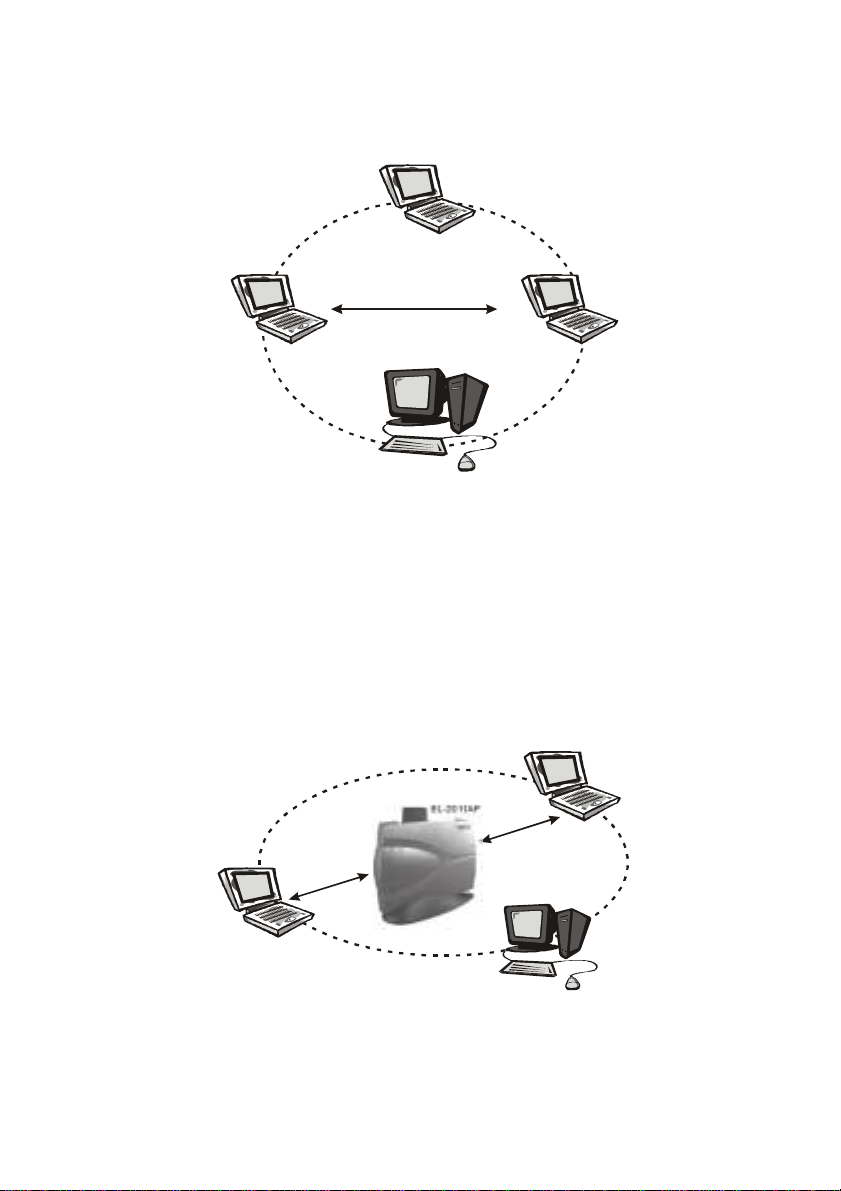
Figure 1-3 A wireless Ad-hoc network
Infrastructure Mode
The infrastructure mode requires the use of an access point (AP). In this
mode, all wireless communications between two computers have to be
via the AP no matter the AP is wired to Ethernet network or stand-alone.
If used in stand-alone, the AP can extend the range of independent
wireless LANs by acting a repeater, which effectively doubling the
distance between wireless stations as shown in Figure 1-4.
Figure 1-4
Extended-range independent WLAN using AP as repeater
4
W/ EL-2011CD
W/ EL-2011CD
W/ EL-2011CD
W/ EL-2011CD
L
Peer to Peer
W/ EL-2011CD
EL-2011AP
W/ EL-2011CD W/ EL-2011CD
L
L
Infrastructure

If wired to an Ethernet network as shown in Figure 1-5, the AP serves
as a bridge and provides the link between the server and the wireless
clients. The wireless clients can move freely throughout the coverage
area of the AP while remaining connected to the server. Since the AP is
connected to the wired network, each client would have access to
server resources as well as to other clients.
Figure 1-5 Single AP bridge
Access points have a finite range, on the order of 50 meters indoor and
100 meters outdoors. In a very large facility such as an enterprise, a
warehouse, or on a college campus, it will probably be necessary to
install more than one access point to cover an entire building or campus,
as shown in Figure 1-6. In this scenario, access points hand the client
off from one to another in a way that is invisible to the client, ensuring
unbroken connectivity. Wireless clients can roam seamlessly between
different coverage areas and remain connected to the network
Figure 1-6 Multiple-AP and roaming
5
W/ EL-2011CD
EL-2011AP
File server
Network Printer
W/ EL-2011CD
W/ EL-2011CD
Enterne t
W/ EL-2011CD W/ EL-2011CD
W/ EL-2011CD
W/ EL-2011CD
File server
Enterprise
Ethernet
EL-2011AP EL-2011AP

Wireless Router and IP Sharing
In infrastructure mode, in addition to acting as a bridge between an
Ethernet and wireless network, the AP can be configured as a wireless
router and IP sharing device for Internet access as shown in Figure 1-7.
You don’t have to buy an expensive router. Nor you have to buy several
modems and setup phone lines. Just share one AP, one Modem, single
dial-up account, and one phone line, dozens of network users can go
surfing the Internet concurrently.
Figure 1-7 Wireless router and IP Sharing
6
W/ EL-2011CD
W/ EL-2011CD
W/ EL-2011CD
56K/ISDN TA/
Cable/ADSL Modem
Firewall
Internet
SOHO
EL-2011AP

Chapter 2 Installing Drivers & Client Utility
This chapter describes how to install the PC Card drivers and client
utility under Windows 95/98/ME/2000 and Windows NT4.0 environment.
2-1 Installation for Windows 95/98/ME/2000
During the installation, Windows 95/98/ME/2000 may need to copy
Windows systems files from the Windows 95/98/ME/2000 installation
diskette or CD-ROM. Therefore you will need a copy of the Windows
95/98/ME/2000 installation diskette or CD-ROM on hand before
installing the driver. On many systems, instead of a CD, the necessary
installation files are archived on the hard disk in C:\WINDOWS
\OPTIONS\CABS directory.
Installation Procedure:
1. Turn on your computer.
2. Be sure that there is no PCMCIA adapter inserted yet.
3. Insert the SL-2011 PLUS Wireless LAN Installation CD into your CD-ROM
drive. The setup program should start automatically as shown in Figure 2-1.
If it does not start, you can run it manually by selecting RUN from the Start
menu and running SETUP.EXE from CD-ROM drive.
Figure 2-1
7
SL-2011 PLUS

4. From SENAO Wireless LAN Installer, select Install SL-2011 PLUS PC Card.
Follow the instructions as they appear.
5. Enter the System ID (or SSID) of the Wireless LAN (default Network ID is
IEEE802.11) as shown in Figure 2-2. The SSID is the name of the Wireless
LAN ServiceArea of the wireless network to which your computer will
connect. The name you enter here must match exactly the name assigned to
the Access Point. Characters, capitalization, and spacing must be identical.
Figure 2-2
6. Select the Network Mode in which your wireless client will operate as shown
in Figure 2-3. If you are unfamiliar with Network Mode, refer to Chapter 1-6
Network Configurations for details. Follow the instructions as they appear.
7. Restart your computer.
8. Insert the PC Card into the PCMCIA slot of your computer.
9. Make sure that the network protocol parameters are set correctly for your
computer. These include the IP address, subnet mask, gateway and DNS. If
you are unfamiliar with how to set network protocol parameters, refer to
Chapter 3 Connection to Network for details.
10. Restart your computer for changes to take effect
8
Tabla de contenidos
Otros manuales de Tarjeta de red de SENAO

Manuales populares de Tarjeta de red de otras marcas


3Com
3Com EtherLink 3C509B Manual de usuario

TRENDnet
TRENDnet TEG-PCITX Manual de usuario

Cisco
Cisco MC16E Manual de usuario

Delta Electronics
Delta Electronics Braking Modules VFDB Series Manual de usuario

TwinMOS
TwinMOS Booming Manual de usuario

Dialogic
Dialogic Media Board DM/V1200BTEPEQ Manual de usuario

Buffalo
Buffalo AirStation WLI-PCM-L11GP Manual de usuario

National Instruments
National Instruments NI 9234 Manual de usuario

Hama
Hama 49276 Manual de usuario

Linksys
Linksys WCF54G - Wireless-G Compact Flash Card Manual de operación

Compaq
Compaq Wireless LAN 100 Manual de usuario

Bose
Bose PowerMatch Dante Manual de usuario