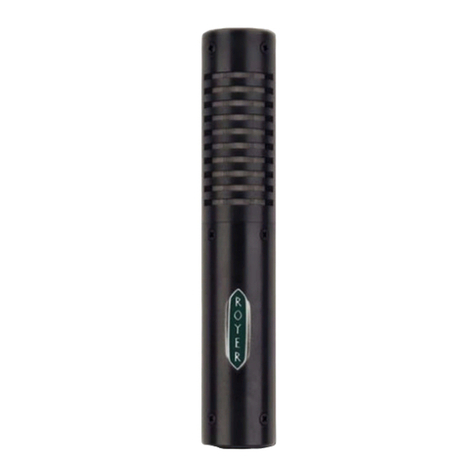
royer R-121 Guía

ROYER Labs
Model R-121
Ribbon Velocity
Microphone
Operation Instructions
Manual & User Guide
Made in U.S.A

TABLE OF CONTENTS
Model R-121 Ribbon Microphone
Revised January 2004
Table of Contents page 1
Introduction page 2
Description page 2
Applications page 3
Ribbons in the Digital World page 3
User Guide page 4
Amplification Considerations page 6
Equalization & Ribbon Microphones page 8
Hum, Noise & Mic Orentation page 8
The Sweet Spot page 9
Other Types of Microphones page 10
Proximity Effect & Working Distance page 11
Microphone Technique page 13
Stereophonic Microphone Technique page 17
Specialized Recording Techniques page 20
Care & Maintenance page 21
Features & Specifications page 22
Electrical Specifications page 23
Mechanical Specifications page 24
Polar Pattern & Frequency Response page 25
Notes page 26
Warranty page 32

Introduction
Congratulations on your purchase of a Royer Labs model R-
121 ribbon microphone. The R-121 is a handcrafted precision
instrument capable of delivering superior sound quality and
exceptional performance.
This operator’s manual describes the R-121, its function and
method of use. It also describes the care and maintenance
required to ensure proper operation and long service life. The
user guide section of this manual offers practical information
that is designed to maximize the performance capabilities of
this microphone.
Royer Labs products are manufactured to the highest industrial
standards using only the finest materials obtainable. Your
model R-121 went though extensive quality control checks
before leaving the factory. Normal care is all that is required to
assure a lifetime of trouble-free service.
Please read the manual thoroughly in order to become familiar
with all of the R-121’s capabilities. It will assist you in making
the most of your microphone’s superior acoustic properties.
This owner’s manual is a handy reference guide and we suggest
you refer to it whenever questions arise on the use and care of
your R-121 ribbon microphone.
Description
The R-121 is a compact bi-directional (figure-eight) velocity
type ribbon microphone designed for professional applications.
The figure-eight pick-up pattern allows the R-121 to be
addressed from either side with equal sensitivity. The in-phase
signal is achieved when the microphone is addressed from the
front, indicated by the “ROYER” logo.
2

The R-121 is reasonably tolerant to shock and vibration, and
performance is unaffected by changes in temperature or humid-
ity. However, ribbon microphones are somewhat more sensitive
to direct blasts of air, and the R-121 is no exception to this rule.
Discretionary use of a windscreen or pop screen, such as the
Royer PS-101, WS58 or equivalent, is highly recommended for
close-miking vocalists or certain types of percussion and wind
instruments.
Applications
The Royer Labs model R-121 is a versatile microphone and is
ideally suited for many critical recording applications. Its
smooth frequency response characteristics and ability to cap-
ture detail make it a fine choice for many instruments, as well
as for general broadcast applications. Its gentle low-frequency
proximity effect makes it especially useful for announcers and
vocalists. Female vocalists often benefit from the R-121’s abil-
ity to capture high frequencies without distortion or edginess.
Orchestral instruments are captured in a natural-sounding way
and free from microphone-induced “hype.” The R-121 has
exceptionally smooth high frequency characteristics. Phase-
related distortion and irregular frequency peaks are conspicu-
ously absent. Theater organs and electric guitar amplifiers
sound big and fat, without unnatural coloration, when repro-
duced with the R-121. These features make the R-121 ribbon
microphone an ideal choice for strings, woodwinds, percussion
and amplified instruments. Acoustic pianos can be captured
accurately without the comb-filtering effects associated with
condenser microphones.
Ribbons in the Digital World
Digital recordings benefit greatly from the properties inherent
in ribbon microphones. Since A to D converters cannot distin-
3

guish between the sound source being recorded and the com-
plex distortion components often associated with condenser
microphones, they sometimes have difficulty tracking the sig-
nal, resulting in ringing and edgy sounding tracks. With ribbon
microphones, ringing is almost non-existent due to the ribbon’s
lack of distortion artifacts and high-frequency peaks. A to D
converters have less difficulty tracking the ribbon generated
signal, resulting in very smooth digital recordings free of
microphone-related edginess.
User Guide
Using the R-121 Ribbon Microphone
There are a few important facts about ribbon microphones that
are key in understanding how to use them intelligently.
1. The R-121 is a side address, bi-directional microphone and
its rejection in the “dead” areas is very strong. Due to this direc-
tionality, the R-121 should be placed at 1.3 times the distance
normally used with omni-directional microphones, or about the
same distance used for cardioid microphones. This method is
used to achieve the same ratio of direct to reflected sound.
2. In the horizontal plane, the R-121 does not discriminate
against the highs off axis; nor does it boost highs on axis.
Therefore, several instruments or vocalists can be placed in
front of the microphone without favoring the performer in the
center of the group.
Several performers can be grouped at both the front and back of
the microphone, with one proviso: since the outputs are out of
phase at the front and back of the microphone, cancellation can
result if, for example, two tenors are placed at opposite sides at
equal distances and they are singing in unison, so listen to the
feed before committing to it.
4

3. When using the R-121 to record loud signal sources, placing
the microphone slightly off axis to the signal source (either hor-
izontally or vertically) minimizes the effect of high pressure
sound levels displacing and possibly damaging the ribbon ele-
ment.
4. The R-121 requires no power supply and is safe to use on
consoles with phantom microphone powering, provided that the
cabling is wired properly. It should be noted that not all ribbon
microphones are compatible with phantom-powering systems,
so check the manufacturer’s recommendations before using
other ribbon microphones. It should also be noted that faulty or
improperly wired cables could cause problems with your R-
121. Do not patch an R-121 through the mic tie lines of a patch
bay if phantom power is enabled on any of your mic pre’s, as
this will give the ribbon element a brief but damaging phantom
power jolt.
5. Never attempt to “test” the R-121 or any ribbon microphone
with an ohmmeter. A blown ribbon could result.
6. Always provide adequate protection for your R-121, or any
ribbon microphone. If the microphone is to remain set up on a
stand when not in use, place a “mic sock” (supplied with every
Royer microphone) over it until it is to be used. Do not carry the
microphone around without placing a mic sock over it. Failure
to follow this commonsense practice may yield a stretched rib-
bon and compromised performance.
7. Do not allow the microphone to be dropped on hard surfaces
such as floors or tables - depending on how the mic falls, you
could stretch the ribbon. The microphone would likely contin-
ue to operate, but performance could be compromised and re-
ribboning the microphone would be necessary to restore normal
operation.
5

Amplification Considerations
The performance of any non-active ribbon microphone is
directly affected by the microphone preamplifier it is paired
with. With so many mic preamps on the market, how do you
select one that gives the best possible performance with a rib-
bon microphone? Additionally, what kind of performance can
you expect from the preamplifiers built into your mixing desk?
While most preamplifiers will handle ribbon microphones well
in most recording situations, some preamps that work perfectly
well with condenser or dynamic mics may prove to be poor per-
formers with ribbons.
To begin with, we must understand the fundamental differences
between ribbon microphones and other popular types, namely
condenser and moving coil dynamics. A ribbon microphone is
actually a dynamic microphone that uses a flat, extremely low
mass ribbon element, rather than a coil/diaphragm assembly.
For this writing, any mention of “dynamic” microphones will
relate to moving coil dynamics.
All condenser microphones have a built-in preamplifier called
a head amp, and therefore put out a hefty signal. Because the
signal is buffered through the head amp, the output impedance
is rather low and less affected by the input impedance of the
microphone preamp. Most dynamic (moving coil) microphones
generate a healthy enough electrical current to work well with
a variety of preamps, and their limited frequency response char-
acteristics make mic loading less of a concern.
Ribbon microphones generate a highly accurate signal, but the
average ribbon mic generates approximately 20dB less output
than condenser microphones. Remember, the ribbon transducer
does not have the benefit of a condenser mic’s built-in “head
amp,” so a ribbon microphone relies solely on the microphone
preamp for all its gain!
6

The so-called ideal preamplifier is the proverbial “straight wire
with gain.” This may be considered the technological ideal and
does not include “coloration” as a desirable feature. However,
coloration is often desirable and has given rise to the populari-
ty of certain preamps and even preamp stages in mixing desks.
Neve preamps and the famous Trident A Range mixing console
are highly praised for their classic sound.
So what should we use with our beloved ribbon microphones?
The features that translate into top performance for a ribbon
microphone are the following:
1. Lots of gain! A ribbon microphone works best with pream-
plifiers that have at least 60-70dB of maximum gain.
2. Low noise is a must! With the amount of gain required for
efficient operation of a ribbon microphone, the noise character-
istics of the preamp play a pivotal role in overall performance
of the captured acoustic event.
3. Load characteristics: A suitable preamplifier should have
input characteristics that impose the least amount of loading on
the ribbon element. In other words, the input impedance should
be high enough that its effect on the performance of the mic is
negligible. A good rule of thumb is to have a preamplifier with
input impedance at least five times the impedance of the micro-
phone. For example, if the mic is rated at 300 Ohms (as Royers
are), the preamp should have an input- impedance of at least
1500 Ohms. If the impedance of the preamp is too low, the
microphone will lose low end and body.
4. Transparency: A good preamp should sound natural, with no
edginess. Tube preamps sound warm, yet wonderfully transpar-
ent. Transformer coupled preamps sound punchy. When record-
ing with condenser or dynamic microphones, engineers often
choose mic preamps that help “warm up the mic,” but warming
the signal up does not need to be a consideration with ribbon
7

mics because they are by nature warm and realistic sounding.
At this point personal taste should prevail over anything.
In conclusion, try to find the best preamp you can afford that
has good gain characteristics and low noise. Coloration is
optional.
Equalization & Ribbon Microphones
One of the great strengths of ribbon microphones is how well
they take EQ. Even with substantial amounts of equalization,
ribbons retain their natural, “real” quality. For example, when a
lead vocal is being performed on an R-121, you can actually
boost upper-end frequencies to the point where the R-121 emu-
lates the performance curve of a condenser mic with excellent
results. This is not to say that a ribbon microphone can substi-
tute for a quality condenser mic in all cases, but the EQ friend-
liness inherent in ribbon microphones does allow for an enor-
mous amount of flexibility.
The reason that ribbon mics take EQ so well is their inherent
low self-noise (less than 15dB), unusually smooth response
characteristics, and freedom from off-axis coloration. Dialing
in high amounts of equalization on condenser or dynamic
microphones also brings up equal amounts of the microphone’s
distortion products and noise; garbage that contributes to an
unnatural, unpleasant sound. Because distortion and self-noise
are almost nonexistent in ribbon microphones, high levels of
EQ can be used without adding harshness or excessive noise.
Hum, Noise & Mic Orientation
All dynamic microphones, including ribbons, are electromag-
netic devices and are, to some degree, susceptible to picking up
stray alternating magnetic fields. Power transformers (such as
those found in guitar amplifiers) and alternating current motors
are the most likely sources of radiated noise. Building wiring
and electrical utility transformers are other likely sources. A
8

well-designed microphone provides shielding to minimize the
effects of stray magnetic radiation, but complete isolation is
impossible and the result can be hum or buzz. Ribbon micro-
phones can potentially manifest this condition to a greater
degree because of their higher gain requirements. Vintage rib-
bon microphones often have poor shielding and the problem
can be worse. The cure for this problem is to identify the source
of the noise and move the microphone away from it. Another
trick is to alter the orientation of the microphone in such a way
that the noise is cancelled out. If you ever experience this situ-
ation while in the studio, try rotating the microphone to identi-
fy the “null” point, then reposition the mic and the sound
source. This is much like having a guitar player with single coil
pickups turn around until amplifier hum disappears.
The Sweet Spot
Finding & Working with the Sweet Spot
Good engineers know the benefits of finding and working with
the “sweet spot” of a given microphone. The sweet spot will be
defined as the optimum placement (working distance and angu-
lar position) of any microphone relative to the sound source.
Each microphone has its own sweet spot whether it is a ribbon,
dynamic or condenser type. The sweet spot will vary with the
type of sound source and its volume intensity, the polar pattern
of the microphone and how consistent it is with frequency, and
the acoustic environment.
Being in the sweet spot means the microphone and the sound
source are in a harmony of sorts; the acoustic information is
exciting the microphone in such a fashion that the resulting
reproduction is very desirable, usually without the need of addi-
tional equalization or electronic manipulation.
There are only general rules as to where the sweet spot may be
9
Otros manuales para R-121
3
Tabla de contenidos
Otros manuales de Micrófono de royer