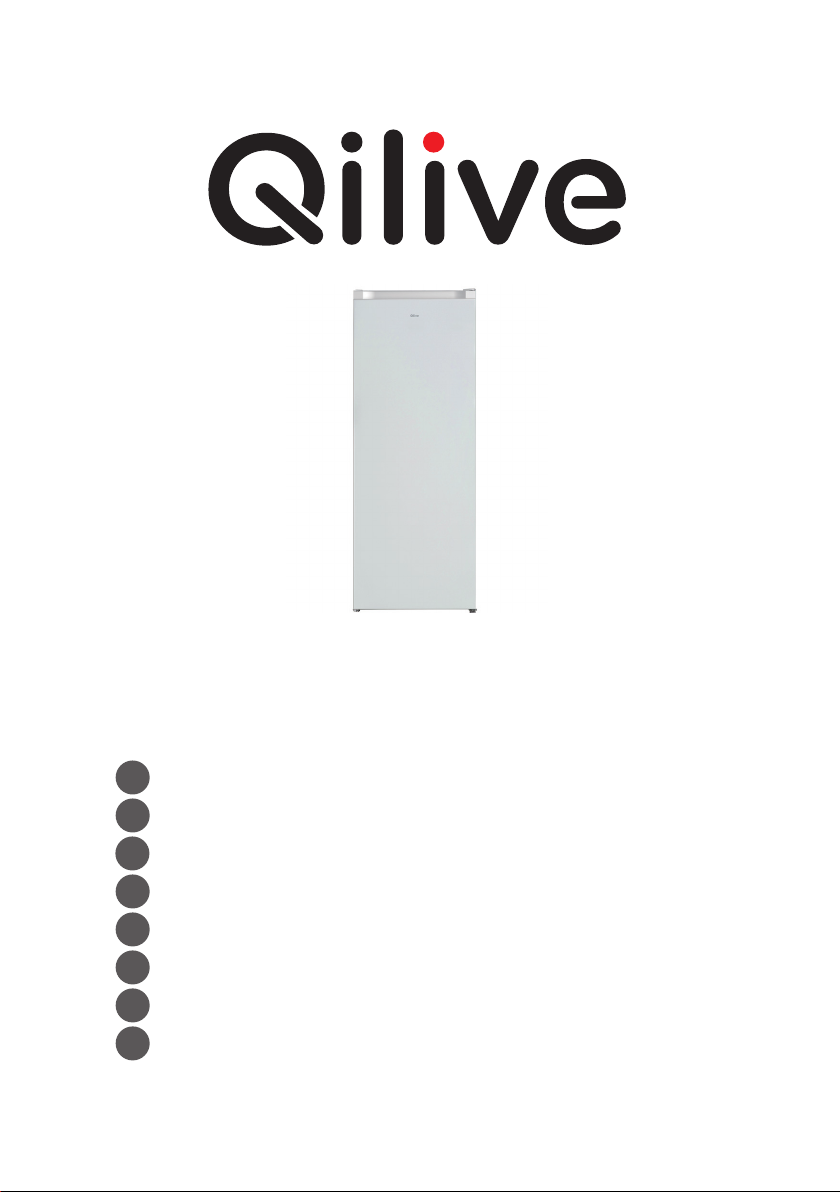
Qilive Q.6824 Manual de usuario

FR
ES
PT
PL
HU
RO
RU
UA
Congélateur vertical
Congelador vertical
Arca congeladora vertical
Zamrażarka pionowa
Álló fagyasztószekrény
Congelator vertical
Вертикальная морозильная камера
Вертикальна морозильна
Freezer upright
Q.6824

EN
FR
ES
PT
PL
HU
RU
RO
UA
User manual
Manuel d’utilisation
Manual de instrucciones
Manual de utilização
Instrukcja obsługi
Használati utasítás
Manual de instrucţiuni
Руководство пользователя
Довідник користувача
P. 4
P. 19
P. 35
P. 50
S. 65
80. o.
P. 94
C. 109
C. 125

EN
FR
ES
PT
PL
HU
RU
RO
UA
1
2
3
4

4
EN
1. SAFETY INSTRUCTIONS
Before using this product, carefully read these instructions and keep the user manual for
future reference.
Warning: It is hazardous for anyone other than authorized service personnel to carry out
servicing or repairs which involves the removal of covers. To avoid the risk of an electric
shock do not attempt to repair this appliance yourself.
Warning: Risk of re / ammable materials!
1. Do not use electrical appliances such as a hair dryer or heater to defrost your Fridge/
Freezer.
2. Containers with ammable gases or liquids can leak at low temperatures.
3. Do not store any containers with ammable materials, such as spray cans, re
extinguisher rell cartridges etc. in the Fridge/Freezer.
4. Do not place carbonated or zzy drinks in the Freezer compartment. Ice lollies can
cause “Frost/Freeze burns”. If consumed straight from the Fridge/Freezer.
5. Do not remove items from the Fridge/Freezer compartment if your hands are damp/
wet, as this could cause skin abrasions or “Frost/Freezer burns”. Bottles and cans must
not be placed in the Freezer compartment as they can burst when the contents freeze.
6. Manufacturer’s recommended storage time should be adhered to. Refer to relevant
instructions.
7. Do not allow children to tamper with the controls or play with the Fridge/Freezer. The
Fridge/Freezer is heavy. Care should be taken when moving it. It is dangerous to alter
the specication or attempt to modify this product in any way.
8. Do not store inammable gases or liquids inside your Fridge/Freezer.
9. If the supply cord is damaged, it must be replaced by the manufacturer, its service agent
or similarly qualied persons in order to avoid a hazard.
CONTENT OVERVIEW:
1. SAFETY INSTRUCTIONS P. 4
2. TECHNICAL SPECIFICATIONS P. 8
3. PRODUCT DESCRIPTION P. 8
4. INSTALLATION P. 8
5. USE P. 10
6. DOOR REVERSAL P. 12
7. MAINTENANCE AND CLEANING P. 14
8. TROUBLESHOOTING P. 16
9. GUARANTEES P. 18

5
EN
10. This appliance can be used by children aged from 8 years and above and persons with
reduced physical, sensory or mental capabilities or lack of experience and knowledge if
they have been given supervision or instruction concerning use of the appliance in a safe
way and understand the hazards involved. Children shall not play with the appliance.
Cleaning and user maintenance shall not be made by children without supervision.
11. This appliance is intended to be used in household and similar applications such as
– sta kitchen areas in shops, oces and other working environments;
– farm houses and by clients in hotels, motels and other residential type environments;
– bed and breakfast type environments;
– catering and similar non-retail applications.
12. Do not store explosive substances such as aerosol cans with a ammable propellant in
this appliance.
13. WARNING: Keep ventilation openings, in the appliance enclosure or in the built-in
structure, clear of obstruction.
14. WARNING: Do not use mechanical devices or other means to accelerate the defrosting
process, other than those recommended by the manufacturer.
15. WARNING: Do not damage the refrigerant circuit.
16. WARNING: Do not use electrical appliances inside the food storage compartments of
the appliance, unless they are of the type recommended by the manufacturer.
17. WARNING: Refrigerating appliances, in particular a refrigerator-freezer Type I, might
not operate consistently (possibility of defrosting of contents or temperature becoming
too warm in the frozen food compartment) when sited for an extended period of time
below the cold end of the temperature range for which the refrigerating appliance is
designed.
18. WARNING: The necessity that, for doors or lids tted with locks and keys, the keys be
kept out of the reach of children and not in the vicinity of the refrigerating appliance, in
order to prevent children from being locked inside.
19. WARNING: The refrigerant used in your appliance and insulation materials requires
special disposal procedures.
20. The refrigerant gas R600a that is contained in the refrigerator is a natural gas. It is not
harmful to the environment, but combustible. It is therefore important to transport and
install your refrigerator carefully so as not to damage the refrigerant ducts. In the event
of a gas leak, avoid contact with nearby ames or res and ventilate the room.
21. WARNING: When positioning the appliance, ensure the supply cord is not trapped or
damaged.
22. WARNING: Do not locate multiple portable socket-outlets or portable power supplies at
the rear of the appliance.
23. Children aged from 3 to 8 years are allowed to load and unload refrigerating appliances.
24. To avoid contamination of food, please respect the following instructions:
– Opening the door for long periods can cause a signicant increase of the temperature
in the compartments of the appliance.
– Clean regularly surfaces that can come in contact with food and accessible drainage
systems.
– Store raw meat and sh in suitable containers in the refrigerator, so that it is not in
contact with or drip onto other food.
– Two-star frozen-food compartments are suitable for storing pre-frozen food, storing or
making ice cream and making ice cubes.
– One-, two- and three-star compartments are not suitable for the freezing of fresh food.
– If the refrigerating appliance is left empty for long periods, switch o, defrost, clean, dry,
and leave the door open to prevent mould developing within the appliance.
25. The marking of this device (symbol of a crossed-out dustbin) complies with
European Directive 2012/19/EU relating to "used electrical and electronic
equipment". This marking means that this equipment, at the end of its useful
life, cannot be disposed of with other household waste. The user is required to

6
EN
deliver it to operators who collect used electrical and electronic equipment. Collection
operators, including local collection points, shops and local authorities, create an
appropriate system for collecting equipment. Appropriate collection of used electrical
and electronic equipment helps avoid harmful impacts on human health and the
environment, resulting from the presence of hazardous components, as well as from
improper storage and treatment of this equipment.
26. European directive 2012/19/EU on Waste from Electrical and Electronic
Equipment (WEEE), requires that used household appliances are not thrown
into the normal municipal waste stream. Used appliances must be collected
separately in order to optimize the rate of recovery and recycling of materials
that compose them, and to reduce the impact on human health and on the
environment. The crossed bin symbol is axed to all the products to remind
you of the obligations of separated collection.
27. Never try to repair the refrigerator yourself, only use a qualied or authorized service person
for repairs.
1.1. ELECTRICAL CONNECTION
WARNING
1. The power cord of this appliance is equipped with a plug which mates with the
standard wall outlets to minimize the possibility of electrical shock.
2. Under any circumstances, ensure that the power cord is grounded.
3. This refrigerator appliance requires a standard 220-240 V/AC 50 Hz electrical outlet
with grounding.
4. This refrigerator appliance is not designed to be used with an inverter.
5. The cord should be secured behind the appliance and not left exposed or dangling
to prevent accidental injury.
6. Never unplug the refrigerator by pulling the power cord. Always grip the plug rmly
and pull straight out from the receptacle.
7. Do not use an extension cord with this appliance. If the power cord is too short,
have a qualied electrician or service technician install an outlet near the appliance.
Use of an extension cord can negatively aect the performance of the unit.
8. Improper use of the grounded plug can result in the risk of electrical shock. If the
power cord is damaged, have it replaced by an authorized service center.
1.2. CLIMATE RANGE
The information about the climate range of the appliance is provided on the rating
plate. It indicates at which ambient temperature (that is, room temperature, in which the
appliance is working) the operation of the appliance is optimal (proper).
Class Symbol Ambient temperature range
Extended temperate SN +10 to +32 °C
Temperate N +16 to +32 °C
Subtropical ST +16 to +38 °C
Tropical T +16 to +43 °C
Note: Given the limit values of the ambient temperature range for the climate
classes for which the refrigerating appliance is designed and the fact that the internal
temperatures could be aected by such factors as location of the refrigerating
appliance, ambient temperature and the frequency of door opening, the setting of
any temperature control device might have to be varied to allow for these factors, if
appropriate.

7
EN
Note: When operating in an environment other than the specied climate type
(i.e., beyond the rated ambient temperature range), the appliance may not be
able to maintain the desirable compartment temperatures.
1.3. LOCKS
If your refrigerator is tted with a lock, keep the key out of reach and not in the vicinity
of the appliance to prevent children being entrapped. When disposing of an old
refrigerator, break o any old locks or latches as a safeguard.
1.4. FREON-FREE
The freon-free refrigerant (R600a) and the foaming insulation material (cyclopentane)
that is environmentally friendly are used for the refrigerator, causing no damage to
the ozone layer and having a very small impact on the global warming. R600a is
ammable, and sealed in a refrigeration system, without leakage during normal use.
But, in case of refrigerant leakage due to the refrigerant circuit being damaged, be sure
to keep the appliance away from open ames and open the windows for ventilation as
quickly as possible.
1.5. WARNINGS FOR DISPOSAL
• Refrigerant and cyclopentane foaming material used for the refrigerator are
ammable. Therefore, when the refrigerator is scrapped, it shall be kept away
from any re source and be recovered by a special recovering company with
corresponding qualication other than be disposed by combustion, so as to prevent
damage to the environment or any other harm.
• When the refrigerator is scrapped, disassemble the doors, and remove gasket of
door and shelves; put the doors and shelves in a proper place, so as to prevent
trapping of any child.
1.6. ELECTRICAL INFORMATION
This electrical appliance must be grounded.
This product is equipped with a plug, which is suitable for all houses equipped with
sockets meeting the current specications. If the tted plug is not suitable for your
socket outlets, it should be cut o and carefully disposed of. To avoid a possible shock
hazard, do not insert the discarded plug into a socket.
This product complies the EEC directives.

8
EN 2. TECHNICAL SPECIFICATIONS
3. PRODUCT DESCRIPTION
1. Thermostat knob
2. Flip cover 3. Freezer drawers
4. Adjustable feet
4. INSTALLATION
4.1. INSTALLATION LOCATION
1. Ventilation condition
The position you select for the refrigerator installation should be well-ventilated and has
less hot air.
Do not locate the refrigerator near a heat source such as cooker, and avoid
it from direct sunlight, thus guaranteeing the refrigeration eect while saving
energy consumption.
Do not locate the refrigerator in a damp place, so as to prevent the refrigerator
from rusting and leaking electricity.
The result of the refrigerant charge amount of the refrigerator being divided by the total
space of the room in which the refrigerator is installed shall be less than 8g/m³.
Note: The amount of refrigerant charged for the refrigerator can be found on the
nameplate.
2. Heat dissipation space
When working, the refrigerator gives o heat to surroundings. Therefore, at least
30 mm of free space should be spared at the top side, more than 100 mm on both
sides, and above 50 mm at the back side of the refrigerator.
Dimensions in mm:
WDHA B C (°) E F
540 550 1440 910 1053 125±5 50 100
Power supply 220 - 240 V~, 50 Hz
Rated current 0.7 A
Energy consumption 192 kWh/year
Protection class I
Climate class N/ST
Total volume 177 L
2-Star compartment volume 28 L
4-star compartment volume 149 L
Freezing capacity 8kg/24h
Refrigerant and inject amount R600a/70g
Net weight 40 kg

9
EN
Figure 1 Figure 2
Note: Figures 1 and 2 only illustrate the space demand of the product.
3. Level ground
Place the refrigerator on the solid and at ground (oor) to keep it stable, or else, it
will give rise to vibration and noise. When the refrigerator is placed on such ooring
materials as carpet, straw mat, polyvinyl chloride, the solid backing plates should
be applied underneath the refrigerator, so as to prevent color change due to heat
dissipation.
Unobstructed ventilation shall be maintained around the appliance or in an
embedded structure.
4.2. PREPARATIONS FOR USE
1. Leveling
Make sure to level your refrigerator/freezer using the front leveling feet. If not level, the
door gasket sealing performance will be aected, or even it may lead to the operating
failure of your refrigerator/freezer.
2. Cleaning
Conrm the accessory parts inside the refrigerator and wipe the inside with a soft cloth.
3. Standing time
After the refrigerator is properly installed and well cleaned, do not switch it on
immediately. Make sure to energize the refrigerator after more than 1 hour’s standing,
so as to ensure its normal operation.
4. Power-on
Insert the plug into the solid socket to start the compressor. After 1 hour, open
the refrigerator door, if the temperature inside the refrigerator compartment drops
obviously, it indicates the refrigeration system is working normally.
5. Storage of food
After the refrigerator runs for a period of time, the internal temperature of the
refrigerator will be automatically controlled according to the user’s temperature setting.
After the refrigerator is fully cooled, put in foods, which usually need 2~3 hours to be
fully cooled. In summer, when the temperature is high, it takes more than 4 hours for
the foods to be fully cooled (Try to open the refrigerator door as less as possible before
the internal temperature cools down).
If the refrigerator is installed in the moisture place, make sure to check
whether the ground wire and leakage circuit breaker are normal. If vibration
noises are produced due to the refrigerator contacting the wall or if the
wall gets blackened by air convection around the compressor, move the
refrigerator away from the wall. Setting up the refrigerator may cause jamming
noise or image chaos to the mobile phone, xed-line telephone, radio receiver,
television surrounding it, so try to keep the refrigerator as far away as possible
in such case.

10
EN 5. USE
5.1. START
This refrigerating appliance is not intended to be used
as a built-in appliance.
1. Turn the thermostat knob to the “2” position,
and plug the freezer into the wall outlet. The
compressor will begin to run.
2. After 30 minutes of operation, check to ensure that
the freezer is cold.
Temperature control
1. The temperature control (thermostat knob, turned by coin) is located near the top
of the unit.
2. Turning the thermostat knob adjusts the temperature of the freezer.
3. The marks on the knob represent dierent settings. Setting “1” is the warmest and
setting “4” is the coolest.
4. The recommended setting is “2” for normal operating conditions.
After the freezer is in place it needs to be left idle for 4 hours. This allows time
for the coolant to settle. Do not turn on the freezer during this period.
5.2. INSTRUCTIONS FOR FOOD STORAGE
• Do not put too many or too weight foods inside the refrigerator. Keep enough space
between foods; if too close, the cold air ow will be blocked, thus aecting the
refrigeration eect.
• Do not store excessive or overweight foods, to avoid the shelf from being crushed.
• When storing the foods, keep a distance away from the inner wall; and do not place
the water-rich foods too close to the refrigerator rear wall, lest they get frozen on
the inner wall.
Freezer mode
Long-term storage of foods: The freezer compartment, where the temperature is
generally controlled below -18 °C, is suitable for the preservation of foods for a long
term, but the shelf life indicated on the food packages should be abided by.
Freezer drawer: Used for the frozen food storage. For the mass pieces of meat or sh,
cut them into smaller ones, pack them up separately with the fresh-keeping bags, and
distribute them evenly in the drawer.
• Allow the hot foods to cool down to the room temperature before putting them in the
freezer compartment.
• Do not put a glass container with liquid or any canned liquid that is sealed in the
freezer compartment, so as to avoid burst due to volume expansion after the liquid
gets frozen up.
• Divide the food into appropriately small portions.
• You’d better pack the food up before freezing it, and the packing bag should be dry,
in case the packing bags are frozen together. Foods should be packed or covered
by suitable materials that are rm, tasteless, impervious to air and water, non-toxic
and pollution-free, to avoid cross-contamination and transfer of odor.
Tips for shopping the frozen foods
1. When you are buying frozen food, look at the storage guidelines on the
packaging. You will be able to store each item of frozen food for the period shown
against the star rating. This is usually the period stated as “Best to use them
before×”, found on the front of the packaging.
2. Check the temperature of the frozen food cabinet in the shop where you buy the
frozen foods.
Tabla de contenidos
Idiomas:
Otros manuales de Congelador de Qilive


