Planar 9D-12 Manual de usuario

v01.2018
EN
Operation manual
Air heaters
PLANAR –9D –12
PLANAR –9D –24

2
Table of Contents
1Introduction ..................................................................................................................... 3
2Basic parameters & specifications .................................................................................. 3
3Safety Measures............................................................................................................... 4
4Description of Heater Structure and Operation............................................................... 5
5Heater control unit........................................................................................................... 6
6Control panel ................................................................................................................... 6
7Scope of Supply............................................................................................................... 9
8Installation requirements............................................................................................... 10
9Post-installation testing .................................................................................................16
10 Recommendations ......................................................................................................... 17
11 Possible malfunction during operations and Remedial Procedure for Heater Ignition
Problems................................................................................................................................18
12 Transportation & storage...............................................................................................19
13 Warranty........................................................................................................................ 19
Production
ADVERS LLC
Novo-Sadovaja str. 106,
443068, Samara, Russia
+7(846)263-07-97
www.autoterm.ru
Sales Department
AUTOTERM LLC
Trikatas 4, Riga, Latvia
LV-1026
+371 20110229
sales@autoterm-europe.com
www.autoterm-europe.com
Technical Support
AUTOTERM LLC
Trikatas 4, Riga, Latvia
LV-1026
+371 25529999
service@autoterm-europe.com

3
1 Introduction
This operation manual is intended to familiarize the User with salient features,
operation, assembly and operating procedures for PLANAR–9D-12, PLANAR–9D-24,
(hereinafter called «the heater») intended for regulated heating of various compartments of
a motorized vehicles at atmospheric temperatures as low as -45°С(-113F).
Minor changes performed on the heater structure by the Manufacturer may not be
documented in this operation manual.
When placing an order or referring to the heater in documents pertaining to other types
of equipment, the heater codes will read as follows:
«Отопитель воздушный / Air Heater PLANAR–9D-12 TU4591-008-40991176-2005»;
«Отопитель воздушный / Air Heater PLANAR–9D-24 TU4591-008-40991176-2005»;
2 Basic parameters & specifications
The basic heater specifications are quoted in Table 1.
The basic parameters are quoted to a margin of 10% tolerance at a temperature of
20С(68F) at a nominal voltage.
Table 1
Parameter Code
Version
PLANAR–9D–12
PLANAR–9D–24
Nominal Supply Voltage, V
12
24
Fuel Type
diesel oil in compliance with GOST 305,
atmospheric temperature-dependent
Heating Efficiency:
max, kW
min, kW
max, kW
min, kW
8
3,2
8
3,2
Heated Air Volume:
max, m3/h
min, m3/h
max, m3/h
min, m3/h
290
70
290
70
Fuel Consumption at:
max power,
l/h
min power,
l/h
max power,
l/h
min power,
l/h
1
0,42
1
0,42
Power consumption, W
max, W
min, W
max, W
min, W
215
12
180
12
Start/Stop Mode
Manual
Maximum Weight, kg
18

4
3 Safety Measures
3.1. The installation of the heater and its fittings shall be performed by authorized
organizations only.
3.2. The heater may only be used for the purposes specified herein.
3.3. The fuel supply line shall not be installed inside the passenger compartment or cabin
of a motor vehicle.
3.4. The vehicle electric harness shall not be installed near the fuel supply line.
3.5. A vehicle that uses the heater shall be equipped with a fire extinguisher.
3.6. It is prohibited to use the pre-heater in areas, where highly inflammable vapors or
ample quantity of dust may be generated or accumulated.
3.7. To prevent the possibility of exhaust gas poisoning, the heater shall not be used when
the vehicle is in the closed, not aired rooms (garage, workshop, etc).
3.8. When refueling the vehicle, the heater shall be switched off.
3.9. When performing welding operations on the vehicle or repairs on the heater,
disconnect the heater from the vehicle battery.
3.10. When assembling or dismantling the heater, observe the safety measures specified by
electric work regulations for the fuel supply system and the vehicle’s wiring system.
3.11. The heater shall not be connected to the vehicle electric circuit while the engine is
running or the battery is switched off.
3.12. The heater’s electric power supply must not be disconnected before the end of
the purge cycle.
3.13. The heater is powered from the accumulator battery regardless of the availability of
the vehicle frame connection.
3.14. The heater’s connectors must not be connected or disconnected while the heater’s
electric power supply is turned on.
3.15. It is forbidden to step on a heater and to put on it subjects.
3.16. It is forbidden to cover a heater with articles of clothing, pieces of fabric, etc. and as
to place them before its entrance or an exit of heated air.
3.17. Wait 5 to 10 seconds before switching the heater back on.
3.18. In the event of two subsequent ignition failures, contact the maintenance department
to report a malfunction.
3.19. In the event of a failure in heater operation, contact a designated repair organization
authorized by the manufacturer.
3.20. Manufacturer warranty shall not apply if the above requirements are not adequately
met.

5
4 Description of Heater Structure and Operation
The heater operates independently from the vehicle engine.
The fuel and electric power supply is provided by the vehicle. See figure 4.1 for the
heater wiring diagram.
The heater is a self-contained heating device comprising the following:
-heating device (see figure 4.2 for basic components thereof);
-fuel supply pump providing fuel for the combustion chamber;
-ignition and indicator device (control panel);
-wiring harness connecting heater fittings to the vehicle battery.
-fuel tank
The heater’s operating principle is based on heating air driven through the heater’s
heat exchange system.
The heat sources are fuel combustion gases from the combustion chamber. The
resulting heat warms the walls of the heat exchanger, which is air-blown from the outside.
Air passes through the ribbing of the heat exchanger and enters the passenger compartment
or other compartments of the vehicle.
Upon ignition, control unit of the heater checks the heater to ascertain whether fittings
such as the flame indicator, the overheat sensor, air pump motor, plugs, fuel supply pump
and the electric circuits thereof are working properly.
If no problem is detected, the ignition process starts.
In accordance with the preset sequence, the combustion chamber is fore-purged and the
glow plug warms up to the required temperature. Air and fuel starts to enter the combustion
chamber under the same procedure, whereupon the ignition process is initiated. Once stable
combustion is achieved, the heating plug switches off. Flame control is provided by the
flame indicator. All processes involved in heater operation are monitored by the control
unit.
The control unit controls heat exchanger temperature and halts the combustion process
as soon as the temperature exceeds the specified limit and the temperature of the heated air.
The heater may be switched off at any time.
Pressing the heater deactivation command stops the fuel entering and the combustion
chamber is purged with air.
During automated operation control of the heater in emergency situations, bear in mind
the following:
1) in the event of ignition failure, the process will be repeated. The heater will switch off
following two consecutive ignition failures;
2) if in a operating time of a heater, a burning stops, then the attempt of starting will be
repeated. In operating time of a heater a flameout is possible till 3 times;
3) if the heat exchanger is overheated (maybe as a result of closure of the heater
inlet/outlet vents), the heater will switch off automatically,
4) if the heated air is overheated maybe as a result of closure of the heater inlet/outlet
vents), the heater will switch off automatically.
5) if voltage drops below 20 V (10 V) or exceeds 30 V (16 V) the heater will switch off;
6) at emergency switching off of a heater on the control panel (CP) the light-emitting
diode blinks. The quantity of blinking corresponds to an error code. Watch an error
code in the manual of control panel.

6
5 Heater control unit
The control unit and the control panel control the heater.
The control unit performs the following functions:
a) initial diagnostics (serviceability check) of heater fittings during ignition,
b) diagnostic of heater elements throughout operation,
c) heater activation/deactivation by command from control panel;
d) combustion process control;
e) automated switching of ventilation after the combustion process stopped;
f) automated deactivation of the heater occurs:
-in the event of failure of one of the controlled elements,
-when any parameter exceeds the specified limit (heat exchanger temperature, air
temperature, supply voltage)
-combustion chamber flame failure (more than 3 times)
6 Control panel
On the front panel of the control panel are located:
1 –Button on/off ventilation mode;
2 –Button on/off heater;
3 –Light-emitting diode to display of working of
heater;
4 –Light-emitting diode to display of the mode of
ventilation;
5 –Potentiometer handle.
The light-emitting diode pos. 3 shows a mode of
working of a heater:
-shines yellow –the heating mode;
-blinks often yellow –during a purge;
-blinks seldom red –at malfunction of heater;
-doesn't shine –at an not working heater.
The light-emitting diode pos.4 shows a condition of the mode of ventilation:
-shines green –if the cabin temperature sensor isn't connected and the heater works
in the ventilation mode;
-blinks green –switching off of the mode of ventilation;
-shines yellow –if the cabin sensor is connected and the heater works at the heating
mode with ventilation function;
-doesn't shine at an idle heater and at the switched-off ventilation mode.
Work with the control panel is described in manual on the control panel.

7
1. View of connector (XS1, XS3, XS7, XP1, XP3, XP7) is shown from contact side (not
from wires side).
2. *color of a tag on wires
3. **to buy in addition
Figure. 4.1- Wiring diagram

8
Figure 4.2 –Basic heater components

9
7 Scope of Supply
See figure 7.1 for scope of supply and connection diagram of basic heater components
PLANAR-9D-12, PLANAR-9D-24.
Figure 7.1 –Connection diagram of basic heater components

10
8 Installation requirements
8.1. Heater installation
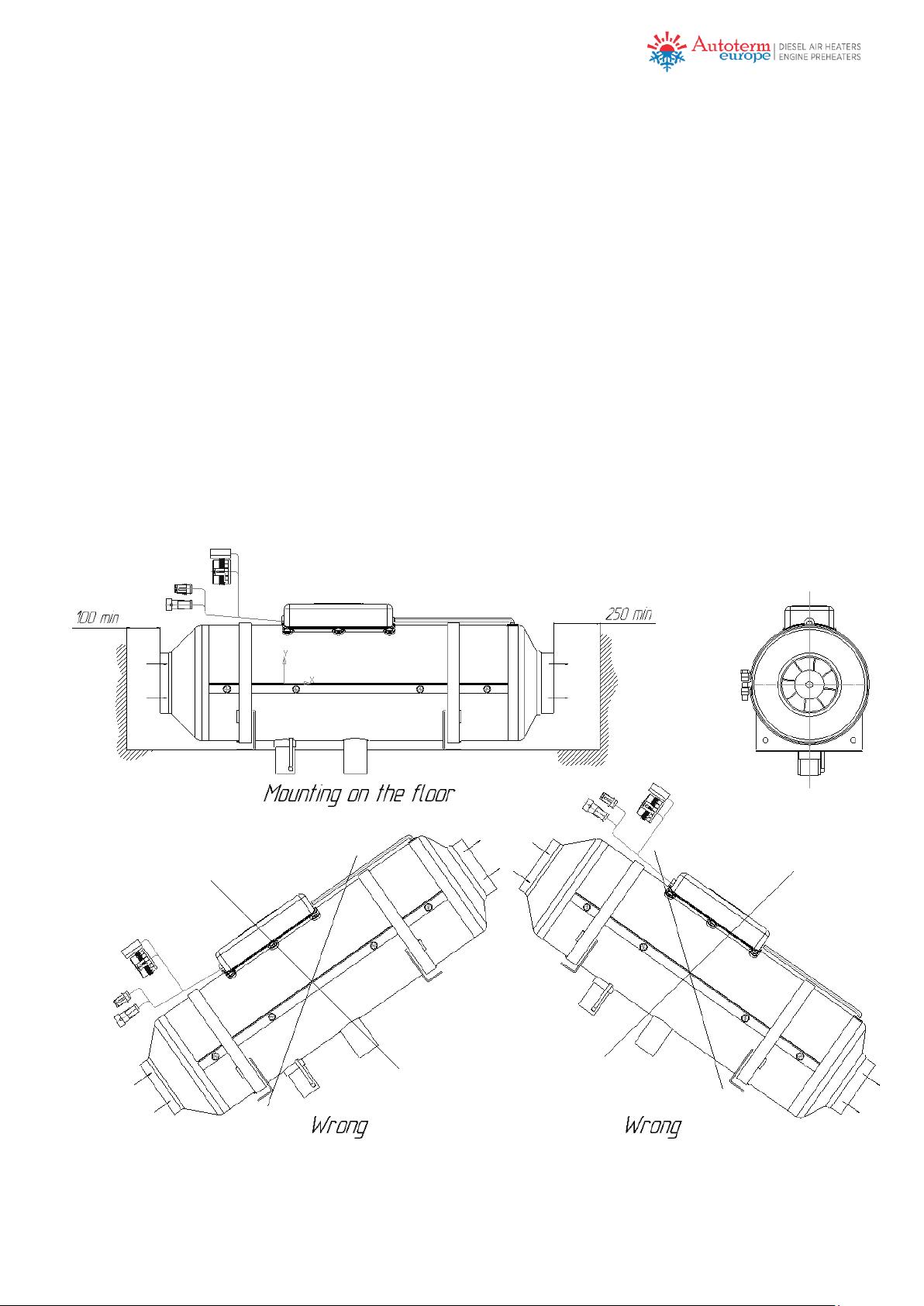
Install the heater according to figure 8.1. Peace of installation for the heater should be
flat. Position the heater’s inlet vent in such a way to prevent absorption of vehicle/heater
exhaust gas in normal operating conditions. The distance between the walls/partitions and
the edge of the inlet vent shall be at least 100 mm (see figure 8.1). The distance between the
walls/partitions and the edge of the outlet vent shall be at least 250 mm. When assembling
or operating the heater, ensure that no foreign objects enter the inlet/outlet vents. Prior to
assembly, ensure availability dismantlement requirements, as this will permit easier
maintenance in future.
See figure 8.1b how to position mounting holes to install the heater into the motor
vehicle casing.
ATTENTION!!! To ensure reliable performance, follow the above
recommendations carefully. Install the heater horizontally as shown on the figure 8.1.
Figure 8.1 –Variants of installation of a heater.
Este manual sirve para los siguientes modelos
1
Tabla de contenidos
Otros manuales de Calentador de Planar
Manuales populares de Calentador de otras marcas

Empire Heating Systems
Empire Heating Systems WCC65 Manual de usuario

Wetekom
Wetekom 92 86 43 Manual de usuario

Desa
Desa SPC170-F Manual de usuario

Watlow
Watlow Watrod Electric Tubular Heaters Manual de usuario

Haverland
Haverland ECO-DRY GPS Series Manual de lista de piezas

Stelpro
Stelpro ASILVC2060 Series Manual de usuario