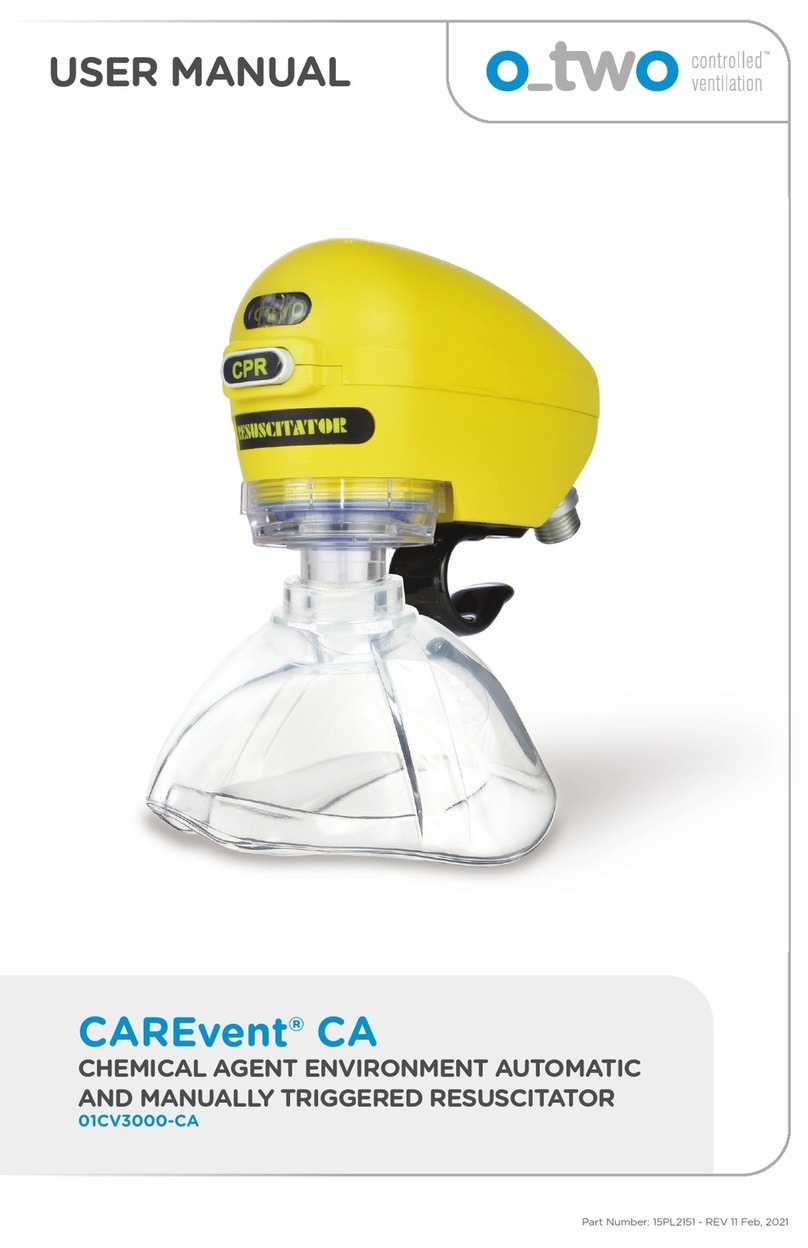
O-Two CAREvent ALS Manual de usuario

USER MANUAL
CAREvent® ALS
Part Number: 17MP9656 - REV 16 Feb, 2021
AUTOMATIC AND MANUALLY
TRIGGERED RESUSCITATOR
01CV3000

3
CAREvent® ALS - User Manual
TABLE OF CONTENTS
1. The CAREvent® ALS Handheld Automatic
and Manually Triggered Resuscitator 4
1.1. Introduction 4
1.2. Warranty Information 5
1.3. The CAREvent® ALS Features 5
1.4. Performance Specifications 7
1.5. Safety Precautions 8
2. Pre Use Functional Checks 8
2.1. Set Up 8
2.2. Testing of the Individual Features
of the Ventilator 9
3. Operating Procedure 9
3.1. Connecting the Supply Hose
and Patient Circuit 9
3.2. Manual Ventilation and
Cardiac Compressions 10
3.3. Automatic Ventilation 11
3.4. Action to be Taken if Patient
Vomits During Resuscitation 12
3.5. Demand Breathing and Automatic
Circuit Shut O 12
4. Servicing 13
4.1. Routine Maintenance 13
4.2. Cleaning and Sterilization 14
5. CAREvent® ALS Accessories 15

4CAREvent® ALS - User Manual
1. THE CAREvent® ALS Handheld Automatic
and Manually Triggered Resuscitator
1.1. Introduction
The CAREvent® ALS Handheld Resuscitator provides trained
individuals with a safe and eective means of providing artificial
ventilation during respiratory and/or cardiac arrest.
The CAREvent® ALS Handheld Resuscitator is lightweight,
portable, and extremely durable. Designed for the demands of the
emergency medical and rescue environment, they can be operated
anywhere an oxygen cylinder or piped wall outlet is present.
Note: An Automatic and Manually Triggered Resuscitator is
considered a critical device, and its components considered
critical components. Only those individuals trained in Cardio-
Pulmonary Resuscitation and the operation of oxygen-powered
ventilators should use this equipment. Thoroughly review this
instruction manual before use.
Note: This resuscitator is intended for first response to a
breathing emergency only and that patients must be transferred
to a transport and emergency ventilator as equipment becomes
available.
INTENDED USE:
The CAREvent CA resuscitator is intended for use in pulmonary
resuscitation during respiratory and/or cardiac arrest, and to
provide short term ventilatory support for both intra-hospital and
inter-hospital of non-breathing patients.
WARNING
Resuscitator used in contaminated environments can be hazardous
unless entrainment is prevented or appropriate filtration is provided.
WARNING
This resuscitator is not recommended for use on neonates and
pregnant or nursing women.
The material used in this device contains “DEHP”.
PHT
DEHP

5
CAREvent® ALS - User Manual
1.2. Warranty
This equipment is manufactured from the finest quality materials.
Each individual part is subject to strict quality control tests to
ensure exceptionally high standards. The manufacturer warrants
to the purchaser of the CAREvent® ALS Handheld Resuscitator
that its component parts are free from defects in material and
workmanship for a period of two years from the date of purchase.
The manufacturer will replace and/or repair all parts of the
resuscitator at its option for two years from the date of purchase
at no cost to the purchaser, upon the notification of the defects, in
writing by the purchaser. All shipping costs shall be borne by the
purchaser. The manufacturer shall be liable under this warranty
only if the resuscitator and its parts have been used and serviced
in the normal manner described in the instruction manual. There
are no other expressed or implied warranties. This warranty gives
no specific legal rights. You may also have other rights that may
vary according to local regulations.
1.3. Features
The CAREvent® ALS Handheld Resuscitator is a pneumatically
powered, time/volume cycled ventilatory resuscitator with the
added feature of a Manually Actuated, Automatic Ventilation
Override Button (Manual Button) to allow the operator to control
the ventilations manually at a rate and volume they desire.
In addition the CAREvent® ALS allows the breathing patient
to “Demand Breathe” on 100% oxygen while their inspiratory
eorts causes the automatic cycling to cease. Should they stop
breathing, the ventilator will automatically restart cycling in the
setting selected.
The “pneumatic logic circuit” can be run on either approved,
compressed, breathing air or medical oxygen. The unit is self
contained and only requires its attachment to a regulated oxygen
or air supply (as specified) for immediate use.

6CAREvent® ALS - User Manual
The CAREvent® ALS Handheld Resuscitator:
• Delivers 100% oxygen during resuscitation (when attached to
an oxygen source).
• Meets American Heart Association/J.A.M.A. recommendations
for C.P.R.
• Provides physiologically normal respiratory rates and volumes.
• Has an Audible Airway Pressure Limiting System set in
accordance with the recommendations of the American Heart
Association/ JAMA.
• Is lightweight and extremely durable.
• Is designed for emergency resuscitation and pre-hospital
care / patient transport and for resuscitation and inter-
departmental transport in the hospital environment where the
potential patient use is with children and adults.
• Has a Manually Actuated, Automatic Ventilation Override
Button (Manual Button).
• Has a seven position selector providing six, preset, automatic
settings for a range of patient sizes from children to adults
with tidal volumes and frequencies of ventilation in line with
established guidelines for the range of patient sizes indicated
and an OFF position to allow the ventilator to be left in a
“standby mode” with the oxygen supply turned on.
• Provides “Demand Breathing” with automatic cycling shut o
and re-start.

7
CAREvent® ALS - User Manual
Tidal Volume 150 - 600 ml
Breaths per Minute 20 – 10
I:E Ratio 1 : 2
Automatic Flow Rate 9.0 - 18.0 L/min
Manual Flow Rate As per automatic setting
Manual Overide Delay Time 17 - 23 Sec
Demand Breathing Flowrate 0 - 120 L/min
Demand Breathing Triggering Pressure -2.0 cmH
2
0 / -2.0 mBar
Inspiratory Resistance -6.0 cmH
2
0 / -5.9 mBar
Expiratory Resistance 6.0 cmH
2
0 / 5.9 mBar
Auto Shut O Delay Time 5 - 8 Sec
Input Pressure 45 - 87 PSI (3.0 - 6.0 Bar)
Maximum Airway Pressure 60 cmH
2
0 / 58.8 mBar
Operating Temperature -18
o
C - + 50
o
C / 0
o
F - +122
o
F
Storage Temperature -40
o
C - +60
o
C / -40
o
F - +140
o
F
Input Connection 9/16” DISS
Patient Connection 15 / 22 mm
Weight 16 OZ (0.45 Kg)(ALS)
14 OZ (0.40 Kg)(BLS)
Size 140 x 63 x 73 mm / 5.5” x 2.5” x 2.9”
Cylinder Duration: CAREvent® ALS
31 ~ 103 minutes*
Cylinder Duration: CAREvent® BLS
69 ~ 138 minutes*
1.4. Performance Specifications
* (Based on an Aluminum “D” size cylinder containing 415 Litres of oxygen.)
(All specifications are subject to a tolerance of +/- 10% except the
I:E Ratio which is subject to a tolerance of +/- 20% and Maximum
Airway Pressure +0/-10%)

8CAREvent® ALS - User Manual
1.5. Safety Precautions
The CAREvent® ALS Handheld Resuscitator is designed to
provide emergency ventilatory support to patients suering from
respiratory and/or cardiac arrest.
The CAREvent® ALS Handheld Resuscitator is intended for use by
suitably trained and qualified personnel. The following precautions
should always be observed:
1. Do not leave the patient unattended.
2. When not in use, always turn o the cylinder.
3. Never allow oil or grease to come into contact with any part of
the cylinder, regulator or resuscitator.
4. Do not disassemble any part of the resuscitator except where
described in this manual, as any unauthorized disassembly
will invalidate the warranty.
5. After use, always ensure that all components are cleaned in
accordance with the instructions provided in this manual.
6. Ensure that all components are reassembled correctly and
that all items are replaced in the carrying case.
7. After use, always ensure that a full air or oxygen cylinder
is attached before returning the unit to its normal storage
position.
8. Ensure that a new sealing washer is used every time you attach
the regulator to the cylinder.
9. It is recommended that an alternative means of ventilating
the patient be available in case of gas supply failure.
2. Pre Use Function Check
2.1. Set Up
Along with the contents of the shipping cartons you will require
the following items to enable you to undertake the pre-use
functional check:
1. Full oxygen cylinder
2. Oxygen regulator with a 60 PSI 9/16 DISS outlet. The regulator
must be able to output a minimum of 120 L/min at no less than
45 PSI ( 3.1 Bar).

9
CAREvent® ALS - User Manual
Having connected the supply hose to the regulator, ensure that
the Setting Selector is in the OFF position and turn on the oxygen
supply. Using a mild soap solution, spray the input connection to
the resuscitator to check for leaks. If any leak is present, tighten
the connection and re-test.
Once no leaks are found, connect the Test Lung to the 15/22 mm
patient connector on the resuscitator. Using the Sliding Setting
Selector , select the first automatic setting.
2.2. Testing of the Individual Features of the Ventilator.
The following features can be individually tested during the pre-
use Functional Check:
1. Maximum Airway Pressure and Audible Alarm
2. Frequency/Tidal Volume Adjustment
3. Manual Ventilation
4. Demand Valve Function and Automatic Circuit Shut O
3. Operating Procedure
3.1. Connecting the Supply Hose and Patient Circuit
The supply hose provided is attached to the oxygen inlet on the
rear of the resuscitator and is tightened “finger tight” (fig 1).
The facemask is attached to the patient connection port by
simply pushing the mask onto the 22mm taper.
WARNING
The use of excessive force in tightening the supply hose may
damage the seal and /or thread.
Attach supply
hose here
Setting Selector
Manual Button
Connecting the supply hose (fig 1)

10 CAREvent® ALS - User Manual
3.2. Manual Ventilation and Cardiac Compressions.
The CAREvent® ALS Handheld Resuscitator has a Manually
Actuated, Automatic Ventilation Override button (Manual Button)
to assist in the timing of ventilations in conjunction with external
cardiac compressions.
By using the Manual Button, the operation of the ventilator can
be easily timed with the chest compressions so as to avoid the
potential problem of the aspiration of stomach contents due to
gastric distension which may occur if overlap of chest compression
and inflation occurs. (It has been shown in some studies that,
in patients that are intubated, this overlap of compression and
inflation may increase cardiac output without the danger of gastric
distension.) The flowrate provided is equivalent to the setting on
the automatic setting selector providing flowrates equivalent to the
size of patient being ventilated, thereby reducing airway pressures
and the risk of aspiration of stomach contents still further.
1. If no respiratory eort is observed, position yourself above
the patient’s head and apply the face mask over the patients
mouth and nose. The thumb and index fingers are used to
hold the mask to the face while the remaining three fingers of
each hand are placed along the angle of the jaw. A tilt action
is used to hyperextend the neck and move the jaw forward.
This helps displace the tongue away from the back of the
throat and maintains an open airway.
2. Select the tidal volume/frequency of ventilation for the size
of patient being resuscitated. Depress the manual button and
observe the rise of the patient’s chest. Release the button
when chest rise is adequate.
3. If the patient’s chest does not rise or gas escapes around
the mask or the pateint valve(A) (Fig.3) operates, reposition
the patients head and adjust your hand position to obtain an
eective mask seal and an open airway.
4. Monitor the patient’s skin, nailbed and lip colour.
5. If mask indicates signs of vomitus, remove immediately and
clear the airway. Restart ventilation immediately after clearing
airway.
6. Continue ventilation at an appropriate rate until relieved or
until spontaneous breathing returns.

11
CAREvent® ALS - User Manual
3.3. Automatic Ventilation
1. If you have been ventilating manually simply release the
manual button and after a short pause (5 - 8 seconds) (17-
23 seconds in the G05 model), the ventilator will commence
automatic cycling at the rate and volume selected. If you
are commencing automatic ventilation immediately, rotate
the setting selector to the setting appropriate for the size of
patient being ventilated and the ventilator will commence
automatic cycling (fig 1).
2. Closely observe the patient’s chest movements. If there is any
leak from around the mask or any obstruction in the patients
airway (blow o valve will operate) reposition patients head
and adjust mask and hand position to ensure a good airway and
mask to face seal.
3. Should repositioning the mask and adjusting hand/neck position
not resolve the situation adjust the automatic selector control
to establish the correct tidal volume. This is accomplished by
moving the control toward the child setting if the blow o valve
operates or towards the adult setting if chest rise is insucient.
This can be done by simply using your thumb to slide the control
without removing your hand from the mask.
WARNING
Automatic ventilation of the patient who is intubated or whose mask
is held in place with the optional head harness system, does not mean
that the patient is safe to be left unattended and constant observation
of the patient’s pulse and chest movement must be continued.
WARNING
The use of gas pressure regulators that do not maintain a minimum output
pressure and flowrate in line with the requirements of the specification may
cause the device to fail resulting in the patient not being ventilated.
Control Position 1 2 3 4 5 6
Tidal Volume V
t
(ml) 150 200 300 400 500 600
Frequency (BPM 20 20 10 10 10 10
Minute Volume Vm (ltrs) 3.0 4.0 3.0 4.0 5.0 6.0
Automatic Flow Rate (L/min) 9.0 12.0 9.0 12.0 15.0 18.0
Body Weight (kg) min. 21 28 42 57 71 85
Automatic Adjustable Setting Selections (fig 2)
Este manual sirve para los siguientes modelos
1
Tabla de contenidos
Otros manuales de Producto respiratorio de O-Two