Proprietary & Confidential – NIVIS LLC
Page 5 - V1.0
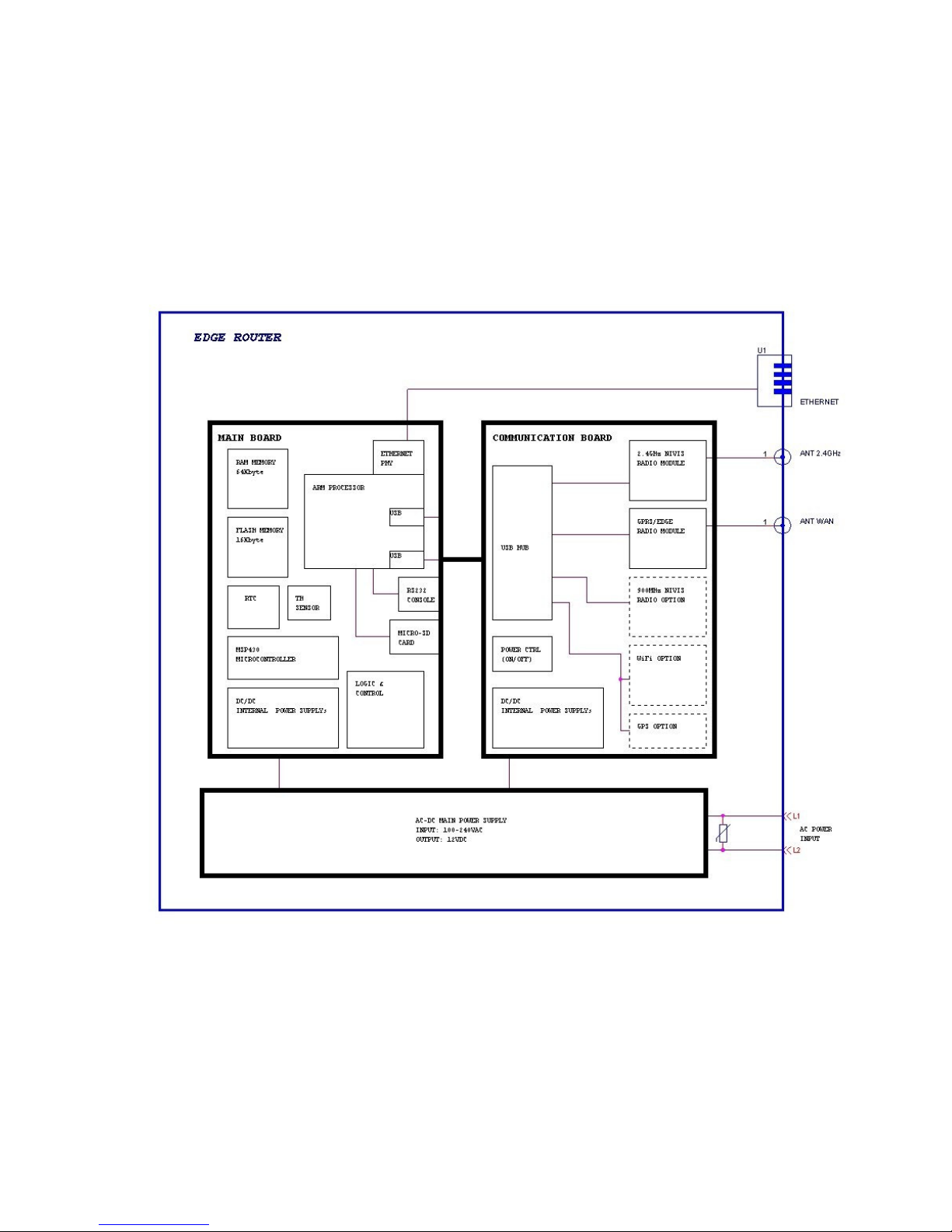
The Edge Router includes an ARM9 processor as the main processing entity that
controls most of the system features (some features are integrated internally into chip).
Subsystems controlled by the ARM processor are:
•Two directly connected serial channels. First channel is used for serial console
port used for factory programming and as debug console and is available on the
as RS232 connection. Second channel is used for intercommunication
(watchdog, commands, control and BSL mode) with the MSP430 microcontroller
that ensure system level watchdog and low power modes of operation. Also the
second channel is used for remote firmware upgrade of MSP430 code by using
the BSL mode programming mode.
•Two directly connected USB host channels. First channel is used for uplink USB
to a 4 port USB hub situated on the communication board in order to extend the
number of channels to necessary slot ports. Second channel is used for
providing the front panel USB user channel for administration via serial interface
and configuration purposes or as general USB host port for further applications.
•One Ethernet port (twisted pair port - 10/100Base-T). ARM processor implements
the Ethernet MAC internally and connects via the external PHY IC to RJ45
available connector on the main board.
•One 16-bit Data Address and Control bus for easy interfacing the memory
subsystem. Multiple chip select signals allow simple interface and multiple
methods for booting the system.
•Hardware SPI bus multiplexed for use with 2K Boot EEPROM option, micro-SD
card slot on main board for boot or storage or optional installed LCD panel.
•A large number of I/O grouped for internal control of board subsystems, for
control of power signals latch, for control of BSL programming mode of MSP430,
for implementing the I2C buses on the board. Two signals drive the Red and
Green on board LED’s.
The ARM memory subsystem is situated on the main board and includes the FLASH
memory (implemented 16Kbyte) and the two RAM memory chips (implement 2 x
32Kbyte). No buffering is included between memory and ARM processor. Boot of
system is realized from FLASH image programmed at factory. Also FLASH
accommodates the file system, application code and space for data storage. The RAM
memory is used to run the live system after boot, as temporary storage file system and
as memory allocated for system.
A set of 4 USB ports present on communication board are connected to USB-to-Serial
converters (internally) and supplemental circuitry that allow creation of slots
(communication slots) for the OEM installed communication modules. Slot powering is
controlled internally via a latch. This ensure a lot of flexibility for available power on/off
modes used in firmware.
The power supply subsystem include a 3.3V permanent power supply with low
quiescent current for MSP430 low power modes, a set of two power supply for 3.3V and
1.8V for the ARM, a 5V power supply for the USB hub and serial to USB converters and
level shifters of the communication board, one high current (up to 4A) switched power
supply for powering the OEM radio modules installed. Some extra linear regulators are