
MyEssentials ME1002-NB Manual de usuario
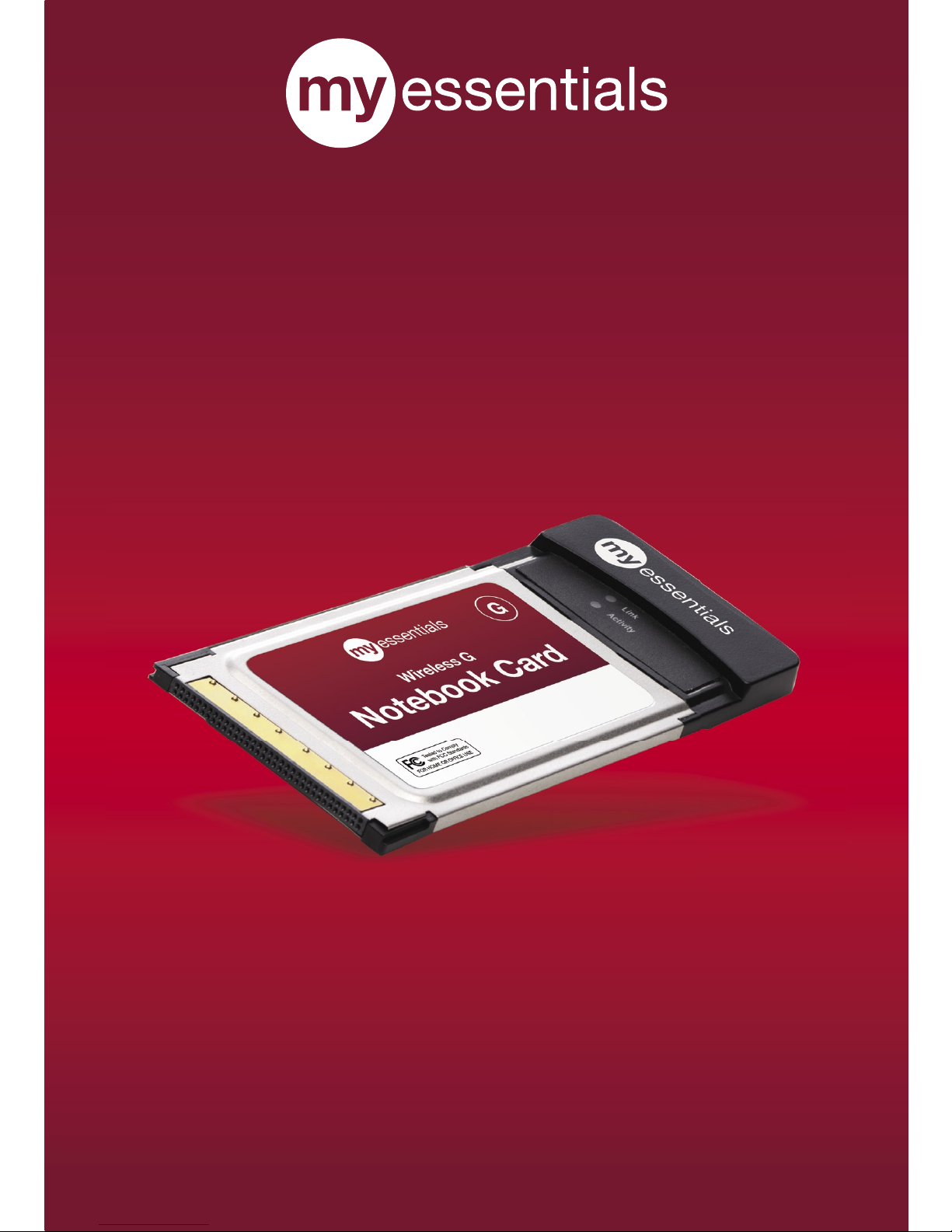
Wireless G
Notebook Card
User Manual
ME1002-NB

Table of Contents
1. Introduction. . . . . . . . . . . . . . . . . . . . . . . . . . . . . . . . . . . . . 1
Benefits of a Home Network. . . . . . . . . . . . . . . . . . . . . . . . . 1
Advantages of a Wireless Network . . . . . . . . . . . . . . . . . . . . 1
Placement of your Wireless Networking
Hardware for Optimal Performance. . . . . . . . . . . . . . . . . . . . 2
2. Overview . . . . . . . . . . . . . . . . . . . . . . . . . . . . . . . . . . . . . . . 6
Product Features . . . . . . . . . . . . . . . . . . . . . . . . . . . . . . . . . 6
Applications and Advantages . . . . . . . . . . . . . . . . . . . . . . . . 7
Product Specifications . . . . . . . . . . . . . . . . . . . . . . . . . . . . . 8
System Requirements. . . . . . . . . . . . . . . . . . . . . . . . . . . . . . 8
Package Contents . . . . . . . . . . . . . . . . . . . . . . . . . . . . . . . . 8
3. Installing and Setting up the Card . . . . . . . . . . . . . . . . . . . 9
Step 1: Install . . . . . . . . . . . . . . . . . . . . . . . . . . . . . . . . . . . . 9
Step 2: Connect . . . . . . . . . . . . . . . . . . . . . . . . . . . . . . . . . 10
Step 3: Configure . . . . . . . . . . . . . . . . . . . . . . . . . . . . . . . . 12
4. Using the MyEssentials Wireless Networking Utility. . . . 13
Accessing the MyEssentials Wireless Networking
Utility from the Windows System Tray . . . . . . . . . . . . . . . . 13
Available Networks . . . . . . . . . . . . . . . . . . . . . . . . . . . . . . . 14
Network Status and Solution Tips . . . . . . . . . . . . . . . . . . . 16
Setting Wireless Network Profiles. . . . . . . . . . . . . . . . . . . . 16
Securing your Wi-Fi Network . . . . . . . . . . . . . . . . . . . . . . . 17
Configuring your MyEssentials Wireless G Notebook
Card to use Security. . . . . . . . . . . . . . . . . . . . . . . . . . . . . . 20
5. Troubleshooting . . . . . . . . . . . . . . . . . . . . . . . . . . . . . . . . 27
6. Information . . . . . . . . . . . . . . . . . . . . . . . . . . . . . . . . . . . . 34

1
2
1
3
4
5
6
section
Introduction
Thank you for purchasing the MyEssentials Wireless G Notebook Card.
Now you can take advantage of this great new technology and gain the
freedom to network your home and office computers wirelessly. This Card
allows you to connect a notebook computer to your network. Please
be sure to read through this User Manual completely, and pay special
attention to the section entitled “Placement of your Wireless Networking
Hardware for Optimal Performance”.
Benefits of a Home Network
Your MyEssentials Home Network will allow you to:
• Share one high-speed Internet connection with all the computers
in your home
• Share resources, such as files, and hard drives among
all the connected computers in your home
• Share a single printer with the entire family
• Share documents, music, video, and digital pictures
• Store, retrieve, and copy files from one computer to another
• Simultaneously play games online, check Internet email, and chat
Advantages of a Wireless Network
Here are some of the advantages of setting up a MyEssentials
wireless network:
• Mobility – you’ll no longer need a dedicated “computer room”
—now you can work on a networked laptop or desktop computer
anywhere within your wireless range
• Easy installation – MyEssentials Easy Installation Wizards make
setup simple
• Flexibility – set up and access printers, computers, and other
networking devices from anywhere in your home
• Easy expansion – the wide range of MyEssentials networking
products let you expand your network to include devices such
as printers and gaming consoles
• No cabling required – you can spare the expense and hassle
of retrofitting Ethernet cabling throughout the home or office
• Widespread industry acceptance – choose from a wide range
of interoperable networking products

Introduction
2
Placement of your Wireless Networking Hardware
for Optimal Performance
Your wireless connection will be stronger the closer your computer is
to your wireless router (or access point). Typical indoor operating range
for your wireless devices is between 100 and 200 feet. In the same way,
your wireless connection and performance will degrade somewhat as the
distance between your wireless router (or access point) and connected
devices increases. This may or may not be noticeable to you. As you
move farther from your wireless router (or access point), connection
speed may decrease. Factors that can weaken signals simply by getting
in the way of your network’s radio waves are metal appliances or
obstructions, and walls.
If you have concerns about your network’s performance that might be
related to range or obstruction factors, try moving the computer to a
position between five and 10 feet from the wireless router (or access
point) in order to see if distance is the problem. If difficulties persist
even at close range, please contact MyEssentials Technical Support.
Note: While some of the items listed below can affect network
performance, they will not prohibit your wireless network from functioning;
if you are concerned that your network is not operating at its maximum
effectiveness, this checklist may help.
1. Placement of your Wireless Router (or Access Point)
Place your wireless router (or access point), the central connection point
of your network, as close as possible to the center of your wireless
network devices.
To achieve the best wireless network coverage for your “wireless clients,”
(i.e., computers enabled with MyEssentials Wireless Notebook Cards and
Wireless USB Adapters):
• Ensure that your wireless router’s (or access point’s) antennas are
parallel to each other, and are positioned vertically (toward the ceiling).
If your wireless router (or access point) itself is positioned vertically,
point the antennas as much as possible in an upward direction.
• In multistory homes, place the wireless router (or access point) on a
floor that is as close to the center of the home as possible. This may
mean placing the wireless router (or access point) on an upper floor.
• Try not to place the wireless router (or access point) near a cordless
2.4GHz phone.

3
2
1
3
4
5
6
section
Introduction
2. Avoid Obstacles and Interference
Avoid placing your wireless router (or access point) near devices that
may emit radio “noise”, such as microwave ovens. Other objects that can
inhibit wireless communication can include:
• Refrigerators
• Washers and/or dryers
• Metal cabinets
• Large aquariums
• Metallic-based, UV-tinted windows
If your wireless signal seems weak in some spots, make sure that objects
such as these are not blocking the signal’s path between your computers
and wireless router (or access point).
3. Cordless Phone Placement
If the performance of your wireless network is impaired after attending
to the above issues, and you have a cordless phone:
• Try moving cordless phones away from the wireless router (or access
point) and your wireless-enabled computers.
• Unplug and remove the battery from any cordless phone that
operates on the 2.4GHz band (check manufacturer’s information).
If this fixes the problem, your phone may be interfering.
• If your phone supports channel selection, change the channel on the
phone to the farthest channel from your wireless network as possible.
For example, change the phone to channel 1 and move your wireless
router (or access point) to channel 11. (Your channel selection will
vary depending on your region.) See your phone’s user manual
for detailed instructions.
• If necessary, consider switching to a 900MHz or 5GHz cordless phone.

Introduction
4
4. Choose the “Quietest” Channel for your Wireless Network
In locations where homes or offices are close together, such as apartment
buildings or office complexes, there may be wireless networks nearby
that can conflict with yours. Use the Site Survey capabilities of your
MyEssentials Wireless Networking Utility to locate any other wireless
networks, and move your wireless router (or access point) and computers
to a channel as far away from other networks as possible.
Experiment with more than one of the available channels in order to find
the clearest connection and avoid interference from neighboring cordless
phones or other wireless devices.
For more MyEssentials wireless networking products, use the detailed Site
Survey and wireless channel information included in your User Manual.
5. Secure Connections, VPNs, and AOL
Secure connections typically require a user name and password, and are
used where security is important. Secure connections include:
• Virtual Private Network (VPN) connections, often used to connect
remotely to an office network
• The “Bring Your Own Access” program from America Online (AOL),
which lets you use AOL through broadband provided by another
cable or DSL service
• Most online banking websites
• Many commercial websites that require a user name and password
to access your account
Secure connections can be interrupted by a computer’s power
management setting, which causes it to “go to sleep.” The simplest
solution to avoid this is to simply reconnect by re-running the VPN
or AOL software, or by re-logging into the secure website.

5
2
1
3
4
5
6
section
Introduction
A second alternative is to change your computer’s power management
settings so it does not go to sleep; however, this may not be appropriate
for portable computers. To change your power management setting in
Windows, see the “Power Options” item in the Control Panel.
If you continue to have difficulty with Secure Connections, VPNs, and
AOL, please review steps 1–4 in the previous pages to be sure you have
addressed these issues.
These guidelines should allow you to cover the maximum possible area
with your wireless router.
For more information regarding our networking products, visit our website at
www.MyEssentialssupport.com or call MyEssentials Technical Support at:
US: 1-866-761-4608

Overview
6
Product Features
The Card complies with the IEEE 802.11g standard in order to
communicate with other 802.11g-compliant wireless devices at 54Mbps.
The Card is compatible with all 802.11g devices as well as other 802.11b
products at 11Mbps. 802.11g products operate on the same 2.4GHz
frequency band as 802.11b Wi-Fi® products.
• 2.4GHz ISM (Industrial, Science, and Medical) band operation
• Integrated easy-to-use Wireless Configuration Utility
• CardBus interface, for operation in virtually any notebook computer
• WPA, WPA2, 64-bit WEP (Wired Equivalent Privacy),
or 128-bit encryption
• Wireless access to networked resources
• Support for both Infrastructure and Ad-Hoc (peer-to-peer)
networking modes
• Data rate of up to 54Mbps (802.11g), or 11Mbps (802.11b)
• Easy installation and use
• External antenna
• LED power and network link indicators

7
2
1
3
4
5
6
section
Overview
Applications and Advantages
• Wireless roaming with a laptop around the home or office
Offers the freedom of networking without cables
• Connection rates of up to 54Mbps
Provides immediate high-speed wireless connectivity at home,
work, and hotspot locations without compromising the use of
existing 802.11b products
• Compatibility with 802.11b products
802.11g wireless LAN solutions are backward-compatible with
existing Wi-Fi (IEEE 802.11b) products and with other products that
display the 54g™ mark
• Difficult-to-wire environments
Enables networking in buildings with solid or finished walls, or open
areas where wiring is difficult to install
• Frequently changing environments
Adapts easily in offices or environments that frequently rearrange
or change locations
• Temporary LANs for special projects or peak time
Sets up temporary networks such as at trade shows, exhibitions, and
construction sites, which need networks on a short-term basis; also
companies who need additional workstations for a peak activity period
• SOHO (Small Office/Home Office) networking needs
Provides the easy and quick, small network installation SOHO
users need

Overview
8
Product Specifications
Host Interface: 32-bit CardBus
Power Consumption: Tx/Rx peak 450/260mA @ 3.3VDC (max)
Operating Temperature: 32–185 degrees F (0–85 degrees C)
Storage Temperature: -40–194 degrees F (-40–90 degrees C)
Humidity: Max. 95% (non-condensing)
Typical Operating Range: Up to 400 ft. (231m) (wireless performance may
vary depending on the networking environment)
(a)
(c)
(b)
(a) Link LED
Lights up when the Card links to a wireless network
(b) Activity LED
Lights up when the Card is active
(c) Card Connector
Part of the Card that fits into your computer’s CardBus slot
System Requirements
• PC-compatible laptop with one available CardBus slot
• Windows® 98SE, Me, 2000, XP
Package Contents
• Wireless G Notebook Card
• Quick Installation Guide
• Installation Software CD
• User Manual
Este manual sirve para los siguientes modelos
1
Tabla de contenidos
Manuales populares de Tarjeta de red de otras marcas


3Com
3Com EtherLink 3C509B Manual de usuario

TRENDnet
TRENDnet TEG-PCITX Manual de usuario

Cisco
Cisco MC16E Manual de usuario

Delta Electronics
Delta Electronics Braking Modules VFDB Series Manual de usuario

TwinMOS
TwinMOS Booming Manual de usuario

Dialogic
Dialogic Media Board DM/V1200BTEPEQ Manual de usuario

Buffalo
Buffalo AirStation WLI-PCM-L11GP Manual de usuario

National Instruments
National Instruments NI 9234 Manual de usuario

Hama
Hama 49276 Manual de usuario

Linksys
Linksys WCF54G - Wireless-G Compact Flash Card Manual de operación

Compaq
Compaq Wireless LAN 100 Manual de usuario

Bose
Bose PowerMatch Dante Manual de usuario