Lab-Volt 8096 Manual de usuario

(732) 938-2000 / 800-LAB-VOLT, FAX: (732) 774-8573, E-MAIL: us@labvolt.com
(418) 849-1000 / 800-LAB-VOLT, FAX: (418) 849-1666, E-MAIL: ca@labvolt.com
INTERNET: http://www.labvolt.com
Model 8096 shown with optional equipment
A
Telecommunications RADAR TRAINING SYSTEM
MODEL 8096
Radar
GENERAL DESCRIPTION
The Lab-Volt Radar Training System consists of seven
subsystems (Models 8096-1 to 8096-8). Subsys-
tems 8096-1 to 8096-3 provide students with hands-on
training in the principles and operation of analog and
digital radar, as well as radar tracking systems.
Subsystem 8096-4 adds an active jamming pod trainer
to the system to train students in the principles and
scenarios of Electronic Warfare (EW).
Subsystem 8096-5 is a sophisticated pulse-mode, radar
cross-section (RCS) measurement training system with
inverse synthetic-aperture radar (ISAR) imagery
capability that is specifically designed for operation at
close range. Subsystem 8096-6 provides students with
training in the principles of electronically steered
antennas. Finally, subsystem 8096-8 introduces students
to the basic principles and operation of synthetic
aperture radar (SAR).
The Radar Training System uses patented
technology to detect and track passive targets at very
short range in the presence of noise and clutter. The
very low transmitter power allows for safe operation in a
variety of training environments.
Radar Training System Features
CActive, real-time radar system operating in a
classroom laboratory
CLow power, safe operation
CLatest technology, e.g., microstrips, Surface Mounted
Devices (SMD’s), Digital Signal Processing (DSP),
and Fast Fourier Transform (FFT)
CPulsed, continuous wave (CW) Doppler, and
frequency-modulated continuous wave (FM-CW)
modes of operation
CA-scope display output
CPlan Position Indicator (PPI) display on a computer
monitor (on-screen PPI display) with fixed-intensity,
intensity-modulated, color-modulated, and color-coded
(weather radar) display modes
CConventional PPI display capability (vector scan output)
CMoving Target Indication (MTI) processor for fixed-
target echo cancellation and clutter rejection
CSensitive Moving Target Detection (MTD) processor
that differentiates between fixed and slowly moving
targets at short range

RADAR TRAINING SYSTEM
MODEL 8096
1All student manuals, instructor guides, and user guides of the Radar Training System are optionally available as PDF files on a single CD-ROM. See Optional Equipment list in this datasheet
for the ordering number of this CD-ROM.
2
Figure 1. Radar echo of a moving target observed on an A-scope
display obtained using a conventional oscilloscope.
CSurveillance processor for Track-While-Scan (TWS)
operation
CComputer-based (i.e., on-screen) control of the radar's
processing and display functions
CComputer-based control of the clutter generation for
the study of the MTI processor functions
CHigh repeatability of hands-on manipulations ensured
through computer-based control of the clutter
generation and radar's key parameters
COn-screen block diagrams of the pulsed radar and
radar processor/display subsystem with hardware-
related (real signal) test points
CComputer-based oscilloscope for time-domain
observation and analysis of test point signals
CPowerful computer-based data monitoring system for
easy study of the first stage in the MTD processing
(FFT Doppler filtering, thresholding, and alarm
generation)
CSplit range-gate tracker
CLeading-edge range tracker
CLobe-switching angle tracker
COn-screen, O-scope display
CO-scope display output
CBuilt-in Electronic Counter-Counter Measures (ECCM)
CActive jamming pod to electronically attack the radar
tracking system
CNoise and deception jamming capabilities
CChaff cloud simulation
CRadar cross-section (RCS) measurement
CInverse synthetic-aperture radar (ISAR) imagery
capability
CPhased array antenna
COperation as a Synthetic Aperture Radar (SAR)
CHigh-resolution SAR image capability
CComprehensive courseware
CSystem level training
CModular construction
CFault-insertion capability for the teaching of
troubleshooting
CMultiple test points
CProtection against incorrect connections
The Basic Radar Training System, Model 8096-1, is
a complete set of hardware, courseware, and all
necessary accessories such as targets and
interconnecting cables that allows the principles of pulse,
CW Doppler, and FM-CW radar systems to be studied.
An oscilloscope is required for target echo visualization
on an A-scope display as well as time-domain
observation of signals at outputs and test points (the
Lab-Volt Model 797 Dual Trace Oscilloscope is
recommended).
The Basic Radar Training System consists of a
transmitter, a receiver, three instrumentation modules,
an antenna with pedestal, a target positioning system,
and a set of accessories. A comprehensive student
manual and an instructor guide, which may be ordered
separately, are also provided1. Refer to the lists of
equipment provided in this data sheet for additional
information.
(continues on page 3)
TABLE OF CONTENTS
General Description ......................... 1
Table of Contents of the Student Manuals ....... 12
ListsofEquipment ......................... 13
Additional Equipment Required to Perform
the Exercises in the Manuals ................. 14
Optional Equipment ........................ 14
Optional Equipment for Models 8096-5 and 8096-8 15
EquipmentDescriptions ..................... 15
Specifications ............................. 27
OrderingNumbers ......................... 34
1

3
Figure 2. The Basic Radar Training System, Model 8096-1
Figure 3. Example of a PPI display obtained with the Radar
Processor/Display.
Figure 4. The Radar Processor/Display, Model 8096-2
The Radar Processor/Display, Model 8096-2, is
used in conjunction with the Basic Radar Training
System, Model 8096-1, to form a complete and modern
pulse radar system. The Radar Processor/Display adds
the following elements to the Basic Radar Training
System: radar echo signal processing functions,
PPI display functions, on-screen block diagrams of the
complete radar and radar processor/display subsystem,
and computer-based (i.e., on-screen) instruments
(oscilloscope and data monitoring system). Two major
types of radar echo signal processing function are
available: Moving Target Indication (MTI) and Moving
Target Detection (MTD). The Radar Processor/Display
also provides computer-controlled generation of clutter
and interference to allow study of the MTI processing
function. The following types of clutter and interference
can be generated: sea clutter, rain clutter, second-trace
echo, noise, and pulse interference.
The Radar Processor/Display consists of a
reconfigurable training module (RTM), a power supply
for the RTM, three interface modules, a set of
accessories including the Lab-Volt Radar Training
System (LVRTS) software, two comprehensive student
manuals, and a user guide. A Windows®based host
computer (to be purchased separately) is required with
the RTM. The Lab-Volt Model 9695 Radar Host
Computer is recommended.
The RTM is the cornerstone of the Radar
Processor/Display. This module, which uses state-of-
the-art digital signal processor (DSP) technology, can be
programmed to act as either an analog pulse radar (i.e.,
a pulse radar with MTI processing) or a digital pulse
radar (i.e., a pulse radar using MTD, correlation and
interpolation, and surveillance processing). Interface
modules that students install in the RTM allow
connection of the various signals coming from the Basic
Radar Training System, as shown in Figure 5. The RTM
can also be programmed to act as a tracking radar when
used with the Radar Tracking Training System,
Model 8096-3.

RADAR TRAINING SYSTEM
MODEL 8096
4
Figure 5. Simplified connection diagram of the Basic Radar Training System and Radar Processor/Display.
The RTM processes the signals from the Basic
Radar Training System to detect targets, and sends data
to the radar host computer via a high-speed data link
(Ethernet link with TCP/IP protocol). The RTM can also
generate clutter and interference which are added to the
I- and Q-channel echo signals from the radar receiver,
before signal processing takes place. The radar host
computer, which runs the LVRTS software, uses the
data produced by the RTM to display the detected
targets on a PPI display. The LVRTS software is a
Windows®-based application2used to download
programs into the DSP memory of the RTM, to select the
type of radar which is implemented (see Figure 6). It also
has an intuitive user interface to:
Cselect the radar processing functions and adjust other
parameters of the radar, such as the video gain,
detection threshold, etc. (see Figure 7)
Ccontrol the radar display functions such as the PPI
display mode selection, Variable Range
Marker (VRM), Electronic Bearing Line (EBL), etc.
(see Figure 8)
Cdisplay diagrams that show how to connect the
equipment (see Figure 9)
Cdisplay the functional block diagrams of the complete
radar and radar processor/display subsystem (see
Figure 10)
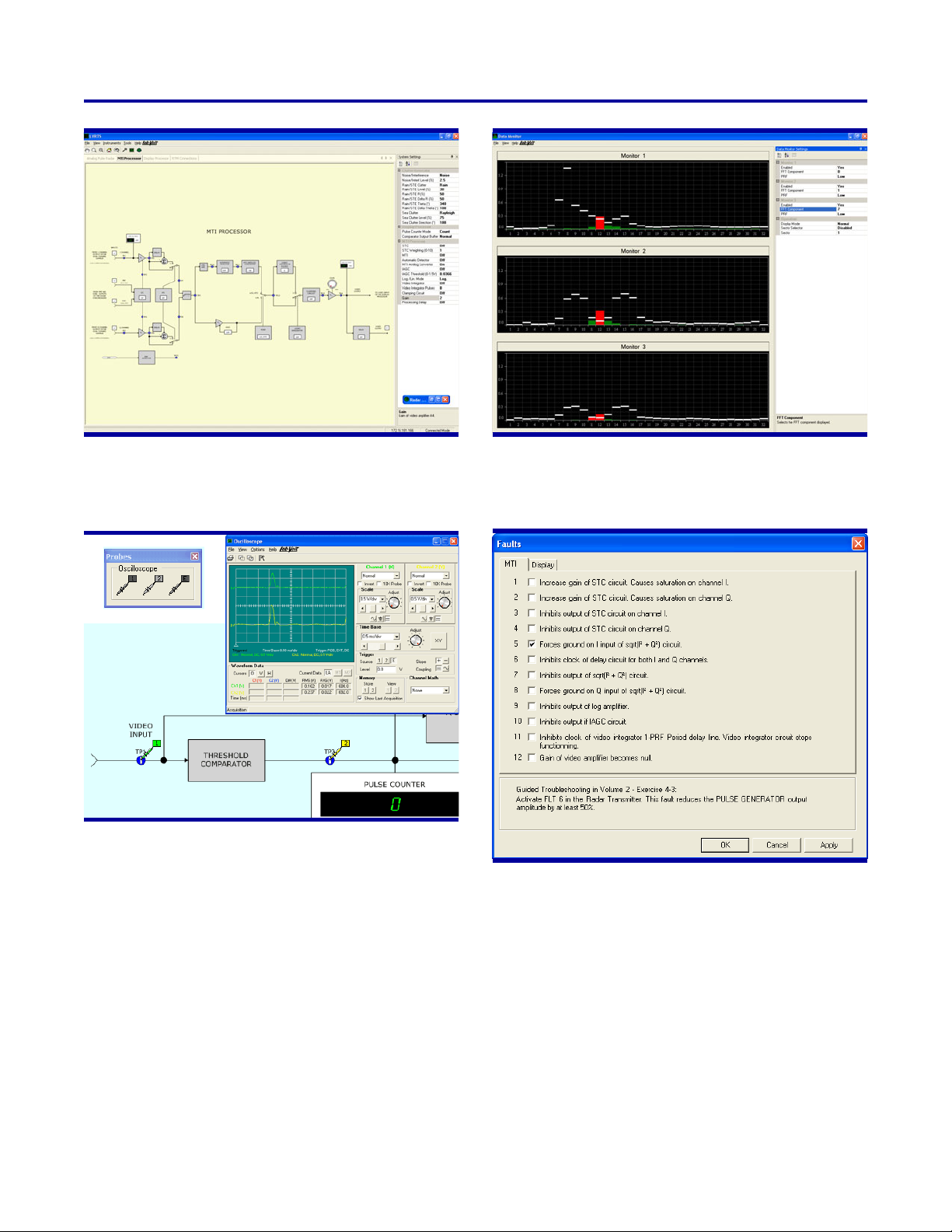
Cconnect virtual probes to test points in the
aforementioned block diagrams to observe real signals
using the built-in oscilloscope (see Figure 11)
Cuse the Data Monitor to observe and analyze the
signal processing sequence involved in Moving Target
Detection (see Figure 12)
Cinsert faults in the system (password-protected
feature) for troubleshooting purposes (see Figure 13)
Cset the parameters that control the generation of
clutter and interference (see Figure 14)
Cobtain on-line help screens (see Figure 15)
2LVRTS is compatible with the Windows®XP and Windows®7 operating systems.

5
Figure 6. On-screen selection of the type of radar which is
implemented.
Figure 7. Computer-based control of the radar processing
functions and operating parameters.
Figure 8. Computer-based control of the radar display functions.
Figure 9. Window showing the interconnections to the RTM.

RADAR TRAINING SYSTEM
MODEL 8096
6
Figure 10. On-screen block diagram of the Moving Target
Indication (MTI) processor.
Figure 11. Real signals can be observed on the built-in
oscilloscope by connecting virtual probes to test points in the on-
screen block diagrams.
Figure 12. The Data Monitor is a powerful tool designed to study
the various stages (FFT Doppler filtering, thresholding, alarm
generation) of Moving Target Detection (MTD).
Figure 13. Faults window in the LVRTS software.

7
Figure 14. Computer-based control of clutter and interference
generation.
Figure 15. On-line help screens are available through a few clicks
of the mouse button.
Figure 16. The Radar Tracking Training System, Model 8096-3.
Figure 17. Antenna replacement is quick and easy thanks to
miniature plug-in connectors in the antenna frame and antenna
pedestal's shaft.
The Radar Tracking Training System, Model 8096-3,
adds on to the pulse radar implemented with the Basic
Radar Training System and the Radar Processor/Display
(Models 8096-1 and 8096-2, respectively), to form a
continuous tracking radar. This radar can track a passive
target that moves in the classroom laboratory. The
Radar Tracking Training System includes an interface
module to be installed in the RTM of the Radar Proces-
sor/Display, a special dual-feed parabolic antenna, a
joystick-type hand controller, a set of accessories, and
a student manual.
Installation of the Radar Tracking Training System is
very simple: insert the interface module in the RTM,
modify a few connections, connect the hand controller to
a USB port of the host computer, and replace the
conventional parabolic antenna with the dual-feed
parabolic antenna. These two antennas come with a
miniature plug-in connector to facilitate replacement, as
shown in Figure 17.
The tracking radar can operate in three different
modes (Scan, Manual, and Lock), which is selected
through the hand-controller buttons. In scan mode, the
antenna rotates at constant speed, allowing observation
of targets on the PPI display. In manual mode, the
operator can isolate a fixed or moving target of his or her
choice, using the hand controller to control the antenna
beam angle and to position an electronic marker (range
gate) over the target echo signal. A computer-based
O-scope display is used to monitor the position of the

RADAR TRAINING SYSTEM
MODEL 8096
8
Figure 18. The Radar Active Target (RAT) Training System,
Model 8096-4
Figure 19. Effect of barrage noise jamming produced by the
jamming pod trainer of the RAT Training System as observed on
the Lab-Volt radar PPI display.
Figure 20. Stealth accessories in the RAT Training System allow
reduction of the jamming pod trainer’s radar cross section.
range gate relative to the echo signal of the target to be
acquired. When the range gate straddles the target echo
signal, the lock mode can be activated and the target is
automatically tracked in range and azimuth by the
system.
Range tracking is achieved by means of the split
range-gate technique, whereas angle tracking is
accomplished using lobe switching (sequential lobing).
In addition to the fully automatic tracking mode, several
useful ECCM features are available, such as a
switchable lobing rate, a range tracking rate limiter in the
range loop, manual control of either the range loop or the
azimuth loop while the system is locked onto a target,
and leading-edge range tracking. The computer-based
interface of the tracking radar allows control of these
functions and offers the same other possibilities as for
the pulse radar system (visualization of the system's
block diagrams, connection of virtual probes in the on-
screen block diagrams, observation of signals on the
built-in oscilloscope, fault insertion, etc.).
The Radar Active Target (RAT) Training System,
Model 8096-4, is used in conjunction with the three
previous subsystems (Models 8096-1, 8096-2, and
8096-3) to train students in the principles and scenarios
of EW. This is a truly unique system that places real-
time, safe, and unclassified EW demonstrations into the
hands of students. The RAT Training System consists of
an active jamming pod trainer, an elaborate set of
accessories, and a comprehensive student manual.
The jamming pod trainer is a Self-Screening Jammer
(SSJ) target that can perform direct or modulated noise
jamming (see Figure 19) as well as repeater jamming. It
includes a remote controller to select the type of
jamming and set the jamming parameters. The jamming
pod trainer and the included accessories are designed
for use with the Lab-Volt radar to implement real EW
situations. This provides an effective means of
introducing students to a real-time jamming situation that
necessitates a response, that is, the use of an
appropriate ECCM to prevent losing track of the target.
The RCS and ISAR Measurement Training System,
Model 8096-5, adds on to the Basic Radar Training
System, Model 8096-1, to form a computer-based,
pulse-mode system that can measure the radar cross
section (RCS) of targets as well as produce ISAR
images of targets (see Figures 21 to 23).

9
Figure 22. RCS pattern of a scale model of a 777 Boeing aircraft
obtained using the RCS and ISAR Measurement Training System.
Figure 23. In the ISAR imagery mode, the RCS and ISAR
Measurement Training System can produce images that show the
shape of a target (view of a 777-Boeing aircraft shown).
Figure 24. The RCS and ISAR Measurement Training System,
Model 8096-5
Figure 21. The RCS pattern of an actual aircraft can be obtained
by placing a reflective scale model on top of the low-RCS rotating
support of the RCS and ISAR Measurement Training System.
The system can generate RCS patterns of targets of
up to 75-cm (30-in) length when the longest pulse width
is used. The system can also generate high-resolution
ISAR images of much larger targets when the shortest
pulse width is used. Because the system is based on
pulse operation, it does not need to be operated in an
anechoic chamber or in an outdoor range. Background
clutter is rejected using time-gating and subtraction
techniques during the measurement process.
The RCS and ISAR Measurement Training System
includes a low-RCS target support to achieve precise
RCS measurements; a high-quality desktop computer
equipped with the necessary interface cards and
RCS measurement/ISAR imagery software; an
RCS/ISAR measurement interface module; a set of
accessories including a reflective scale model of a 777
Boeing aircraft; and a system user guide. Other
reflective scale models are optionally available. See
Optional Equipment for Models 8096-5 and 8096-8 in
this data sheet.

RADAR TRAINING SYSTEM
MODEL 8096
3The SAR Training System can also be used with the older RCS and ISAR Measurement Training System, Model 8095-5.
10
Figure 25. The Radar Phased Array Antenna Trainer, Model 8096-6
Figure 27. SAR image of a 777-Boeing aircraft reflective scale
model obtained with the SAR Training System.
Figure 26. The Radar Phased Array Antenna Trainer is fully
compatible with the Lab-Volt radar training system. It allows
sector-scan operation with no antenna motion.
The Radar Phased Array Antenna Trainer,
Model 8096-6, is specifically designed to be used with
the complete, pulse radar system that can be
implemented with the Basic Radar Training System and
the Radar Processor/Display (Models 8096-1
and 8096-2, respectively). The trainer includes a phased
array antenna, a beam-steering control module, the
necessary cables, and a comprehensive student manual
that deals with the principles of electronically steered
antennas.
Beam steering in the Radar Phased Array Antenna
Trainer is achieved using a microwave switch coupled to
a Rotman lens and microstrip tapered slot array
antennas. Beam steering control can be manual,
continuous or radar PRF dependent. Scan speeds of up
to 1080 scans/min can be achieved, thereby allowing the
PPI display (sector scan) of the radar system to be
refreshed at much higher rates than with a conventional
mechanically rotated parabolic antenna. Targets can
thus be followed in near real time.
The Synthetic-Aperture Radar (SAR) Training
System, Model 8096-8, adds on to the RCS and ISAR
Measurement Training System, Model 8096-53, to form
a synthetic aperture radar that can produce high-
resolution images (see Figures 27 to 29).
3
Tabla de contenidos
Otros manuales de Robótica de Lab-Volt
Manuales populares de Robótica de otras marcas

STEMCenter USA
STEMCenter USA Pi-Bot v2.00 Manual de usuario

SunFounder
SunFounder PiDog Manual de usuario

Universal Robots
Universal Robots UR5 Manual de usuario

Universal Robots
Universal Robots E Series Manual de usuario

YASKAWA
YASKAWA MOTOMAN-MPL80 II Manual de usuario

EFORT
EFORT ECR5 Manual de instrucciones