
InkSmith Mako Manual de usuario

LASER CUTTER USER MANUAL
CO2 LASER

2
WARNINGS
InkSmith Ltd.
44 Gaukel Street, Kitchener
Ontario, N2G 4P3
1-844-465-7684 ext. 1
www.inksmith.ca
InkSmith cannot be held responsible for any direct or indirect damages, which result from using or
working with the products electrical circuits or software described herein. The apparatus must be
used only by trained and skilled personnel. This Operation Manual must be read and followed prior to
operating the laser machine.
Furthermore, InkSmith reserves the right to change or alter any product described herein without prior
notice.
In case of failure, please check the device rst according to section 6.1 Tips for Troubleshooting. If
unsuccessful, please note all data of the device (year of manufacture, software version, etc.) and call us
from a telephone next to the switched on device.
For queries or technical problems please contact InkSmith directly at the above address.

1.0 MACHINE OVERVIEW 4
1.1 General Acknowledgments......................................................................................................4
1.2 Technical Specications..........................................................................................................5
1.3 Machine Info............................................................................................................................6
2.0 SAFETY 7
2.1 General Safety..........................................................................................................................7
2.2 Laser Safety Precautions.........................................................................................................8
2.3 Operational Safety...................................................................................................................10
2.4 Approved/Not Approved Materials...........................................................................................11
3.0 INITIAL SETUP 12
3.1 What’s Included.......................................................................................................................12
3.2 Location Considerations.........................................................................................................13
3.3 Electrical Requirements..........................................................................................................13
3.4 Exhaust Requirements............................................................................................................13
3.5 Machine Diagram....................................................................................................................14
3.6 Connecting Components........................................................................................................15
4.0 OPERATION 16
4.1 Powering Machine ON/OFF.....................................................................................................16
4.2 Calibrating the Laser...............................................................................................................16
4.3 Control System Navigation.....................................................................................................20
4.4 Preparing Files for Print..........................................................................................................22
4.5 Preparing the Machine for Work.............................................................................................33
5.0 MAINTENANCE 35
5.1 Machine Cleaning...................................................................................................................35
5.2 Maintenance Schedule...........................................................................................................37
6.0 ADDITIONAL INFO 38
6.1 Tips & Troubleshooting...........................................................................................................38
6.2 Training Completion Form......................................................................................................39
6.3 Technical Support Contact.....................................................................................................40
TABLE OF CONTENTS
3
1.1 GENERAL ACKNOWLEDGMENTS
Please read and follow this Operation Manual carefully before installation and operation of the laser
cutting machine. Damage to persons and/or material can result from not following the Operation
Manual. Operation of the machine is only permitted with consumables listed in the Approved Materials
lists.
It is extremely important that the laser cutter is only operated after the machine has be properly
adjusted. Use of the laser cutter with unapproved materials is not recommended. The manufacturer
does not admit liability for damage to personnel and/or equipment resulting from such use.
The laser cutting machine must only be operated, maintained and repaired, by personnel that are
familiar with the correct operation and dangers of the machine.
Failure to follow the operation, maintenance and repair instructions described in this Operation Manual
excludes any liability of the manufacturer if a defect occurs.
Please note, when processing conductive materials, conductive dust or particles in the air might
damage electrical components and lead to short circuits. Please note, such use is not covered in the
machine warranty.
Please retain a copy of this manual for reference.
MAKO LASER CUTTER USER MANUAL
1.0 MACHINE OVERVIEW
4

1.0 MACHINE OVERVIEW
1.2 TECHNICAL SPECIFICATIONS
5

1.0 MACHINE OVERVIEW
1.3 MACHINE INFO
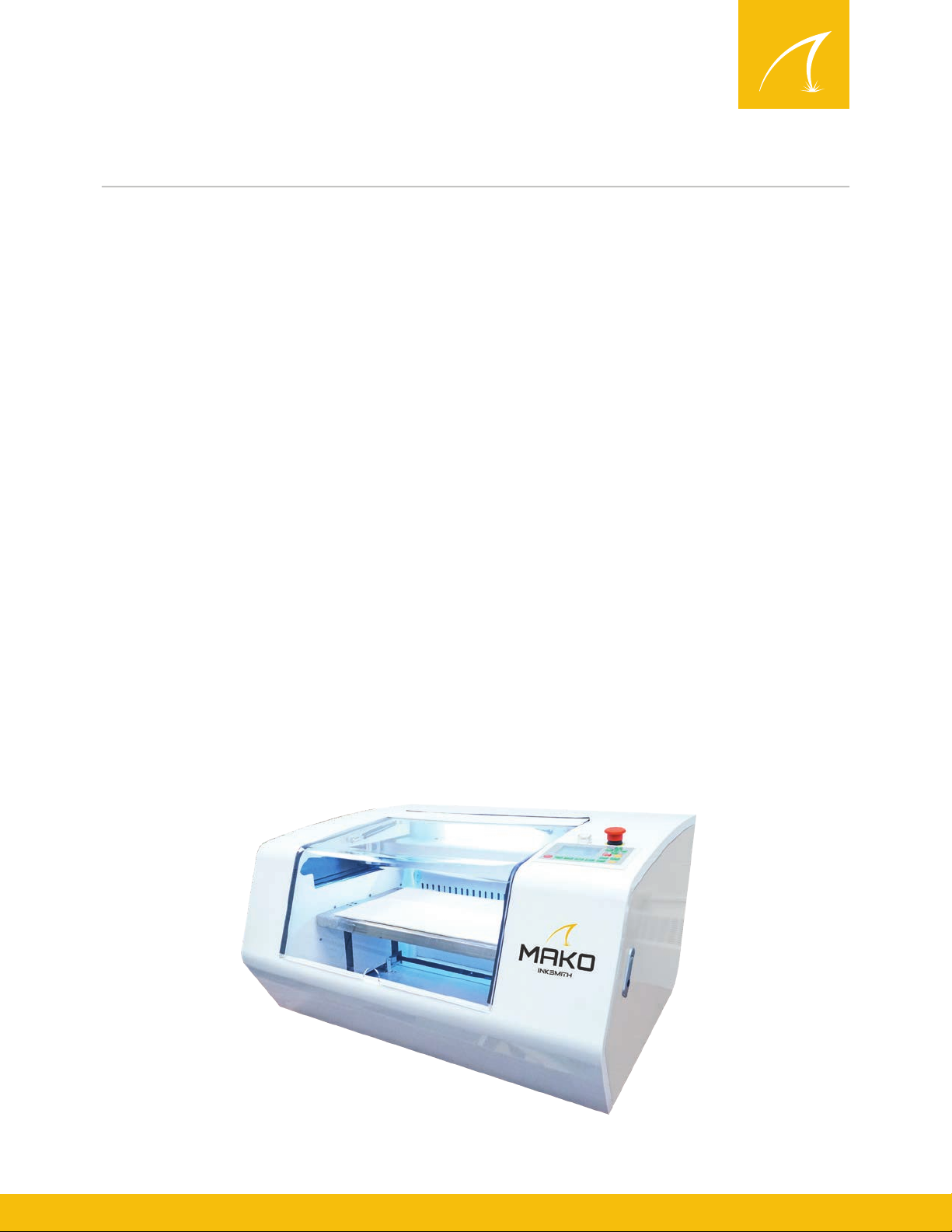
The Mako Laser Cutters are a series of high precision laser cutting machines capable of delivering
professional results quickly and eciently. The Mako Laser Cutters are able to cut and engrave on a
variety of materials including wood, cardboard, fabric, leather, and acrylic.
Information about your specic machine can be found on the Equipment Name Plate located on the
back of the laser cutting machine. This Name Plate will detail the model number, series number, input
supply, power supply, manufacturer, and factory date. Please do not change or remove the Equipment
Name Plate from the machine.
6
MACHINE INFO
SAFETY PRECAUTIONS

2.1 GENERAL SAFETY
All persons involved in the installation, set-up, operation, maintenance of the machine, must have
read and understood the Operation Manual and specically the “Safety” section. It is recommended
that organizations generate a internal qualication process for operating the laser cutting machine.
Personnel who complete laser safety training should be recognized with written proof of qualication
(see section 6.2).
To ensure the safety of all operators and performance of the laser cutting machine, only those
individuals who have read this Operation Manual may operate the laser cutting machine.
Safety Information for Operating Personnel
1. All persons involved in the installation, set-up, operation, maintenance of the machine, must have
read and understood the Operation Manual.
2. Machine operators must ensure no unauthorized individuals install, set-up, operate, maintain and/or
repair the laser cutting machine.
3. It is the duty of the operator to check the machine before operation and to immediately report
defects that may affect the safety of the machine.
4. The operator must ensure that the machine is only operated in perfect working condition.
5. Modifying or removing safety components of the laser machine will void the machine warranty and
may result in undue risk for the operator.
6. If the removal of safety components is required during the repair or service of the machine, the
replacement of the safety components must be performed immediately after completion of the
service and repair activities.
7. Preparation, retooling, maintenance and repair activities must only be performed with equipment
switched off, by trained personnel.
8. It is forbidden to perform unauthorized modications or changes to the machine.
2.0 SAFETY
7

2.0 SAFETY
2.2 LASER SAFETY PRECAUTIONS
The Mako Laser Cutter contains a powerful CO2 laser tube, which is used to cut, etch and engrave
materials on its cutting bed. Once focused, the 40W laser has sucient power to vaporize up to 6mm of
plywood in a single pass. It is a very powerful machine and should be treated as such.
For this reason, there are interlocks in place to prevent injury by shutting off the power to the
laser whenever the interlocking cover is in the open position. With the cover closed, the machine
is considered a class 2 laser (lowest hazard level), as any active beam is fully enclosed. This is a
classication that requires no special safety considerations.
WARNING: It is not only dangerous and irresponsible to over-ride or undermine a safety interlock
system, it is also an offense under the Occupational Health and Safety Act.
While this power is 100% contained within the machine during normal usage, it is possible, through the
use of keys that open access panels on the side of the machine, to become exposed to the laser beam
or radiation scattered from it. These keys should be kept in a secure location during normal laser use as
they should never be accessed by untrained personnel.
As with all types of radiation, the damage to human tissue is a result of the wavelength, the ux (the
amount of radiation impacting each square meter of tissue) and the duration of the exposure. The
invisibility of infrared radiation to the human eye means that it is impossible to detect an exposure
visually to limit one’s exposure time. As such, the rst indication of exposure to a CO2 laser beam would
be the detection of damaged tissues. Should this tissue be a cornea or retina, the damage could be
permanent and debilitating.
The beam should never be operated while the interlocking door is open, or if the interlock switch or key
on the main door is damaged or disabled in any way.
Laser Safety Information
• To assess the potential dangers laser systems pose, they are classied into 5 safety classes:
1, 2, 3a, 3b and 4. The InkSmith Mako Laser Cutter is a device of class 2 (USA: Class II). This
is guaranteed by the protective housing and the safety installations. Please note that improper
operation of the device can override the status of safety class 2 and can cause the emission of
harmful radiation.
8

2.0 SAFETY
• This laser system contains a carbon dioxide (CO2) laser source of class 4 that emits intensive and
invisible laser radiation. Without safety precautions the direct radiation or even diffuse reected
radiation is dangerous!
• Without safety precautions, the following risks exist with exposure to laser radiation:
- Eyes: Burns to the retina for NIR (Near Infra Red) LASER
- Burns to the cornea for CO2 Laser
- Skin: Burns
- Clothing: Danger of re
• Never try to modify or disassemble the laser and do not try to start up a system that had been
modied or disassembled!
• Dangerous radiation exposure can result from the use of operation or adjustment equipment
other than that described here, and if different operational methods are performed.
• Dangerous radiation exposure can result from the use of prohibited materials such as:
- blank or polished metals
- metals with very high reectivity like copper, brass, gold, silver
- any materials with highly reecting coatings
• Other highly reecting materials, especially in combination with high laser power, low
processing speed and/or work pieces with curved or inclined surfaces, laser radiation might
be reected towards the protection cover. With a very low probability this protection cover could be
damaged if the reected radiation is FOCUSED onto the surface of the protection cover. Therefore
visual inspection for point-like defects on the protection cover should be done if the aforementioned
conditions are given.
• If you detect such effects on the protection cover, immediately turn off the laser machine and
contact InkSmith to get a new protection cover.
9

2.0 SAFETY
2.3 OPERATIONAL SAFETY
As the machine fully encloses the beam and ventilation protects the user from smoke and vapours
created during operation of the machine, no special personal protective equipment is required to
operate the Laser Cutter.
However, it is mandatory to have a re extinguisher nearby at all times during operations, and that all
operations are performed under the direct supervision of a person trained in Fire Safety and the use of
re extinguishers.
Although it is not required, your organization may suggest the use of safety glasses during operation of
the laser.
Regardless of safety glasses use, do not stare directly at the bright light produced from the laser beam
when interacting with the materials it is cutting or etching.
The red dot pointer is a low power visible light laser that can run even when the loading door is open.
Never point the red dot pointer directly at any person’s eyes. Be aware of potential surface reections.
There is always a risk of re present when laser cutting combustible materials, therefore the laser is
never to be operated without direct supervision of trained personnel.
A tiny ame is normal for some materials during laser operations. Any ame that continues to burn
after the laser has moved positions is an indication that the material is on re. Such a situation must be
addressed immediately. Very small ames can be extinguished by blowing them out like a candle, or by
smothering with a suitable material. If a ame gets larger than your st, the nearest supervisor should
be notied immediately. If they use the re extinguisher, all other lab personnel must immediately
evacuate the building and the nearest pull station must be activated.
WARNING: Never leave the immediate area of the laser while it’s operating. Do not work/play on
mobile devices or read books while supervising the machine. Regular, line of sight supervision is
necessary as a re in the machine will make no sound to draw attention to the machine. Due to the
inward-drawing ventilation, there will also be no smell of smoke to indicate a re. If such a re
builds to the point where it ignites wiring, paint or plastic in the laser cutter before it is put out, it
poses an extreme danger to the operator and the entire building.
DANGER: Only trained and qualied personnel are allowed to operate the laser cutter.
10
Tabla de contenidos
Manuales populares de Instrumento de medición de otras marcas


Endress+Hauser
Endress+Hauser Proline Promag 50 Especificaciones técnicas

Siemens
Siemens SITRANS F Coriolis FCT030 Manual de lista de piezas

KLINGER
KLINGER CMF V Series Manual de usuario

EXFO
EXFO FTB-2 Manual de operación y mantenimiento

Keysight
Keysight M8290A Manual de usuario

ADTEK
ADTEK MW-5 Manual de usuario