9
3 ID Qube Series: principle of operation
3.1 Avalanche photodiodes and single-photon avalanche detectors
An avalanche photodiode (APD) is a highly sensitive semiconductor electronic device that exploits the
photoelectric effect (Figure 1) to convert light to electricity. APDs can be thought of as photodetectors
that provide a built-in first stage of gain through avalanche multiplication. By applying a high reverse
bias voltage, APDs show an internal current gain effect due to impact ionization (avalanche effect). In
general, the higher the reverse voltage the higher the gain. For APDs the reverse voltage is always
below the breakdown voltage and APDs are not sensitive enough to detect single-photons. The
breakdown voltage of a diode is the minimum reverse voltage to make the diode conduct appreciably
in reverse.
Single-Photon Avalanche Diode (SPAD) (also known as a Geiger-mode APD, photon counters, SPADs
or single-photon detectors) are a class of solid-state photodetectors with a reverse biased p-n junction
in which a photo-generated carrier can trigger an avalanche current due to the impact ionization
mechanism. SPADs are able to detect low intensity signals (down to single photons).
The fundamental difference between a SPAD and an APD is that SPADs are specifically designed to
operate with a reverse bias voltage well above the breakdown voltage (on the contrary APDs operate
at a bias voltage less than the breakdown voltage). This kind of operation is also called Geiger mode
in literature, for the analogy with the Geiger counter.
3.2 Principle of photon counting
The figure represents the I-V (current–voltage) characteristics of an APD and illustrates how single-
photon sensitivity can be achieved. This mode is also known as Geiger mode. The APD is biased, with
an excess bias voltage, above the breakdown
value VBr and is in a metastable state (point A). It
remains in this state until a primary charge
carrier is created. In this case, the amplification
effectively becomes infinite, and even a single-
photon absorption causes an avalanche
resulting in a macroscopic current pulse (point A
to B), which can readily be detected by
appropriate electronic circuitry.
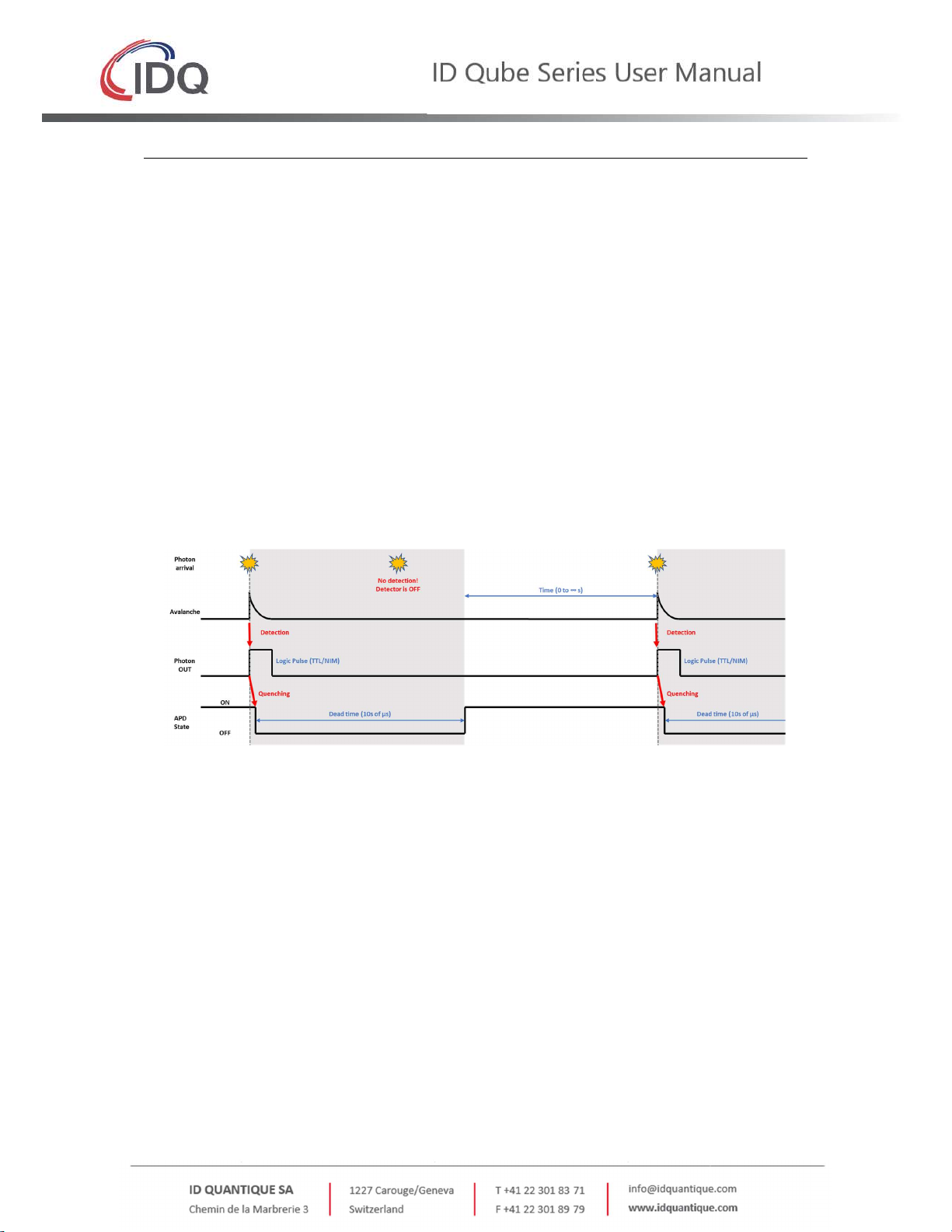
This circuitry must also limit the value of the
current flowing through the device to prevent its
destruction and quench the avalanche to reset
the device (point B to C). After a certain time, the
excess bias voltage is restored (point C to A) and the APD is again ready to detect a single photon. The
actual value of the breakdown voltage depends on the semiconductor material, the device structure
and the temperature. For InGaAs/InP APDs, it is typically around 50V. The detection efficiency but also
the noise of an APD in Geiger mode depends on the excess bias voltage.