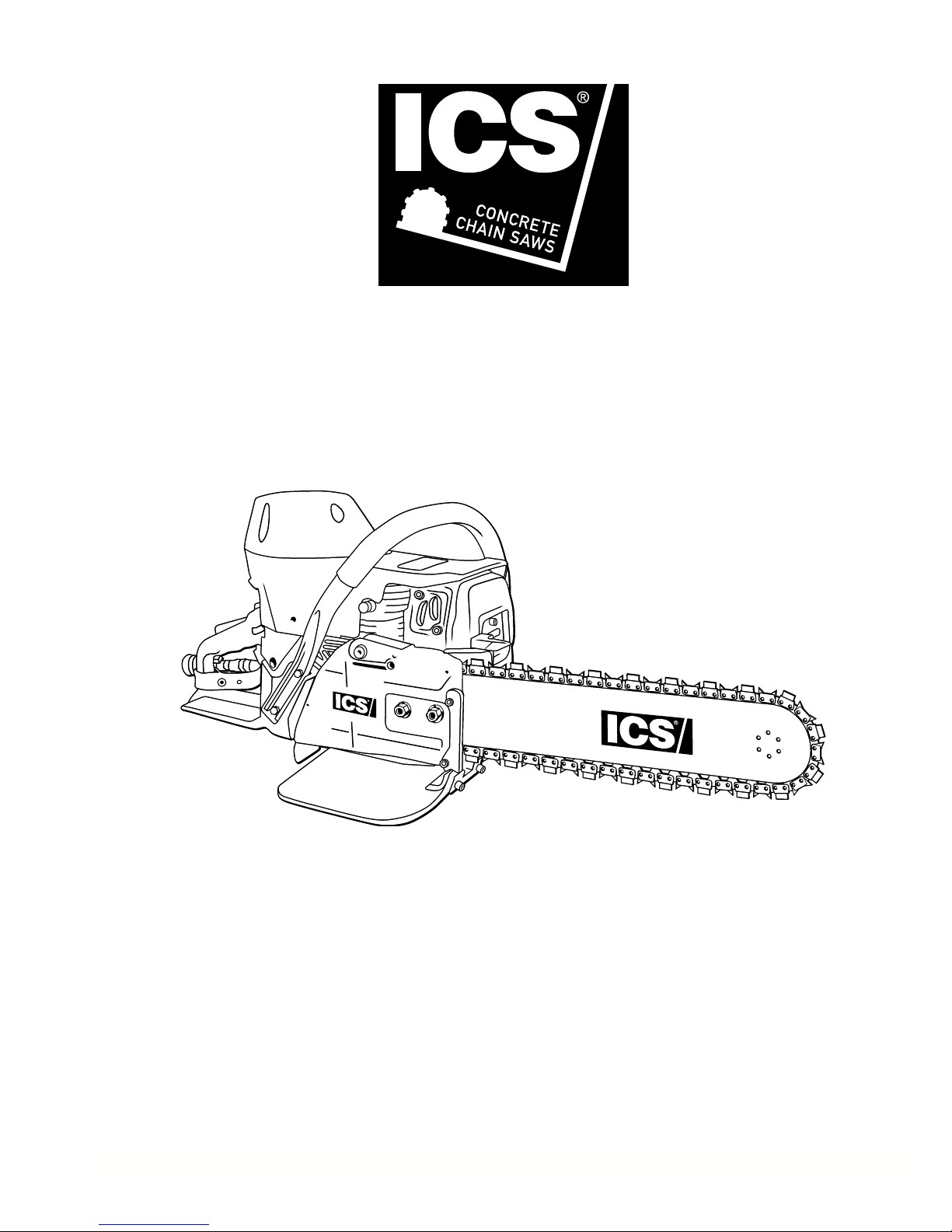
ICS 613GC Manual de usuario

© 2011 ICS, Blount International Inc. Specications are subject to change without notice. REV0511 F/N 011909
613GC
OPERATOR’S MANUAL

© 2011 ICS, Blount International Inc. Specications are subject to change without notice. REV0511 F/N 011909
TITLE 613GC OPERATOR’S MANUAL
2
TABLE OF CONTENTS
SYMBOLS & LABELS 3
SAFETY 4
TECHNICAL SPECIFICATIONS 7
SET-UP 8
OPERATION 11
MAINTENANCE 16
TROUBLESHOOTING 23
REFERENCE 24
INTRODUCTION
This manual outlines the maintenance and operation of ICS® manufactured products.
This is a professional tool and is soley intended for use by trained and experienced operators.
To get the maximum benefit from your saw, and ensure maximum safety, be sure to read this manual
thoroughly, and periodically review safety instructions.

© 2011 ICS, Blount International Inc. Specications are subject to change without notice. REV0511 F/N 011909
TITLE613GC OPERATOR’S MANUAL
3
SYMBOLS & LABELS
THE FOLLOWING SYMBOLS & DEFINITIONS ARE FOUND THROUGHOUT THIS MANUAL AND
ARE DESIGNED TO MAKE YOU AWARE OF POTENTIAL HAZARDS OR UNSAFE PRACTICES.
A potentially hazardous situation exists which, if not avoided,
could result in death or serious injury.
A potentially hazardous situation exists which, if not avoided,
may result in minor or moderate injury or property damage.
A potential situation exists which, if not avoided, may result in
product or property damage.
THE FOLLOWING SYMBOLS & LABELS MAY BE FOUND IN THIS MANUAL OR ON THE SAW
Read the operator’s manual carefully and understand the
contents before you use this equipment.
Always use:
• Protective helmet
• Ear protection
• Protective glasses or full face protection
Wear hand protection
IMPORTANT
WARNING
CAUTION

© 2011 ICS, Blount International Inc. Specications are subject to change without notice. REV0511 F/N 011909
TITLE 613GC OPERATOR’S MANUAL
4
SAFETY
WARNING
THE FOLLOWING SYMBOL APPLIES TO ALL THE ITEMS LISTED ON THIS PAGE
A potentially hazardous situation exists which, if not avoided,
could result in death or serious injury.
Diamond chain breakage can result in high-speed ejection of parts, which can result in death
or serious personal injury to operators or bystanders. The items listed below are critical to
minimizing the risk of diamond chain breakage and injury.
• DO NOT operate a diamond chainsaw with a damaged, modified, broken, or missing side
cover, bottom guard, or guard flap. The side cover, bottom guard, and guard flap provides
protection against contact with moving parts, ejected debris, broken diamond chain,
thrown water and concrete slurry.
• DO NOT operate a saw with loose, missing, damaged or improperly repaired parts.
• DO NOT insert a chain-based cut-off saw into a slot narrower than the diamond
chain segments. Rapid pushback might occur. Reference: Most diamond segments
are .225 inches (5.72 mm) wide.
• DO NOT use damaged, modified or improperly repaired diamond chain.
• DO NOT run a chain-based cut-off saw upside-down. Concrete debris can fly back into
the operator’s face.
• DO NOT cut ductile iron pipe with a chain-based cut-off saw. Segment loss or diamond
chain breakage may occur.

© 2011 ICS, Blount International Inc. Specications are subject to change without notice. REV0511 F/N 011909
TITLE613GC OPERATOR’S MANUAL
5
SAFETY
CAUTION
THE FOLLOWING SYMBOL APPLIES TO ALL ITEMS LISTED ON THIS PAGE
A potentially hazardous situation exists which, if not avoided,
may result in minor or moderate injury or property damage.
• Always turn a chain-based cut-off saw OFF when performing maintenance on the saw
including diamond chain tensioning.
• Never use equipment that is not functioning properly. Have the cut-off saw repaired by
qualified service personnel.
• Turn engine OFF before refueling. Keep away from open flame. Always provide adequate
ventilation when handling fuel. Move chain-based cut-off saw at least 10 feet (3 m) away
from refueling area before starting.
• SealPro®diamond chains require a minimum water pressure of 20 psi (1.5 bar).
Insufficient water supply may result in excessive wear to the diamond chain, which
can lead to loss of strength and diamond chain breakage.
• Never start a chain-based cut-off saw unless the guide bar,
diamond chain and side cover are properly installed.
GENERAL SAFETY PRECAUTIONS
• Always wear protective clothing, including hard hat, eye protection, hearing protection,
and gloves.
• Avoid loose fitting clothing.
• Perform safety checks before starting each day.
• Always operate tool with solid footing and with both hands on cut-off saw.
• Remove or control slurry to prevent slippery conditions while cutting.
• Be sure there are no obstructions (plumbing, electrical conduit, air ducts) and no
unnecessary people present.
• Set up a well-marked safety zone with a roped boundary and clear signs.
• Provide adequate ventilation when working in an enclosed area. Breathing exhaust gases
is dangerous.
• To avoid electrocution, check for live electrical wiring near cutting area.

© 2011 ICS, Blount International Inc. Specications are subject to change without notice. REV0511 F/N 011909
TITLE 613GC OPERATOR’S MANUAL
6
SAFETY
IMPORTANT
THE FOLLOWING SYMBOL APPLIES TO ALL ITEMS LISTED ON THIS PAGE
A potential situation exists which, if not avoided, may result
in product or property damage.
Note: The chain-based cut-off saw is equipped with a two-stroke engine and must always be
run using a mixture of gasoline and ICS®two-stroke engine oil. It is important to accurately
measure the amount of oil to be mixed to ensure that correct mixture is obtained. When
mixing small amounts of fuel, even small inaccuracies can drastically affect the ratio of
the mixture.
• This engine is designed to be operated on premium unleaded gasoline.
• Use high quality, unleaded gasoline with a minimum octane rating of 90. If lower octane
gasoline is used, engine temperature will increase which will result in a piston seizure
and damage to the engine.
• Fuel mixture: 25:1 gasoline/oil mixture. Incorrect fuel mixture is the number one cause
of piston seizure.
• Use ICS®brand two-stroke engine oil.
• Never use two-stroke oil formulated for water-cooled two-cycle engines, such as
outboard motor oil.
• Never use motor oil intended for four-stroke engines.
• Use of water is required to cool bar and chain during break-in period.
ENGINE BREAK-IN
• It is very important to break-in a new engine to “seat” all moving parts, especially the
piston rings.
• To break-in the engine, run one full tank of 25:1 fuel at idle, cycling the throttle every
5 to 10 minutes to prevent loading.
• Failure to break-in an engine may result in piston seizure.
• Failure to break-in an engine at altitude will result in 50% loss of power output for the first
hour of operation making the initial cutting experience unsatisfactory.
• Proper chain tension, especially for first cut, is extremely important. Over-tensioning of
bar and chain, especially at altitude, could result in severe loss of power output making
initial cutting experience unsatisfactory.

© 2011 ICS, Blount International Inc. Specications are subject to change without notice. REV0511 F/N 011909
TITLE613GC OPERATOR’S MANUAL
7
TECHNICAL SPECIFICATIONS
Engine Type 2-stroke Single Cylinder Air Cooled
Displacement 4.9 cu-in (80cc)
Horsepower 5.7 HP (4.2 kw) @ 9,000 RPM
Torque 37.2 in-lbs (4.2 Nm)
Engine Speed 11,500 +/- 500 rpm
2,800-3,200 rpm idle
Diamond Chain Speed In cut = 4,000 sfm
No load = 5,300 sfm
Weight 21 lbs (9.5 kg) with guide bar and
diamond chain
Cut Depth Up to 12 inches (30.5cm)
10 inches square (25.4cm)
Dimensions
18 inches (46cm) length
11.5 inches (29cm) height
10 inches (25cm) width
Air Filter Dry nylon
Carburetor Walbro WJ85B, throttle shaft sealed,
pressure compensating
Starter Dust and water shielded
Ignition Special water resistant electronic
ignition
Clutch Three-weight, single spring
Fuel ratio 25:1 gasoline-to-oil
Fuel Capacity 0.23 gal (.88 liter)
15-18 minutes run time per tank
Water Supply Minimum 20psi (1.5 bar)
Noise Level 101dB at 3 ft (1m)
Vibration Level 10.5 m/s2 (front handle)
Engine Break-in Period One tank, without cutting, cycling
throttle
Spark Plug NGK BPMR8Y

© 2011 ICS, Blount International Inc. Specications are subject to change without notice. REV0511 F/N 011909
TITLE 613GC OPERATOR’S MANUAL
8
SET- UP
STEP 1
Loosen side cover nuts and remove side
cover.
GUIDE BAR AND DIAMOND CHAIN INSTALLATION
STEP 4
Mount the diamond chain on the guide bar
starting at the drive sprocket and continue
over the guide bar nose.
STEP 2
Remove shipping spacer.
Install the diamond chain correctly.
If using a single bumper chain, the
bumper must always lead the segment
into the cut as shown here.
STEP 5
Install the side cover.
STEP 3
Place bar onto studs and chain adjustment
pin.

© 2011 ICS, Blount International Inc. Specications are subject to change without notice. REV0511 F/N 011909
TITLE613GC OPERATOR’S MANUAL
9
SET- UP
GUIDE BAR AND DIAMOND CHAIN INSTALLATION
STEP 8
All chains have a tendency to stretch
when used. Diamond chains stretch more
than wood cutting chains because of the
abrasive materials they are cutting. When
a chain stretches to a point where the drive
links are hanging approximately 1/2”
(12 mm) to 3/4” (18 mm)** below the bar,
it’s time to tension the chain. See Note 2.
STEP 7
If the chain is too loose, it could come off
the bar, or it will allow the drive sprocket to
spin without turning the chain, which can
chew up the chain drive links. If the chain
is too tight, a lot of the saw’s power goes
into turning the chain rather than into the
cut. In extreme over-tightened cases, the
saw may not be able to turn the chain at
all. In addition, damage can occur to the
bar nose and premature stretch may occur.
See Note 1.
STEP 9
Before cutting, check for proper tension by
pulling the chain around the bar by hand. If
you cannot easily pull by hand, the chain is
too tight and needs to be loosened a little.
See Note 3.
** As measured without pulling
downward (eg. hanging by gravity)
3/4" (18 mm)**
STEP 6
Make sure all the drive links are inside
the guide bar groove then lift the bar nose
and tension the chain by turning the screw
clockwise.

© 2011 ICS, Blount International Inc. Specications are subject to change without notice. REV0511 F/N 011909
TITLE 613GC OPERATOR’S MANUAL
10
SET- UP
Note 1: Be aware that the guide bar rails may develop sharp edges over time so always pull the
diamond chain by the diamond segments.
Note 2: Do not “over tension” the diamond chain. Loss of power will result. It is normal for the
drivelinks to hang underneath the guide bar. The diamond chain should be tight but be able to be
pulled around the guide bar by hand.
Note 3: To prevent chain tensioner breakage, be sure the side cover nuts are tightened to
approximately 20 ft-lbs (27Nm).
GUIDE BAR AND DIAMOND CHAIN INSTALLATION
STEP 10
Continue to lift up on the nose of the guide
bar and firmly tighten the side cover nuts.
NOTE: To prevent chain tensioner
breakage, be sure the side cover nuts
are tightened to approximately 20 ft-lbs
(27 Nm).
STEP 11
Attach to water source with pressure of not
less than 20 psi (1.4 bar).
Otros manuales para 613GC
5
Tabla de contenidos
Otros manuales de Sierra de ICS

ICS
ICS 660GC Manual de usuario

ICS
ICS 633GC Manual de usuario

ICS
ICS SpeedHook 853PRO Manual de usuario

ICS
ICS 603GC Manual de usuario

ICS
ICS SpeedHook 823H Manual de usuario

ICS
ICS 613GC Manual de usuario

ICS
ICS 680GC Manual de usuario

ICS
ICS SpeedHook 814PRO Manual de usuario

ICS
ICS 613GC Manual de usuario

ICS
ICS 701A Manual de usuario