
ICS Schneider Messtechnik A43 Manual de usuario

ES
FR
DE
EN
Bimetal thermometers
for heating, ventilation and air-conditioning
Bimetall-Thermometer
für Heizungs-, Klima- und Lüftungstechnik
Thermomètres bimétalliques
pour le chauffage, la ventilation et la climatisation
Termómetros bimetálicos
para la calefacción, ventilación y climatización
Model A43
Model A48
Model E45
Model A50
Model A46
Model A51

ES
FR
DE
EN
2
11484498.03 07/2017 EN/DE/FR/ES
WIKA operating instructions bimetal thermometers for HVAC
Operating instructions bimetal thermometers Page 3 - 22
Betriebsanleitung Bimetall-Thermometer Seite 23 - 42
Mode d'emploi thermomètres bimétalliques Page 43 - 62
Manual de Instrucciones de termómetros
bimetálicos Página 63 - 81

3
11484498.03 07/2017 EN/DE/FR/ES
WIKA operating instructions bimetal thermometers for HVAC
EN
Contents
1. General information 4
2. Design and function 5
3. Safety 6
4. Transport, packaging and storage 9
5. Commissioning, operation 10
6. Faults 15
7. Maintenance and cleaning 16
8. Dismounting, return and disposal 17
9. Specifications 18
Contents

4WIKA operating instructions bimetal thermometers for HVAC
11484498.03 07/2017 EN/DE/FR/ES
EN
1. General information
1. General information
■
The bimetal thermometers described in the operating instructions have been
manufactured using state-of-the-art technology. All components are subject to stringent
quality and environmental criteria during production. Our management systems are
certified to ISO 9001 and ISO 14001.
■
These operating instructions contain important information on handling the instrument.
Working safely requires that all safety instructions and work instructions are observed.
■
Observe the relevant local accident prevention regulations and general safety
regulations for the instrument's range of use.
■
The operating instructions are part of the product and must be kept in the immediate
vicinity of the instrument and readily accessible to skilled personnel at any time. Pass
the operating instructions on to the next operator or owner of the instrument.
■
Skilled personnel must have carefully read and understood the operating instructions
prior to beginning any work.
■
The general terms and conditions contained in the sales documentation shall apply.
■
Subject to technical modifications.
■
Further information:
- Relevant data sheet: TM 43.01 (model A43)
TM 45.02 (model E45)
TM 46.02 (model A46)
TM 48.01 (model A48)
TM 50.03 (model A50)
TM 51.01 (model A51)
5
11484498.03 07/2017 EN/DE/FR/ES
WIKA operating instructions bimetal thermometers for HVAC
EN
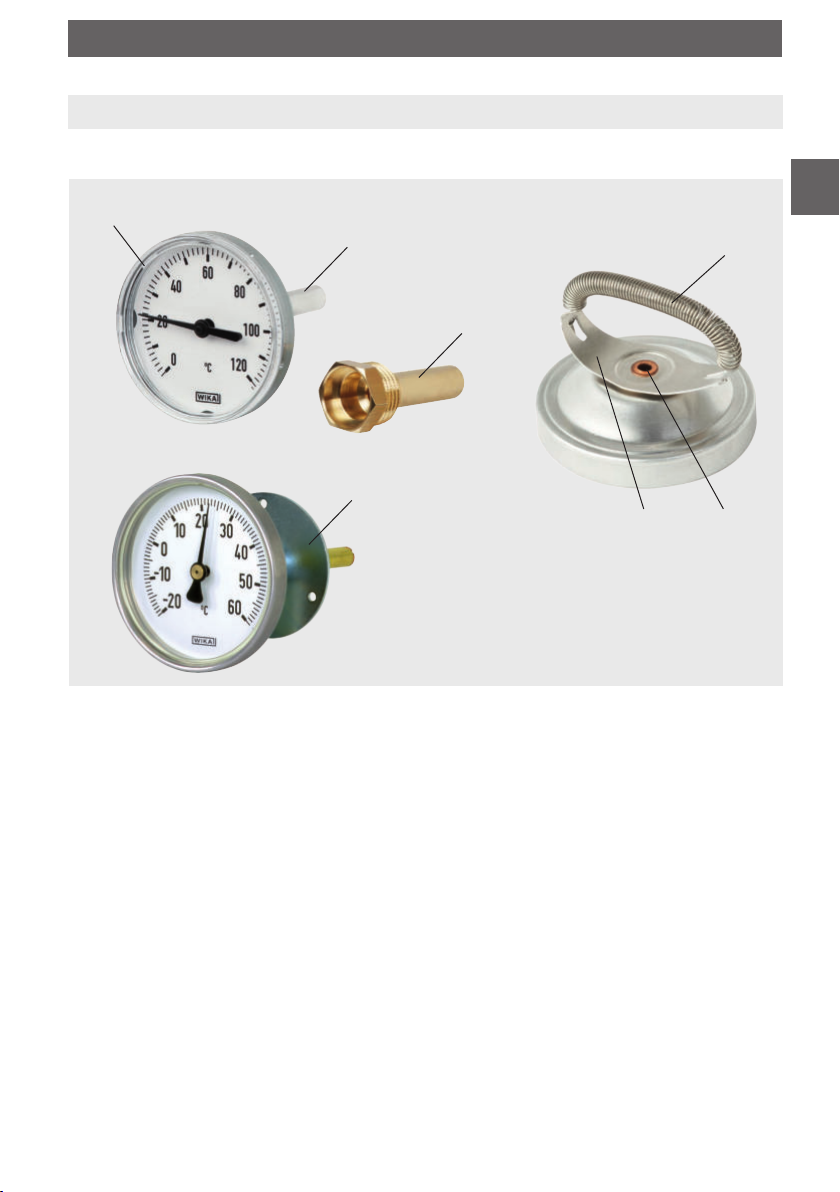
2. Design and function
2. Design and function
2.1 Overview (example)
Case and dial
Stem
Thermowell
Mounting flange
Mounting clip
Temperature sensor
Attachment plate
2.2 Description
The bimetal thermometers described here are used for simple temperature indication,
predominantly in the heating, ventilation and air-conditioning industry.
Bimetal thermometers utilise the different properties of two metals for temperature
measurement.These are in the form of thin metal strips laid on top of each other.The
design of these thermometers is very simple.The combined metal strips are arranged
around a pointer in a spiral. On a change, the bimetal moves the pointer and indicates the
temperature on a scale.
Model A46.11, contact probeModel A43
Model A48

6WIKA operating instructions bimetal thermometers for HVAC
11484498.03 07/2017 EN/DE/FR/ES
EN
2. Design and function / 3. Safety
The models A43, E45, A46, A50 and A51 are particularly suited to application in heating
technology.
For applications in ventilation and air-conditioning, the models A48 and A51 are available.
2.3 Scope of delivery
Cross-check scope of delivery with delivery note.
Depending on the instrument version, the instrument can be delivered with loose
accessory components (e.g. thermowell, mounting flange, mounting clip).
3. Safety
3.1 Explanation of symbols
WARNING!
... indicates a potentially dangerous situation that can result in serious injury
or death, if not avoided.
CAUTION!
... indicates a potentially dangerous situation that can result in light injuries or
damage to equipment or the environment, if not avoided.
WARNING!
... indicates a potentially dangerous situation that can result in burns, caused
by hot surfaces or liquids, if not avoided.
Information
... points out useful tips, recommendations and information for efficient and
trouble-free operation.
3.2 Intended use
The bimetal thermometers are mainly used in heating, air-conditioning and refrigeration
equipment to monitor the process temperature.
The models A43, A46, A50 and A51 are used for temperature measurements on liquid and
gaseous media with the use of a suitable thermowell.
Max. permissible operating pressure at thermowell: 6 bar

7
11484498.03 07/2017 EN/DE/FR/ES
WIKA operating instructions bimetal thermometers for HVAC
EN
3. Safety
Model A46.11 is suitable for the measurement of pipe surface temperatures.
The models A48 and A51 are used in refrigeration and air-conditioning technology for
measuring the temperature in air ducts. They are only suitable for the measurement of
gaseous, non-hazardous and also non-pressurised media.
When installing, commissioning and operating these instruments, observe the appropriate
national safety regulations.
The instruments are not approved for use in hazardous areas!
The instruments are not suitable for outside use and must be protected from direct sunlight
and moisture.
The instruments have been designed and built solely for the intended use described here,
and may only be used accordingly.
The technical specifications contained in these operating instructions must be observed.
Improper handling or operation of the instrument outside of its technical specifications
requires the instrument to be taken out of service immediately and inspected by an
authorised WIKA service engineer.
The manufacturer shall not be liable for claims of any type based on operation contrary to
the intended use.
3.3 Improper use
WARNING!
Injuries through improper use
Improper use of the instrument can lead to hazardous situations and injuries.
▶
Refrain from unauthorised modifications to the instrument.
▶
Do not use the instrument within hazardous areas.
▶
Do not use the instrument with abrasive or viscous media.
Any use beyond or different to the intended use is considered as improper use.
Do not use this instrument in safety or emergency stop devices.

8
EN
3.4 Responsibility of the operator
The instrument is used in the industrial sector.The operator is therefore responsible for
legal obligations regarding safety at work.
The safety instructions within these operating instructions, as well as the safety, accident
prevention and environmental protection regulations for the application area must be
maintained.
To ensure safe working on the instrument, the operating company must ensure
■
that suitable first-aid equipment is available and aid is provided whenever required.
■
that the operating personnel are regularly instructed in all topics regarding work safety,
first aid and environmental protection and know the operating instructions and in
particular, the safety instructions contained therein.
■
that the instrument is suitable for the particular application in accordance with its
intended use.
■
that personal protective equipment is available.
3.5 Personnel qualification
WARNING!
Risk of injury should qualification be insufficient!
Improper handling can result in considerable injury and damage to equipment.
▶
The activities described in these operating instructions may only be carried
out by skilled personnel who have the qualifications described below.
Skilled personnel
Skilled personnel, authorised by the operator, are understood to be personnel who, based
on their technical training, knowledge of measurement and control technology and on
their experience and knowledge of country-specific regulations, current standards and
directives, are capable of carrying out the work described and independently recognising
potential hazards.
Special operating conditions require further appropriate knowledge, e.g. of aggressive
media.
3. Safety

9
11484498.03 07/2017 EN/DE/FR/ES
WIKA operating instructions bimetal thermometers for HVAC
EN
4. Transport, packaging and storage
4.1 Transport
Check the instrument for any damage that may have been caused by transport.
Obvious damage must be reported immediately.
CAUTION!
Damage through improper transport
With improper transport, a high level of damage to property can occur.
▶
When unloading packed goods upon delivery as well as during internal
transport, proceed carefully and observe the symbols on the packaging.
▶
With internal transport, observe the instructions in chapter 4.2 “Packaging
and storage”.
If the instrument is transported from a cold into a warm environment, the formation of
condensation may result in instrument malfunction. Before putting it back into operation,
wait for the instrument temperature and the room temperature to equalise.
4.2 Packaging and storage
Do not remove packaging until just before mounting.
Keep the packaging as it will provide optimum protection during transport (e.g. change in
installation site, sending for repair).
Permissible conditions at the place of storage:
■
Storage temperature: -20 ... +60 °C
■
Humidity: 35 ... 85 % relative humidity (non-condensing)
Avoid exposure to the following factors:
■
Direct sunlight or proximity to hot objects
■
Mechanical vibration, mechanical shock (putting it down hard)
■
Soot, vapour, dust and corrosive gases
■
Hazardous environments, flammable atmospheres
Store the instrument in its original packaging in a location that fulfils the conditions listed
above. If the original packaging is not available, pack and store the instrument as described
below:
1. Wrap the instrument in a plastic film.
2. Place the instrument, along with shock-absorbent material and the stem protector (if
accompanying), in the packaging.
3. If stored for a prolonged period of time (more than 30 days), place a bag containing a
desiccant inside the packaging.
4. Transport, packaging and storage

10
EN
5. Commissioning, operation
5. Commissioning, operation
Personnel: Skilled personnel
Tools: Open-ended spanner (SW 21), slot-type screwdriver
WARNING!
Physical injuries and damage to property and the environment caused
by hazardous media
Upon contact with hazardous media, harmful media (e.g. corrosive, toxic,
carcinogenic), and also with refrigeration plants and compressors, there is a
danger of physical injuries and damage to property and the environment.
Aggressive media with extremely high temperatures and under high pressure
or vacuum may be present at the instrument.
▶
For these media, in addition to all standard regulations, the appropriate
existing codes or regulations must also be followed.
Examine the packaging material carefully so that no accessories that might
be packed within are lost and check whether the required accessories -
depending on the case mounting type - are present (see chapter 2.3 “Scope
of delivery”).
5.1 Thermowell
(not with models E45.10, A46.11, A48.10 and A51)
CAUTION!
Damage as a result of improper installation
If, when fitting, the instrument, the torque required for this is applied to the
case, then this can lead to the damage of the thermometer.
▶
When installing with a thermowell, this should be tightened via the spanner
flats provided for this and using a suitable open-ended spanner.
Before installing, check whether the material used (specified in the delivery note) is
chemically resistant/neutral against the medium being measured.
Este manual sirve para los siguientes modelos
5
Tabla de contenidos
Idiomas:
Otros manuales de Termómetro de ICS Schneider Messtechnik


