5Parker Hannifin Corporation
Helac/Cylinder Division
Enumclaw, Washington USA
www.helac.com
Helical, Hydraulic Rotary Actuators
L10 Series Service & Repair Manual
Catalog HY34-3000
Theory of Operation
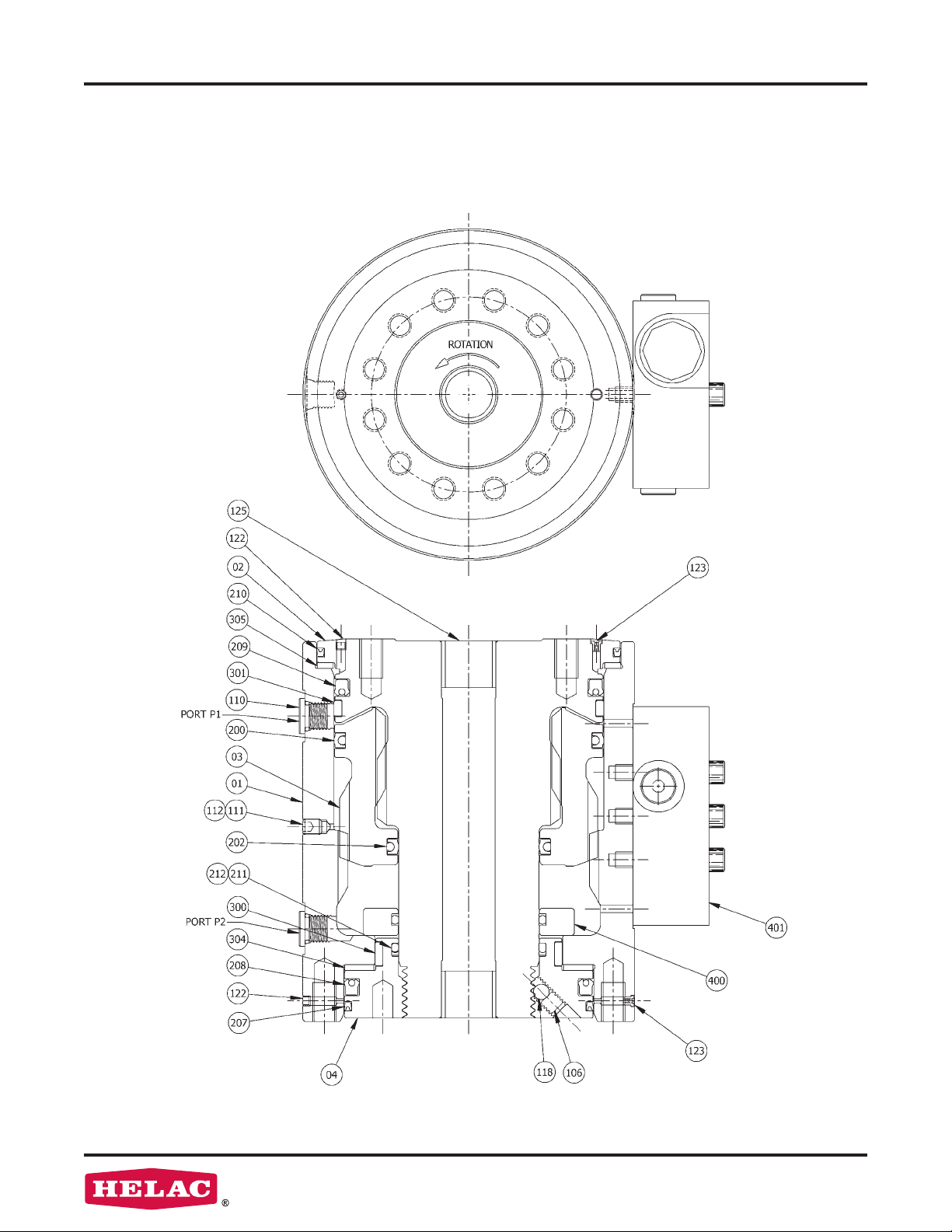
The L10 Series rotary actuator is a simple mechanism
that uses Helac's sliding spline technology to convert
linear piston motion into powerful shaft rotation. Each
actuator is composed of a housing with an integral ring
gear (1) and only two moving parts: the central shaft
with an integrated bearing and mounting ange (2), and
the annular piston sleeve (3).
Helical spline teeth machined on the shaft engage
matching splines on the inside diameter of the piston.
The outside diameter of the piston carries a second set
of splines, of opposite hand, which engage the matching
splines of the housing's ring gear.
As hydraulic pressure is applied, the piston is displaced
axially within the housing - similar to the operation of
a hydraulic cylinder - while simultaneously, the splines
cause the shaft to rotate. When the control valve is
closed, oil is trapped inside the housing, preventing
piston movement and locking the shaft rmly in position.
The shaft is supported radially by the large upper
radial bearing and the lower radial bearing. Axially, the
shaft is separated from the housing by the upper and
lower thrust washers. The end cap is adjusted for axial
clearance and locked in position by set screws or pins.
Bars indicate starting positions of
piston and shaft. Arrows indicate
direction they will rotate. The
housing with integral ring gear
remains stationary. For clarity, the
shaft ange, bearings, and end
cap are not shown.
Applying uid pressure will
displace the piston axially while the
helical gearing causes the piston
and shaft to rotate simultaneously.
The double helix design
compounds rotation: shaft rotation
is about twice that of the piston.
Applying pressure to the opposite
port will return the piston and shaft
to their original starting positions.
3
2
1
Theory of Operation