
Elseta IOMOD 8DI8DO Manual de usuario

ELSETA
IOmod 8DI8DO
User manual for IEC 60870-5-103 protocol
Elseta
4/17/2019
V1.1

IOmod 8DI8DO
4/17/2019
V1.1 | ELSETA | Introduction
2
TABLE OF CONTENTS
1 Introduction .................................................................................................................................................. 5
1.1 Features .................................................................................................................................................. 5
2 Operational information .............................................................................................................................. 5
2.1 IEC 60870-5-103 working information ................................................................................................. 5
2.1.1 Initialization .................................................................................................................................. 5
2.1.2 Data polling ................................................................................................................................... 5
2.1.3 Output control .............................................................................................................................. 6
2.1.4 Input messages .............................................................................................................................. 6
2.1.5 Time synchronization ................................................................................................................... 6
2.1.6 General interrogation .................................................................................................................... 6
2.2 Device configuration ............................................................................................................................. 6
2.2.1 Input inversion and polarity selection ......................................................................................... 6
2.2.2 Input / Output grouping .............................................................................................................. 6
2.2.3 Input filter ...................................................................................................................................... 8
2.2.4 Output pulse time ......................................................................................................................... 8
2.2.5 Output detection with inputs ...................................................................................................... 9
2.2.6 Addressing configuration ............................................................................................................ 10
3 Testing with “THE VINCI” software ........................................................................................................... 10
4 Technical information ................................................................................................................................. 12
5 Mounting and installation guide ................................................................................................................ 13
5.1 IOmod 8DI8DO RS485 interface ........................................................................................................ 13
5.2 IOmod 8DI8DO inputs ........................................................................................................................ 13
5.3 IOmod 8DI8DO outputs ..................................................................................................................... 14
6 Configuration over USB ............................................................................................................................... 15
6.1 Driver installation ................................................................................................................................ 15
6.2 IOmod configuration with PuTTY terminal ...................................................................................... 16
6.3 Main Menu .......................................................................................................................................... 19
6.4 Protocol simulator .............................................................................................................................. 20
6.5 Firmware upgrade over USB .............................................................................................................. 20
7 Information about the equipment manufacturer ..................................................................................... 22
8 Document history ....................................................................................................................................... 23

IOmod 8DI8DO
4/17/2019
V1.1 | ELSETA | Introduction
3
COPYRIGHTS AND TRADEMARKS
Elseta is a trademark of UAB Elseta and identifies products manufactured by UAB Elseta. All of the
product copyrights belong to UAB Elseta. These documents and product properties cannot be changed
without the knowledge and written consent of UAB Elseta. This document may be modified by UAB Elseta
without additional notice.
DECLARATION OF CONFORMITY
(in accordance with ISO / IEC Guide 22 and EN Section 45014)
Manufacturer: UAB Elseta
Address of the manufacturer L. Zamenhofo g. 3 LT Vilnius, Lithuania
We claim that:
The device IOmod 8DI8DO
Conforms to the following standards:
EMC:
Radiation EN 55022 (Class A)
1 emitted radiation (30-1000MHz)
Second radiation conductors (0.15-30MHz)
EN 50082-1 Immunity test
1 IEC 801-3: Radio-frequency electromagnetic field
2 IEC 801-2: Electrostatic discharge.
3 IEC 801-4: Quick periodic electrostatic discharges
Additional information:
The device complies with the Low Voltage Directive 73/23 / EEC and EMC Directive 89/336 / EEC.
Device assembly complies with the RoHS Directive.

IOmod 8DI8DO
4/17/2019
V1.1 | ELSETA | Introduction
4
SAFETY REQUIREMENTS
Equipment’s operating notes must be met for your personal safety, as well as to avoid damage to the
equipment. These notes are marked with a warning triangle symbol and the various degrees of risk of
falling within signs. All work related to electronic systems design, installation, commissioning, adjustment
and maintenance should be carried out in accordance with the safety requirements.
USED SYMBOLS
Danger - important notice, which may affect the safety of the user or device.
Attention - notice on possible problems that may arise in individual cases.
Information Notice - the information that is useful advice or special places.
Equipment installation, commissioning and maintenance may only be
performed by a qualified professional authorized to perform commissioning,
grounding and labelling for devices, systems and circuits. The person must
be aware of occupational safety in the workplace, understand the equipment
components and have the knowledge and skills to operate high voltage
equipment.
Always turn off the power supply before installation or maintenance. It must
be in mind that equipment can have a common ground connection even when
turned off. Always check power supply, cables and interconnected
components before reconnection.
This product cannot be implemented or resold to install in areas that are
regarded as high-security such as nuclear power plants, aircraft navigation,
military equipment, transport traffic management – areas where equipment
failure can result in a nature or human injury.
Do not operate the equipment in extreme weather conditions as they may
affect the operation of the equipment.

IOmod 8DI8DO
4/17/2019
V1.1 | ELSETA | Introduction
5
1 INTRODUCTION
IOmod 8DI8DO is a small size stand-alone Modbus RTU or IEC 60870-5-103 digital input and digital
output controller (protocol depends on firmware). IOmod can be used for industrial applications, where
digital signalling is used and robust communication is needed. IOmod is an ideal solution for applications
such as data acquisition, control, process monitoring at remote places. This user manual is written for
IEC 60870-5-103 protocol firmware version.
1.1 FEATURES
• 8 digital inputs;
• Configurable active input signal polarity or input inversion;
• 8 digital open collector outputs;
• Galvanically isolated inputs and outputs;
• Pulsed or latched mode for individual outputs;
• Possible output feedback measurement with inputs;
• Configuration over USB console;
• Values with data and time information;
• Time synchronization over IEC-60870-5-103;
• Drag and Drop firmware upgrade over USB mass storage;
• Modbus RTU, IEC-60870-5-103 communication over RS485;
• Software-selectable line termination resistor on RS485;
• LED indication for input/output and data transmission;
• Easy integration with WCC Lite gateway and CloudIndustries.eu platform;
2 OPERATIONAL INFORMATION
IOmod 8DI8DO uses Modbus RTU or IEC 60870-5-103 protocol to communicate with master device over
RS485 interface. Protocol used by device can be changed by uploading corresponding firmware. Default
communication settings are: 9600 baud rate, 8N1, Link address – 1.
IOmod 8DI8DO configuration can be changed over USB interface with terminal console like PuTTY or
similar.
2.1 IEC 60870-5-103 WORKING INFORMATION
2.1.1 Initialization
IOmod uses a standard IEC-60870-5-103 communication scheme. Initiation, control messages
and queries are initiated by the master (controlling station), while IOmod device (controlled station) only
answers these requests. Therefore, the first message should be sent by master to start/restart
communication (RESET CU or LINK RESET FCB). This message is answered by IOmod with an
acknowledgement (ACK) to enable master to proceed with sending other messages defined by IEC-
60870-5-103 protocol. Other messages are ignored until a successful initialization has taken place.
2.1.2 Data polling
When initialization is complete, master may poll IOmod device with both Class 1 and Class 2 requests.
Class 2 is used when master polls for a cyclic data. Controlled device answers with a message containing
Access Demand flag when spontaneous data exists and master then sends request for Class 1. IOmod
would then respond with time-tagged message.

IOmod 8DI8DO
4/17/2019
V1.1 | ELSETA | Operational information
6
On first Class 1 request IOmod device always asks for the Access Demand to send an identification
string. However, if there are spontaneous messages to be sent, they will be sent before the identification
string.
2.1.3 Output control
To control device outputs master (controlling station) sends command conforming to the IEC-60870-5-
103 protocols. It should contain output address which is 128 by default. Info number represents number
of output pin, while info elements shows DPI information of output state (1 – off, 2 – on, 0 - intermediate
and 3 – not used (defines error)). Successful command is accepted with a positive acknowledge.
Negative acknowledge is returned if the output is already set or if another command for the same output
is already in progress and hasn’t finished yet.
2.1.4 Input messages
When input status changes, IOmod device filters input glitches through filters with a user configurable
filter time. When the filter is passed device sends “Spontaneous” message with “Function type” as input
address (default function type of inputs – 160), and “Info number” as input pin number. Please note that
spontaneous messages are answered with a four-byte time structure not containing date info. Controlling
station should therefore be able to handle the signals sent before the start of a new day.
2.1.5 Time synchronization
To initiate the time synchronization between devices master must send variable frame, with function code
“User data with ACK”, ASDU type “6” and Cause of Transmission “8”. Info elements must contain the 7-
byte time structure.
As per IEC-60870-5-103 protocol specification time synchronization can be completed for multiple
devices using broadcasting messages. It is included in IEC-60870-5-103 firmware since version 1.7.3.
To broadcast time synchronization message, link address should be equal to 255.
2.1.6 General interrogation
General Interrogation (GI) is initiated by the master with variable frame, including function code “3” (User
data with ACK), ASDU type “7” and Cause of Transmission “9”. Slave device then responds with an
acknowledgement (ACK). Master gets GI data by polling with Class 2 request till slave transmits “End of
GI” (Cause of Transmission – “10”). IOmod device responds with a time-tagged message, including DPI
states of inputs and outputs (Outputs are sent first). Output and input numbers are represented by “Info
number” in protocol.
2.2 DEVICE CONFIGURATION
2.2.1 Input inversion and polarity selection
When active low signalling is needed, user can configure input polarity. When internal pull-up resistors
are turned on, all input statuses are turned on. When low signal is connected to input, status of that input
is turned off. If user desires to turn input status on, when that input signal is low, user then inverts inputs
logically. All input indication LED’s stay the same (are not inverted).
2.2.2 Input / Output grouping
Sometimes two inputs or two outputs must be captured as one DPI input or output. Inputs and outputs
can be grouped into the pairs of two. This allows outputs to be controlled by one DPI command (of
address of first output in the group). Only two neighbour pins can be grouped into pair, while first pin in
pair must be an odd number pin. When grouped, second pin in the pair is not used anymore – all requests
for this pin generate an error. For example – OUT1 and OUT2 can be grouped, after that OUT2 is not
IOmod 8DI8DO
4/17/2019
V1.1 | ELSETA | Operational information
7
used; OUT2 and OUT3 cannot be grouped; OUT3 and OUT4 can be grouped, but OUT4 is not used,
etc.
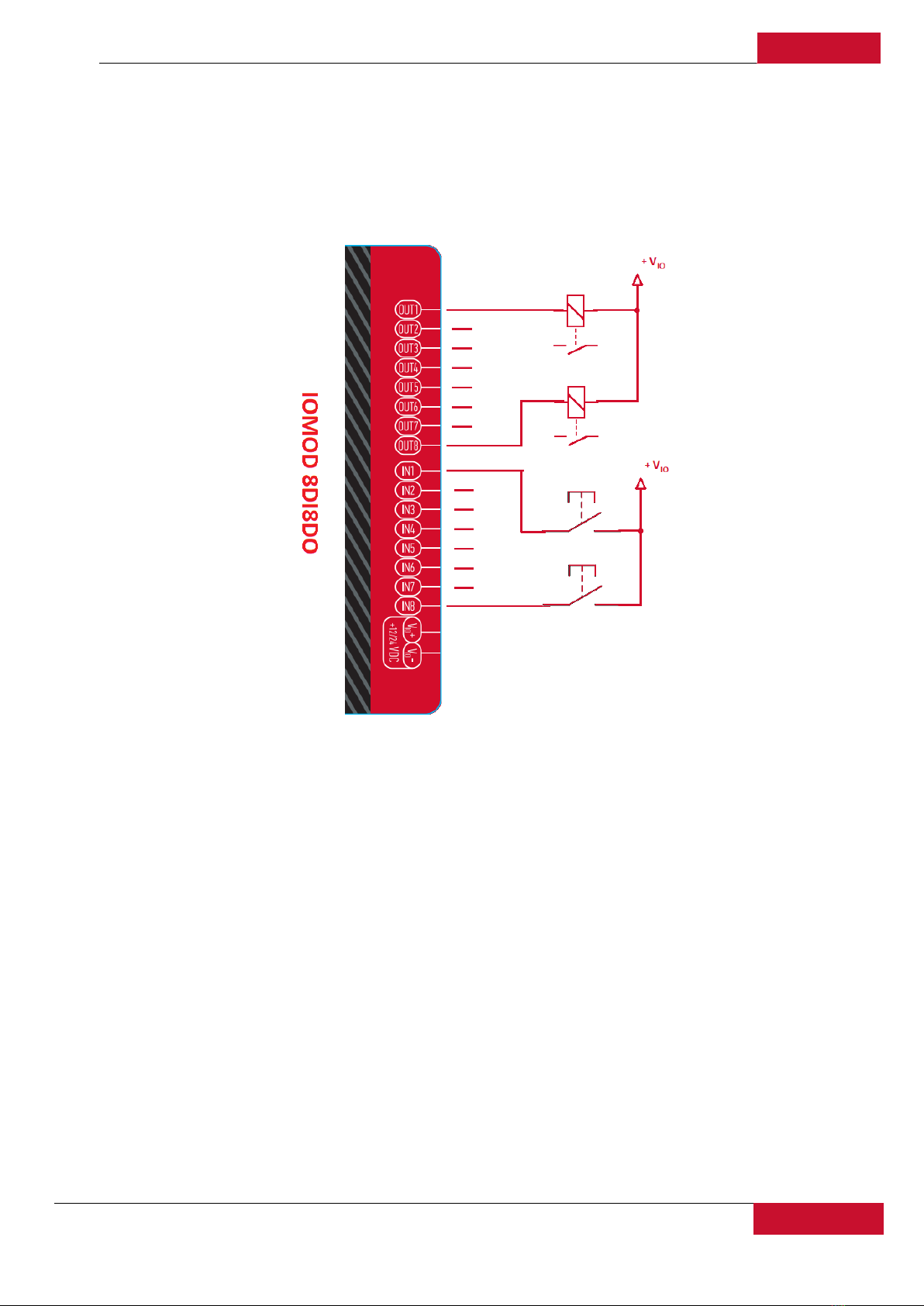
Fig. 3.1 shows outputs and inputs ungrouped and controlled independently. In this mode, General
Interrogation will be composed of 8 output states and 8 input states.
Fig. 3.1. Independent control of input and output pins
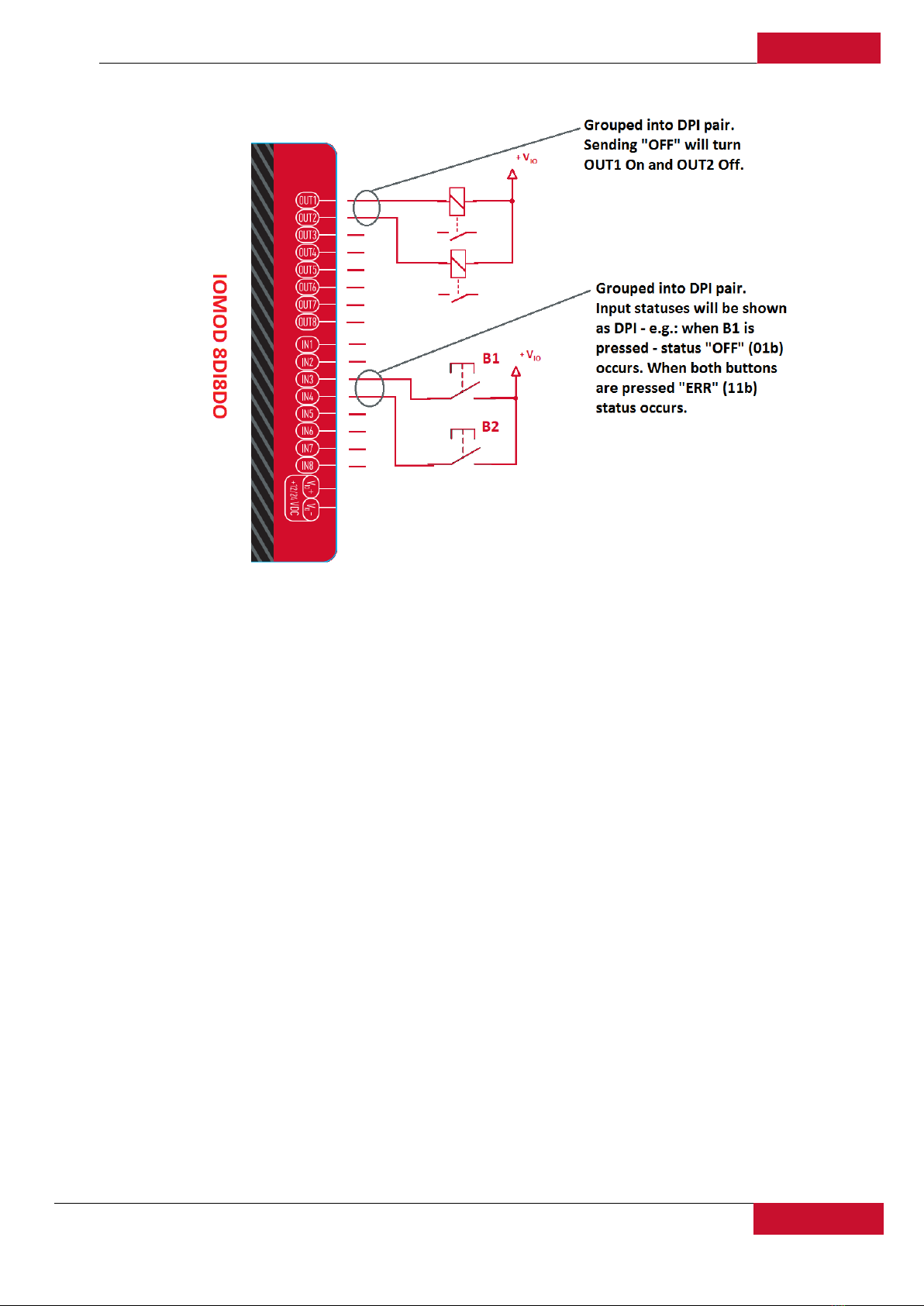
In addition to this, Fig. 3.2 shows first two outputs grouped into pair, while 3rd and 4th inputs are grouped
into pair. Now, General interrogation will be composed of 7 output states (with OUT2 missing), and 7
input states (with IN4 missing). Output and input numbers is represented by “Info number” in protocol.
IOmod 8DI8DO
4/17/2019
V1.1 | ELSETA | Operational information
8
Fig. 3.2. Control of grouped output and input pins
2.2.3 Input filter
Input filter is a simple glitch filter with time input. This filter time corresponds to stable time that input must
achieve before sending a status change.
2.2.4 Output pulse time
User can configure outputs to be pulse controlled – it means that output will be turned on for configured
amount of time. When this time runs out, output is turned off. This is useful when pulse toggle relays are
used. Output pulse is independent from output grouping option and can be used on both grouped and
ungrouped outputs. When output is grouped, device will allow only one command completion at a time –
when output is already turned ON, other “turn ON” requests will be responded with NACK. If user desires
latching outputs to be used, output pulse time is set to 0.
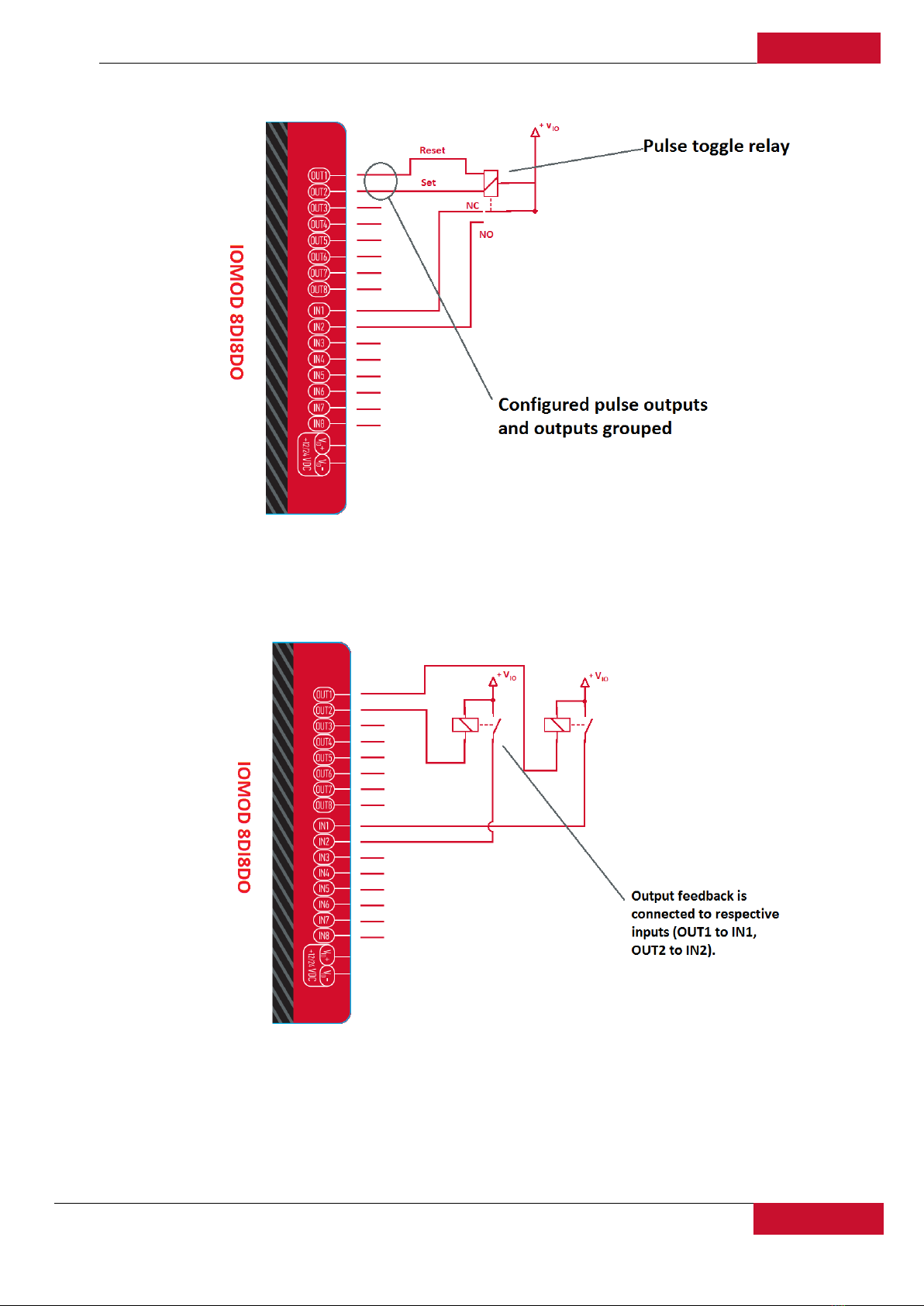
Fig. 3.3 shows example of pulse output usage. In this example inputs and outputs are grouped, and
output pulse time is set to 1s. When user sends ON command, OUT2 is pulsed for 1s, and relay is set.
This will connect NO contact and IN2 will turn on (assuming it is not inverted). When user sends OFF
command, OUT1 is pulsed, and relay is reset, turning IN1 on.
IOmod 8DI8DO
4/17/2019
V1.1 | ELSETA | Operational information
9
Fig. 3.3. Controlling a relay with a pulsed output
2.2.5 Output detection with inputs
User can detect an output change with inputs (example shown in Fig. 3.4).
Fig. 3.4. Detecting outputs with an input feedback
To find out if relays are turned on, user can connect relay outputs to IOmod inputs (maximum allowed
voltage must be taken into account). When relays are turned on, device responds with IEC-60870-5-103
protocol message “Remote Operation”. If inputs are never turned on or off, device will send “Remote
Operation” message after time-out period, with current input statuses. Time-out period is configured by
user as a Feedback Time.

IOmod 8DI8DO
4/17/2019
V1.1 | ELSETA | Testing with “THE VINCI” software
10
2.2.6 Addressing configuration
Devices Output, Input and Output feedback addresses are configurable. This addresses in IEC 60870-
5-103 protocol are considered as “Function Type”. Output address and Output feedback address are 128
by default. Input address is 160 by default.
Device is addressed by “Link address”, which is 1 by default.
3 TESTING WITH “THE VINCI” SOFTWARE
To test IOmod with default settings, user connects device through RS485 to IEC 60870-5-103 master.
Example using “The Vinci Expert” as serial interface converter and adapter to PC with “The Vinci”
software. When opening “The Vinci” software, choose IEC 60870-5-103 – Master mode. Initial settings –
9600 baud rate; 8 data, no parity, 1 stop bit. Press Start, send Time synchronization, General
interrogation and go to the “Statistic” tab:
Fig. 3.5. Testing IOMOD device with “THE VINCI” software
As seen in Fig. 3.5, Outputs and inputs are shown with info numbers 1-8, and function types are 128 and
160 respectively.
General Interrogation, Time Synchronization and General Command options can be found at right side
of the program, in “System” tab.
Output commands are controlled by “General command” window at right side of the program, in “System”
tab, with Output address (Function type) 128, and output number (Info number). Fig. 3.6 shows 1st and
6th output command sent and “CMD ACK” response received.
Fig. 3.7 shows first 4 Outputs and last 4 Inputs grouped (notice the order of info numbers).
Otros manuales para IOMOD 8DI8DO
1
Tabla de contenidos
Manuales populares de Unidad de control de otras marcas

Festo
Festo Compact Performance CP-FB6-E Manual de lista de piezas

Elo TouchSystems
Elo TouchSystems DMS-SA19P-EXTME Manual de usuario

JS Automation
JS Automation MPC3034A Manual de usuario

JAUDT
JAUDT SW GII 6406 Series Guía rápida

Spektrum
Spektrum Air Module System Manual de usuario

BOC Edwards
BOC Edwards Q Series Manual de usuario


