
Dishlex DSF6106X Manual de usuario

DSF6106W
DSF6106X
User Manual
EN
Dishwasher

Contents
Safety information 2
Safety instructions 3
Control panel 4
Programs 5
Before first use 5
Daily use 6
Hints and tips 9
Care and cleaning 10
Troubleshooting 11
Technical information 12
Warranty 12
Subject to change without notice.
Safety information
Before the installation and use of the appliance, carefully read the supplied
instructions. The manufacturer is not responsible if an incorrect installation
and use causes injuries and damages. Always keep the instructions with the
appliance for future reference.
Children and vulnerable people safety
•This appliance can be used by children aged from 8 years and above and
persons with reduced physical, sensory or mental capabilities or lack of
experience and knowledge if they have been given supervision or
instruction concerning use of the appliance in a safe way and understand
the hazards involved.
•Do not let children play with the appliance.
•Keep all detergents away from children.
•Keep children and pets away from the appliance door when it is open.
•Cleaning and user maintenance shall not be made by children without
supervision.
General Safety
•This appliance is intended to be used in household and similar
applications such as:
–farm houses; staff kitchen areas in shops, offices and other working
environments;
–by clients in hotels, motels, bed & breakfast and other residential type
environments.
•Do not change the specification of this appliance.
•The operating water pressure (minimum and maximum) must be between
0.5 (0.05) / 8 (0.8) bar (kPa)
•Obey the maximum number of 13 place settings.
2

•If the supply cord is damaged, it must be replaced by the manufacturer, its
Authorised Service Centre or a similarly qualified persons in order to avoid
a hazard.
•Put knives and cutlery with sharp points in the cutlery basket with the
points down or in a horizontal position.
•Do not keep the appliance door open without supervision to prevent to fall
on it.
•Before maintenance, deactivate the appliance and disconnect the mains
plug from the mains socket.
•Do not use water spray and steam to clean the appliance.
•The appliance is to be connected to the water mains using the new
supplied hose-sets. Old hose sets must not be reused.
•The ventilation openings in the base (if applicable) must not be obstructed
by a carpet.
•Some dishwasher detergents are strongly alkaline. They can be extremely
dangerous if swallowed. Avoid contact with the skin and eyes and keep
children away from the dishwasher when the door is open.
•Check that the detergent receptacle is empty after completion of the wash
cycle.
Safety instructions
Installation
• Remove all the packaging.
• Do not install or use a damaged appliance.
• Do not install or use the appliance where the
temperature is less than 0 °C.
• Obey the installation instruction supplied with the
appliance.
Electrical connection
Warning! Risk of fire and electrical
shock.
• The appliance must be earthed.
• Make sure that the electrical information on the
rating plate agrees with the power supply. If not,
contact an electrician.
• Always use a correctly installed shockproof socket.
• Do not use multi-plug adapters and extension
cables.
• Make sure not to cause damage to the mains plug
and to the mains cable. Should the mains cable
need to be replaced, this must be carried out by our
Authorised Service Centre.
• Connect the mains plug to the mains socket only at
the end of the installation. Make sure that there is
access to the mains plug after the installation.
• Do not pull the mains cable to disconnect the
appliance. Always pull the mains plug.
Water connection
• Make sure not to cause damage to the water hoses.
• Before you connect the appliance to new pipes or
pipes not used for a long time, let the water flow
until it is clean.
• The first time you use the appliance, make sure that
there is no leakage.
• If the water inlet hose is damaged, immediately
disconnect the mains plug from the mains socket.
Contact the Authorised Service Centre to replace
the water inlet hose.
Use
• Do not sit or stand on the open door.
• Dishwasher detergents are dangerous. Obey the
safety instructions on the detergent packaging.
3

• Do not drink and play with the water in the
appliance.
• Do not remove the dishes from the appliance until
the programme is completed. There can be
detergent on the dishes.
• The appliance can release hot steam if you open the
door while a programme operates.
• Do not put flammable products or items that are wet
with flammable products in, near or on the
appliance.
Service
• Contact the Authorised Service Centre to repair the
appliance. We recommend only the use of original
spare parts.
• When you contact the Authorised Service Centre,
ensure that you have the following information that
is available on the rating plate.
Model :
PNC :
Serial Number :
Disposal
Warning! Risk of injury or suffocation.
• Disconnect the appliance from the mains supply.
• Cut off the mains cable and discard it.
• Remove the door catch to prevent children and pets
to get closed in the appliance.
Control panel
1 2 3
456
1On/off indicator
2Program marker
3Indicators
4Start button
5Half load button
6Program knob
Indicators
Indicator Description
Washing phase. It comes on when the washing phase operates.
End indicator.
4

Indicator Description
Rinse aid indicator. It is always off while the program operates.
Half Load indicator.
Programs
Program Degree of soil
Type of load
Program phases Consumption values
1)
Duration
(min)
Energy
(kWh)
Water
(l)
2) Normal soil
Crockery and
cutlery
• Prewash
• Wash 50 °C
• Rinses
• Dry
128 0.75 11.7
Normal soil
Crockery and
cutlery
• Prewash
• Wash 65 °C
• Rinses
• Dry
100 - 120 1.2 - 1.4 15 - 16
Heavy soil
Crockery, cut-
lery, pots and
pans
• Prewash
• Wash 70 °C
• Rinses
• Dry
130 - 150 1.3 - 1.5 13 - 15
3) Fresh soil
Crockery and
cutlery
• Wash 60 °C
• Rinse
30 0.9 9
4) All • Prewash 14 0.1 4
1) The pressure and the temperature of the water, the variations of the mains supply, the options and the quantity of dishes
can change the values.
2) With this program you have the most efficient use of water and energy consumption for crockery and cutlery with normal
soil. (This is the standard program for test institutes).
3) With this program you can wash a partial load with fresh soil. It gives good washing results in a short time. It is not recom-
mended to use detergent tablets in the Quick 30 program.
4) Use this program to quickly rinse the dishes. This prevents the remaining food to bond on the dishes and bad odours to
come out from the appliance. Do not use detergent with this program.
Information for test institutes
For all the necessary information for test performance,
send an email to:
Write down the product number (PNC) that is on the
rating plate.
Before first use
1. Fill the rinse aid dispenser. 2. Open the water tap.
5

3. Start a program to remove any processing
residuals that can still be inside the appliance. Do
not use detergent and do not load the baskets.
Adding rinse aid
2
1
4
3
2
1
The rinse aid helps to dry the dishes without streaks and stains. It is automatically released during the hot rinse
phase.
Daily use
1. Open the water tap.
2. Set the correct program for the type of load and the
degree of soil.
Make sure that the appliance is in Program selection
mode.
• If the rinse aid indicator is on, fill the rinse aid
dispenser.
3. Load the baskets.
4. Add the detergent.
5. Start the program.
Adding detergent
2
1
2
0
3
0
A
B
If the program has a prewash phase, put a small quantity of detergent also in compartment B.
Adding multi-tablets
2
0
3
0
A
B
2
0
3
0
• Set the rinse aid dispenser to the lowest position.
6
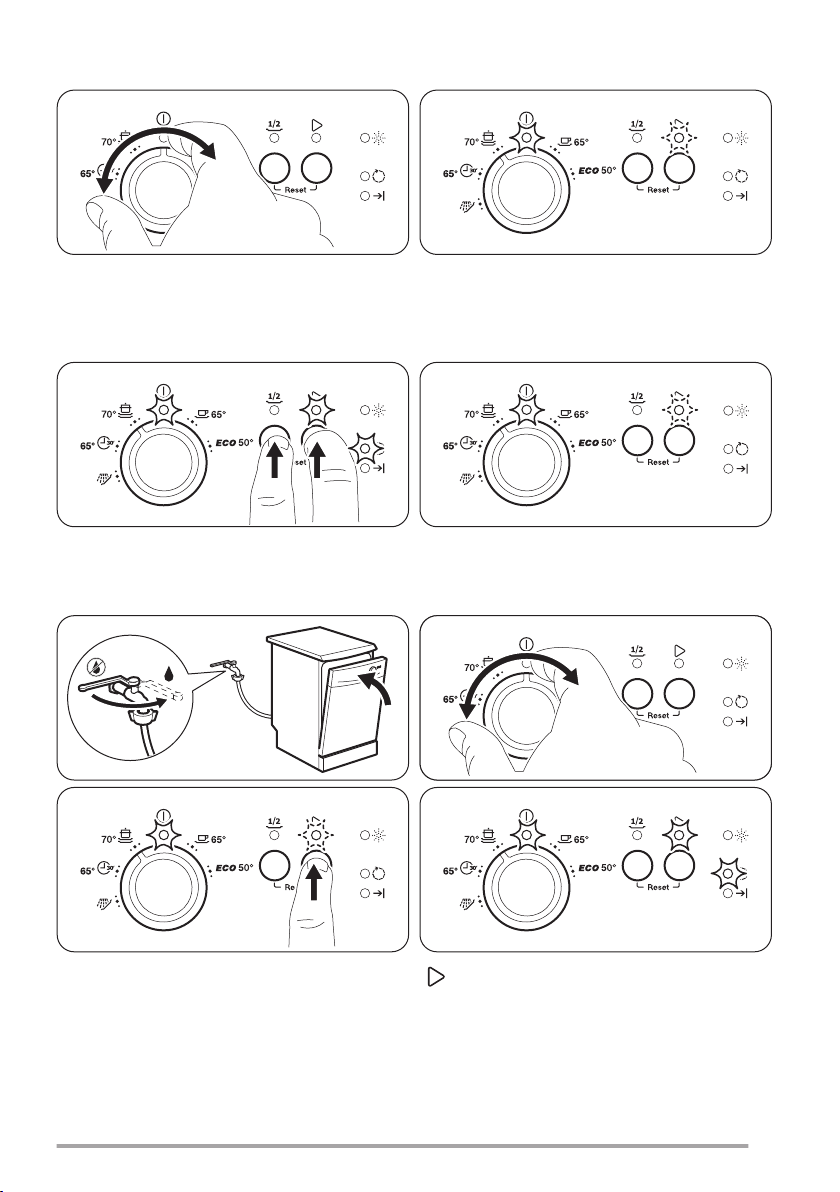
Program selection mode
The appliance must be in Program selection mode to start a program. If the control panel does not show this
condition, use the Reset function.
Reset
With Reset you can cancel the running program . The appliance goes back to the Program selection mode.
Starting a program
Open the water tap, close the door, select a program, press .
7

Option Half load
1. Set the program.
2. Press the related indicator comes on.
3. Press to start the program.
This option is available with , and .
With this option you can wash a small load of tableware and cookware. The option decreases the program duration
and the consumption of water and energy. Load both baskets and use less quantity of detergent.
Opening the door while the appliance operates
If you open the door while a program is running, the appliance stops. When you close the door, the appliance
continues from the point of interruption.
At the end of the program
5 min
8

The indicator comes on. If you do not deactivate the appliance within 5 minutes all indicators goes off. This
helps to decrease energy consumption.
Turn the knob to . Close the tap.
For the better drying results keep the appliance door ajar for some minutes before you remove the
dishes. Let the dishes cool down before you remove them form the appliance. Hot dishes are easily
damaged.
Hints and tips
General
The following hints will ensure optimal cleaning and
drying results in daily use and also help to protect the
environment.
• Remove larger residues of food from the dishes into
the waste bin.
• Do not pre-rinse dishes by hand. When needed, use
the prewash program (if available) or select a
program with a prewash phase.
• Always use the whole space of the baskets.
• When loading the appliance, make sure that the
dishes can be completely reached and washed by
the water released from the spray arm nozzles.
Make sure that items do not touch or cover each
other.
• You can use dishwasher detergent and rinse aid
separately or you can use the multi-tablets (e.g.
''3in1'', ''4in1'', ''All in 1''). Follow the instructions
written on the packaging.
• Select the program according to the type of load and
degree of soil. With the ECO program you have the
most efficient use of water and energy consumption
for crockery and cutlery with normal soil.
Using rinse aid and detergent
• Only use rinse aid and detergent for dishwasher.
Other products can cause damage to the appliance.
• Detergent tablets do not fully dissolve with short
programs. To prevent detergent residues on the
tableware, we recommend that you use the tablets
with long programs.
• Do not use more than the correct quantity of
detergent. Refer to the instructions on the detergent
packaging.
What to do if you want to stop using multi-tablets
Before you start to use separately detergent and rinse
aid do the following procedure.
1. Make sure that the rinse aid container is full.
2. Start the shortest program with a rinsing phase. Do
not add detergent and do not load the baskets.
3. Adjust the released quantity of rinse aid.
Loading the baskets
• Only use the appliance to wash items that are
dishwasher-safe.
• Do not put in the appliance items made of wood,
horn, aluminium, pewter and copper.
• Do not put in the appliance items that can absorb
water (sponges, household cloths).
• Remove remaining food from the items.
• Make soft the remaining burned food on the items.
• Put hollow items (cups, glasses and pans) with the
opening down.
• Make sure that cutlery and dishes do not bond
together. Mix spoons with other cutlery.
• Make sure that glasses do not touch other glasses.
• Put small items in the cutlery basket.
• Put light items in the upper basket. Make sure that
the items do not move.
• Make sure that the spray arm can move freely
before you start a program.
Before starting a programme
Make sure that:
• The filters are clean and correctly installed.
• The spray arms are not clogged.
• There is dishwasher rinse aid (unless you use multi-
tablets).
• The position of the items in the baskets is correct.
• The programme is applicable for the type of load
and for the degree of soil.
• The correct quantity of detergent is used.
9

Unloading the baskets
1. Let the tableware cool down before you remove it
from the appliance. Hot items can be easily
damaged.
2. First remove items from the lower basket, then from
the upper basket.
At the end of the program water can still
remain on the sides and on the door of
the appliance.
For the better drying results open the
door 5-10 cm and allow tableware to cool
down for 30-40 min.
Care and cleaning
Warning! Before maintenance,
deactivate the appliance and disconnect
the mains plug from the main socket.
Dirty filters and clogged spray arms
decrease the washing results. Make a
check regularly and, if necessary, clean
them.
Cleaning the filters
B
A
C
• Make sure that there are no residues of food or soil in or around the edge of the sump.
• Put back in place the flat filter (C). Make sure that it is correctly positioned under the 2 guides.
• Reassemble the filters (A) and (B).
• Put back the filter (A) in the flat filter (C). Turn it clockwise until it locks.
An incorrect position of the filters can cause bad washing results and damage to the appliance
Cleaning the spray arms
Do not remove the spray arms. If the holes in the spray
arms are clogged, remove remaining parts of soil with a
thin pointed object.
External cleaning
• Clean the appliance with a moist soft cloth.
• Only use neutral detergents.
• Do not use abrasive products, abrasive cleaning
pads or solvents.
Internal cleaning
• Carefully clean the appliance, including the rubber
gasket of the door, with a soft moist cloth.
• If you regularly use short duration program, these
can leave deposits of grease and limescale inside
the appliance. To prevent this, we recommend to
10
Este manual sirve para los siguientes modelos
2
Tabla de contenidos
Otros manuales de Lavavajillas de Dishlex

Dishlex
Dishlex Global Series Manual de usuario

Dishlex
Dishlex DSF6205W Manual de usuario

Dishlex
Dishlex DX103 Manual de usuario

Dishlex
Dishlex DSF6305W Manual de usuario

Dishlex
Dishlex DSF6206W Manual de usuario

Dishlex
Dishlex DX 203 Manual de usuario

Dishlex
Dishlex DX 301 Manual de usuario

Dishlex
Dishlex DX103 Manual de usuario

Dishlex
Dishlex DSF6104WA Manual de usuario

Dishlex
Dishlex DSF6105W Manual de usuario


