SPITFIRE II OWNER’S MANUAL PAGE 7 OF 17
Experiment and find what works for you. The original circuit design in your amp was for the
High position only. Our advice is to try this position first, dial in a tone and play. Switch to the
Low position WITHOUT adjusting other knobs than repeat in the Mid position. The point of
refraining from adjusting front panel knobs is to get a real feel for what that control does.
When you get locked in to the position you like, then adjust away!
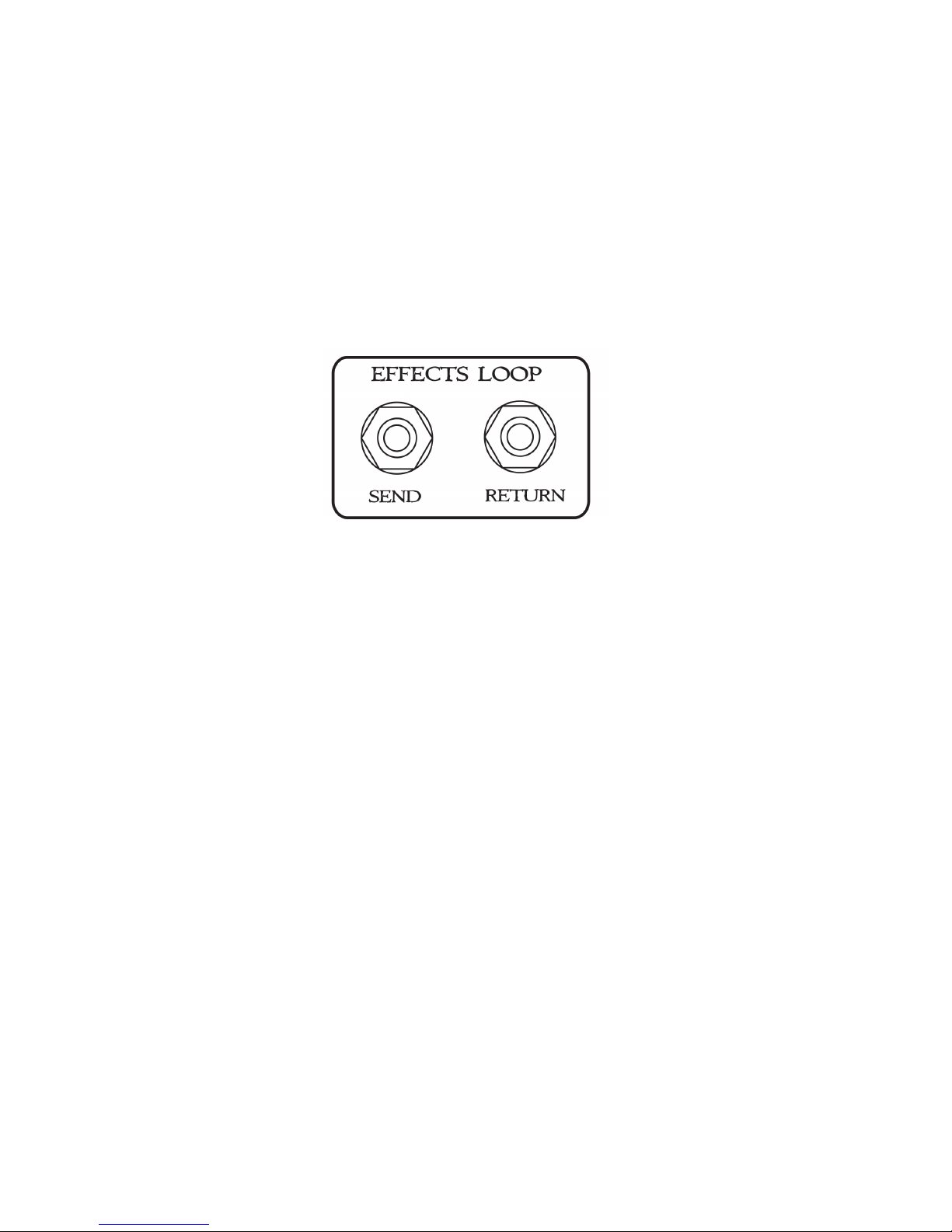
EFFECTS LOOP
The Effects Loop is tube driven. It is wired in series and there is no need to turn it on or off.
The Return jack will activate when you put a cable in it. Hence, when you plug a cable in, it
turns on. When you unplug it, it’s off.
People sometimes inquire about the lack of an effects send. There is one. When the loop is
engaged, each Volume control becomes that Volume/Gain’s effects send. So, when on the
clean channel with the loop engaged, the Volume control on the clean channel becomes the
effects send. When on Channel 2, Volume/Gain A, that Volume control becomes 2A’s effects
send, and so on. So if you’re clipping your effects, that is the control to reach for.
What about that E. Return knob on the front panel? When the loop is on, the E. Return knob
replaces each channel’s volume control and becomes the overall master volume control.
This turns each Volume control into a balancing control to level out channel volumes (and
that channel’s effects send as noted in the preceding paragraph). What is the advantage to
this? When you have the loop engaged, you can heat up the preamp to drive the channel
hotter while controlling the overall volume.
Let’s do a test.
1. Set your amp on Channel 2A.
2. Set the Gain at 6 and the Volume at 4. It should be pretty loud.
3. Now, make sure the E. Return control is set to 0 and plug a short patch
cable into the loop (provided), jumping the Send to the Return. When you
play now, you should hear nothing.
4. Gently bring the E. Return knob up. When you get to about 2 or 3, you
should be at a normal, listenable level for home practice, and tonally the
amp should be about the same.