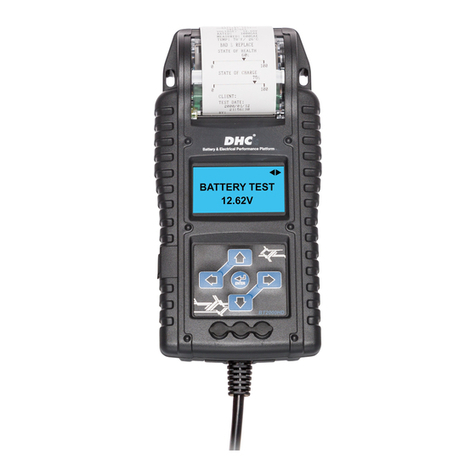
DHC BT2100 Manual de usuario

READ ENTIRE MANAUAL BEFORE USING THIS PRODUCT
Model BT2100
BATTERY & ELECTRICAL SYSTEM ANALYZER

- 1 -
TEST PROCEDURES/ OPERATING INSTRUCTIONS
IMPORTANT:
1. For testing 6 and 12 volt batteries, and 12 and 24 volt charging
systems. (ONLY 12 volt for START & STOP battery test)
2. Suggested operation range 32°F(0°C) to 122°F(50°C) in ambient
temperature.
○
1
○
2
○
3
○
4
○
5
○
6
○
7
Temperature Sensor
Display
Directional Keys
USB Port
Voltmeter Jack
AMP Clamp Jack
Printer
BT2100

- 2 -
WARNING:
Pursuant to California Proposition 65, this product contains chemicals
known to the State of California to cause cancer and birth defects or
other reproductive harm. Wash hands after handling.
1. Working in the vicinity of a lead acid battery is dangerous. Batteries
generate explosive gases during normal battery operation. For this
reason, it is of utmost importance, if you have any doubt, that each
time before using your tester, please read these instructions very
carefully.
2. To reduce risk of battery explosion, follow these instructions and
those published by the battery manufacturer and manufacturer of
any equipment you intend to use in the vicinity of the battery.
Observe cautionary markings on these items.
3. Do not expose the tester to rain or snow.
PERSONAL SAFETY PRECAUTIONS:
1. Someone should be within range of your voice or close enough to
come to your aid when you work near a lead acid battery.
2. Have plenty of fresh water and soap nearby in case battery acid
contacts skin, clothing or eyes.
3. Wear safety glasses and protective clothing.
4. If battery acid contacts skin or clothing, wash immediately with soap
and water. If acid enters eye, immediately flood eye with running cold
water for at least ten minutes and get medical attention immediately.
5. NEVER smoke or allow a spark or flame in vicinity of battery or engine.
6. Be extra cautious to reduce risk of dropping a metal tool onto the
battery. It could spark or short-circuit the battery or other electrical
parts and could cause an explosion.
7. Remove personal metal items such as rings, bracelets, necklaces and
watches when working with a lead acid battery. It can produce a short
circuit current high enough to weld a ring or the like to metal causing
a severe burn.

- 3 -
PREPARING TO TEST
1. Be sure area around battery is well ventilated while battery is being
tested.
2. Clean battery terminals. Be careful to keep corrosion from coming in
contact with eyes.
3. Inspect the battery for cracked or broken case or cover. If battery is
damaged, do not use tester.
4. If the battery is not sealed maintenance free, add distilled water in
each cell until battery acid reaches level specified by the manufacturer.
This helps purge excessive gas from cells. Do not overfill.
5. If necessary to remove battery from vehicle to test, always remove
ground terminal from battery first. Make sure all accessories in the
vehicle are off to ensure you do not cause any arcing.
1. Before you test a battery in a vehicle, turn off the ignition, all
accessories and loads. Close all the vehicle doors and the trunk lid.
2. Make sure you have put 6pcs 1.5V batteries into the battery chamber.
Oxyride batteries are not recommended because of the initial 1.7 Volt
output. If the 1.5V battery runs out of power, screen will show
“REPLACE INTERNAL BATTERY” or” POWER LOW”. Replace those 4pcs
1.5V batteries before starting the test.
Note that nothing will be seen on the display until the tester is
connected to a vehicle battery.
BEFORE TEST

- 4 -
3. Make sure the battery terminals are clean. Wire brush them if
necessary. Clamp the black load lead to the vehicle negative battery
terminal. Clamp the red load lead to the vehicle positive battery
terminal. Please clamp on the lead part of the terminal only. Clamping
on the iron part of the terminal will lead to wrong test results.
4. Paper load:
a. Open the clear cover.
b. Place a new paper roll in the compartment.
c. Put a short length of paper from the
compartment and press down the clear
cover to close.
1. Press the ◄ ► key to select START-STOP Test.
2. Press the ◄ ► key to select battery type:
a. AGM FLAT PLATE
b.EFB (ENHANCED FLOODED)
Press «ENTER» button to confirm choice.
3. Press the ◄ ► key to select battery rating :
CCA/SAE, EN, IEC, or DIN. Press «ENTER» button to
confirm choice.
START-STOP BATTERY TEST

- 5 -
4. Press the ◄ ► key to input the battery capacity:
SAE (CCA): 25~3,000
EN: 25~2,830
DIN: 25~1,685
IEC: 25~1,985
Press «ENTER» to begin test.
5. Press the◄ ► key to confirm the location of the
battery if a surface charge is detected, follow the
tester ‘s introductions to remove the surface
charge.
6. Testing battery.
7. Aim the “Temperature Measurement sensor”
2.5cm (1 inch) from the top or sides of the battery
case and press <<ENETR>>. Measured temperature
may vary by distance from the battery, under hood
conditions, and cabinet temperature.
8. Press the ◄ ► key to confirm if the battery has
been charged recently.
9. When the test is completed, the display shows the results as follows.
{Press the◄ ► key to select: Temperature, SOH (STATE OF HEALTH) ,
and SOC (STATE OF CHARGE)}.
(GREEN backlight)
The battery is good and capable of holding a
charge.
The battery is good but needs to be recharged.
GOOD & PASS
GOOD & RECHARGE
(GREEN backlight)

- 6 -
Battery is discharged, the battery condition
cannot be determined until it is fully charged.
Recharge & retest the battery.
The battery will not hold a charge. It should be
replaced immediately.
The battery has at least one cell short circuit. It
should be replaced immediately.
10. Add RO# and VIN#? YES or NO. Select YES to enter RO number and
vehicle plate number.
11. Press ENTER to print the result.
NOTE: Under certain conditions the follow messages may be displayed.
The tested battery is bigger than 3000 SAE (CCA) or
the connection is not established. Check the capacity
of the battery & make sure the clamps are properly connected.
LOAD ERROR
RECHARGE & RETEST
BAD & REPLACE
BAD CELL & REPLACE
(YELLOW backlight)
(RED backlight)
(RED backlight)

- 7 -
The connection between battery and cable set is
loosed, please check cable clamp.
Please change new AA batteries.
Please insert new paper row.
The voltage of tested battery is too high and cannot
be measured.
The voltage of tested battery is unstable Please switch
off the engine, wait for 90 second and retest.
CHECK CLAMP
INTERNAL BATTERY LOW
NO PAPER
VOLTAGE HIGH
VOLTAGE UNSTABLE

- 8 -
1. Press the ◄ ► key to select Battery Test.
2. Press the ◄ ► key to confirm the battery voltage.
3. Press the ◄ ► key to confirm if the battery has
been charged recently.
4. Press the ◄ ► key to select the battery type:
a. FLOODED
b.AGM FLAT PLATE
c. AGM SPIRAL
d.VRLA/GEL
Press «ENTER» to confirm choice.
5. Press the ◄ ► key to select battery rating:
CCA/SAE, EN, IEC or DIN. Press «ENTER» to confirm
choice.
6. Press the ◄ ► key to input the battery capacity:
• SAE (CCA):25~3,000
• EN:25~2,830
• DIN:25~1,685
• IEC:25~1,985
• JIS:Battery Type No.
Press «ENTER» to begin the test.
7. Press the ◄ ► key to confirm the location of the
battery if a surface charge is detected, follow the
tester ‘s instruction to remove the surface charge.
8. Testing battery.
BATTERY TEST

- 9 -
9. Aim the “Temperature Measurement sensor”
2.5cm (1 inch) from the top or sides of the battery
case and press <<ENETR>>. Measured
temperature may vary by distance from the battery, under hood
conditions, and cabinet temperature.
10. When the test is completed, the display shows the results as
following. {Press the◄ ► key to select: Temperature, SOH (STATE
OF HEALTH), and SOC (STATE OF CHARGE)}.
3
The battery is good and capable of holding a charge.
The battery is good but needs to be recharged.
Battery is discharged, the battery condition cannot
be determined until it is fully charged. Recharge &
retest the battery.
The battery will not hold a charge. It should be
replaced immediately.
The battery has at least one cell short circuit. It
should be replaced immediately.
11. Press ENTER button to enter RO number and vehicle plate number.
GOOD & PASS
GOOD & RECHARGE
RECHARGE & RETEST
BAD & REPLACE
BAD CELL & REPLACE
Tabla de contenidos
Otros manuales de Instrumento de medición de DHC
Manuales populares de Instrumento de medición de otras marcas

Endress+Hauser
Endress+Hauser Proline Promag 50 Especificaciones técnicas

Siemens
Siemens SITRANS F Coriolis FCT030 Manual de lista de piezas

KLINGER
KLINGER CMF V Series Manual de usuario

EXFO
EXFO FTB-2 Manual de operación y mantenimiento

Keysight
Keysight M8290A Manual de usuario

ADTEK
ADTEK MW-5 Manual de usuario