MA1044 MAQ20-RTD31/-RTD41 Hardware User Manual
Page 2 of 38
2.0 System Description and Documentation
A MAQ20 Data Acquisition System must have as a minimum a Communications Module, a
Backbone, and one I/O Module. Examples include:
MAQ20-COM2, -COM4 Communications Module, Ethernet, USB & RS-232 or RS-485 Interface
MAQ20-JTC, -KTC, -TTC, -RSTC Type J, K, T, R, or S Thermocouple Input Module
MAQ20-mVDN, -VSN, -VDN Voltage Input Module
MAQ20-ISN, -IDN Process Current Input Module
MAQ20-IO, -VO Process Current Output and Process Voltage Output Module
MAQ20-BKPL4, -BKPL8, -BKPL16, -BKPL24 4, 8, 16, or 24 Channel System Backbone
Refer to Dataforth MAQ20 Industrial Data Acquistion & Control System for a complete listing of
available modules and accessories.
System power is connected to the Communications Module, which in turn powers the I/O modules.
For systems with power supply requirements exceeding what the Communications Module can
provide, the MAQ20-PWR3 Load Share Power Supply module is used to provide additional power.
When a MAQ20 I/O module is inserted into a system, module registration occurs automatically, data
acquisition starts, and data is stored locally in the module. The system is based on a Modbus
compatible memory map for easy access to acquired data, configuration settings, and alarm limits.
Information is stored in consistent locations in module memory for ease of use and system design.
MAQ20 modules are designed for installation in Class I, Division 2 hazardous locations and have a
high level of immunity to environmental noise commonly present in heavy industrial environments.
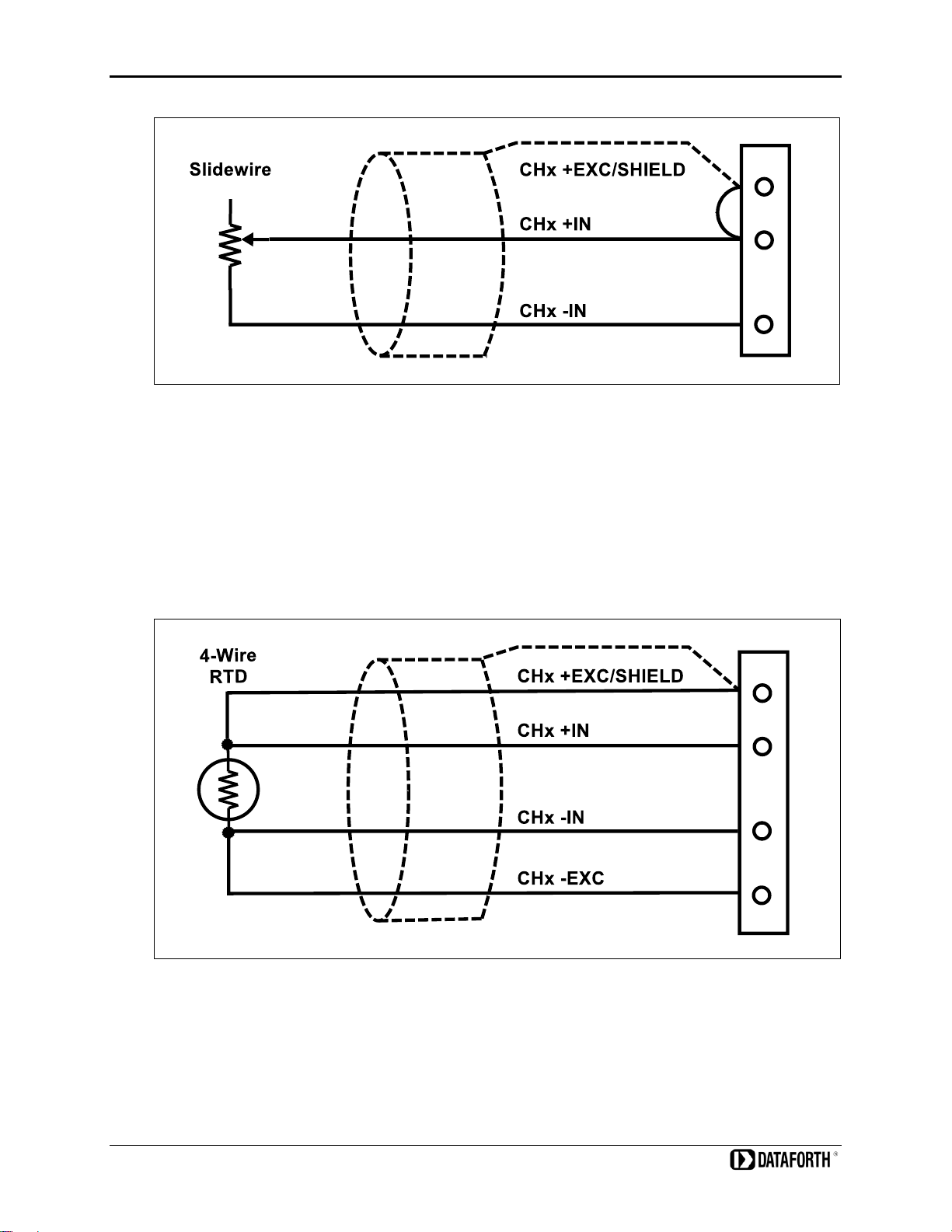
The MAQ20 RTD and potentiometer input modules, MAQ20-RTD31 and MAQ20-RTD41,
interface to 3-wire sensor and 4-wire sensors. MAQ20-RTD31 has 6 input channels and MAQ20-
RTD41 has 5 input channels. MAQ20-RTD31 interfaces to 100Ω Platinum RTDs, 120Ω Nickel RTDs
and Potentiometers and MAQ-RTD41 interfaces to 100Ω Platinum RTDs and 120Ω Nickel RTDs.
Precision, matched, low magnitude current sources for sensor excitation minimize self-heating and
cancel lead resistance errors when using 3-wire connections. All channels are individually
configurable for sensor, range, alarm, and averaging to match the most demanding applications.
High, Low, High-High and Low-Low alarms provide essential monitoring and warning functions to
ensure optimum process flow and fail-safe applications. Hardware low-pass filtering in each channel
provides rejection of 50 and 60 Hz line frequencies. Field I/O connections are made through a
pluggable terminal block with positions designated for the termination of wiring shields.
Input-to-Bus isolation is a robust 1500Vrms and each individual channel is protected up to 240Vrms
continuous overload in the case of inadvertent wiring errors. Over-ranged channels do not adversely
affect other channels in the module which preserves data integrity.
MAQ20 system literature and software is available for download from the
MAQ20 Software & User Manual Download Center. This includes, but is not limited to:
MA1036 MAQ20 Quick Start Guide
MA1040 MAQ20 Communications Module Hardware User Manual
MA1038 MAQ20 ReDAQ Shape for MAQ20 User Manual
MA1060 MAQ20 IPEmotion Plug-In Software User Manual
MA1064 MAQ20 Python API User Manual
MAQ20-940/-941 ReDAQShape Software for MAQ20 –Developer Version/User Version
MAQ20-951/952 IPEMotion Software for MAQ20
MAQ20-960 MAQ20 Python API