6
out with cold water. This procedure should be carried out
three times, to remove any manufacturing dust, etc.
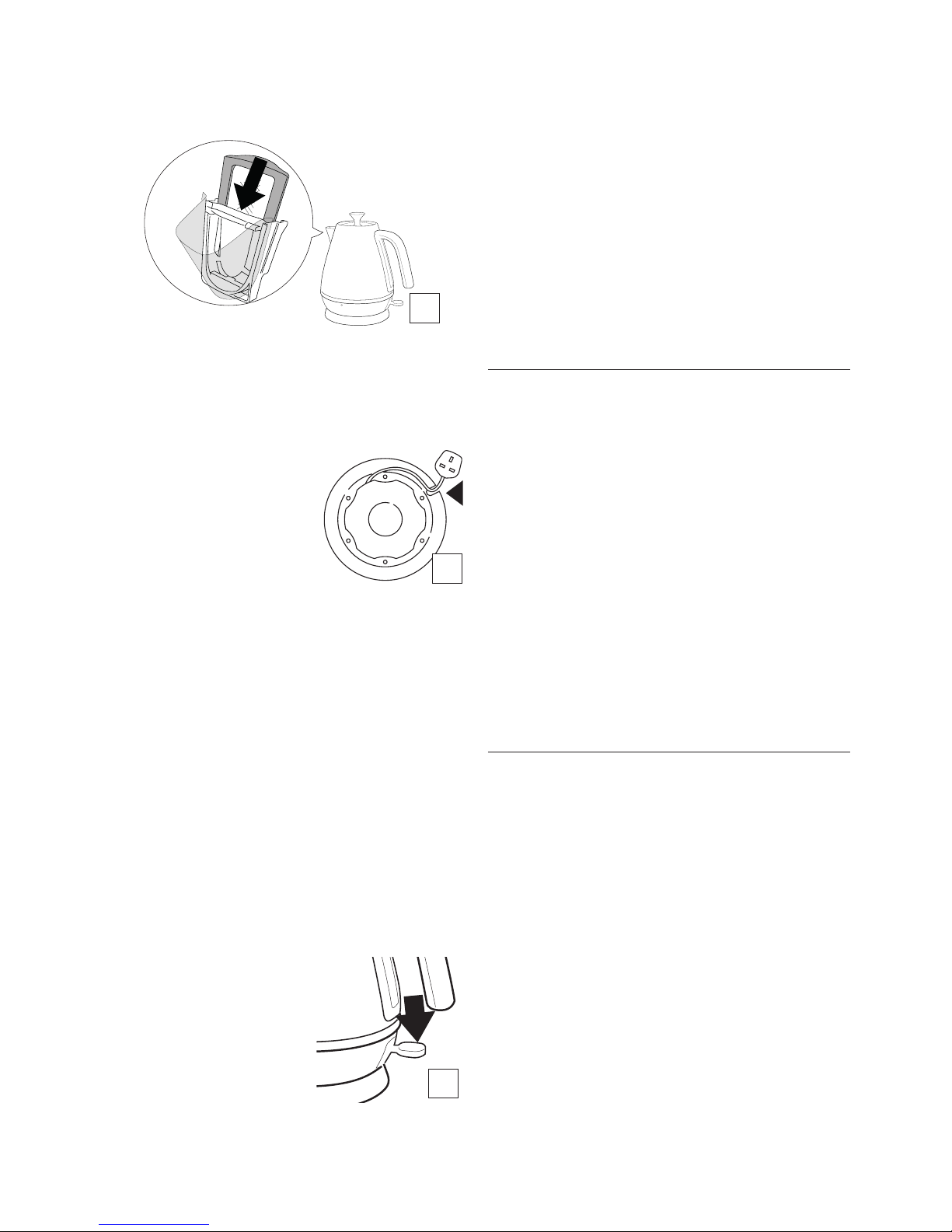
- After the kettle has been rinsed out, re-t the lter (g. 3).
In use
With the specially designed power base and central connector,
you can now set the kettle on the base at any angle, from any
position.
- Release cord from storage base
and adjust length by winding
around the base to give the
correct cord length to reach the
plug socket to be used (g. 4).
- Do not leave loose cord hanging
over the edge of work surfaces.
Filling
- Remove the kettle from the base unit before lling.
- Open lid and ll kettle to desired level.
Do not ll with less than 0,3 litre of water to prevent
the kettle running dry while operating; misuse of this kind
will shorten the life of the element.
Do not ll with more than 1.7 litres of water (up to
the MAX level). If the kettle is overlled, there is a risk
that boiling water may be ejected causing burns.
Switching on
- Plug the power base into the mains socket.
- Place kettle on power base.
- Press the ON/OFF switch down (g. 5) to switch the kettle
on.
- The pilot light will switch on.
- The kettle will automatically
switch o once the water is
boiled (the ON/OFF switch
will click upwards and the
lights will switch o ).
- To turn the kettle o before
the water boils, you may
move the ON/OFF switch up to the OFF position, or simply
lift the kettle from its base - it will switch o and the switch
will return to the OFF position automatically.
Pouring
- Remove the kettle from the power base and carefully pour
out the water.
Do not tilt the kettle suddenly or pour water out at too
sharp an angle.
- When you lift the kettle from the base, you may see
moisture on the top surface of the base. Condensation on
the base is perfectly normal, and should not be a cause for
alarm.
SAFETY DEVICES
1) Automatic ON/OFF switch:
Your kettle is tted with an ON/OFF switch which
automatically switches o once the water has boiled. If the
kettle has just boiled, wait a minute or so before re-boiling
the kettle. Do not attempt to hold the ON/OFF switch in the
on position or adjust the switch mechanism.
2) Safety cut-out:
If the kettle is switched ON with too little or no water, it is
protected against damage by a safety cut-out which will
switch o the power.
If this cut-out operates, disconnect the kettle from the
mains supply and leave to cool down before relling with
cold water (otherwise the element could be damaged).
3) If kettle is lifted from base while operating (ON), it will
automatically switch o.
MAINTENANCE
Cleaning the kettle
- Allow the kettle to cool down fully and disconnect the
appliance from the mains before cleaning.
- Do not immerse the kettle or base in water.
- Use a soft dampened cloth to wipe the outside of the kettle
and dry with a soft, dry cloth.
- DO NOT use metal polish or harsh scouring agents.
- Ensure that all connectors and sockets are kept dry.
Scale
Scale is mainly calcium carbonate (chalk), a harmless, naturally
occurring mineral found in most water supplies. “Hard” water
contains more of this mineral than “soft”water. When the water
is heated, the minerals in the water solidify, making the water
appear cloudy. These minerals form a thin lm on the walls,
element and on the surface of the water.The water may look like
it has white coloured pieces of plastic oating on the surface.
On traditional kettle elements, scale forms a hard white “crust”
5
3
4