Page 2 of 39
BLOCKsignalling blocksignalling.co.uk
Introduction
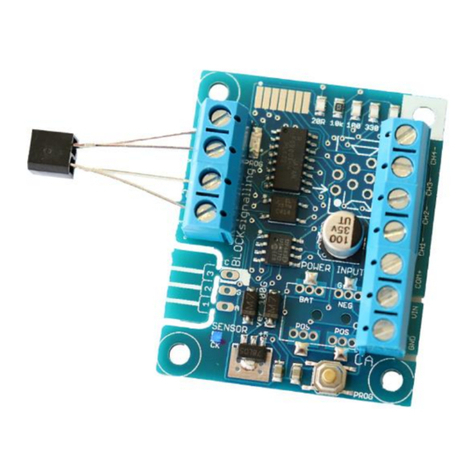
The BLOCKsignalling Section Control Module is designed to protect a section of
track to prevent more than one train entering that section at one time (see later for
details of the Station Stop Modes).
At the entrance to the section there is a signal and a short isolated piece of track
which can be energised with DCC or DC by a relay and diode rectifier built-in to the
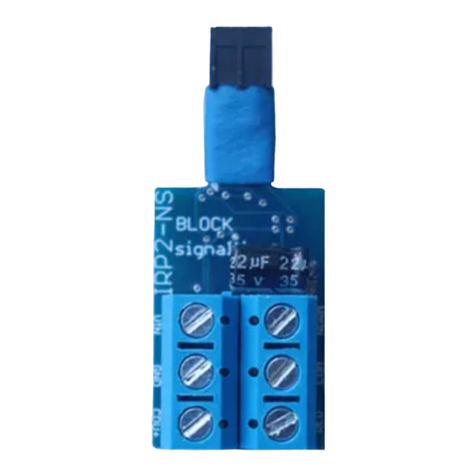
module. There is also an infra-red sensor (sensor 1) which is located below the
track which is able to detect trains passing the signal.
The isolated section of track is normally energised with DCC and the signal normally
shows a green aspect.
At the start of the section, the infra-red sensor is continuously looking for a trains
passing, and as soon as it detects one, it switches the signal to red and feeds DC to
the isolated section of track, slowing any approaching train to a standstill in front of
the red signal (see later for bidirectional running). In order for this to function
correctly, the loco needs to be configured to “Stop on DC”(see later for details of
how to configure this).
The module then uses a second infra-red sensor (sensor 2) located at the exit from
the section of track to detect when the train has completely left the section.
When this is confirmed, the signal at the entrance to the block is switched from
danger back to green (if a 2-aspect signal is used).
If 3- or 4-aspect signals are connected, then information from the following blocks is
used to switch the signal to show yellow or double yellow.
In 2-aspect mode, a Dapol signal can be driven via a relay connected to CH5 for
some of the modes (2, 7 and 8). This is discussed in further detail later.
The isolated track section at the entrance is also re-energised with DCC and any
waiting train will then accelerate away past the signal.