
Wen 33013 Manual de usuario

MILLING
MACHINE
Model # 33013
Your new tool has been engineered and manufactured to WEN’s highest standards for dependability, ease
of operation, and operator safety. When properly cared for, this product will supply you years of rugged,
trouble-free performance. Pay close attention to the rules for safe operation, warnings, and cautions. If
you use your tool properly and for its intended purpose, you will enjoy years of safe, reliable service.
IMPORTANT:
NEED HELP? CONTACT US!
Have product questions? Need technical support?
Please feel free to contact us at:
800-232-1195
WENPRODUCTS.COM
(M-F 8AM-5PM CST)
bit.ly/wenvideo
For replacement parts visit
WENPRODUCTS.COM
NOTICE: Please refer to wenproducts.com for the most up-to-date instruction manual.
3072101

PRODUCT SPECIFICATIONS
33013
120V, 60Hz, 4.5A
1/2 in. (13 mm)
5/8 in. (16 mm)
1-1/8 in. (30 mm)
0 to 1100 RPM (Low)
0 to 2500 RPM (High)
R8
11-13/16 in. (300 mm)
5-1/8 in. (130 mm)
7 in. (180 mm)
45° Left & Right
70 - 75 dB
18-1/8 x 4-3/4 in. (460 x 120 mm)
23-1/4 x 22 x 29-1/2 in.
130.1 lbs
TABLE OF CONTENTS
2
3
4
6
7
8
10
13
15
16
18
23
Product Specifications
Safety Introduction
General Safety Rules
Specific Rules for the Milling Machine
Electrical Information
Know Your Milling Machine
Assembly & Preparation
Adjustments
Operation
Maintenance
Exploded View & Parts List
Warranty Statement
Model Number:
Motor:
Drilling Bit Diameter Capacity:
End Milling Bit Diameter Capacity:
Face Milling Bit Diameter Capacity:
Spindle Speed:
Spindle Taper
Cross (X) Axis Travel:
Longitudinal (Y) Axis Travel:
Vertical (Z) Axis/Headstock Travel:
Bevel Angle:
Noise Level:
Table Dimensions:
Maximum Product Dimensions:
Net Product Weight:
2

SAFETY INTRODUCTION
Thanks for purchasing the WEN Milling Machine. This is an exciting moment. You have received your new tool,
opened the box, and are now about to read through the instruction manual. This manual provides information
regarding potential safety concerns, as well as helpful assembly and operating instructions. Safe operation of this
tool requires that you read and understand this operator’s manual and all labels affixed to the tool.
SAFETY ALERT SYMBOL: Indicates danger, warning, or caution. The safety symbols and the
explanations with them deserve your careful attention and understanding. Always follow the safety
precautions to reduce the risk of fire, electric shock and personal injury. However, please note that
these instructions and warnings are not substitutes for proper accident prevention measures.
NOTE: The following safety information is not meant to cover all possible conditions and situations that may oc-
cur. WEN reserves the right to change this product and specifications at any time without prior notice.
Keep this manual available to all users during the entire life of the tool and review it frequently
to maximize safety for both yourself and others.
3

GENERAL SAFETY RULES
WARNING! Read all safety warnings and instructions. Failure to follow all instructions may result
in electric shock, fire and serious injury. The term “power tool” in the warnings refers to your mains-
operated (corded) power tool. Save all warnings and instructions for future reference.
WORK AREA SAFETY
1. Keep work area clean and well lit. Cluttered or dark areas invite accidents.
2. Do not operate power tools in explosive atmospheres, such as in the presence of flammable liquids, gases or
dust. Power tools create sparks which may ignite the dust or fumes.
3. Keep children and bystanders away while operating a power tool. Distractions can cause you to lose control.
ELECTRICAL SAFETY
1. Power tool plugs must match the outlet. Never modify the plug in any way. Do not use any adapter plugs with
earthed (grounded) power tools. Unmodified plugs and matching outlets will reduce risk of electric shock.
2. Avoid body contact with earthed or grounded surfaces such as pipes, radiators, ranges and refrigerators. There
is an increased risk of electric shock if your body is earthed or grounded.
3. Do not expose power tools to rain or wet conditions. Water entering a power tool will increase the risk of elec-
tric shock.
4. Do not abuse the cord. Never use the cord for carrying, pulling or unplugging the power tool. Keep cord away
from heat, oil, sharp edges or moving parts. Damaged or entangled cords increase the risk of electric shock.
5. When operating a power tool outdoors, use an extension cord suitable for outdoor use. Use of a cord suitable
for outdoor use reduces the risk of electric shock.
6. If operating a power tool in a damp location is unavoidable, use a ground fault circuit interrupter (GFCI) pro-
tected supply. Use of a GFCI reduces the risk of electric shock.
PERSONAL SAFETY
1. Stay alert, watch what you are doing and use common sense when operating a power tool. Do not use a power
tool while you are tired or under the influence of drugs, alcohol or medication. A moment of inattention while
operating power tools may result in serious personal injury.
2. Use personal protective equipment. Always wear eye protection. Protective equipment such as dust mask, non-
skid safety shoes, hard hat, or hearing protection used for appropriate conditions will reduce personal injuries.
3. Prevent unintentional starting. Ensure the switch is in the off-position before connecting to power source and/
or battery pack, picking up or carrying the tool. Carrying power tools with your finger on the switch or energizing
power tools that have the switch on invites accidents.
4. Remove any adjusting key or wrench before turning the power tool on. A wrench or a key left attached to a
rotating part of the power tool may result in personal injury.
5. Do not overreach. Keep proper footing and balance at all times. This enables better control of the power tool
in unexpected situations.
4

GENERAL SAFETY RULES
6. Dress properly. Do not wear loose clothing or jewelry. Keep your hair, clothing and gloves away from moving
parts. Loose clothes, jewelry or long hair can be caught in moving parts.
7. If devices are provided for the connection of dust extraction and collection facilities, ensure these are connected
and properly used. Use of dust collection can reduce dust-related hazards.
POWER TOOL USE AND CARE
1. Do not force the power tool. Use the correct power tool for your application. The correct power tool will do
the job better and safer at the rate for which it was designed.
2. Do not use the power tool if the switch does not turn it on and off. Any power tool that cannot be controlled
with the switch is dangerous and must be repaired.
3. Disconnect the plug from the power source and/or the battery pack from the power tool before making any ad-
justments, changing accessories, or storing power tools. Such preventive safety measures reduce the risk of starting
the power tool accidentally.
4. Store idle power tools out of the reach of children and do not allow persons unfamiliar with the power tool or
these instructions to operate the power tool. Power tools are dangerous in the hands of untrained users.
5. Maintain power tools. Check for misalignment or binding of moving parts, breakage of parts and any other
condition that may affect the power tool’s operation. If damaged, have the power tool repaired before use. Many
accidents are caused by poorly maintained power tools.
6. Keep cutting tools sharp and clean. Properly maintained cutting tools with sharp cutting edges are less likely to
bind and are easier to control.
7. Use the power tool, accessories and tool bits etc. in accordance with these instructions, taking into account
the working conditions and the work to be performed. Use of the power tool for operations different from those
intended could result in a hazardous situation.
SERVICE
Have your power tool serviced by a qualified repair person using only identical replacement parts. This will en-
sure that the safety of the power tool is maintained.
CALIFORNIA PROPOSITION 65 WARNING
Some dust created by power sanding, sawing, grinding, drilling, and other construction activities may contain
chemicals, including lead, known to the State of California to cause cancer, birth defects, or other reproductive
harm. Wash hands after handling. Some examples of these chemicals are:
• Lead from lead-based paints.
• Crystalline silica from bricks, cement, and other masonry products.
• Arsenic and chromium from chemically treated lumber.
Your risk from these exposures varies depending on how often you do this type of work. To reduce your expo-
sure to these chemicals, work in a well-ventilated area with approved safety equipment such as dust masks spe-
cially designed to filter out microscopic particles.
5

SPECIFIC RULES FOR THE MILLING MACHINE
These safety instructions can’t possibly warn of every scenario that may arise with this tool,
so always make sure to stay alert and use common sense during operation.
6
1. Your milling machine is designed for drilling, end milling and face milling operations on small workpieces. Us-
ing the machine for any other purpose for which it is not designed may result to serious injuries and/or damage to
the machine.
2. This machine is intended for use by properly trained and experienced personnel only. If you are not familiar
with the proper and safe operation of milling, do not use it until proper training and knowledge have been ac-
quired.
3. Always wear ANSI Z87.1-approved eye protection and a face shield/dust mask when using this machine. Chips
and dust fly at high speed during operation, and may cause injuries if they hit you.
4. DO NOT wear loose clothing or jewelry. Keep your hair, clothing and gloves away from moving parts. Loose
clothes, jewelry or long hair can be caught in the tool.
5. Securely mount the machine to a stable workbench to prevent it from sliding or tipping over.
6. Select the right tool for your task at hand. Make sure all cutters and bits are sharp and free of damage. DO
NOT use dull or damaged tools. Securely tighten both the cutter holder and cutter before operation.
7. Use a milling vise (not included) to clamp your workpiece securely. Never hold the material with your hands.
8. Use the appropriate speed for the task and workpiece. The harder the workpiece and the larger the cutter
diameter, the slower the spindle speed should be.
9. Never attempt to change the HIGH/LOW speed range when the machine is running.
10. Allow the machine to ramp up to the operating speed before engaging the workpiece. Do not turn on the ma-
chine while the cutter is contacting the workpiece.
11. Remove the chuck key, spindle lock rod and all adjustment devices before starting the machine.
12. Maintain a balanced stance at all times and do not lean over the machine during operation.
13. Always keep fingers and other body parts away from the cutter when the machine is running to prevent acci-
dental injury. Never try to move workpieces while the cutter is in motion.
14. Always turn OFF and unplug the machine before cleaning, making adjustments or changing attachments. Ac-
cidental start-ups may occur if the tool is plugged in during an accessory change or adjustment.
15. Follow the maintenance instructions for cleaning, lubricating and making adjustments to the machine.
16. Check for damaged or worn out parts before using the machine. Check for alignment of moving parts, jamming,
breakage, improper mounting, or any other conditions that may affect the tool’s operation. Any part that is damaged
should be properly repaired or replaced before use.

WARNING: This tool is for indoor use only. Do not expose to rain or use in damp locations.
GROUNDING INSTRUCTIONS
In the event of a malfunction or breakdown, grounding provides the path of
least resistance for an electric current and reduces the risk of electric shock.
This tool is equipped with an electric cord that has an equipment grounding
conductor and a grounding plug. The plug MUST be plugged into a matching
outlet that is properly installed and grounded in accordance with ALL
local codes and ordinances.
Do not modify the plug provided. If it will not fit the outlet, have the proper
outlet installed by a licensed electrician.
IMPROPER CONNECTION of the equipment grounding conductor can result in electric shock. The conduc-
tor with the green insulation (with or without yellow stripes) is the equipment grounding conductor. If repair or
replacement of the electric cord or plug is necessary, do not connect the equipment grounding conductor to a live
terminal.
In all cases, make certain the outlet in question is properly grounded. If you are not sure, have a licensed electri-
cian check the outlet.
GUIDELINES FOR USING EXTENSION CORDS
When using an extension cord, be sure to use one heavy enough to carry the current your product will draw. An
undersized cord will cause a drop in line voltage resulting in loss of power and overheating. The table below shows
the correct size to be used according to cord length and nameplate ampere rating. When in doubt, use a heavier
cord. The smaller the gauge number, the heavier the cord.
Make sure your extension cord is properly wired and in good condition. Always replace a damaged extension
cord or have it repaired by a qualified person before using it. Protect your extension cords from sharp objects,
excessive heat and damp/wet areas.
USE ONLY THREE-WIRE EXTENSION CORDS that have three-pronged plugs and outlets that accept the
tool’s plug as shown in Fig. A. Repair or replace a damaged or worn cord immediately.
Use a separate electrical circuit for your tools. This circuit must not be less than a #12 wire and should be protect-
ed with a 15 A time-delayed fuse. Before connecting the motor to the power line, make sure the switch is in the
OFF position and the electric current is rated the same as the current stamped on the motor nameplate. Running
at a lower voltage will damage the motor.
Grounded
Outlet
3-Prong
Plug
AMPERAGE REQUIRED GAUGE FOR EXTENSION CORDS
25 ft. 50 ft. 100 ft. 150 ft.
4.5A 18 gauge 16 gauge 16 gauge 14 gauge
ELECTRICAL INFORMATION
7
UNPACKING THE MACHINE
Prepare a sturdy and level surface on the ground that can support the weight of the machine. Open the crate and
unbolt the machine from the skid. This big boy is very heavy, so get a good friend (or a trustworthy foe) to help you
lift and assemble the machine.
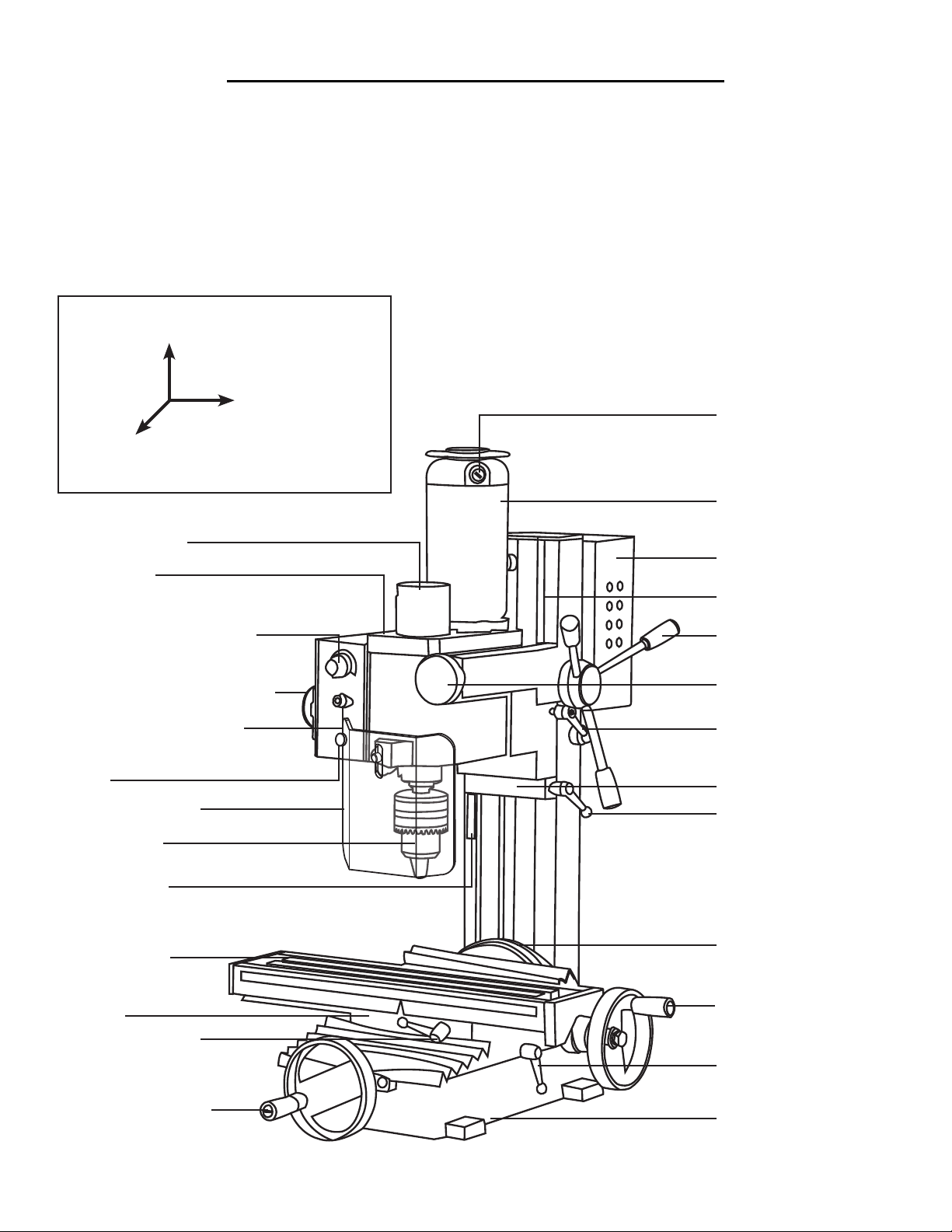
KNOW YOUR MILLING MACHINE
Carefully remove the tool and all contents from the packaging. Check all components and compare against the
machine and packing list diagrams. If any part is damaged or missing, please contact our customer service at (800)
232-1195, M-F 8-5 CST or email us at [email protected].
8
Motor
Carbon Brush Cap
(One on each side)
Electrical Box
Emergency Stop with Cover
Power Indication Light
Fuse
Protective Shield
Power Switch and
Speed Adjustment Knob
Headstock
Drawbar Cover
Drill Chuck
Depth Gauge
Worktable
(with T-slots)
Column
Saddle
Cross Feed Lock
Lever
Feed Handle (Z-axis)
Vertical Feed
Lock Lever
Base
Longitudinal Feed
Lock Lever
Bevel Gauge
Cross Feed
Handwheel (X-axis)
Depth Stop Block
Depth Stop Lock
Lever
Fine Feeding Wheel
Longitudinal Feed
Handwheel (Y-axis)
Vertical, Z-axis (up & down)
Cross, X-axis (left & right)
Longitudinal,
Y-axis (front & back)
X, Y, Z Axes
KNOW YOUR MILLING MACHINE
9
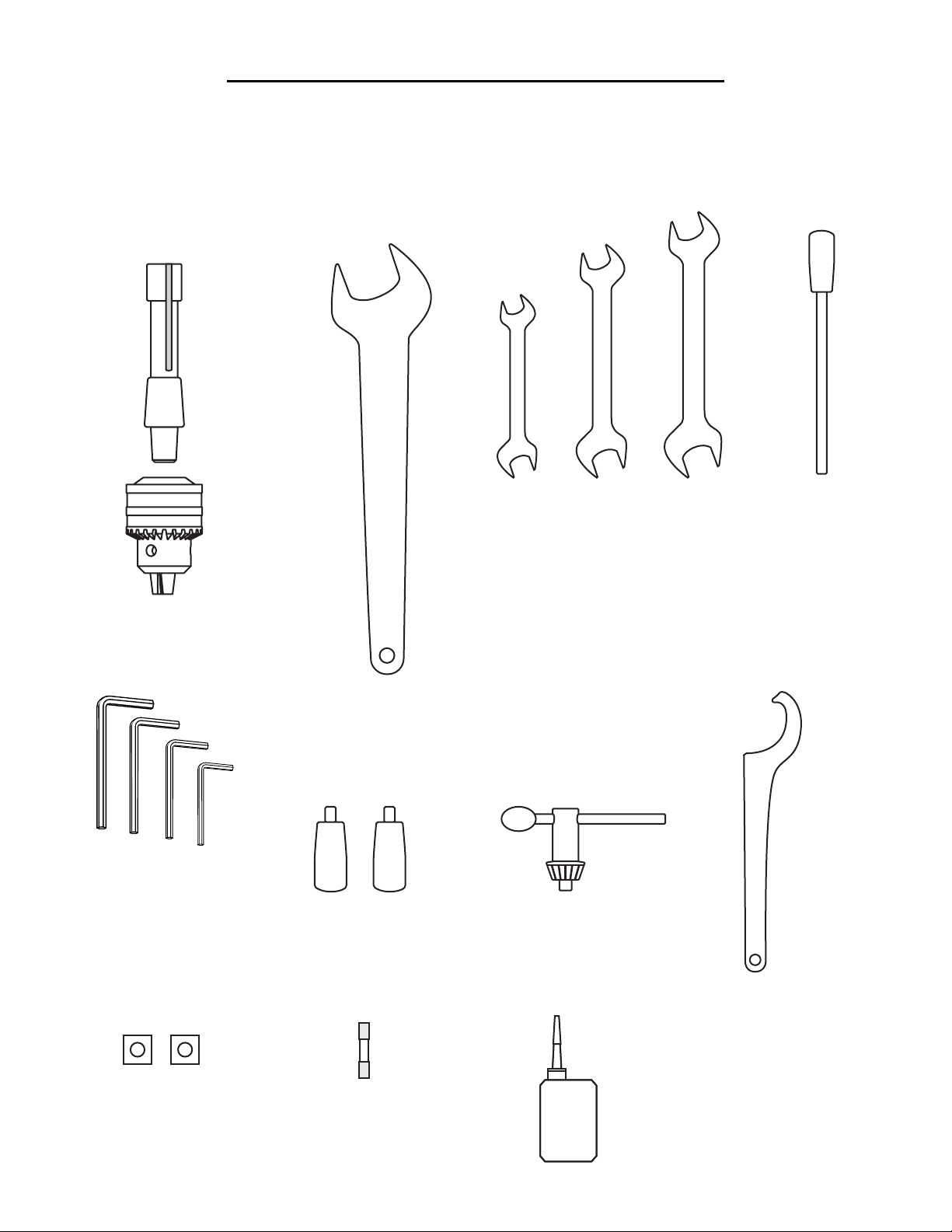
PACKING LIST
Drill Chuck &
Taper Shank
(Pre-installed, for holding
drill bits)
Handle x 2
(To be mounted onto
the handwheels)
Spindle Lock Rod
5A Spare Fuse
M10-1.5 T-Nut x 2
(For vise mounting on table)
Double End Wrench x 3
M8/M10 M14/M17 M17/M19
Large Wrench M36
(For loosening the bevel
lock nut)
Hex Wrench x 4
M3M4M5M6
Drill Chuck Key
(For tightening/loosening
the drill chuck)
Oil Bottle
(Comes without oil. Fill with
lubricating oil for dispensing)
Hook Spanner Wrench
D45-52

115mm 180mm
80mm 300mm
490mm
410mm
10mm4x
ASSEMBLY & PREPARATION
WARNING: To prevent injury from accidental operation, make sure the tool is switched OFF and un-
plugged from the power source before assembling the tool or making any adjustments.
Fig. 1
Fig. 2
10
CLEANING THE SURFACES
Your tool comes protected with a layer of heavy-duty anti-rust coating. Remove the protective coating from sur-
faces using a soft cloth, moistened with kerosene (do not use cellulose-based solvents such as paint thinner or
lacquer thinner, as these will damage the painted surfaces). Apply a light layer of good-quality machine oil onto the
machine’s surfaces to protect from rust and corrosion.
MOUNTING TO A BENCHTOP
For safe operation, the machine must be securely
mounted onto a flat, secure workbench. Place the
workbench away from direct sunlight, high moisture
or dust.
Position the machine on the benchtop and leave
enough space around the machine for table travel.
For unrestricted handwheel operation, make sure
the cross feed and longitudinal feed handwheels ex-
tend out beyond the edge of the benchtop. Square
the machine to the benchtop using a precision level.
Drill four 10 mm-diameter mounting holes on the
benchtop (same size as the machine’s mounting
hole). Mount the machine using four M10 bolts and
INSTALLING THE HANDLES
Install the two handles (Fig. 2 - 1) onto the longitudinal
feed handwheel and cross feed handwheel. Fully tighten
the handles.
PREPARING VISES TO SECURE WORKPIECE
A vise (not included) is a crucial attachment to hold your
workpiece in place when using the milling machine. You
can purchase a milling vise or quick vise that is suitable
for your workpiece and milling operation.
nuts (mounting hardware not included).
TIP: Your milling machine is compatible with the
WEN 6588 Multipurpose Planer Stand, available
at wenproducts.com. Forget measuring and drilling
holes on your workbench, simply mount your ma-
chine onto the mobile stand with pre-drilled holes,
and transport your machine around the workshop
with ease.
1
You may also use clamping kits to hold the workpieces to the machine’s worktable. Follow the instructions with your
accessory for proper installation and operation.
Tabla de contenidos
Otros manuales de Herramientas eléctricas de Wen

Wen
Wen 4206 Manual de usuario

Wen
Wen 3650 Manual de usuario

Wen
Wen 20314 Manual de usuario

Wen
Wen 4208 Manual de usuario

Wen
Wen JT630H Manual de usuario

Wen
Wen 4214 Manual de usuario

Wen
Wen 4214 Manual de lista de piezas

Wen
Wen 4206 Manual de usuario

Wen
Wen JT6561 Manual de usuario

Wen
Wen 4214 Manual de usuario


