TREND T12EL Manual de usuario

T12/T14
-2-
Fig. A
1
T12
T14
T14
2
4
12
16
20
17
15
14
18
19
8
9
11
10
7
3
6
5
13

T12/T14
-3-
Fig. B1
Fig. B3
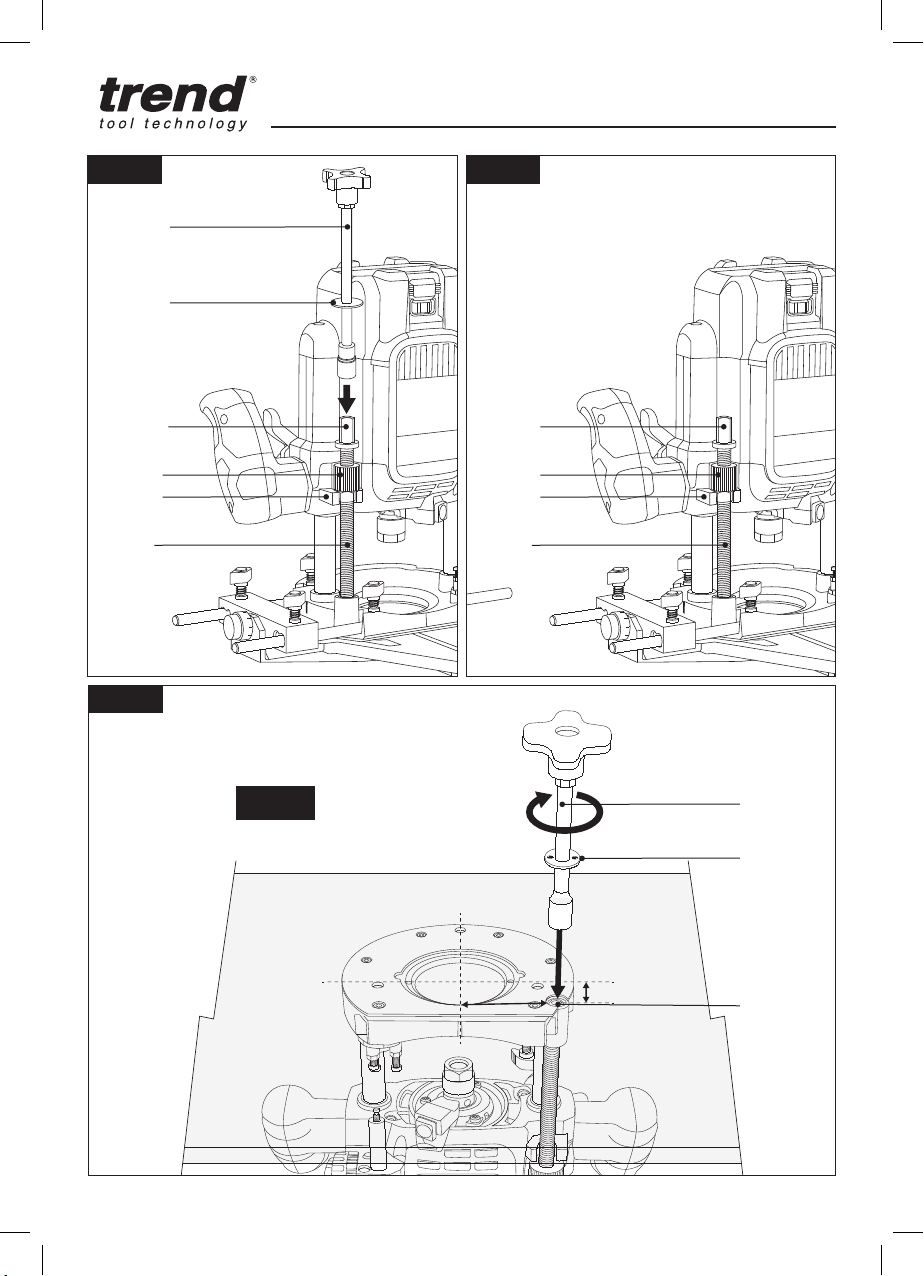
Fig. D
Fig. B2
Fig. C
Fig. C
45
6
7
9
35
54
14
16
17
12
18
15
19

T12/T14
-4-
Fig. F
Fig. H
Fig. G
Fig. I
Fig. E 11
10
55
30 31 29
28
27
57
8
9
10
58
60
24
59
25
4
51
5
T12
T14

T12/T14
-5-
1
1
2
3
4
Fig. L
Fig. N
Fig. M
Fig. O
Fig. J Fig. K
10
1028
28
2
53
2
26
10 52
36
37
34
32
33
26
28
29

T12/T14
-6-
Fig. Q
Fig. R
Fig. P
34
38
49
48
47
40
43
46
44
42
41
50
T14

T12/T14
-7-
Fig. S3
61
61
63
63
51 51
4 4
62 62
5 5
64
Fig. S1 Fig. S2
T14

EN - T12/T14
-8-
EN - T12 & T14
Thank you for purchasing this Trend product, we hope
you enjoy many years of creative and productive use.
Please remember to return your guarantee card within 28
days of purchase.
TECHNICAL DATA
T12EL T12E T14E
Voltage V AC 115 230 230
Type 1 1 1
Power input W 2100 2300 2300
No load speed min 1 9000
22000
9000
22000
9000
22000
Router carriage mm 2 column 2 column 2 column
Max cutter diameter
(Portable Router)
mm 50 50 50
Max cutter diameter
in table
mm 50 50 86
Collet size for Europe mm - 12 12
Collet size for UK
and ROI
inch 1/2 1/2 1/2
Weight kg 6.4 6.4 6.5
Noise values and vibration values (triax vector sum) according
to EN62841 2 17:
LPA (emission sound
pressure level)
dB(A) 94.2 95.1 95.1
LWA (sound power
level)
dB(A) 105.2 106.1 106.1
K (uncertainty for the
given sound level)
dB(A) 2.5 2.5 2.5
Vibration emission
value ah,hv =
m/s24.1 3.1 3.1
Uncertainty K = m/s20.31 0.31 0.31
The vibration and/or noise emission level given in this
information sheet has been measured in accordance
with a standardised test given in EN62841 and may be
used to compare one tool with another. It may be used
for a preliminary assessment of exposure.
WARNING: The declared vibration and/or
noise emission level represents the main applications
of the tool. However if the tool is used for different
applications, with different accessories or poorly
maintained, the vibration and/or noise emission may
differ. This may significantly increase the exposure level
over the total working period.
An estimation of the level of exposure to vibration and/or
noise should also take into account the times when the
tool is switched off or when it is running but not actually
doing the job. This may significantly reduce the exposure
level over the total working period.
Identify additional safety measures to protect the
operator from the effects of vibration and/or noise such
as: maintain the tool and the accessories, keep the
hands warm (relevant for vibration), organisation of work
patterns.
EC DECLARATION OF CONFORMITY
MACHINERY DIRECTIVE
T12E & T14E
Plunge Router
Trend Tool Technology Ltd declares that these products
described under Technical Data are in compliance with:
2006/42/EC, EN 62841-1:2015 + AC:2015; EN 62841-2-
17:2017.
These products also comply with Directive 2014/30/EU
and 2011/65/EU. For more information, please contact
Trend Tool Technology Ltd at the following address or
refer to the back of the manual.
The undersigned is responsible for compilation of the
technical file and makes this declaration on behalf of
Trend Tool Technology Ltd
Neil McMillan
Technical Director
Trend Tool Technology Ltd
Unit 6 Odhams Trading Estate
St Albans Road, Watford
Herts, WD24 7TR
United Kingdom
01/11/21
UK DECLARATION OF
CONFORMITY
THE SUPPLY OF MACHINERY
(SAFETY) REGULATIONS 2008
T12E & T14E
Plunge Router
Trend Tool Technology Ltd declares that these products
described under “technical data” are in compliance with:
The Supply of Machinery (Safety) Regulations, 2008,
S.I. 2008/1597 (as amended), BS EN 62841-1:2015 +
AC:2015; BS EN 62841- 2-17:2017.
Technical File Contact
Trend Tool Technology Ltd
3rd Floor, Kilmore House,
Park Lane, Spencer Dock,
Dublin 1, Ireland

EN - T12/T14
-9-
These products conform to the following UK Regulations
Electromagnetic Compatibility Regulations, 2016,
S.I.2016/1091 (as amended).
The Restriction of the Use of Certain Hazardous
Substances in Electrical and Electronic Equipment
Regulations 2012, S.I. 2012/3032 (as amended).
For more information, please contact Trend Tool
Technology Ltd at the following address or refer to the
back of the manual.
The undersigned is responsible for compilation of the
technical file and makes this declaration on behalf of
Trend Tool Technology Ltd .
Neil McMillan
Technical Director
Trend Tool Technology Ltd
Unit 6 Odhams Trading Estate
St Albans Road, Watford
Herts, WD24 7TR
United Kingdom
01/11/21
WARNING: To reduce the risk of injury, read
the instruction manual.
Definitions: Safety Guidelines
The definitions below describe the level of severity
for each signal word. Please read the manual and pay
attention to these symbols.
DANGER: Indicates an imminently hazardous
situation which, if not avoided, will result in death or
serious injury.
WARNING: Indicates a potentially hazardous
situation which, if not avoided, could result in death or
serious injury.
CAUTION: Indicates a potentially hazardous
situation which, if not avoided, may result in minor or
moderate injury.
NOTICE: Indicates a practice not related
to personal injury which, if not avoided, may result in
property damage.
Denotes risk of electric shock.
Denotes risk of fire.
GENERAL POWER TOOL SAFETY
WARNINGS
WARNING: Read all safety warnings,
instructions, illustrations and specifications
provided with this power tool. Failure to follow all
instructions listed below may result in electric shock, fire
and/or serious injury.
SAVE ALL WARNINGS AND
INSTRUCTIONS FOR FUTURE
REFERENCE
The term “power tool” in the warnings refers to your
mains- operated (corded) power tool or battery-operated
(cordless) power tool.
1) Work Area Safety
a) Keep work area clean and well lit. Cluttered or
dark areas invite accidents.
b) Do not operate power tools in explosive
atmospheres, such as in the presence of
flammable liquids, gases or dust. Power tools create
sparks which may ignite the dust or fumes.
c) Keep children and bystanders away while
operating a power tool. Distractions can cause you to
lose control.
2) Electrical Safety
a) Power tool plugs must match the outlet. Never
modify the plug in any way. Do not use any
adapter plugs with earthed (grounded) power
tools. Unmodified plugs and matching outlets will
reduce risk of electric shock.
b) Avoid body contact with earthed or grounded
surfaces such as pipes, radiators, ranges and
refrigerators. There is an increased risk of electric
shock if your body is earthed or grounded.
c) Do not expose power tools to rain or wet
conditions. Water entering a power tool will increase
the risk of electric shock.
d) Do not abuse the cord. Never use the cord for
carrying, pulling or unplugging the power tool.
Keep cord away from heat, oil, sharp edges or
moving parts. Damaged or entangled cords increase
the risk of electric shock.
e) When operating a power tool outdoors, use an
extension cord suitable for outdoor use. Use of a
cord suitable for outdoor use reduces the risk of electric
shock.

EN - T12/T14
-10-
f) If operating a power tool in a damp location is
unavoidable, use a residual current device (RCD)
protected supply. Use of an RCD reduces the risk of
electric shock.
3) Personal Safety
a) Stay alert, watch what you are doing and use
common sense when operating a power tool. Do
not use a power tool while you are tired or under
the influence of drugs, alcohol or medication. A
moment of inattention while operating power tools may
result in serious personal injury.
b) Use personal protective equipment. Always
wear eye protection. Protective equipment such as
dust mask, non-skid safety shoes, hard hat or hearing
protection used for appropriate conditions will reduce
personal injuries.
c) Prevent unintentional starting. Ensure the
switch is in the off-position before connecting to
power source and/or battery pack, picking up or
carrying the tool. Carrying power tools with your finger
on the switch or energising power tools that have the
switch on invites accidents.
d) Remove any adjusting key or wrench before
turning the power tool on. A wrench or a key left
attached to a rotating part of the power tool may result in
personal injury.
e) Do not overreach. Keep proper footing and
balance at all times. This enables better control of the
power tool in unexpected situations.
f) Dress properly. Do not wear loose clothing or
jewellery. Keep your hair and clothing away from
moving parts. Loose clothes, jewellery or long hair can
be caught in moving parts.
g) If devices are provided for the connection of
dust extraction and collection facilities, ensure
these are connected and properly used. Use of dust
collection can reduce dust-related hazards.
h) Do not let familiarity gained from frequent use
of tools allow you to become complacent and
ignore tool safety principles. A careless action can
cause severe injury within a fraction of a second.
4) Power Tool Use and Care
a) Do not force the power tool. Use the correct
power tool for your application. The correct power
tool will do the job better and safer at the rate for which
it was designed.
b) Do not use the power tool if the switch does
not turn it on and off. Any power tool that cannot be
controlled with the switch is dangerous and must be
repaired.
c) Disconnect the plug from the powersource and/
or the battery pack, if detachable, from the power
tool before making any adjustments, changing
accessories, or storing power tools. Such preventive
safety measures reduce the risk of starting the power
tool accidentally.
d) Store idle power tools out of the reach of
children and do not allow persons unfamiliar with
the power tool or these instructions to operate the
power tool. Power tools are dangerous in the hands of
untrained users.
e) Maintain power tools and accessories. Check
for misalignment or binding of moving parts,
breakage of parts and any other condition that
may affect the power tool’s operation. If damaged,
have the power tool repaired before use. Many
accidents are caused by poorly maintained power tools.
f) Keep cutting tools sharp and clean. Properly
maintained cutting tools with sharp cutting edges are
less likely to bind and are easier to control.
g) Use the power tool, accessories and tool bits,
etc. in accordance with these instructions, taking
into account the working conditions and the work
to be performed. Use of the power tool for operations
different from those intended could result in a hazardous
situation.
h) Keep handles and grasping surfaces dry, clean
and free from oil and grease. Slippery handles and
grasping surfaces do not allow for safe handling and
control of the tool in unexpected situations.
5) Service
a) Have your power tool serviced by a qualified
repair person using only identical replacement
parts. This will ensure that the safety of the power tool
is maintained.
Safety Instructions for Routers
a) Hold the power tool by insulated gripping
surfaces only, because the cutter may contact
its own cord. Cutting a “live” wire may make exposed
metal parts of the power tool “live” and could give the
operator an electrical shock.
b) Use clamps or another practical way to secure
and support the workpiece to a stable platform.
Holding the work by your hand or against the body
leaves it unstable and may lead to loss of control.
c) Keep handles dry, clean and free from oil and
grease. This will enable better control of the tool.
d) Maintain a firm grip with both hands on the tool
to resist starting torque. Maintain a firm grip on the
tool at all times while operating.
e) Keep hands away from cutting area above and
below the base. Never reach under the workpiece
for any reason. Keep the router base firmly in contact
with the workpiece when cutting.
Este manual sirve para los siguientes modelos
4
Tabla de contenidos
Idiomas:
Otros manuales de Herramientas eléctricas de TREND

TREND
TREND T5MK1 Manual de usuario

TREND
TREND T9 Manual de usuario

TREND
TREND T3-USA Manual de referencia

TREND
TREND T4 USA Manual de usuario

TREND
TREND PRT Manual de usuario

TREND
TREND T5E Manual de usuario

TREND
TREND T20 Manual de usuario

TREND
TREND pmn Manual de usuario

TREND
TREND KWJ900 Manual de usuario

TREND
TREND T1 Manual de usuario