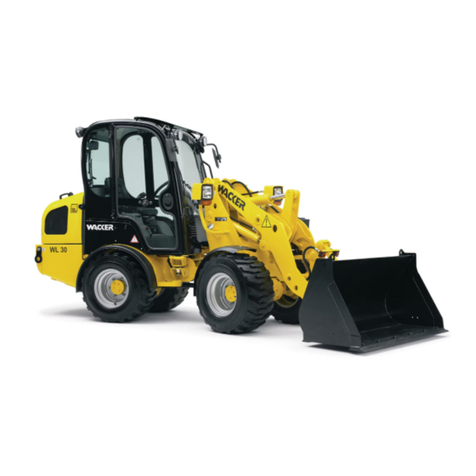
STARTING THE ENGINE: LOADING THE BUCKET:
With the "PAYLOADER" properly inspected and
checked as explained inthe preceding pages, the engine
may be started. Be sure the engine crankcase oil is
upto the "full" mark onthe oil dipstick and the cooling
system is full of cooling fluid. Be sure the hydraulic
reservoir contains the correct amount of oil. Be sure
the fuel line shut-off cock is open and the fuel tank
contains a sufficient supply of fuel.
1. Be sure the speed range lever and the valve con-
trol lever is inneutral position before attempting
to start the engine. Since the hydraulic pump is
coupled directl y to the engine, the hydraulic hoist
may be operated as soon as the engine is started.
To start the engine proceed as follows:
2. Place the ignition switch in "on" position.
3. Press the starter button. Pull out the choke
slightly to close the choke valve for easier start-
ing if necessary.
4. Whenthe engine starts, watch the oil gauge on the
dash to be sure it is registering. Allow the engine
to idle for a time, running without load until it
becomes warmed up. Push in the choke rod to
open the choke valve as soon as the engine will
run on aless enriched mixture. Follow this pro-
cedure whenever the engine is started.
STOPPING THE ENGINE:
To stop the engine, merely push in the ignition
switch to "off" position.
Be sure the valve control lever and the gearshift
levers are in neutral position before leaving the seat
of the machine.
DRIVING THE "PAYLOADER"
Skill in the use of the machine is acquired by
practice and by intelligent observation of the perfor-
mance of the machine. For instance, correct loading
of the bucket can be judged by the sound of the engine,
and the speed of the tractor.
1. Start the engine; when it has been running long
enough to warmuppartially, and oil pressure has
been built up as indicated on the dash gauge, the
"PAYLOADER" may be put to work.
2. Draw backwardonthevalve control lever to raise
the boom and bucket about two or three feet above
the ground.
3. Depres s the clutch and shift the directional lever
and the speed range lever into one of their posi-
tions, depending on direction and speed of travel
wanted.
4. Release the pressure on the clutch pedal while
increasing pressure on the accelerator pedal and
drive to the working area.
Shift to the low speed range when loading the
bucket. Have the bucket fully retracted and hold the
cutting edge at digging level. Drive the machine for-
ward into the bank or stock pile, letting the forward
movement of the machine fill the bucket.
The loading operation is best done on level or
slightly up-hill terrain. The inherent tendency is to
'dig in" when working down grade. Also, backing up-
hill with a heavy load is difficult due to the increased
weight on the drive wheels.
When the bucket is full or the end of the cut is
reached, pull backward on the boom lever to raise the
bucket out of the cut. As the bucket raises it will
crowd forward, into the face of the cut, exclusive of
the forward travel of the machine. This is especially
noticeable when cutting into a bank or stock pile. The
forward movement of the tractor and the bucket tip-
back feature will give a scooping action, similar to a
"dipper stick" shovel, as the bucket raises out of the
stock pile or face of the bank being cut. As the bucket
raises, it tips back to hold a full load with minimum
spillage.
TRANSPORTING LOADS:
When transporting loads, the travel speed of the
machine will depend on the length of haul and the kind
of surface over which the machine must pass. Rough
terrain calls for slow speed.
When the bucket is full, raise the boom to carry
the cutting edge of the bucket about four (4) feet above
the ground. Never transport the machine, loaded or
empty, with the bucket fully raised. The nearer the
ground the bucket is held, the bette r the stability,
especially on slopes or when turning the machine.
Shift the gears into position for speed and direction of
travel desired, and drive the machine to the dumping
location.
DUMPING THE BUCKET:
When dumping into a truck or bin, raise the
bucket so it clears the top edge safely. Move the
machine up so the bucket is inside the dumping area.
With the boom lever in the hold or neutral position,
push forward slowly on the bucket control lever, thus
causing the bucket to tip forward and spill its load.
The load may be dumped entirely or part at a time,
by manipulating the bucket lever. Dumping the load
slowly will ease the shock of suddently added weight
to a truck body. Releasing pressure on the bucket
control lever will allow it to return to neutral, holding
the bucket in dumped position. Pull backward on the
bucket control lever, to return the bucket to closed
position, before backing the machine away from the
dumping area. Back the machine well away from the
truck or bin and lower the bucket to carry position
[about
four (4) feet above the ground) before returning
the machine for another load.
8