
Team Losi MultiPro Manual de usuario

INTRODUCTION
INTRODUCTION
Specifications
01
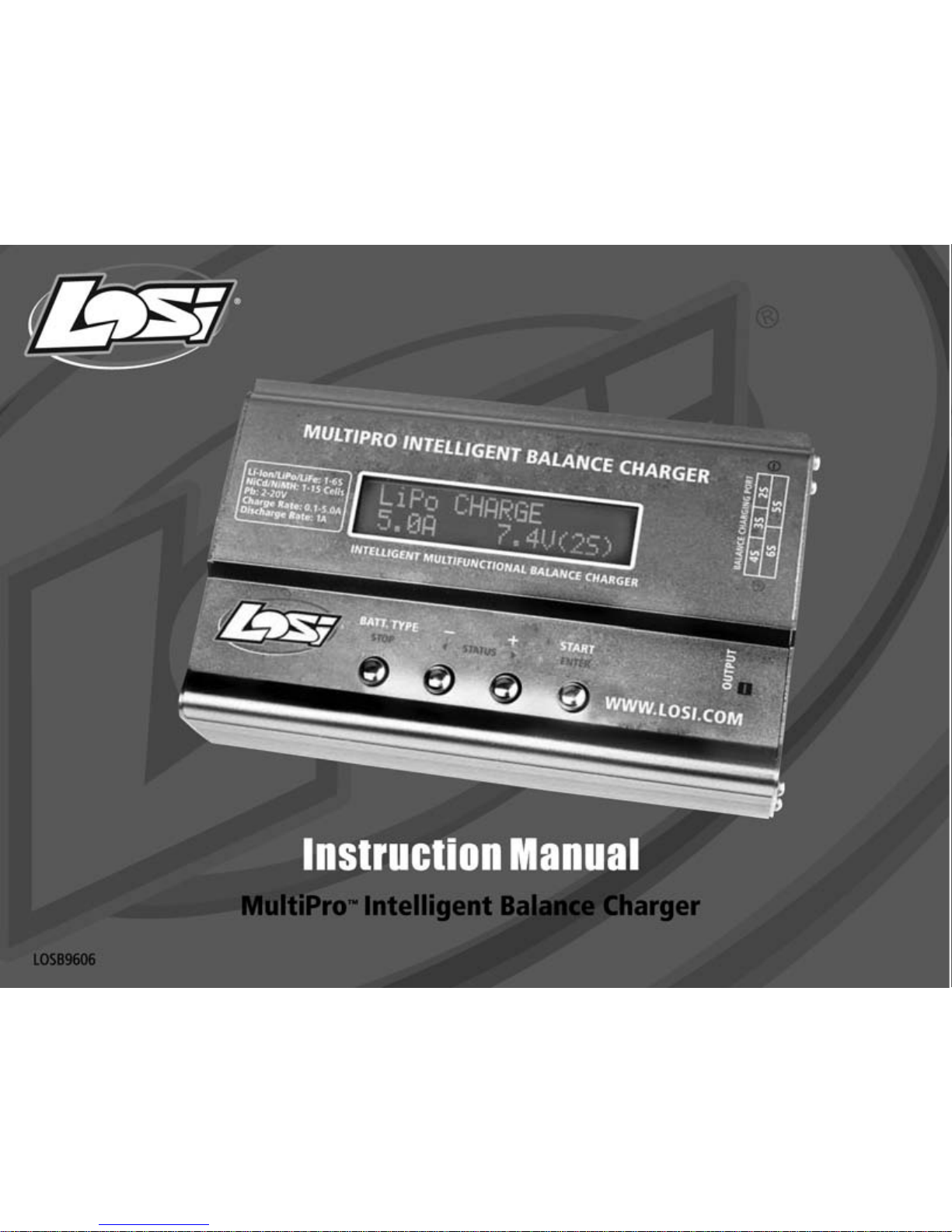
Thank you for purchasing the MultiPro™ Intelligent Balance Charger by Losi.This product is a
rapid charger with a high performance microprocessor and specialized operating software. Please
read this operating manual completely before using this product.
Operating voltage range:
Circuit power:
Charge current range:
Discharge current range:
Current drain for balancing LiPo:
NiCd/NiMH battery cell count:
Li-ion/LiPo cell count:
Pb battery voltage:
Weight:
Dimensions:
DC 11.0 - 18.0 V
AC to DC adapter (DC 11.0 - 18.0 V/5 A)
Max. charge power 50 W
Max. discharge power 5 W
0.1-5.0 A
0.1-1.0 A
300 mAh/cell
1-15 cells
1-6 series
2 - 20 V
227 g (net weight)
133 x 87 x 33 mm)

SPECIAL FEATURES
SPECIAL FEATURES
Optimized operating software
Internal independent lithium battery balancer
Balancing individual cells while battery is discharging
Adaptable to various types of lithium batteries
Fast and storage mode
02
The MultiPro™ charger features an automatic charging function that sets the operating current during the
process of charging or discharging.This can prevent overcharging of lithium batteries which could lead to a
battery fire or explosion. It will disconnect the circuit automatically and alarm the user once a malfunction is
detected. All programs on this charger are controlled through two-way communication, achieving maximum
safety and ease-of-use. All settings are user configurable.
This charger employs an individual-cell voltage balancer. It isn’t necessary to connect an external balancer for
balance charging.
During the process of discharging, this charger can monitor and balance each cell of the battery individually. If the
charger detects that the voltage of any single cell is abnormal, an error message will be displayed and the process
will be ended automatically.
The ‘fast’ mode is used to reduce the charge duration, whereas the ‘storage’ mode can control the final voltage of
the battery. This will allow long-term storage of the battery and protect the useful life of the battery.
This charger can charge various types of lithium batteries including Li-ion, LiPo, and the new LiFe batteries.
Maximum safety
SPECIAL FEATURES
Automatic charging current limit
Capacity limit
Temperature threshold*
Processing time limit
Input power monitoring
Data store/load
03
Delta-peak sensitivity: The automatic charge termination is based on the principle of delta-peak voltage
detection.When the battery’s voltage exceeds the threshold, the process will be terminated automatically.
You can set the upper limit of the charging current when charging NiCd and NiMH batteries.This is useful for
NiMH batteries of low impedance and capacity when using the ‘AUTO’ charging mode.
The charging capacity is calculated as the charging current multiplied by time. If the charging capacity exceeds
the limit, the process will be terminated automatically when it reaches the maximum value you have set.
To protect your car’s battery from being over discharged when used as the DC power input, the voltage is
continuously monitored. If the voltage drops below the lower limit, the process will be ended automatically.
Data for a maximum of five batteries can be stored for your convenience.You can store data pertaining to
program settings of the battery for continuous charging or discharging.Users can recall this data at any time
without any special program setting.
The battery’s internal chemical reaction will cause the temperatue of the battery to rise. If the temperature limit
is reached, the process will be terminated automatically.*
* This function is available by connecting the optional temperature probe, not included.
You can also limit the maximum process time to avoid overcharging your battery.

Cyclic charging/discharging
SPECIAL FEATURES
04
One to five cycles and continuous process of charge<>discharge to help balance and stimulate the battery’s
activity.

WARNING:
WARNING:
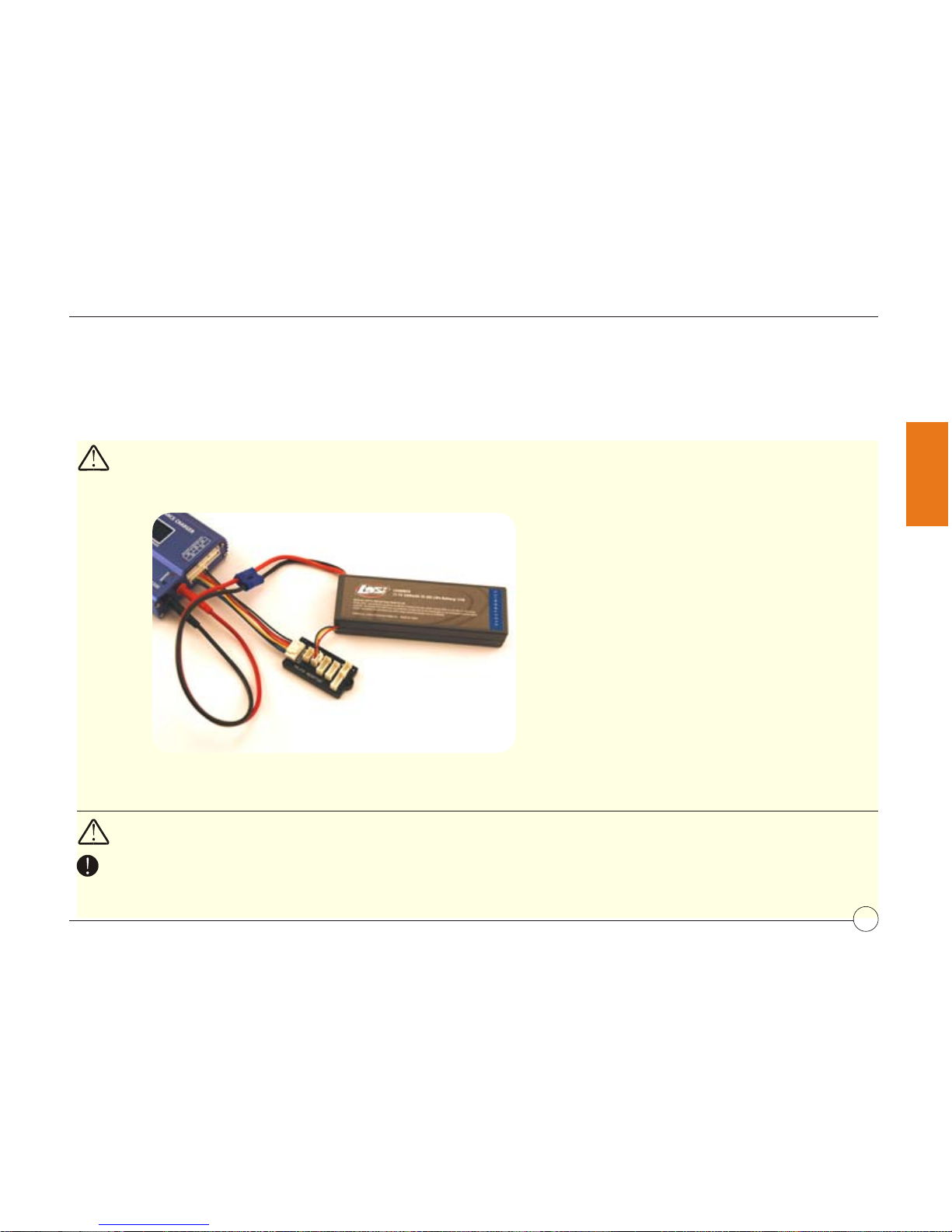
LITHIUM POLYMER BALANCE CHARGE PROGRAM
CONNECTION DIAGRAM
LITHIUM POLYMER BALANCE CHARGE PROGRAM
CONNECTION DIAGRAM
06
This diagram shows the correct way to connect your battery to the MultiPro™ charger while charging in the
balance charge program mode.
Failure to connect as shown in this diagram will damage the charger.
The main battery leads must be connected along with the balance lead connectors as shown before charging
your battery. Pay close attention to the polarity of the main battery leads.
If using crocodile clips be sure they are unable to touch together!
WARNING AND SAFETY NOTES
WARNING AND SAFETY NOTES
07
These warnings and safety notes are particularly important. Please follow the instructions for maximum
safety; otherwise the charger and the battery can be damaged or, at worst, it can cause a fire.
Never leave the charger unattended when it is connected to its power supply. If any malfunction is found,
TERMINATE THE PROCESS AT ONCE and refer to the operation manual.
This charger and the battery should both be placed on a heat-resistant, non-flammable and non-
conductive surface. Never place them on a car seat, carpet, or similar surface.Keep all flammable and
volatile materials away from the operating area.
Make sure you know the specifications of the battery to be charged or discharged to ensure it meets the
requirements of this charger. If the program is set up incorretly, the battery and charger may be damaged.
Improper settings can cause the battery to become overcharged potentially leading to fire or explosion.
This warranty is not valid for any damage or subsequent damage arising as a result of misuse or failure to
observe the procedures outlined in this manual.
Keep the charger well away from dust, dampness, rain, heat, direct sunshine, and vibration. Never drop it.
The allowable input voltage is 11-18V DC

NiCd/NiMH
Voltage level: 1.2V/cell
Allowable fast charge current: 1-2C (depending upon the performance of the cell)
Discharge voltage cutoff level: 0.85V/cell (NiCd), 1.0V/cell (NiMH)
Li-ion
Voltage level: 3.6V/cell
Max. charge voltage: 4.1V/cell
Allowable fast charge current: 1C or less
Discharge voltage cutoff level: 2.5V/cell or higher
LiPo
Voltage level: 3.7V/cell
Max. charge voltage: 4.2V/cell
Allowable fast charge current: 1C or less
Discharge voltage cutoff level: 3.0V/cell or higher
LiFe
Voltage level: 3.3V/cell
Max. charge voltage: 3.6V/cell
Allowable fast charge current: 4C or less
Discharge voltage cutoff level: 2.0 V/cell or higher
Pb
Voltage level: 2.0V/cell
Max. charge voltage (lead-acid): 2.46V/cell
Allowable fast charge current: 0.4C or less
Discharge voltage cutoff level: 1.75V/cell or higher
WARNING AND SAFETY NOTES
08
WARNING AND SAFETY NOTES
09
To avoid short circuit between the charge leads, always connect the charge cable to the charger first, then
connect the battery. Reverse the sequence when disconnecting.
Do not connect more than one battery pack to this charger at any time.
Never attempt to charge or discharge the following types of batteries:
A battery pack which consists of different types of cells (including different manufacturers).
A battery that is already fully charged or just slightly discharged.
Nonrechargeable batteries (explosion hazard).
Batteries that require a different charge technique from NiCd, NiMH, LiPo, or Gel cell (Pb, lead
acid).
A faulty or damaged battery.
A battery fitted with an integral charge circuit or a protection circuit.
Batteries installed in a device or which are electrically linked to other components.
Batteries that are not expressly stated by the manufacturer as suitable for the current the
charger delivers during the charging process.
Tabla de contenidos
Otros manuales de Cargador de baterías de Team Losi


