Model 5422A User Guide Issue 1, September 2021
Studio Technologies, Inc. Page 7
Model 5422A
DANTE INTERCOM AUDIO ENGINE
Pass-thru can also be used as a simple means of adjusting
the level of one or more Dante signals. Using the Model
5422A’s web menu pages, the level of each input and
output channel can be independently adjusted over a ±20
dB range. With the unit’s ability to support AES67 and the
Dante Domain Manager (DDM) application, many special-
ized interfacing tasks can be accomplished.
IFB
The IFB operating mode is specifically included for produc-
tions that utilize the Remote Integration (REMI) or At-Home
model where production personnel are located physically
apart from on-air talent. “Interruptible foldback” (IFB) talent
cue signals, each typically created from a program audio
source and a voice-only interrupt source, are critical for
supporting the needs of on-air personnel. Creating these
in a REMI environment can be challenging. However, by
utilizing the Model 5422A’s IFB capability this can become
a simple matter. Each IFB function uses two Dante input
channels (program audio and interrupt audio) and provides
two Dante output channels (program with interrupt and
program-only). Configuration choices allow the presence
of interrupt audio to be recognized by voice-detect (VOX)
or tone-detect (TOX) algorithms. Each will allow creation
of excellent talent cueing “feeds.” However, TOX provides
a unique operating scenario where an 18 kHz (nominal)
tone, combined with interrupt audio, can reliably activate
and deactivate an IFB function. In this way, an IFB-ac-
tive signal provided by way of a proprietary data link isn’t
required for fully “pro” IFB signals to be created. During
interrupt activity the program audio can be attenuated (or
fully muted) following a configurable parameter. A Model
5422A can have as few as two independent IFB functions
by selecting a 4-channel group. Selecting a 32-channel
group can provide 16 independent IFB functions. As such,
using a Model 5422A-02 allows the creation of up to 32
independent IFB functions.
Audio Switching
When a group is configured for Audio Switching operation
a high-frequency tone controls the routing of an audio
input source to one of two outputs. The control tone is
connected to a separate Dante input, allowing full isolation
between the input audio source and the control tone signal.
An audio source is connected to a Dante receiver (input)
channel and then routed to a designated Dante transmit-
ter (output) channel when a control signal is not present.
This is the “normally active” input-to-output path. When
the Audio Switching function’s tone-detect (TOX) resource
recognizes the presence of a high-frequency control tone
the audio input source is muted on the normally active
output and routed to the normally inactive output. When
the high-frequency control tone is no longer present the
switching action is reversed.
The Audio Switching function could be described as logi-
cally implementing a “form-C” relay or SPDT switch contact
action. (Although the audio signal will only flow from the one
input to the two outputs.) The switching action is always
performed with no clicks, “pops,” or other audio artifacts
added; full audio fidelity is preserved. The Audio Switching
function can be useful for a wide range of applications. A
single channel of audio can be controlled for broadcast ap-
plications with the audio source and control tone originating
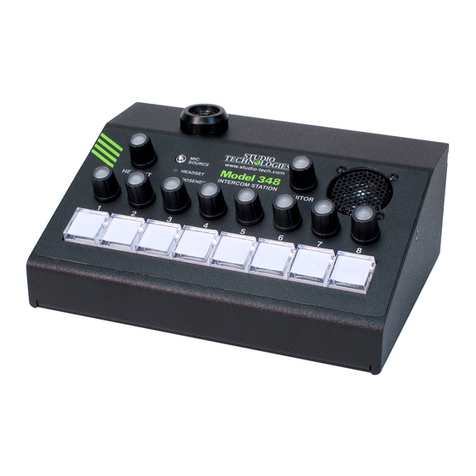
at separate locations. Devices such as the Studio Technolo-
gies’ Model 348 Intercom Station can generate compatible
audio control tones. Multiple Audio Switching functions can
be easily configured to allow support for multi-channel ap-
plications. For example, a single control tone could be used
to control audio signals passing through to a 16-, 24-, or
32-channel loudspeaker playback system.
Channel Level Adjustment and Labeling
The nominal level of each Dante receiver (input) channel
and Dante transmitter (output) channel can be individually
adjusted. This would apply to the 32 channels associated
with the Model 5422A-01 and the 64 channels with the
Model 5422A-02. The adjustment range is ±20 dB in 1-dB
steps. This capability can be useful when using a Model
5422A to interface various pieces of equipment that may
have different internal operating levels.
The Model 5422A includes extensive capabilities to allow
the labeling (naming) of Dante audio channels. This can
help ensure that the specific configuration selected for a
Model 5422A can be understood by other technical person-
nel. In this way, changes to channel labels won’t require the
use of the Dante Controller application although the labeling
conventions are, of course, fully compatible.
Flexible Networking Capability
Using the Dante Controller application program, the Model
5422A’s three Gigabit Ethernet ports can be selected
to operate in one of four modes: Switched, Redundant,
Switched+Mgmt, and Redundant+Mgmt. This should
allow virtually any desired networking implementation to
be easily achieved.
In the Switched mode a single Ethernet connection to
either of the Model 5422A’s two Dante Ethernet ports will
provide connectivity to the associated Dante network. The
remaining Dante Ethernet port will provide Dante network
“loop-through” capability and can be used to interface with
another piece of Ethernet-connected equipment. The man-
agement Ethernet port will be used to access the Model
5422A’s monitoring and configuration webpages.
In the Redundant mode two independent Ethernet connec-
tions are made to the Model 5422A’s two Dante Ethernet
ports, enabling Dante’s redundant networking capabil-