
Stanford Research Systems SIM923A Manual de operación

Operation and Service Manual
RTD Temperature Monitor
SIM923A
Stanford Research Systems
Revision 1.4 •August 24, 2006

Certification
Stanford Research Systems certifies that this product met its published specifications at the time
of shipment.
Warranty
This Stanford Research Systems product is warranted against defects in materials and workman-
ship for a period of one (1) year from the date of shipment.
Service
For warranty service or repair, this product must be returned to a Stanford Research Systems
authorized service facility. Contact Stanford Research Systems or an authorized representative
before returning this product for repair.
Information in this document is subject to change without notice.
Copyright c
Stanford Research Systems, Inc., 2004 – 2006. All rights reserved.
Stanford Research Systems, Inc.
1290–D Reamwood Avenue
Sunnyvale, CA 94089 USA
Phone: (408) 744-9040 •Fax: (408) 744-9049
Printed in U.S.A. Document number 9-01580-903
SIM923A RTD Temperature Monitor

Contents
General Information iii
Service .............................. iii
Symbols ............................. iv
Notation ............................. v
Specifications .......................... vi
1 Getting Started 1 – 1
1.1 Introduction to the Instrument . . . . . . . . . . . . . 1 – 2
1.2 Front-Panel Operation . . . . . . . . . . . . . . . . . . 1 – 2
1.3 Sensor Interface . . . . . . . . . . . . . . . . . . . . . . 1 – 4
1.4 SIMInterface........................ 1–6
2 Remote Operation 2 – 1
2.1 Index of Common Commands . . . . . . . . . . . . . . 2 – 2
2.2 Alphabetic List of Commands . . . . . . . . . . . . . . 2 – 4
2.3 Introduction ........................ 2–6
2.4 Commands......................... 2–7
2.5 StatusModel........................ 2–19
i

ii Contents
SIM923A RTD Temperature Monitor

General Information
The SIM923A RTD Temperature Monitor, part of Stanford Research
Systems’ Small Instrumentation Modules family, consists of a single-
channel sensor excitation and readout for precision low-noise resis-
tive thermometry. Front-panel analog outputs provide both scaled
(linear voltage proportional to temperature) and raw (buffered sensor
voltage) signals. Two reversable DC current sources (10 µA & 1 mA)
provide sensor excitation to the four-wire measurement circuit.
Service
Do not install substitute parts or perform any unauthorized modifi-
cations to this instrument.
The SIM923A is a single-wide module designed to be used inside the
SIM900 Mainframe. Do not turn on the power until the module is
completely inserted into the mainframe and locked in place.
iii

iv General Information
Symbols you may Find on SRS Products
Symbol Description
Alternating current
Caution - risk of electric shock
Frame or chassis terminal
Caution - refer to accompanying documents
Earth (ground) terminal
Battery
Fuse
On (supply)
Off (supply)
SIM923A RTD Temperature Monitor

General Information v
Notation
The following notation will be used throughout this manual:
•Front-panel buttons are set as [Button];
[Adjust ] is shorthand for “[Adjust ] & [Adjust ]”.
•Front-panel indicators are set as Overload.
•Remote command names are set as *IDN?.
•Literal text other than command names is set as OFF.
SIM923A RTD Temperature Monitor
vi General Information
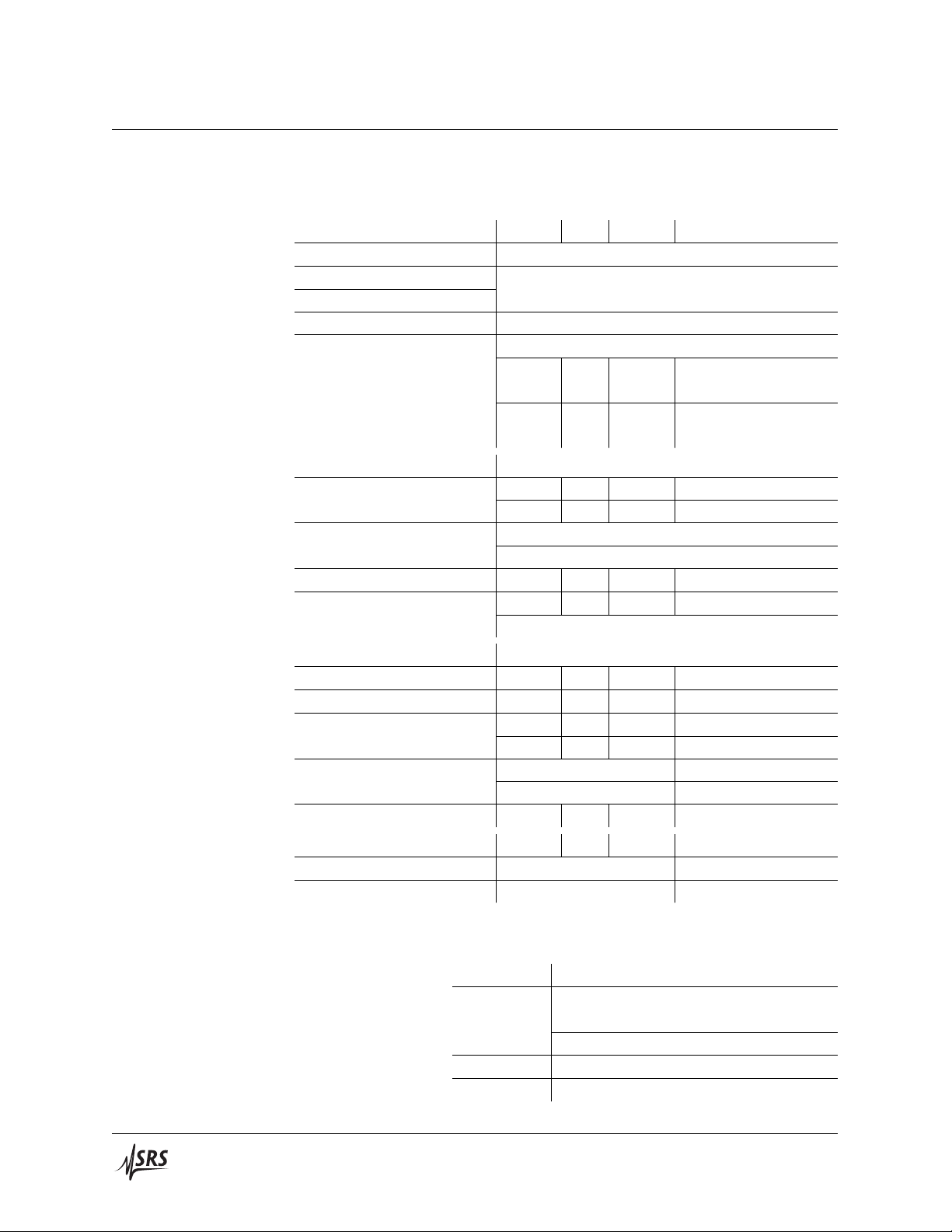
Specifications
Performance Characteristics
Min Typ Max Units
Inputs Number of inputs 1
Sensor type Platinum RTD or other resistive
sensor (either PTC or NTC)
Measurement type 4–wire
Excitation constant current
(10 µA setting) 9.999 10 10.001 µA DC
±15 ppm/◦C
(1 mA setting) 0.9999 1.0 1.0001 mA DC
±15 ppm/◦C
Sensor Characteristics Sensor units Ohms
sensor+lead resistance 1400 Ω(1 mA exc.)
140 kΩ(10 µA exc.)
Calibration curves built-in: IEC 751/DIN 43760
1 user defined curve
Curve size 1024 points
Temperature range 1.4 873 K (typical)
sensor dependent
Measurement Measurement Rate 5 readings per second
Display resolution 4 digits
Interface resolution 7 digits
Measurement resolution 1.2 mΩrms (1 mA exc.)
120 mΩrms (10 µA exc.)
Accuracy, (23 ±1)◦C 5 mΩ + 0.01 % (1 mA exc.)
0.5 Ω + 0.01 % (10 µA exc.)
Temperature coefficient −5+5 ppm/◦C
Operating Temperature 0 40 ◦C
Power ±15,+5 V DC
Supply current 50 (±15 V), 250 (+5 V) mA
General Characteristics
Interface Serial (RS-232) through SIM interface
Connectors DB–9 (female)
4–wire measurement +ground
DB–15 (male) SIM interface
Weight 1.4 lbs
Dimensions 1.500 W×3.600 H×7.000 D
SIM923A RTD Temperature Monitor

1 Getting Started
This chapter gives you the necessary information to get started
quickly with the SIM923A RTD Temperature Monitor.
In This Chapter
1.1 Introduction to the Instrument . . . . . . . . . . . . 1 – 2
1.1.1 Overview .................... 1–2
1.2 Front-Panel Operation . . . . . . . . . . . . . . . . . 1 – 2
1.2.1 Excitation . . . . . . . . . . . . . . . . . . . . 1 – 2
1.2.2 Units....................... 1–2
1.2.3 Reverse...................... 1–3
1.2.4 Setpoint ..................... 1–4
1.2.5 Scaled Output . . . . . . . . . . . . . . . . . . 1 – 4
1.3 Sensor Interface . . . . . . . . . . . . . . . . . . . . . 1 – 4
1.3.1 Four-wire measurement . . . . . . . . . . . . 1 – 4
1.3.2 Two-wire measurement . . . . . . . . . . . . 1 – 5
1.4 SIMInterface ...................... 1–6
1.4.1 SIM interface connector . . . . . . . . . . . . 1 – 6
1.4.2 Direct interfacing . . . . . . . . . . . . . . . . 1 – 6
1–1

1–2 Getting Started
1.1 Introduction to the Instrument
The SIM923A RTD Temperature Monitor provides excitation and
readout for a single resistive temperature detector (RTD). Analog
outputs, both proportional to temperature and the buffered sensor
voltage, are available on the front panel.
1.1.1 Overview
The SIM923A uses a ratiometric design, where the excitation current
is passed through both an internal, stable reference resistor and the
user’s resistive thermometer. The instrument measures the ratio
of the voltage across the user’s resistor to the voltage across the
reference resistor, multiplied by the (known) value of the reference
resistor, to obtain the user result.
Two separate excitation and reference circuits are included in the
SIM923A, a 1 mA excitation appropriate for ∼1 kΩfull-scale mea-
surements, and a 10 µA excitation useable for up to ∼100 kΩfull-
scale measurements. The excitation is also reversable, permitting the
user to test for potential offset voltages in the setup.
A precision 24–bit analog-to-digital converter records the results.
New sensor measurements are available at a rate of 5 conversions
per second.
1.2 Front-Panel Operation
The front panel of the SIM923A(see Figure 1.1) provides a simple
operator interface.
1.2.1 Excitation
The current source of the SIM923A RTD Temperature Monitor can
be fully controlled from the front panel.
To select between 10 µA and 1 mA briefly tap [Excitation]. To toggle
the current on and off,hold [Excitation] for about 1 second, until the
display switches between the numerical result and the word .
The excitation can also be controlled with the EXCIand EXONremote
interface commands.
1.2.2 Units
The SIM923A displays results either as raw sensor units (in ohms) or
temperature (in kelvin). Pressing [Units] toggles between these two
modes; the active units are indicated by the illuminated K, or Ω(or
SIM923A RTD Temperature Monitor
Tabla de contenidos


