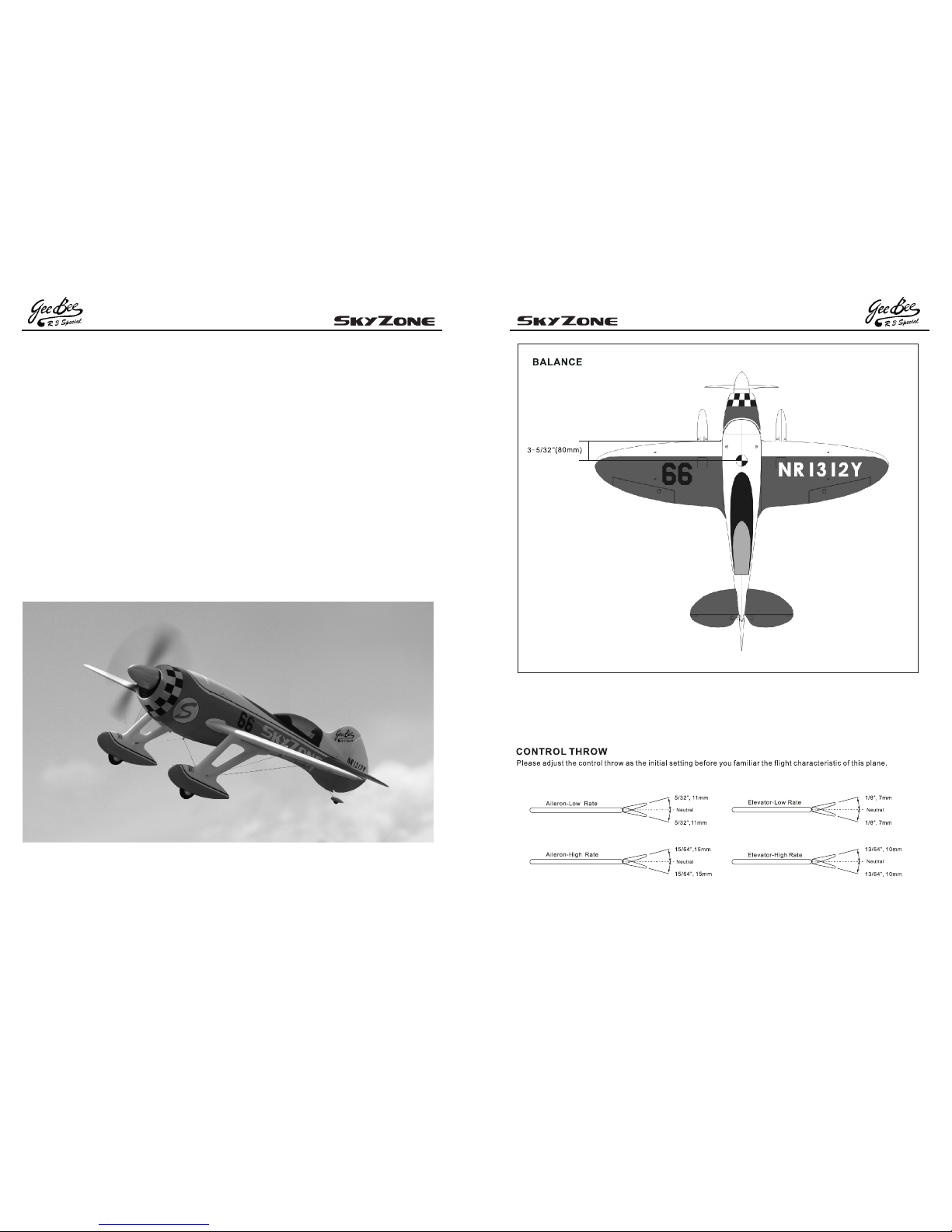
INTRODUCTION
!Congratulations on the purchase of the EPO Pylon Racer, the Gee Bee R3. Replica from the most popular
pylon racer in the world that will make you outstand at your local flying field. Please follow the manual and
complete the final assembly, we hope you can enjoy the flying of this racer.
CAUTION
Before beginning the assembly read the instructions thoroughly to give an understanding of the sequence
of steps and a general awareness of the recommended assembly procedures. By following these
instructions carefully and referring to the corresponding pictures, the assembly of your model will be both
enjoyable and rewarding. The result will be a well built, easy to fly plane.
The Gee Bee R3 is designed for intermediate to advance pilots and it requires basic flying skill.
PRE-ASSEMBLEY NOTES
1.Please assemble your model according to this instruction manual. Do not attempt to modify or change
your model in any way as doing so may adversely change its flying characteristics. Doing so will be out
of warranty.
2.The plane is almost assembled, a lot of assembly steps are finished by factory craftsman. Only a few
final assembly steps that will need user to do.
3.Before you begin please check entire contents of this kit against the exploded photos on the side panel
of the color box. If you find that any parts are either missing or damaged, please contact our dealer
immediately for replacement. Note: Your dealer cannot accept kit from return if assembly has begun.
COMBO PLUS VERSION CONTENTS
Semi- assembled Airplane
Motor: Outrunner 800KV (AS9270SZ)
BLC-30: Skyzone BLC-30A ( AS9271SZ)
Servo: 2 Micro ( AS9233SZ), 2 Mini Servos( AS9272SZ)
OTHER ITEMS REQUIRED FOR COMBO PLUS VERSION
Radio: A 4CH Radio control system
Battery: 3S1P 11.1V 2200mAh Lipo Battery
Charger: Equivalent 3S Balance Charger
USING YOUR NEW ESC
Improper polarity or short circuit will damage the ESC, this beyond our warranty.
Alert Tone s
The Skyzone ESC is equipped with audible alert tones to indicate abnormal conditions at power up.
1.Continuous beeping tone (****) Indicates that throttle stick is not in the minimum position.
2.Single beeping tone followed by a one second pause (* * * *) Indicates that the battery pack voltage
exceeds the acceptable range. (The ESC automatically checks and verifies the battery voltage once
the battery is connected).
BUILT-IN IN TELLIGENT ESC SAFETY FUNCTIONS.
1.Over-heat protection: When the temperature of ESC exceeds 110℃ until it below 110℃.
2.Throttle Signal Lost Protection: The ESC will automatically cut off the power to the motor when it
detects a lost of throttle signal for 2 seconds, then the motor will emit continuous beeping tone.
POWERING UP THE ESC FOR THE FIRST TIME & SETTING THE AU TOMATIC
THROTTLE CALI BRATION
Features Automatic Throttle Calibration to attain the smoothest throttle response and resolution
throughout the entire throttle range of your transmitter. This step is done once to allow the ESC to “learn
and memorize” your transmitter's throttle output signals and only repeated if you change your
transmitter.
1.Switch your transmitter ON and set the throttle stick to highest position.
2.Connect the battery pack to the ESC. Wait for about 2 seconds, the motor will beep for twice, then put
the throttle to the lowest position, the motor will also beep, which indicates that your ESC has got the
signal range of the throttle from your transmitter.
The throttle is now calibrated and your ESC is ready for operation.
ENTERING THE PROGRAMMING MODE
1.Switch your transmitter ON and set the throttle to its highest position.
2.Connect the battery pack to the ESC.
3.Wait until you hear two short beeps (●● ●● ●● ●●) , the ESC is now in programming mode.
4.With the throttle stick at highest position, there will be another beeps(_●) about 5 seconds, the
Programming is ready to start the sequence as reference table that you can set up the desired function.
5.When reaching the desired function by recognizing the tones, move throttle stick to lowest position.
6.The ESC will emit two beeps (_●) and the function is stored.
7.The programming procedure is stop as it allows one setting of function each time.
8.Switch off the power for few seconds before next setting or using.
GENERAL SAFETY PRECAUTIONS
1.Do not install the propeller (fixed wing) or drive pinion(helicopter) on the motor when you test the ESC
and motor for
the first time until you make sure the settings on radio is correct.
2.Never use ruptured or punctured battery cells.
3.Never use battery packs that are known to overheat.
4.Never use short circuit battery or motor terminals.
5.Always use proper insulation material for cable insulation.
6.Always use proper cable connectors.
WRONG BATTERY POLARITY WILL DAMAGE THE ESC AND VOID THE WARRANTY
1.Use only batteries that are supported by the ESC and ensure the correct polarity before connecting.
2.Always TX power on first and power off last.
3.Ensure the throttle stick is in the lowest position before connecting the battery pack.
4.Only connect your battery pack just before flying and do not leave your battery pack connected after
flying.
5.Handle your model with extreme care once the battery pack is connected and keep away from the
propeller at all
times. Never stand in-line or directly in front of any rotating parts.
6.Do not get wet of your ESC.