SKI CS1800C-00 Manual de usuario

WARNING: To reduce the risk of injury, the user must read and understand the
Owner’s Manual before using this product. Save these instructions for future reference.
AVERTISSEMENT : Afin de réduire les risques de blessure, l’utilisateur doit lire et
comprendre le guide d’utilisation avant d’utiliser cet article. Conservez le présent guide
afin de pouvoir le consulter ultérieurement.
ADVERTENCIA : Para reducir el riesgo de lesiones, el usuario debe leer y comprender
el Manual del operador antes de utilizar este producto. Guarde estas instrucciones para
consultarlas en caso sea necesario.
Owner’s Manual
Guide d’utilisation
Manual del propietario
For Customer Service
Pour le service à la clientèle
Servicio al cliente 1-877-SKIL-999 OR www.skil.com
Brushless 40V 18" Chain Saw
Scie à chaîne sans balais de 40 V, 18 po
Motosierra de 18 pulgadas de 40 V sin escobillas
Model/ Modelo/ Modèle: CS1800C-00

2
TABLE OF CONTENTS
General Machine Safety Warnings..................................3
Chain Saw Safety Warnings .......................................5
Additional Warnings .............................................8
Symbols ......................................................10
Get To Know Your Chain Saw.....................................14
Specications .................................................15
Recommended Bar And Chain For This Chain Saw ..................15
Operating Instructions ..........................................17
Maintenance...................................................27
Troubleshooting ...............................................35
Limited Warranty Of Skil Consumer Machines.......................37
WARNING Drilling, sawing, sanding or machining wood products can expose you to
wood dust, a substance known to the State of California to cause cancer.
Avoid inhaling wood dust or use a dust mask or other safeguards for personal protection. For
more information go to www.P65Warning.ca.gov/wood.
WARNING Some dust created by power sanding, sawing, grinding, drilling and other
construction activities contains chemicals known to the State of California
to cause cancer, birth defects or other reproductive harm. Some examples of these chemicals
are:
– Lead from lead-based paints.
– Crystalline silica from bricks, cement, and other masonry products.
– Arsenic and chromium from chemically-treated lumber.
Your risk from these exposures varies, depending upon how often you do this type of work. To
reduce your exposure to these chemicals:
– Work in a well-ventilated area.
– Work with approved safety equipment, such as dust masks that are specially designed to
lter out microscopic particles.
– Avoid prolonged contact with dust from power sanding, sawing, grinding, drilling, and
other construction activities. Wear protective clothing and wash exposed areas with soap
and water. Allowing dust to get into your mouth or eyes or to lie on the skin may promote
absorption of harmful chemicals.

3
GENERAL MACHINE SAFETY WARNINGS
WARNING Read all safety warnings and all instructions. Failure to follow the
warnings and instructions may result in electric shock, re and/or serious
injury.
SAVE ALL WARNINGS AND INSTRUCTIONS FOR FUTURE
REFERENCE.
The term “machine” in the warnings refers to your mains-operated (corded) machine or
battery-operated (cordless) machine.
Work area safety
Keep work area clean and well lit. Cluttered or dark areas invite accidents.
Do not operate machines in explosive atmospheres, such as in the presence of
ammable liquids, gases or dust. Machines create sparks which may ignite the dust or
fumes.
Keep children and bystanders away while operating a machine. Distractions can cause
you to lose control.
Electrical safety
Machine plugs must match the outlet. Never modify the plug in any way. Do not use any
adapter plugs with earthed (grounded) machines. Unmodied plugs and matching outlets
will reduce risk of electric shock.
Avoid body contact with earthed or grounded surfaces, such as pipes, radiators,
ranges and refrigerators. There is an increased risk of electric shock if your body is earthed
or grounded.
Do not expose machines to rain or wet conditions. Water entering a machine will increase
the risk of electric shock.
Do not abuse the cord. Never use the cord for carrying, pulling or unplugging the
machine. Keep cord away from heat, oil, sharp edges or moving parts. Damaged or
entangled cords increase the risk of electric shock.
When operating a machine outdoors, use an extension cord suitable for outdoor use.
Use of a cord suitable for outdoor use reduces the risk of electric shock.
If operating a machine in a damp location is unavoidable, use a ground fault circuit
interrupter (GFCI) protected supply. Use of a GFCI reduces the risk of electric shock.
Personal safety
Stay alert, watch what you are doing and use common sense when operating a
machine. Do not use a machine while you are tired or under the inuence of drugs,
alcohol or medication. A moment of inattention while operating machines may result in
serious personal injury.
Use personal protective equipment. Always wear eye protection. Protective equipment
such as a dust mask, non-skid safety shoes, hard hat or hearing protection used for
appropriate conditions will reduce personal injuries.
Prevent unintentional starting. Ensure the switch is in the off-position before
connecting to power source and/or battery pack, picking up or carrying the machine.
Carrying machines with your nger on the switch or energising machines that have the switch
on invites accidents.
Remove any adjusting key or wrench before turning the machine on. A wrench or a key
left attached to a rotating part of the machine may result in personal injury.
Do not overreach. Keep proper footing and balance at all times. This enables better
control of the machine in unexpected situations.

4
Dress properly. Do not wear loose clothing or jewellery. Keep your hair, clothing and
gloves away from moving parts. Loose clothes, jewellery or long hair can be caught in
moving parts.
If devices are provided for the connection of dust extraction and collection facilities,
ensure these are connected and properly used. Use of dust collection can reduce dust-
related hazards.
Do not let familiarity gained from frequent use of machines allow you to become
complacent and ignore machine safety principles. A careless action can cause severe
injury within a fraction of a second.
Machine use and care
Do not force the machine. Use the correct machine for your application. The correct
machine will do the job better and safer at the rate for which it was designed.
Do not use the machine if the switch does not turn it on and off. Any machine that cannot
be controlled with the switch is dangerous and must be repaired.
Disconnect the plug from the power source and/or remove the battery pack, if
detachable, from the machine before making any adjustments, changing accessories,
or storing machines. Such preventive safety measures reduce the risk of starting the
machine accidentally.
Store idle machines out of the reach of children and do not allow persons unfamiliar
with the machine or these instructions to operate the machine. Machines are dangerous
in the hands of untrained users.
Maintain machines and accessories. Check for misalignment or binding of moving
parts, breakage of parts and any other condition that may affect the machine’s
operation. If damaged, have the machine repaired before use. Many accidents are caused
by poorly maintained machines.
Keep cutting machines sharp and clean. Properly maintained cutting machines with sharp
cutting edges are less likely to bind and are easier to control.
Use the machine, accessories and machine bits etc. in accordance with these
instructions, taking into account the working conditions and the work to be performed.
Use of the machine for operations different from those intended could result in a hazardous
situation.
Keep handles and grasping surfaces dry, clean and free from oil and grease. Slippery
handles and grasping surfaces do not allow for safe handling and control of the machine in
unexpected situations.
Battery machine use and care
Recharge only with the charger specied by the manufacturer. A charger that is suitable
for one type of battery pack may create a risk of re when used with another battery pack.
Use machines only with specically designated battery packs. Use of any other battery
packs may create a risk of injury and re.
When battery pack is not in use, keep it away from other metal objects, like paper clips,
coins, keys, nails, screws or other small metal objects, that can make a connection
from one terminal to another. Shorting the battery terminals together may cause burns or a
re.
Under abusive conditions, liquid may be ejected from the battery; avoid contact. If
contact accidentally occurs, ush with water. If liquid contacts eyes, additionally seek
medical help. Liquid ejected from the battery may cause irritation or burns.
Do not use a battery pack or machine that is damaged or modied. Damaged or
modied batteries may exhibit unpredictable behavior resulting in re, explosion or risk
of injury.

5
Do not expose a battery pack or machine to re or excessive temperature. Exposure to
re or temperature above 265 °F (130 °C) may cause explosion.
Follow all charging instructions and do not charge the battery pack or machine
outside the temperature range specied in the instructions. Charging improperly or at
temperatures outside the specied range may damage the battery and increase the risk of
re.
Service
Have your machine serviced by a qualied repair person using only identical
replacement parts. This will ensure that the safety of the machine is maintained.
Never service damaged battery packs. Service of battery packs should only be performed
by the manufacturer or authorized service providers.
CHAIN SAW SAFETY WARNINGS
General chain saw safety warnings
a) Keep all parts of the body away from the saw chain when the chain saw is operating.
Before you start the chain saw, make sure that the saw chain is not contacting
anything. A moment of inattention while operating chain saws may cause entanglement of
your clothing or body with the chain.
b) Always hold the chain saw with your right hand on the rear handle and your left
hand on the front handle. Holding the chain saw with a reversed hand conguration
increases the risk of personal injury and should never be done.
c) Hold the chain saw by insulated gripping surfaces only, because the saw chain may
contact hidden wiring. Saw chains contacting a “live” wire may make exposed metal
parts of the machine “live” and could give the operator an electric shock.
d) Wear eye protection. Further protective equipment for hearing, head, hands, legs
and feet is recommended. Adequate protective equipment will reduce personal injury
from ying debris or accidental contact with the saw chain.
e) Do not operate a chain saw in a tree, on a ladder, from a rooftop, or any unstable
support. Operation of a chain saw in this manner could result in serious personal injury.
f) Always keep proper footing and operate the chain saw only when standing on xed,
secure and level surface. Slippery or unstable surfaces such as ladders may cause a
loss of balance or control of the chain saw.
g) When cutting a limb that is under tension, be alert for spring back. When the tension
in the wood bers is released, the spring loaded limb may strike the operator and/or throw
the chain saw out of control.
h) Use extreme caution when cutting brush and saplings. The slender material may
catch the saw chain and be whipped toward you or pull you off balance.
i) Carry the chain saw by the front handle with the chain saw switched off and away
from your body. When transporting or storing the chain saw always t the guide bar
cover. Proper handling of the chain saw will reduce the likelihood of accidental contact
with the moving saw chain.
j) Follow instructions for lubricating, chain tensioning and changing accessories.
Improperly tensioned or lubricated chain may either break or increase the chance for
kickback.
k) Cut wood only. Do not use chain saw for purposes not intended. For example:
do not use chain saw for cutting metal, plastic, masonry or non-wood building
materials. Use of the chain saw for operations different than intended could result in a
hazardous situation.
l) Do not attempt to fell a tree until you have an understanding of the risks and how to
avoid them. Serious injury could occur to the operator or bystanders while felling a tree.

6
m) Follow all instructions when clearing jammed material, storing or servicing the
chain saw. Make sure the switch is off and the battery pack is removed. Unexpected
actuation of the chain saw while clearing jammed material or servicing may result in
serious personal injury.
CAUSES AND OPERATOR PREVENTION OF KICKBACK
Kickback may occur when the nose or tip of the guide bar touches an object, or when the
wood closes in and pinches the saw chain in the cut.
Tip contact in some cases may cause a sudden reverse reaction, kicking the guide bar up and
back towards the operator.
Pinching the saw chain along the top of the guide bar may push the guide bar rapidly back
towards the operator.
Either of these reactions may cause you to lose control of the saw, which could result in
serious personal injury. Do not rely exclusively upon the safety devices built into your saw. As
a chain saw user, you should take several steps to keep your cutting jobs free from accident
or injury.
Kickback is the result of chain saw misuse and/or incorrect operating procedures or conditions
and can be avoided by taking proper precautions as given below:
• Maintain a rm grip, with thumbs and ngers encircling the chain saw handles, with
both hands on the saw and position your body and arm to allow you to resist kickback
forces. Kickback forces can be controlled by the operator, if proper precautions are taken.
Do not let go of the chain saw.
• Do not overreach and do not cut above shoulder height. This helps prevent unintended
tip contact and enables better control of the chain saw in unexpected situations.
• Only use replacement guide bars and saw chains specied by the manufacturer.
Incorrect replacement guide bars and saw chains may cause chain breakage and/or
kickback.
• Follow the manufacturer’s sharpening and maintenance instructions for the saw
chain. Decreasing the depth gauge height can lead to increased kickback.
• Do not operate a chain saw in a tree unless you have been specically trained to
do so. Operation of a chain saw in a tree without proper training could increase the risk of
serious personal injury.

7
KICKBACK SAFETY DEVICES ON
THIS CHAIN SAW
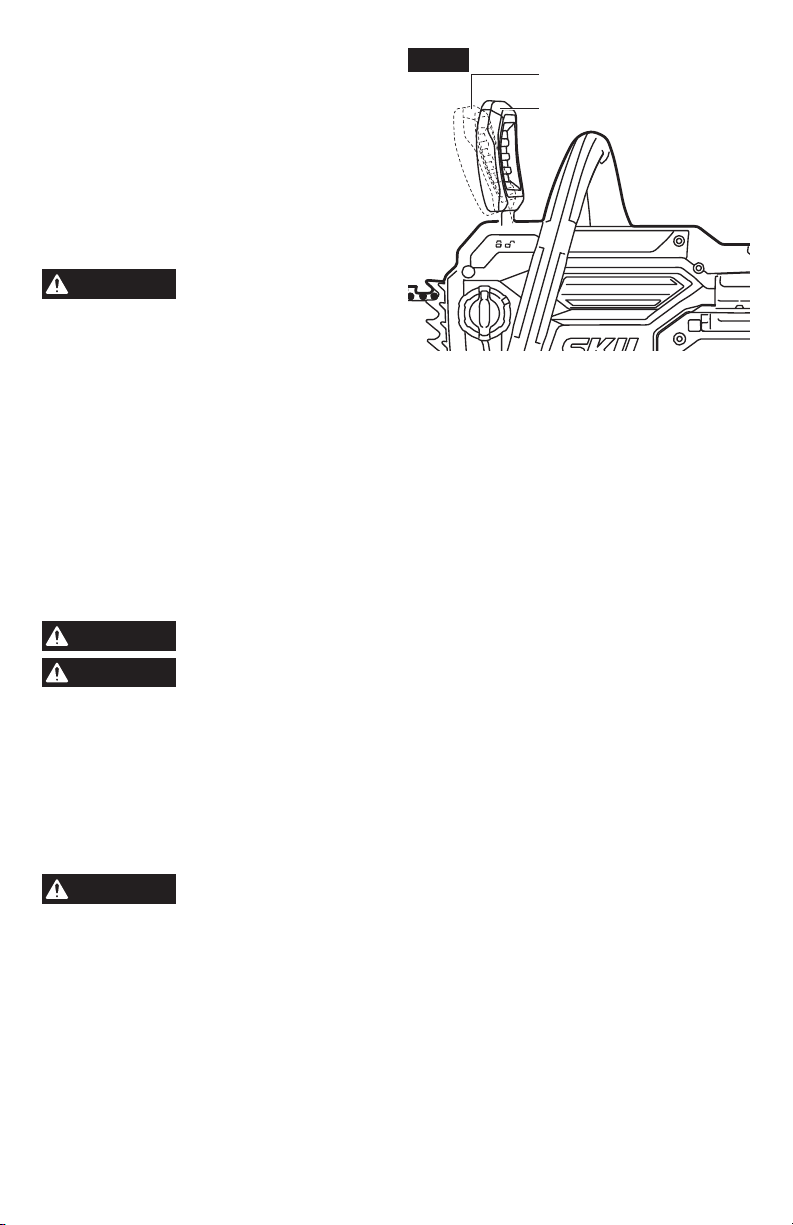
Chain Brake
The chain saw comes equipped with a chain
brake, which stops both the motor and the
motion of the chain when kickback occurs. The
chain brake can be activated by the forward
motion of the chain kickback brake paddle as
the saw rotates backward during kickback.
WARNING Never modify or attempt
to disable the chain
brake.
Make sure that the chain brake is working
properly before using the chain saw. The chain
kickback brake paddle should move back and forth easily.
To test the operation of the chain brake, perform the following steps (Fig. 1):
• Place the chain saw on a at bare surface and make sure no objects or obstructions that
could come in contact with the bar and chain are in the immediate vicinity.
• Disengage the chain brake by pulling the chain kickback brake paddle towards the front
handle.
• Install the battery pack and start the chain saw.
• Push the chain kickback brake paddle towards the front of the saw. A properly functioning
hand brake will stop the movement of the chain immediately. If the chain brake is not
working properly, do not use the chain saw until it has been repaired by a qualied service
technician.
WARNING Conrm that the chain brake works properly before each use.
WARNING If the chain brake is clogged with wood chips, the function of the
chain brake may deteriorate. Always keep the device clean.
Low Kickback Saw Chain
The rakers (depth gauges) ahead of each cutter can minimize the force of a kickback
reaction by preventing the cutters from digging in too deeply at the kickback zone. Only
use a replacement chain that is equivalent to the original chain or has been certied as a
low kickback chain per ANSI B175.1. A low kickback tooth saw chain is a chain that has
met the kickback performance requirements of ANSI B175.1 (American National Standard
for Machines - Gasoline-Powered Chain Saws - Safety Requirements) when tested on the
representative sample of chain saws below 3.8 c.i.d. specied in ANSI B175.1.
CAUTION As saw chains are sharpened during their useful life, they lose some of the
low kickback qualities and extra caution should be used.
Guide Bar
This saw comes equipped with a guide bar that has a small radius nose. Small radius noses
generally have less potential for kickback. When replacing the guide bar, please order the
guide bar we recommend in this manual.
Fig. 1 Chain kickback brake paddle
in brake position
Chain kickback brake paddle
in operating position

8
ADDITIONAL WARNINGS
A chain saw is intended for two-handed
use (Fig.2), with the right hand on the rear
handle and the left hand on the front handle.
Serious injury to the operator, helpers, and/
or bystanders can result from one-handed
operation.
Make sure that the area in which you are
cutting is free from obstructions. Do not let
the nose of the guide bar contact a log, branch,
fence, or any other obstruction that could be hit
while you are operating the saw.
Always cut with the unit running at full
speed. Fully squeeze the switch trigger and
maintain cutting speed.
With a basic understanding of kickback, you can reduce or eliminate the element of
surprise (Fig.3.4.5). Sudden surprise contributes to accidents.
Fig. 3
Rotational
Kickback
Fig. 4
Kickback
Danger Zone
Keep proper footing and balance at all
times.
Avoid unintentional contact with the
stationary saw chain or guide bar rails.
These can be very sharp. Always wear gloves
and long pants or chaps when handling the
chain saw, saw chain, or guide bar.
Never operate a chain saw that is damaged
or improperly adjusted or that is not
completely and securely assembled. Be
sure that the saw chain stops moving when the
trigger switch is released.
Do not incinerate the appliance even if it is
severely damaged. The batteries can explode
in a re.
Inspect the workpiece for nails, wire, or other foreign objects prior to cutting.
When bucking, secure the work piece prior to cutting. When felling or pruning, identify
and secure hazardous branches.
Fig. 2
Fig. 5 Linear Kickback
Pinch
Kickback

9
Aggressive or abusive cutting or misuse
of the chain saw can cause premature bar,
chain, and/or sprocket wear, as well as a
broken chain or bar, leading to kickback,
chain throw or the ejection of material.
Never use the guide bar as a lever. A bent
guide bar can cause premature bar, chain, and/
or sprocket wear, as well as a broken chain
or bar, leading to kickback, chain throw or the
ejection of material.
Cut only one work piece at a time.
Push and Pull – The reaction force is always
opposite to the direction the chain is moving
where wood contact is made. Thus, the
operator must be ready to control the PULL
when cutting on the bottom edge of the bar,
and the PUSH when cutting along the top
edge. See Figure 6.
Plan the work, ensuring an obstacle-free
work area and, in the case of felling, at least
one escape path from the falling tree.
When felling, keep bystanders at least two
tree lengths away.
If situations occur which are not covered in this
manual, use care and good judgment. Contact
SKIL Customer Service for assistance.
SAVE THESE INSTRUCTIONS!
Fig. 6
PULL
PUSH

10
SYMBOLS
Safety Symbols
The purpose of safety symbols is to attract your attention to possible dangers. The safety
symbols and the explanations with them deserve your careful attention and understanding.
The symbol warnings do not, by themselves, eliminate any danger. The instructions and
warnings they give are no substitutes for proper accident prevention measures.
WARNING Be sure to read and understand all safety instructions in this Owner’s
Manual, including all safety alert symbols such as “DANGER,”
“WARNING,” and “CAUTION” before using this machine. Failure to following all instructions
listed below may result in electric shock, re, and/or serious personal injury.
The denitions below describe the level of severity for each signal word. Please read the manual
and pay attention to these symbols.
This is the safety alert symbol. It is used to alert you to potential
personal injury hazards. Obey all safety messages that follow this
symbol to avoid possible injury or death.
DANGER DANGER indicates a hazardous situation which, if not avoided, will
result in death or serious injury.
WARNING WARNING indicates a hazardous situation which, if not avoided, could
result in death or serious injury.
CAUTION CAUTION, used with the safety alert symbol, indicates a hazardous
situation which, if not avoided, will result in minor or moderate injury.
Damage Prevention and Information Messages
These inform the user of important information and/or instructions that could lead to equipment
or other property damage if they are not followed. Each message is preceded by the word
“NOTICE”, as in the example below:
NOTICE Equipment and/or property damage may result if these instructions are not
followed.
WARNING The operation of any machines can result in foreign
objects being thrown into your eyes, which can result
in severe eye damage. Before beginning machine operation, always
wear safety goggles or safety glasses with side shields and a full face
shield when needed. We recommend a Wide Vision Safety Mask for use
over eyeglasses or standard safety glasses with side shields. Always
use eye protection which is marked to comply with ANSI Z87.1.
Tabla de contenidos
Idiomas: