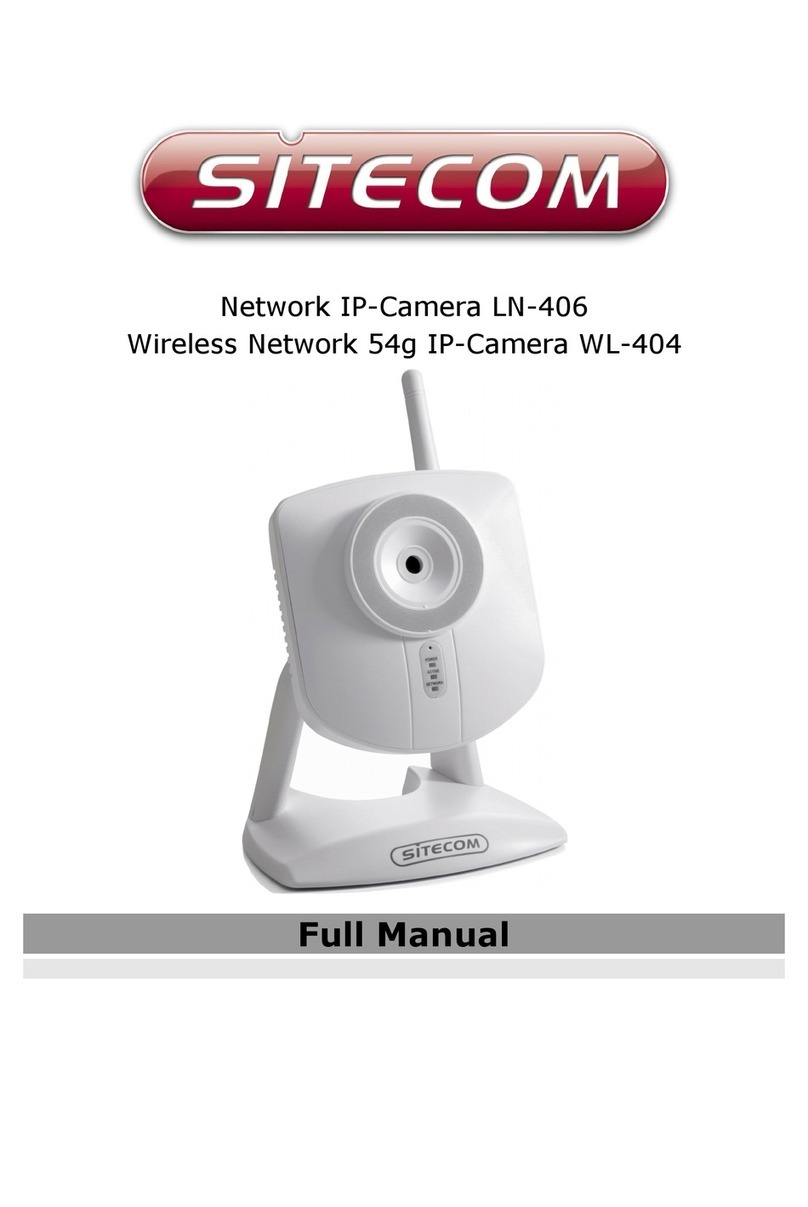
Sitecom LN-402 Manual de usuario

(Wireless) IP Camera
LN-402/WL-400
Full Manual

1
About This Guide
This manual describes Internet Camera, including a
description of the features, as well as the installation
procedures and web configuration. Included in the
manual are the operating procedures for the IPView
application.

2
1. Introduction
Thank you for the purchase of the Internet Camera
connecting directly to an Ethernet or Fast Ethernet. It is
different from the conventional PC Camera, the Internet
Camera is a standalone system with built-in CPU and
web-based solutions providing a low cost solution that
can transmit high quality video images for monitoring.
The Internet Camera can be managed remotely,
accessed and controlled from any PC/Notebook over the
Intranet or Internet via a web browser. The simple
installation procedures and web-based interface offers
easy integration to your network application
environments coupled with many applications such as
remote monitoring for a cost-effective solution.
2. System Requirements
• 10Base-T Ethernet or 100Base TX Fast Ethernet
• Recommended system for accessing the IP
camera
o Web based:
Pentium 2 266Mhz or above
32MB video memory (64MB
recommended)
800x600 video resolution at 16-bits
or above
Java or ActiveX enabled web
browser (Internet Explorer 5.0,
Netscape 6 or above)
o IPView:

3
Pentium 3 450Mhz or above
64MB video memory
800x600 video resolution at 16-bits
or above
3. Features and Benefits
This section describes the features and benefits of the
Internet Camera
Simple To Use
The Internet Camera is a standalone system with built-in
CPU requiring no special hardware or software such as PC
frame grabber cards. The Internet Camera supports both
ActiveX mode (for Internet Explorer users) and Java
mode (for Internet Explorer and Netscape Navigator
users). Therefore, all that is required is a web browser
software such as Internet Explorer 5.0 or above or
Netscape 6.0 or above. Just plug and view the picture
from your Internet Camera with a valid IP Address.
Support Variety of Platforms
The Internet Camera supports TCP/IP networking, SMTP
e-mail, HTTP and other Internet related protocols, and
can be utilized in a mixed operating system environment
such as Windows, Unix, and Mac. It can be integrated
easily into other www/Intranet applications.
Web Configuration
Applying a standard web browser, the administrator can
configure and manage the Internet Camera directly from
its own web page via the Intranet or Internet. Up to 64

4
users name and password are permitted with privilege
setting controlled by the administrator.
Remote Utility
The powerful IPView application assigns the administrator
with a pre-defined user ID and password, allowing the
administrator to modify the Internet Camera settings
from the remote site via Intranet or Internet. When a
new firmware is available, you can also upgrade remotely
over the network for added convenience. Users are also
allowed to monitor the image, and take snapshots.
Broad Range of Applications
With today’s high-speed Internet services, the Internet
Camera can provide the ideal solution for live video
images over the Intranet and Internet for remote
monitoring. The Internet Camera allows remote access
from a web browser for live image viewing and allows
administrator to manage and control the Internet Camera
anywhere and any time in the world. Apply the Internet
Camera to monitor various objects and places such as
homes, offices, banks, hospitals, child-care centers,
amusement parks and other varieties of industrial and
public monitoring. The Internet Camera can also be used
for intruder detection; in addition, it can capture still
images for archiving and many more applications.
4. Physical Description
This section describes the externally visible features of
the Internet Camera.

Front Panel
Link
/
Act
Power
Power LED
The Power LED is positioned on the right side of the
Internet Camera’s lens while facing the Internet Camera.
A steady blue light confirms that the Internet Camera is
powered on.
Note: There are three settings for the Power LED to
control the light illumination for monitoring purpose from
Normal / Off / Dummy. Please refer to the Web
Configuration section for detailed information and usage.
5

Link LED
The Link LED is positioned on the right side of the
Internet Camera’s lens while facing the Internet Camera.
It is located right of the Power LED
A steady orange light confirms that the camera has good
connection to LAN connectivity.
Dependent on the data traffic the LED will begin to flash
to indicate that the Internet Camera is receiving/sending
data from/to the network.
Note: There are three settings for the Link LED to
control the light illumination for monitoring purpose from
Normal / Off / Dummy. Please refer to the Web
Configuration section for detailed information and usage.
Rear Panel
Ethernet
port
Antenna connector
(WL-400 only)
Reset
button
Power
connector
6

7
Network Cable Connector
The Internet Camera’s rear panel features an RJ-45
connector for connections to 10Base-T Ethernet cabling
or 100Base-TX Fast Ethernet cabling (which should be
Category 5 twisted-pair cable). The port supports the
NWay protocol, allowing the Internet Camera to
automatically detect or negotiate the transmission speed
of the network.
Antenna connector (WL-400 only)
Screw on the antenna supplied with the WL-400 here.
DC Power Connector
The DC power input connector is located on the Internet
Camera’s rear panel, and is labeled DC 5V with a single
jack socket to supply power to the Internet Camera.
Power will be generated when the power supply is
connected to a wall outlet.
Reset Button
Reset will be initiated when the reset button is pressed
once, and Power LED begins to flash.
Factory Reset will be initiated when the reset button is
pressed continuously for three seconds or when Power
LED begins to light up. Release the reset button and the
Power LED will begin to flash, indicating the Internet
Camera is changing to factory reset. When factory reset
is completed, the Internet Camera will be set to default
on channel 11 and EES-ID is set as “NULL String” (This
default setting will let the Internet Camera connect to
ANY access point on the infrastructure network). The IP

8
address will also return to the default setting as
192.168.0.20.

9
5. Hardware Installation
• For the installation of the (wireless) IP camera it
is assumed you have a working network
environment.
• It is highly recommended to first connect the IP
camera using a UTP cable instead of directly using
the wireless mode (WL-400 only).
• Connect the UTP cable; use standard UTP cables
to connect the camera to one of the LAN ports on
your network HUB, switch or router. Note that
when connecting the camera directly to a network
adapter you should use a crossed-over UTP cable.
• Connect the power supply adapter to the IP
camera. Only use the adapter supplied with the
camera.
• Check the LED’s:
o The power LED (‘PWR’) should be ON
o The link/activity LED (‘LNK’) should be ON
6. Security
To ensure the highest security and prevent unauthorized
usage of the Internet Camera the Administrator has the
exclusive privilege to access the System Administration
for settings and control requirements to allow users the
level of entry and authorize the privileges for all users.
The Internet Camera supports multi-level password
protection and access to the Internet Camera is strictly
Este manual sirve para los siguientes modelos
1
Tabla de contenidos
Otros manuales de Cámara IP de Sitecom