
Scarecrow B.I.R.D. SYSTEM Manual del operador

USERS INSTRUCTION MANUAL
SCARECROW B.I.R.D. SYSTEM™

CONTENTS
Page 1-2 - Items Supp ied and Avai ab e Accessories
Pages 2-4 - Practica Setup Tips
Page 5 - Assemb y / Fixing
Pages 6-7 - Power Supp y and Connections
Page 8-9 - System Design
Page 10 - Keypad Guide and Defau t Settings
Page 11 - Turning the Unit On/Off
Pages 12- - Programming Instructions
Page 15 - Other Features
Page 16 - Pin Contro / Use
Page 17 - Re-Set Defau t Factory Settings and Technica Support

ITEMS SUPPLIED
SCARECROW B.I.R.D. SYSTEM™
A fully automatic and random play bird dispersal system, incorporating:
•Random play bird dispersal processor
•10 standard distress calls
•Integrated Long Line Transformer
•Built in keypad for setting controls
•Built in lig t sensor
•Capable of osting up to 30 loudspeakers (SEE BELOW).
•Power Supply; 15V dc regulated switc mode; c oice of EU/UK plug top
•4 x 1215/L Loudspeakers - IP65 rated 20 watt re-entrant orn loudspeaker, fitted
wit fully adjustable mounting bracket.
Standard calls: Herring Gull, Black Headed Gull, Starling, Rook, Crow, Pigeon, Jackdaw,
Canada Goose 1, Canada Goose 2 and Birds of Prey
ADDITIONAL LOUDSPEAKERS: OPTIONS
•1212/L LOUDSPEAKER; IP65 rated 10 watt re-entrant orn loudspeaker fitted wit
fully adjustable mounting bracket. Used w ere a more specific “directional”
broadcast is required.
•1215/L LOUDSPEAKER; IP65 rated 20 watt re-entrant orn loudspeaker, fitted wit
fully adjustable mounting bracket.
Page 1

Note: The 1220/L LOUDSPEAKER Class 1 ‘EexmN’ is or use in hazardous atmospheres, and
more detail is provided in the appropriate manual.
I the Scarecrow B.I.R.D. System™ processor unit can be situated in a sa e environment, but
the 1220/L speakers are required in view o the site environment, then the 4 x 1212L/1215L
speakers provided as standard with the normal Scarecrow B.I.R.D. System™ price will be
upgraded to 1220L speakers, subject to the appropriate additional payment.
ACCESORY ITEMS AVAILABLE
Solar Power Option
; suitable for B.I.R.D. System™, Scarecrow 180™ and Scarecrow
360™ System. System comprises:
•Solar Panel – Pole mount only
•Battery & regulator pack - Option for wall or pole mounting
Ambient Lig t Sensor;
to facilitate Dawn / Dusk function only w en main Scarecrow
B.I.R.D. System
™
processor (wit built in lig t sensor) as to be located indoors.
Should the above accessories be required please contact your supplier, or Scarecrow direct, on
PRACTICAL TIPS
Point of Broadcast
•Ideally, t e point of broadcast s ould be from a ig point – too low to t e ground
will only limit t e area covered, and t erefore t e success obtained.
Vo ume Leve s
•T e volume of broadcast as to be at a natural level for t e birds to identify t e
broadcast as a natural call:
oToo loud – t e broadcast will merely appear to sound like a noise, and no
reaction is likely.
oToo quiet =- t ey simply will not ear t e call, and again a dispersal reaction
is unlikely.
•To attain w at is perceived as a natural level for t e target species, begin
broadcasting t e system at t e lowest volume level and t en increase t e volume
until you see t e birds react to t e call
Page 2

PRACTICAL TIPS (Cont.)
Coverage
•Total coverage t e system is able to provide is dependent on many factors, not least
of w ic is t e number of speakers utilised. Under normal circumstances we would
not look to design a system w ere any speaker(s) are required to broadcast in excess
of 100m distance.
•Ot er dependent factors would include t e lie of t e land, prevailing weat er
conditions, strengt /direction of wind, ot er ambient noise, air temperature,
s ape/design of target area and obstructions to sound broadcast.
•Taking t is into account, it is important to remember t at t e broadcast needs to
sound at a natural level to t e birds for greatest effect – too loud or too quiet, will
merely eit er sound like a noise to t e target birds and be ignored, or not eard at
all.
Effect on other wi d ife
•T e calls broadcast are only recognisable by t e target bird species, and t erefore
as no lasting effect on ot er wildlife at all.
•T at is not to say t at t ere will be no reaction – in some extreme cases, t e
broadcast of a distress call may for example bring in a Hawk oping to find some
easy food.
Re ocating the Scarecrow B.I.R.D. System
•Under normal circumstances due to t e cable runs wit t e Scarecrow B.I.R.D.
System™, once speakers are in place t ey are left w ere t ey are.
•W ilst “speaker relocation” is an option, it is recommended t at a system s ould
ideally remain in situ if an area is required to be kept free of birds; nevert eless,
speakers can be repositioned if required.
•T e concept of t e system is to create t e impression over time t at t e area is a
“t reat area” and one t erefore to avoid – so over time t e bird numbers may even
reduce. T is is ac ieved by t e regular (but not too frequent) broadcast of t e
Distress Call, w ic clearly cannot be ac ieved if t e system is relocated to
alternative areas.
Variab e Vo ume
•T e system incorporates a “variable volume” feature – during broadcast t e volume
will automatically vary between t e maximum set level, and approximately 20
metres from t e unit.
•T is is to provide t e perception of predator movement, to aid to t e overall
confusion and concern of t e target specie, to improve dispersal performance.
•
T is feature also ensures t at no matter w ere t e target bird may be wit in t e
overall coverage area during t e time of broadcast, at some point t e broadcast
sound level will certainly sound as if it is at a natural level.
Page 3

Independent Speaker Channe broadcast
•T e system incorporates t ree independent speaker c annels.
•Eac speaker c annel can accommodate up to a maximum of 10 speakers. T e
system uses a 30w amplifier and t erefore speakers need to be tapped down
according to t e number of speakers (e.g. tapped down to 2.5w if t e maximum 10
speakers are being used per c annel) - t e speaker c annels do not broadcast at t e
same time so 30w per c annel is acceptable.
•T e broadcast is made out of eac c annel in turn, independently, and on a
randomised basis.
•As wit t e variable volume, t is is to provide t e perception of predator movement,
to aid to t e overall confusion and concern of t e target specie, to improve dispersal
performance.
•T is feature works in conjunction wit t e variable volume.
•In t e event of a system design requiring say only 8 speakers, t e c oice exists to:
oUse just one c annel wit all 8 speakers – in t is instance all speakers will
broadcast at t e same time, t us mitigating t e effect of “predator
movement” by way of t e sound sweeping from one set of speakers to
anot er.
oUse 2 c annels wit say 4 speakers in eac c annel – in t is instance t e two
sets of 4 speakers will broadcast one after t e ot er – so some “predator
movement” effect is obtained.
oUse 3 c annels wit a split of speakers across t e 3 c annels – in t is instance
t e full effect of “predator movement” is obtained.
Note: The decision as to which option to ollow may be driven by other actors such as
installation costing.
Habitat Management
•W ilst t e unique efficiency of SCARECROW bio-acoustic products is long establis ed
SCARECROW BIO-ACOUSTIC SYSTEMS LIMITED stress t at t ey can only work
effectively as part of an overall and planned programme of bird control.
•T is will include total ygiene management and w ere applicable t e use of
operatives w o ave been professionally trained.
•
Wit out limitation, SCARECROW BIO-ACOUSTIC SYSTEMS LIMITED will not accept
liability for any consequences as a result of poor equipment maintenance, misuse,
inappropriate use, lack of operative training, failure of due diligence or t roug lack
of prior project consultation.
Page 4

ASSEMBLY / FIXING
•T e Scarecrow B.I.R.D System™ main processor box is typically a traditional wall
fixing using screws/raw plugs (not supplied).
•Fixing can be eit er inside or outside depending on client needs and site
circumstances.
•Ideally t e processor s ould not be positioned too far away from t e speaker
locations – t is is merely to facilitate ease of installation; if circumstances dictate t is
is not possible, consideration t en needs to be given to cable c oice used (see
below).
•Wit t e Scarecrow B.I.R.D. System™, speaker placement is vitally important to
obtain t e desired dispersal effect over t e target area – please see Page 8 under
“System Design”.
•T e speakers used ave fully adjustable mounting brackets (see Page 1) typically
fixed to position wit screws/raw plugs (not supplied).
•T e processor box as t ree separate speaker c annels, eac of w ic can take up
to a maximum of 10 speakers eac . T e speaker c annel connections are s own
below:
•Cabling for speakers is on a “Daisy C ain” basis between speakers, starting from t e
processor box.
•Please see Page 4 under “Independent Speaker C annel Broadcast” to determine
ow many speaker c annels you wis to utilise prior to commencing speaker cabling.
Page 5

•In terms of cable c oice used on site, t e following guidelines s ould be considered:
FLEXIBLE
DISTANCE IN METRES
4.00mm
2
300
2.50
mm
2
200
1.50
mm
2
120
1.00
mm
2
75
POWER SUPPLY AND CONNECTIONS
SCARECROW B.I.R.D. SYSTEM™
•T e standard system requires just one cable connection, as supplied. One end of t e
cable connection is fixed to t e side of t e Scarecrow B.I.R.D. System™ in t e “Power
Input” connection.
Page 6
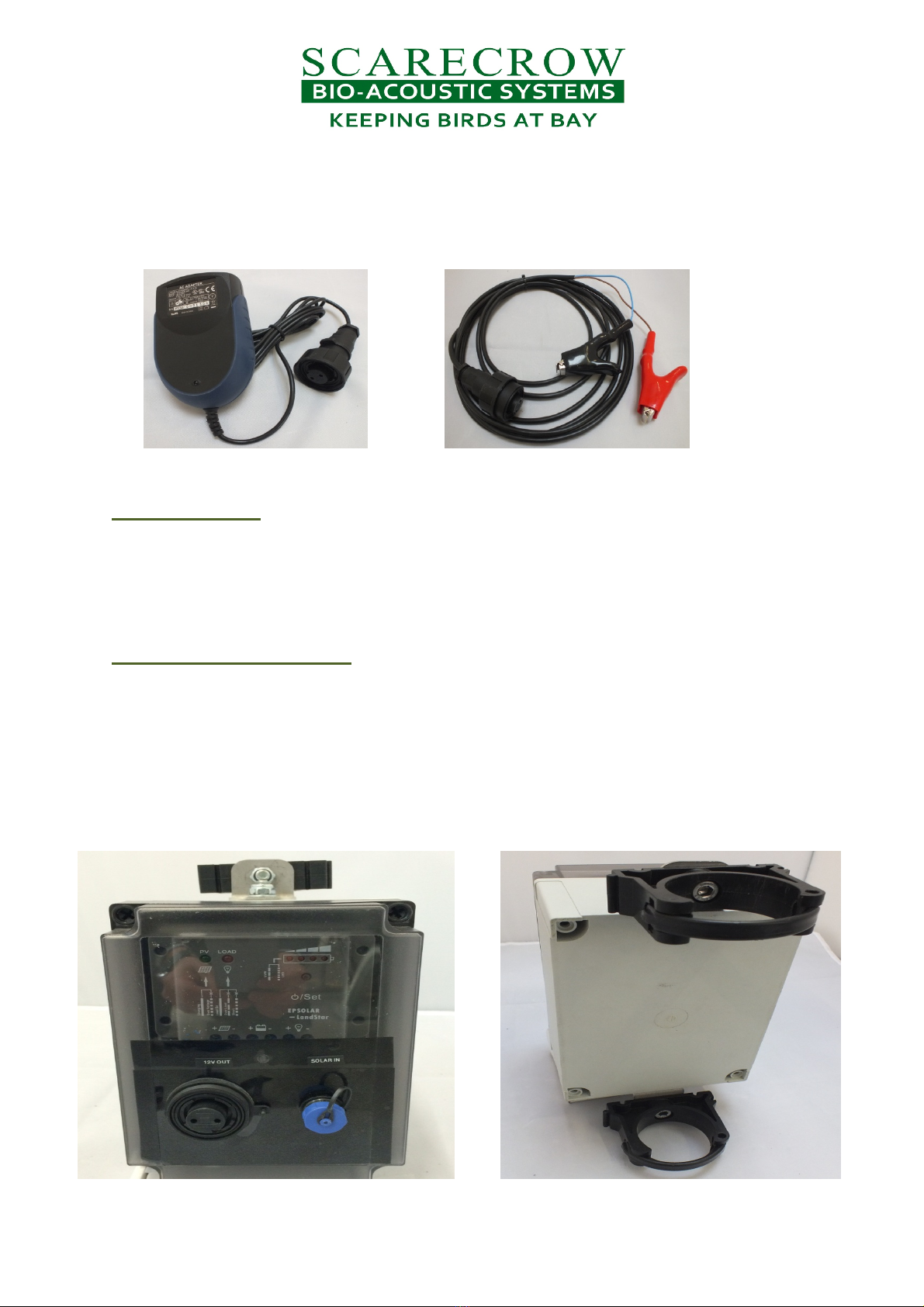
T e ot er end is t e c oice made of eit er 15V DC regulated switc mode EU/UK power
supply, or Battery Lead, and is fixed to power source.
LIGHT SENSOR
If t e main processor box is fitted inside a building, t en t e built in Lig t Sensor will not
function as it s ould. If t e remote Ambient Lig t Sensor is purc ased, t e cable fixing is
made to t e main processor UNIT as s own above on Page 6. .
SOLAR POWER OPTION
T e solar power unit is a standalone unit and as two connectors.
T e first is “Solar”, connecting t e solar panel to t e battery and regulator.
T e second is “12V Out”, connecting t e battery and regulator to t e main Scarecrow
B.I.R.D. System™ unit, at “Power Input”.
Page 7

Furt er instructions on t e assembly of t e Solar Pack are included wit t ese accessories.
SYSTEM DESIGN
System Design is really all about speaker placement to take into account suc factors as t e
following:
•Sound broadcast over t e entire target area, including dealing wit any barriers to
sound (e.g. walls, alcoves), w ere feasible wit in constraints of budget.
Some sites have so many barriers to sound, or so many “nooks and crannies” to protect, it
becomes commercially impractical to provide a system likely to provide 100% coverage.
•Eac speaker ideally broadcasting over muc t e same distance.
The main processor box is where the system volume is set, and as explained later, the setting
o the “maximum volume broadcast”. I you have some speakers that are required to
broadcast over say 40m, whilst others have to broadcast over 100m, clearly the volume
setting is likely to be incorrect or one o the speaker sets.
•Ot er ambient noise factors t at may impact on broadcast.
I there are strong, and regular/ requent ambient noise eatures, these may be taken into
account in terms o speaker placement and broadcast direction to ensure the normal sound
broadcast is not mitigated by virtue o the ambient noise.
•Strong prevailing weat er conditions.
Where easible it is a good idea to maximize the bene it o regular/ requent prevailing winds, to use
these to enhance the distance that sound will naturally travel. I not considered, the converse could
apply that the wind could reduce the distance that the dispersal sound will travel, by blowing in the
opposite direction to that which the loudspeakers are directed.
•Impact of broadcast on any neig bouring properties, to mitigate t e risk of any
“noise complaints”.
The broadcast should be set at a “natural level” or the birds to react, so should, in theory, be
no di erent to i a bird were present anyway. However it is always best, i possible, to set the
broadcast direction away rom any nearby residential areas, or areas where the regular
broadcast may have an impact.
Page 8
Tabla de contenidos


