Prowinch PWJTHF300 Manual de usuario

®
Reg. U.S. TM. O.
User’s Manual / Manual de usuario
Safety Warnings / Advertencias de seguridad
PWJTHF & PWJTHT Single phase models

This page intentionally left blank

1. PROWINCH® DISCLAIMER...........................................................................................4
11. MAPS PROWINCH® ...................................................................................................47
2. SAFETY BULLETIN.......................................................................................................5
3. SAFETY PRECAUTIONS...............................................................................................9
4. SPECIFICATIONS....................................................................................................... 14
Product Code...................................................................................................................................14
Fixed Hoist Specications...........................................................................................................16
Trolley Hoist Specications........................................................................................................17
Hoist Dimensions...........................................................................................................................17
Specications Chart (For all models of Prowinch® Electric chain hoist......................14
Load Level and Service life.........................................................................................................15
Hoist Safety Precautions..............................................................................................................10
Before Using The Equipment........................................................... .........................................10
During Operation.......................................................................................................................... 11
Inspection, Maintenance and Repairs................................................................................... 11
5. INSTALLATION...........................................................................................................21
6. OPERATION................................................................................................................26
Unpacking.........................................................................................................................................21
Chaing Bag Assembly...................................................................................................................22
Electrical Connections..................................................................................................................23
Chaing Bag Assembly...................................................................................................................24
Adjust Trolley width (Models with Trolley)...........................................................................25
Install Trolley Into Beam (Models)............................................................................................25
Qualied Operator ............................................................................................................................26
Handling Precautions..........................................................................................................................26
Recommended Operation.................................................................................................................27
9. TROUBLESHOOTING.................................................................................................35
During Operation...........................................................................................................................35
Power..................................................................................................................................................37
Motor..................................................................................................................................................37
Brake...................................................................................................................................................38
Inside Wiring....................................................................................................................................38
Transformer......................................................................................................................................39
Contactor & Electric Reply .........................................................................................................39
Limit Swich.......................................................................................................................................40
Push Button Swich.........................................................................................................................40
Electric Shock...................................................................................................................................41
Hook....................................................................................................................................................41
Load Chain........................................................................................................................................42
Chaing Wheel..................................................................................................................................43
Load Pulley And Empty Pulley..................................................................................................43
Chain Guide ....................................................................................................................................43
Chain Wheel, Junction Part........................................................................................................43
Bearing..............................................................................................................................................43
Trolley................................................................................................................................................44
Electric Trolley.................................................................................................................................44
Manual Trolley................................................................................................................................44
7. PARTS.........................................................................................................................28
Motor and Body Assembly Drawing ......................................................................................28
Motor and Body Assembly Parts List......................................................................................29
Trolley Assembly Drawing..........................................................................................................30
Trolley Assembly Parts List..........................................................................................................31
8. INSPECTION & MAINTENANCE................................................................................32
Periodic Inspection .......................................................................................................................32
10. WIRING DIAGRAM....................................................................................................45
Conventional Hoist Wiring Diagram ( PWJTHF - PWJTHT )......................................................45

4Disclaimers
PROPERTY REGISTRY Nº 189487
ANY REPRODUCTION IS FORBIDDEN
PROPERTY OF PROWINCH® 2023 - V.2[LM]
ALL RIGHTS RESERVED
PROWINCH LLC COMPANY WITH QUALITY MANAGEMENT SYSTEM
PROWINCH® DISCLAIMER
4V.01.23 [LM]
Prowinch® LLC declares that it has made all safety recommendations related to the purchased product to the customer. As a
result, it does not assume any responsibility for any damages or losses that the client or third parties may suer. These can be
caused by or as a direct or indirect result of a breach or omission of instructions or safety warnings in the User Manual and Security
Warnings provided with the unit purchased. Prowinch® LLC will not be liable for accidents and/or damages to persons and/or
property resulting from the negligent use of the product. In no case does Prowinch® LLC assume any liability arising from using
these voluntary recommendations and does not oer any guarantee concerning them. These recommendations do not take
precedence over the current safety regulations of the plant. For purposes of enforcing the warranty of the product purchased,
Prowinch® LLC, will only be liable for any damage when proven the user has followed each one of the warnings contained in the
User Manual and Safety.
1. It is the sole responsibility of the Client / User to verify that
the acquired equipment, products, and accessories comply
with the characteristics, capacities, requirements, compo-
nents, accessories, and other conditions for the use that the
Client/user intends to give it.
2. It is also the sole responsibility of the Client / User to ensure
that the equipment and products purchased are operated
and maintained with adequate safety standards and by
personnel properly trained in their use. The Client / User is
also responsible for implementing all security measures
necessary to prevent accidents or damages to people or
property and for following the indications and warnings of
the corresponding manual.
3. Any assistance provided by Prowinch® LLC in selecting the
equipment, capacities, and characteristics required by the
client is delivered free of charge and based on the informa-
tion about the application, use, and requirements provided
by the client. It is not the responsibility of Prowinch® LLC to
verify the accuracy of the given information. It is the sole and
exclusive responsibility of the client -or who will use the
equipment and products acquired- to ensure that the speci-
cations comply with the capabilities, characteristics,
up-to-date maintenance, and everything necessary for a
correct and safe operation about the intended use.
4. Prowinch® LLC recommends using winches with four
brakes for personnel lifting. The use of winches with three
brakes or less, or operating with safety standards less than
required for personnel lifting is not recommended.
5. To guarantee the safety of the equipment's operators, it is
necessary to conduct inspections and maintenance of the
equipment according to the recommended frequency of its
work cycle. It is mandatory to keep records and evidence,
including written and photographic reports of: Maintenance,
Start-up, Load Tests, Training, Certications, Inspections, and
Reports of failures and accidents.
6. The reports mentioned above must be emailed to regis-
an event.
7. Compliance with timely implementation of mandatory
activities described in points 6 and 7, in addition to all the
activities mentioned in the corresponding guidelines, are the
user's sole responsibility. Failure to comply with the prece-
ding conditions releases Prowinch® LLC from any liability. The
information contained in this manual may contain technical
errors or inaccuracies. Prowinch® LLC is not responsible for
errors, omissions, or incorrect information. This manual is
subject to change without prior notice. Download the latest
version available at www.prowinch.com. Always check
www.prowinch.com for the latest information regarding this
product.
Please check our warranty policies on our website
www.prowinch.com/warranty.

Users must be knowledgeable about the safe and proper use of Hoists, Cranes, and other Lifting
and material-movement-related equipment and be aware of their responsibilities as outlined in all
applicable standards and regulations.
The ASME/ANSI B30 Standard contains provisions for the construction, installation, operation,
inspection, testing, maintenance, and use of cranes and other lifting and material-movement-rela-
ted
equipment.
As OSHA’s, ASME, and ANSI standards state, a qualied person shall perform the installation, setup,
and operation of these units and equipment.
OSHA requires rated load tests for new and altered cranes. OSHA’s standard at 29 CFR 1910.179(k)
states:
Operational tests.
Before initial use, all new and altered cranes must be tested to ensure compliance with this section,
including the following functions:
Hoisting and lowering.
Trolley travel.
Bridge travel.
Limit switches, locking, and safety devices.
The trip setting of hoist limit switches shall be determined by tests with an empty hook traveling at
increasing speeds up to the maximum speed. The actuating mechanism of the limit switch must be
located so that it will trip the switch, under all conditions, in sucient time to prevent contact of the
hook or hook block with any part of the trolley.
Rated load test. Test loads shall be at most 125 percent of the rated load unless otherwise recom-
mended by the manufacturer. Once you have performed a rated load test, paragraph
1910.179(k)(2) requires that test reports be placed on le where readily available to appropriate
personnel.”
To ensure safety and installation requirements, Prowinch requires a Load Test to be performed
before initial use for all Hoists, Winches, and Cranes, as well as other related components. Not
fullling this requirement is dangerous, could lead to equipment failure, and will automatically void
the warranty.
The B30 Standard is intended to:
(a) Prevent or minimize worker injury and otherwise provide for protecting life, limb, and property
by prescribing safety requirements.
(b) Provide direction to manufacturers, owners, employers, users, and others responsible for proper
application.
5
SAFETY BULLETIN
5
V.01.23 [LM]

(c) Guide governments and other regulatory bodies in developing, communicating, and enforcing
appropriate safety directives. The equipment covered by the B30 Standard is subject to hazards
that cannot be reduced by mechanical means but only by the exercise of intelligence, care, and
common sense. It is essential to have personnel involved in the use and operation of equipment
that is competent, careful, physically, and mentally qualied, and trained in the proper operation of
the equipment and the handling of loads. Serious hazards include, but are not limited to, improper
or inadequate maintenance, overloading, dropping, or slipping of the load, obstructing the free
passage of the load, and using equipment for a purpose for which it was not intended or designed.
Failure to Read, understand and follow the corresponding ASME B30 Standard information for your
Hoist and Lifting equipment may result in severe INJURY or DEATH. It is YOUR RESPONSIBILITY to
consider all risk factors and follow all the equipment-related ASME B30 standard, which comprises
the following volumes:
B30.1 Jacks, Industrial Rollers, Air Casters, and Hydraulic Gantries.
B30.2 Overhead and Gantry Cranes (Top Running Bridge, Single or Multiple Girder, Top Running
Trolley Hoist).
B30.3 Tower Cranes.
B30.4 Portal and Pedestal Cranes.
B30.5 Mobile and Locomotive Cranes.
B30.6 Derricks.
B30.7 Winches.
B30.8 Floating Cranes and Floating Derricks.
B30.9 Slings.
B30.10 Hooks.
B30.11 Monorails and Underhung Cranes.
B30.12 Handling Loads Suspended From Rotorcraft.
B30.13 Storage/Retrieval (S/R) Machines and Associated Equipment.
B30.14 Side Boom Tractors.
B30.15 Mobile Hydraulic Cranes.
B30.16 Overhead Hoists (Underhung).
B30.17 Overhead and Gantry Cranes (Top Running Bridge, Single Girder, Underhung Hoist).
B30.18 Stacker Cranes (Top or Under Running Bridge, Multiple Girder With Top or Under Running
Trolley Hoist).
B30.19 Cableways.
B30.20 Below-the-Hook Lifting Devices.
B30.21 Lever Hoists.
B30.22 Articulating Boom Cranes.
B30.23 Personnel Lifting Systems.
B30.24 Container Cranes.
B30.25 Scrap and Material Handlers.
6SAFETY BULLETIN
6V.01.23 [LM]

B30.26 Rigging Hardware.
B30.27 Material Placement Systems. B30.28
Balance Lifting Units. B30.29 Self-Erecting
Tower Cranes. B30.30 Ropes.
7
SAFETY BULLETIN
DO NOT
DAILY CHECKLIST
7
V.01.23 [LM]
1. DO NOT Operate, install, or repair the hoist unless trained and authorized.
2. DO NOT Operate the hoist unless you have rst read the operator’s manual.
3. DO NOT Operate the hoist without appropriate PPE and without performing a pre-shift
inspection.
4. DO NOT Operate the hoist if not complying with all required OSHA regulations.
5. DO NOT Lift more than the rated load.
6. DO NOT Lift people or lift loads over people.
7. DO NOT Wrap the hoisting rope or chain around the load.
8. DO NOT Operate with the chain/rope not properly seated in the sprockets, drum, or sheave.
9. DO NOT Operate unless the direction of the hook travel agrees with the direction shown on the
control.
10. DO NOT Operate the hoist unless the hook travel limit devices function properly.(Test without
a load PRE-SHIFT )
11. DO NOT Operate the hoist with twisted, kinked, damaged, dirty, or unlubricated chain or
rope.
12. DO NOT Operate a damaged or malfunctioning hoist.
13. DO NOT Operate the hoist when the hook is not centered under the hoist
14. DO NOT Remove or obscure this tag or other WARNING & SAFETY LABELS.
TAGGED HOIST: Ensure the crane or hoist is not tagged out of order.
CONTROL DEVICES: Test Run. Ensure all motions agree with control device mark-ing.
BRAKES: Check all motions for excessive drift and abnormal stopping distances.
HOOK: Check for damage, cracks, nicks, gouges, deformations on throat opening, wear on saddle
or load-bearing point, and twist.
HOOK LATCH: Check for proper operations.

WIRE ROPE: Check for broken wires, broken strands, kinks, and deformation or damage to the rope
structure.
CHAIN: Check for corrosion, wear, elongation, twist, nicks, or gouges. Keep Chain/Wire Rope Clean
and Lubricated.
REEVING: Check the rope for proper reeving and that rope parts are not twisted.
LIMIT SWITCHES: Ensure that all limit devices stop lifting motion before the load block or chain/rope
stop strikes the hoist.
OIL LEAKAGE: Check for any signs of oil leakage on the crane/hoist and the oor. UNUSUAL
SOUNDS: Check for unusual sounds from the hoist while operating.
WARNING & SAFETY LABELS: Ensure that labels are not missing and they are legible.
8SAFETY BULLETIN
8V.01.23 [LM]

•Prowinch® Electric Chain Hoist is designed for safe and reliable service if operated according to this
User Manual.
•Respect all warnings for personal and third-party safety. The inadequate operation of this equipment
may cause injuries or damage to the equipment.
•Read and understand this User Manual carefully before installation and commission of equipment.
Always keep this User Manual in an accessible location.
•With compact structure, lightweight, and ease of use, PWJTHF and PWJTHT models are preferred
hoists for daily use in factories, mines, seaports, and warehouses.
•Hoists misused may harm users and result in wounds, injuries, or death. This User Manual highlights
symbols and notes for caution, warning, and danger. Attention to these areas ensures the safety of
the operator.
9
SAFETY PRECAUTIONS
9
V.01.23 [LM]
Thank you for purchasing a Prowinch® winch. This manual describes the operation and main-
tenance of the winch. All information in this publication is based on the newest production
information is available at print time.
3. SAFETY PRECAUTIONS
Hard Hat Safety Glasses Safety Gloves Safety Shoes
Mandatory use of:

10 SAFETY PRECAUTIONS
10 V.01.23 [LM]
3.1. Hoist Safety Precautions
3.2. Before using the Equipment:
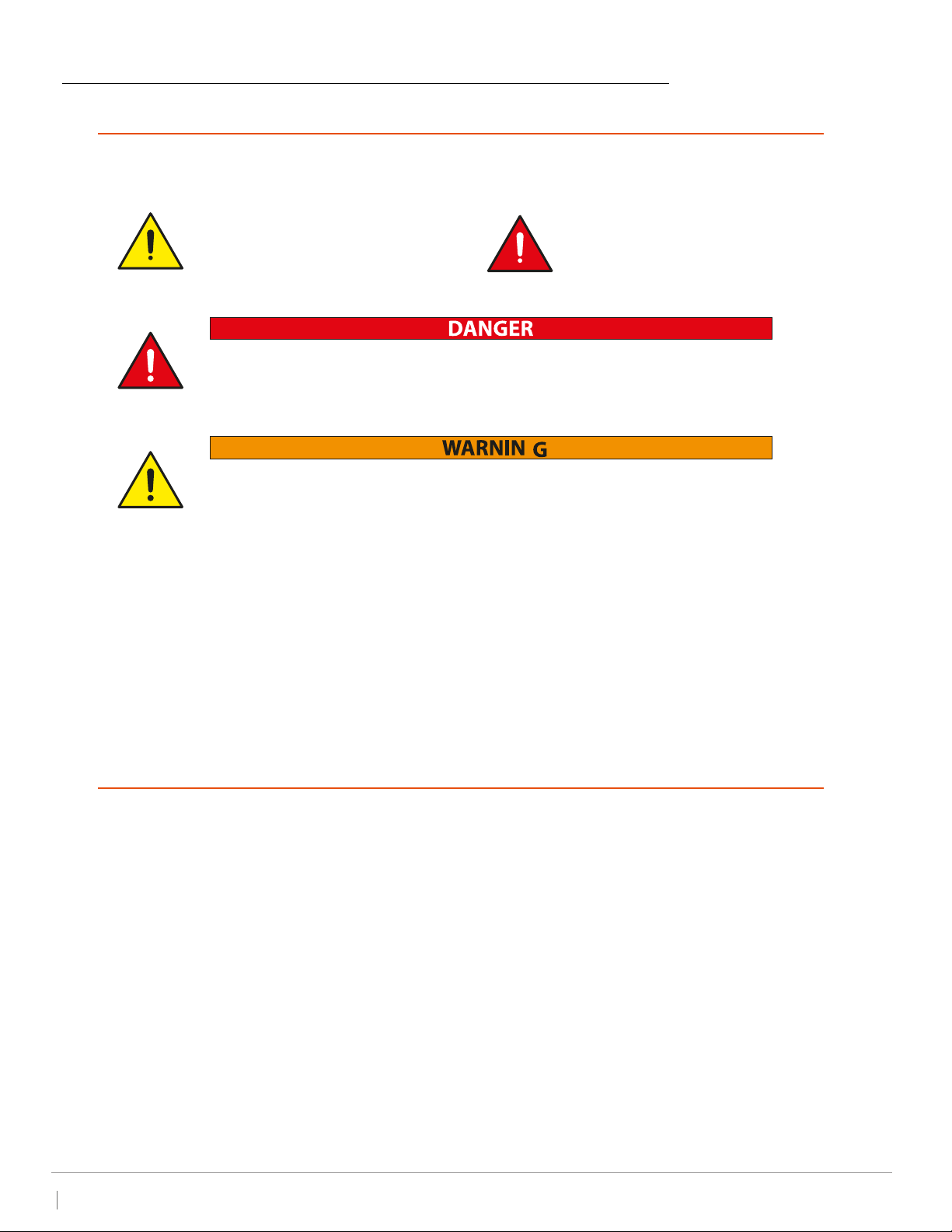
- This symbol indicates a potentially
dangerous situation which if not
avoided may cause severe injuries
or death
All operators and other users who are near the steel chain or its load must wear required
safety equipment: gloves, safety helmet / hard hat, safety shoes and eye protection.
Before installing, removing, inspecting, or performing any maintenance on the winch,
the unit must be unplugged, locked out, and tagged out. Do not use this equipment in
hazardous locations.
WARNING: DANGER:
This symbol indicates unsafe practices
or situations which may cause damage
to the property and even injuries to the
personnel.
Read and understand the contents of this User Manual thoroughly before handling the product. Practicing
After carefully reading and understanding this User Manual, store it for future reference.
•Read and understand the instructions in this User Manual and labels associated with hoist before opera-
ting equipment.
• Wear appropriate clothing: Do not wear jewelry or loose clothes as they may attach to chain or hook.
• Wear leather gloves.
• Wear non-slip safety shoes, helmet, and eye protection.
• Perform full check of hoist. Check for damaged parts or unusual characteristics.
•Keep a safe distance: suggested distance is at least 1.5 times the length of hoist’s chain. Broken or loose
chain may cause injuries or death.
• Check hoist and chain are properly lubricated.
• Secure electric chain hoist to a suitable support.
• Visually inspect all electric chain hoists in addition to regular and maintenance inspections.
Este manual sirve para los siguientes modelos
5
Tabla de contenidos
Otros manuales de Cabrestante de Prowinch

Prowinch
Prowinch PWR05 Manual de usuario

Prowinch
Prowinch PWJTHF Manual de usuario

Prowinch
Prowinch PWG Series Manual de usuario

Prowinch
Prowinch PWMD Series Manual de usuario

Prowinch
Prowinch PWPT1000 Manual de usuario

Prowinch
Prowinch PWCD Series Manual de usuario

Prowinch
Prowinch PWUZ Series Manual de usuario

Prowinch
Prowinch PWPT1000 Manual de usuario

Prowinch
Prowinch PWUT Series Manual de usuario

Prowinch
Prowinch PWCD Series Manual de usuario