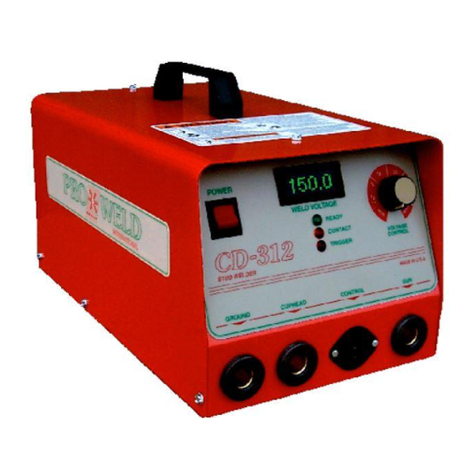
ARC 656
PRO WELD
1
.0 INTRODUCTION
Your new stud welding equipment has been carefully co
n-
structed using the finest components and material available.
Used properly, this equipment will give you many years of
profitabl
e, efficient service.
The system incorporates the latest in engineering advances for
complete, reliable end welding of mild ste
el, stainless steel
and aluminum fasteners.
A careful study of this manual will enable you to understand
how the welder operate
s to insure proper performance under
all conditions.
2.0 WARRANTY
The electrical and mechanical components of the stud
welder are thoroughly performance inspected prior to asse
m-
bly in the welder. The assembled welder is completely pe
r-
formance checked. The welder is delivered to you in fun
c-
tional electro
-mechanical condition.
All parts used in the assembly of the welder and its a
c-
cessories are fully warranted for a period of 1 YEAR from the
date of delivery. In addition, the welding capacitors are wa
r-
ranted for a period of 1 YEAR from the date of delivery. The
printed circuit boards used in all proweld equipment are wa
r-
ranted for a period of 3 years.
Under the warranty, the manufacturer reserves the right
to repair or replace, at their option,
defective parts which fail
during the guarantee period. Notice of any claim for warranty
repair or replacement must be furnishe
d to the manufacturer
by the purchaser within ten (10) days after the defect is first
discovered. The manufacturer does not assu
me any liability
for paying shipping cost or any labor or materials furnished
where such cost are not expressly authorized in wr
iting.
The manufacturer does not warrant any parts or acce
s-
so
ries against failures resulting from misuse, abuse, improper
installation, maladjustment, or use not in accordance with the
oper
ating instructions furnished by the manufacturer. The
wa
r
ranty is valid only when studs are purchased from sources
approved by the manufacturer or are of identical specific
a-
tions to the manufacturer’s
3.0 UNPACKING YOUR UNIT
Upon receipt of your unit, place it as close as possible to the
point of installation before unpacking it. Once the unit is u
n-
packed, it is recommended that you inspect it for any physical
damage that may have occurred in shipping.
Y
our unit has been completely assembled and inspected at
the factory. Upon receipt, the unit must be hooked up to the
recommended
incoming power before welding.
Place the unit in a large enough area to provide adequate ve
n-
tilation. Do not restrict the air flow around the front louvers
or from the fan at the rear of the unit. Do not allow water to
enter the unit in any way.
4.0 SUGGESTED SAFETY PRECAUTIONS
In any welding operation, it is the responsibility of the welder
to observe all safety rules to insure his or her personal safety
and to protect those working in the area.
Reference is directed without endorsement or recommend
a-
tion to ANSI Z49.1, Safety in Welding and Cutting, and to
AWG Publication A6,1
-
66, Recommended Safe Practices for
Gas
-
Shielded A
rc Welding.
4.1 Personal Safety Precautions
1. Always treat electricity with respect. Under open circuit
conditions, the welding machines output voltage may be da
n-
gerous.
2. Don’t work on live circuits or conductors. Disconnect the
main power before checking the machine or performing any
maintenance or repair operations.
3. Be sure the welding machine cabinet is properly grounded
to a good electrical ground. Con
sult local electrical codes.
4. Never operate a welder in the rain, or operate a welder
while standing in water. Avoid wearing
wet or sweaty clothes
when welding.
5. Don’t operate with worn or poorly connected cables, and
don’t operate the weld gun with loose cable connections. I
n-
spect all cables frequently for insulation failures, exposed
wires, loose connections and repair as needed.
6. Don’t overload w
elding cables or continue to operate with
over heated cables.
7. Don’t weld near flammable materials or liquids in or near
the
area, or on ducts or pipes carrying explosive gases.
8. Don’t weld on containers which have held combustible or
flammable materials, or on materials which give off flamm
a-
ble or toxic vapors when heated.
PAGE 1