
primatech SECOR d Manual de usuario
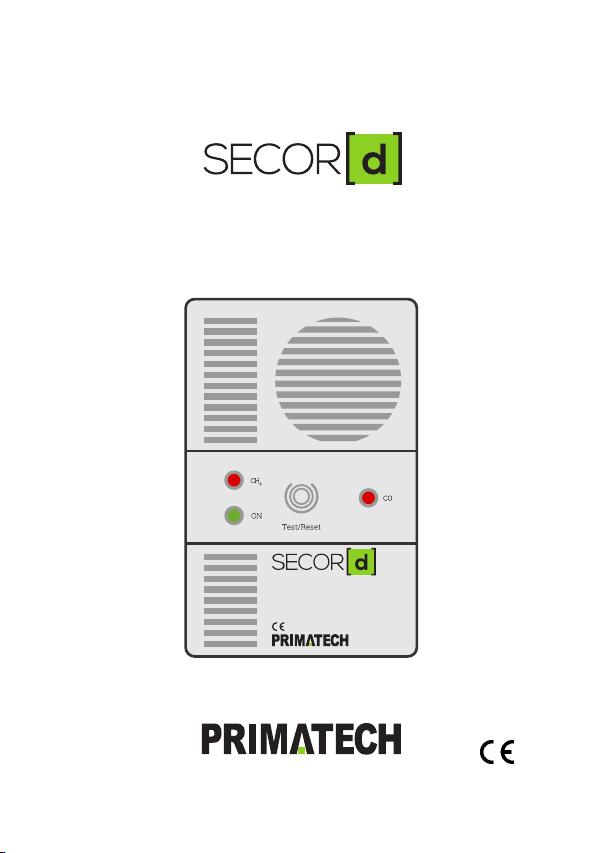
METHANE GAS AND CARBON
MONOXIDE DETECTOR
USER’S MANUAL
Methane Gas (CH4) and
Carbon monoxide (CO)
Dual Detector


by
WARNING! Please read the manual carefully
before installation of the detector.Failure to
follow instructions will lead to loss of warranty.
Dual Detector for Methane (CH )
4
and Carbon Monoxide (CO)

TABLE OF CONTENTS
TECHNICAL SPECIFICATIONS............................................2
WHAT YOUR METHANE GAS AND CO DETECTOR CAN
AND CANNOT DO..............................................................3
WHERE TO INSTALL YOUR METHANE GAS AND CO
DETECTOR..........................................................................5
WHERE NOT TO INSTALL YOUR METHANE GAS AND CO
DETECTOR..........................................................................6
CONNECTION METHODS.................................................9
OPERATION......................................................................12
TESTING THE DETECTOR................................................13
MAINTENANCE................................................................13
DETECTOR LIFETIME.......................................................15

TECHNICAL SPECIFICATIONS:
Sensor: Semiconductor SnO2
Power supply: 230 V AC (-15% +10%) 50/60 Hz
Detected gas: methane and carbon monoxide
Methane Gas sensitivity: 3% - 20% LEL
Alarm before 3 min: 300 ppm Carbon monoxide
concentration
Initial delay time: 2 min 30 sec
Indicators:
Green LED: Power supply
Red LED: Carbon Monoxide Visual alarm
Red LED: continuous – Methane gas visual alarm
flashing – normal operation
BUZZER: acoustic alarm – min. 85 dB at 1 m
Sensor lifetime: 5 years
Contact ratings:
8(2) A @ 250 V AC SPDT
3A @ 250 V AC SPST (optional)
Operating temperature: -10° C ÷ +40° C
Storage temperature: -20° C ÷ +50° C
Humidity limits (non-condensing): 20% - 90% RH
Protection Grade: IP 42
Case:
Material: ABS V0
Color: white
Size: 115 x 75 x 43 mm (W x H x D)
Weight: 300 g
2

WARNING! The installation of the detector in an area
where it is not recommended for it to be installed can
affect sensor operation.
WARNING! Do not tamper with the detector, since
this may stop the detector working or cause an
electric shock hazard.
WHAT YOUR METHANE GAS AND CO
DETECTOR CAN AND CANNOT DO
This unit is designed to sense unacceptable levels of gas
from malfunctioning furnaces, appliances or other
sources. This unit will provide early warning of the
presence of gas, usually before a healthy adult would
experience symptoms.
It will provide warning of a gas condition when a
concentration between 3% and 20% LEL for methane is
detected, before the gas concentration reaches a
dangerous level for triggering an explosion.
In the case of an apartment with several rooms with open
doors on the same floor or different floors, the gas
concentration will be higher in the room where the leak
occurs and will decrease in the other rooms further away
from the origin of the leak. The detector cannot detect a
gas leak which has been produced on another level of the
building. The gas detector will indicate the presence of gas
only in the proximity of the sensor, but the gas can be
located in other areas too. The detectors have limitations.
Like any other electronic device, gas detectors are not
foolproof. 3

You must test your gas detector monthly.
If your Gas Detector fails to test properly, or if its self-
diagnostic test reveals a malfunction, have the unit
replaced immediately. It's important to safeguard your life
from carbon monoxide(CO) gas because it is impossible to
see, taste, or smell the toxic fumes of CO. CO accidentally
kills people each year.
Most confuse the symptoms of CO exposure with the flu
or food poisoning as the symptoms are similar. Exposure
to CO can impede coordination, worsen cardiovascular
conditions, and produce fatigue, headache, weakness,
confusion, disorientation, nausea, and dizziness. High
levels of CO exposure can result in death. Homeowners
should be aware of the risks of CO exposure.
CO is produced as a result of incomplete burning of
carbon-containing fuels including coal, wood,charcoal,
natural gas, propane, and fuel oil. CO can be emitted by
combustion sources such as unvented kerosene and gas
space heaters, leaking chimneys and furnaces, back-
drafting from furnaces, gas water heaters, wood stoves,
and fireplaces, gas stoves, generators and other gasoline
powered equipment, automobile exhaust from attached
garages, and tobacco smoke.
4
WHERE TO INSTALL YOUR METHANE GAS AND CO
DETECTOR
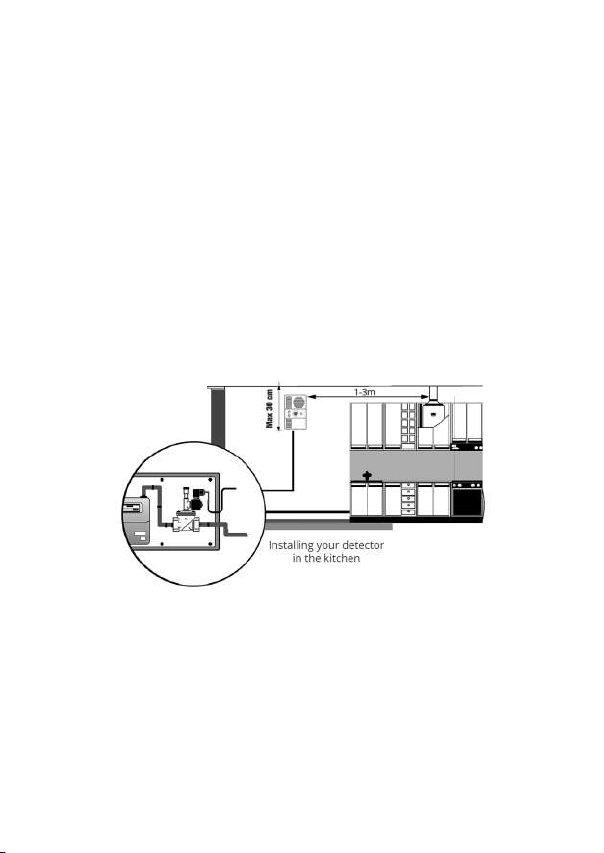
The gas detector should be installed in the room where
a gas leak is most likely to occur. This may be the kitchen
because of the presence of a gas cooker and other gas
appliances.
The gas , lighter than air, tends to rise and fill all the
volume above the level of the leak. Also several factors
may modify this behavior, such as heat sources and
ventilation. In general the concentration above the level
of a leak will be equal to or greater than the
concentration below.
It should be possible to view all the light indicators and
hear the alarm,in case of a leak, when you are in the
vecinity of the chosen location of the detector.
The gas detector should be installed above the level of a
possible gas leak and near the ceiling (typically 30 cm from
the ceiling), in a place where air movements are not
impeded by furniture and furnishings.
5

The detector should be at horizontal distance of between
1 m and 3 m from the potential source.
If there is a partition in a room, the detector should be
located on the same side of the partition as the potential
source.
The detector in room with sloped ceiling should be
located at the highest side of the room.
The detector located in sleeping room or in room remote
from the fuel-burning appliance should be located
relatively close to the breathing zone of the occupants.
WHERE NOT TO INSTALL YOUR METHANE
GAS AND CO DETECTOR
The detector should not be installed:
- in an enclosed space (for example in a cupboard or
behind a curtain);
- where it can be obstructed (for example by furniture);
- directly above a sink;
- next to a door or window;
- next to an extractor fan;
- next to an air vent or other similar ventilation
openings;
- in an area where the temperature may drop below -
10°C or exceed +40°C;
- where dirt and dust may block the sensor;
- in a damp or humid location;
- in the immediate vicinity of the cooking appliance.
6

The detector should not be installed above or next to gas
appliances because small gas releases may occur at start
up and they may generate unwanted alarms. It should be
noticed that installation near cookers may lead to alarms
produced by cooking vapors and not gas leaks.
It should also be noticed that contamination by grease
may impede the correct operation of the apparatus.
The detector should not be painted during the cleaning,
decorating or painting activities.
In order to avoid situations in which the safety of the
apparatus could be affected on short and long term, the
detector should not be installed in areas where emissions
of the paint solvents can appear, or near the heating
systems, stoves or fireplaces, or near the exhausted
gases.
Vapors of cleaning liquid gases, varnishes, paints, vapors
from the kitchen activities can affect the detector
operating and can cause false alarms and malfunctions of
the detector.
Avoid the expo sure of the detector in humid
environments or subjecting it to shocks
(e.g. the cleaning operations in the house).
According to the EN 50244 and EN 50292 standards,
ideally, a detector should be installed in every room
containing a fuel burning appliance. For added protection,
install additional detectors in remote rooms, in which the
occupants spend considerable time whilst
awake and from which they may not be able to hear an
7
Tabla de contenidos
Manuales populares de Alarma de monóxido de carbono de otras marcas


System Sensor
System Sensor CO1224T Manual de usuario

Deltronic Security
Deltronic Security CN-1231 Manual de usuario

GE Interlogix
GE Interlogix 240 COE - Carbon Monoxide Alarm Manual de usuario

Sygonix
Sygonix 2377794 Manual de usuario

Kidde
Kidde 8LLCO Manual de usuario

Convoy Tech
Convoy Tech CO311 Manual de usuario