
PowerLand PD4000 Manual de usuario
Owner’s Manual
Full Power Output Panel
4000 WATT GASOLINE 6.5HP
This manual provides information regarding the operation and maintenance of these
products. We have made every effort to ensure the accuracy of the information in this manual.
We reserve the right to change this product at any time without prior notice.
Please keep this manual available to all users during the entire life of the generator.

FEATURES
·
Powerful Enough to Run Essential Appliances
·
During Power Outages
·
120 and 240 Volt AC Outputs
·
12V DC Output for Automotive Battery Charging
·
Low Oil Automatic Shutoff
·
Circuit Breaker for Overload Protection
·
Max Fuel Tank Capacity
·
Handles and Wheels For Extra Mobility
·
Meets EPA and CARB emissions standards

TABLE OF CONTENTS
GENERAL SAFETY PROCEDURES………………………………………………………………1
PACKAGE CONTENTS…………………………………………………………………………….4
GENERATOR COMPONENTS……………………………………………………………………..5
PREPARING THE GENERATOR FOR USE....…...............………………………………………6
Using the Generator for the First Time....................................…………………………...6
Step 1-Add Oil.………………………………….…………………………………..6
Step 2- Add Gasoline.…………………………………………………....................7
Step 3- Ground the Generator...................……………………………………….7
Subsequent Use of the Generator.....................…………………………………………..8
Step 1- Check the Oil..........................……………………………………………..8
Step 2-- Check the Gas Level......................……………………………………...8
Step 3- Ground the Generator...................………………………………………..8
STARTING THE GENERATOR...................……………………………………………………….9
USING THE GENERATOR...................………………………………………………………….10
AC Usage........................…………………………………………………………………10
DC Usage......................…………………………………………………………………..12
STOPPING THE GENERATOR....................……………………………………………………13
MAINTENANCE / CARE.........................………………………………………………………13
Cleaning the Generator............................................……………………………………13
Checking the Oil.........................…………………………………………………………14
Changing/Adding Oil..………………………………………………………………………14
Air Cleaner Maintenance..……………………………………………………………..15
Fuel Filter Cup Cleaning…………………………………………………………………….16
Spark Plug Maintenance....………………………………………………………………..16
Emptying the Gas Tank..………………………………………………………………….17
STORAGE / TRANSPORT PROCEDURES.................................……………………………..17
SPECIFICATIONS.....................................................……………………………………………17
TROUBLESHOOTING .............................................……………………………………………18
WIRING DIAGRAM .................................................……………………………………………20
EXPLODED VIEW AND PARTS LIST....................................…............……………………….21
Notice Regarding Emissions
Engines that are certified to comply with California and U.S. EPA emission regulations for
SORE (Small Off Road Equipment), are certified to operate on regular unleaded gasoline,
and may include the following emission control systems: (EM) Engine Modifications and
(TWC) Three-Way Catalyst (if so equipped).
GENERAL SAFETY PROCEDURES
Please familiarize yourself with the following safety symbols and words:
The safety alert symbol is used with one of the safety words (DANGER, CAUTION, or
WARNING) to alert you to hazards. Please pay attention to these hazard notices both in this
manual and on the generator.
DANGER: Indicates a hazard that will result in serious injury or death if instructions are not
followed.
WARNING: Indicates a strong possibility of causing serious injury or death if instructions are not
followed.
CAUTION: Indicates a possibility of personal injury or equipment damage if instructions are not
followed.
DANGER: This generator produces poisonous carbon monoxide gas when
running. This gas is both odorless and colorless. Even if you do not see or smell
gas, carbon monoxide may still be present. Breathing this poison can lead to
headaches, dizziness, drowsiness, and eventually death.
·Use outdoors ONLY in non-confined areas.
·Keep several feet of clearance on all sides to allow proper ventilation of the generator.
WARNING: The exhaust from this product contains chemicals known to the State
of California to cause cancer, birth defects, or other reproductive harm.
WARNING: This generator may emit highly flammable and explosive gasoline
vapors, which can cause severe burns or even death. A nearby open flame can lead
to explosion even if not directly in contact with gas.
·Do not operate near open flame.
·Do not smoke near generator.
·Always operate on a firm, level surface.
·Always turn generator off before refueling.Allow generator to cool for at least 2 minutes
before removing fuel cap. Loosen cap slowly to relieve pressure in tank.
·Do not overfill gas tank. Gas may expand during operation. Do not fill to the top of the
tank.
·Always check for spilled gas before operating.
·Empty gasoline tank before storing or transporting the generator.
·Before transporting, turn fuel valve to off and disconnect spark plug.

WARNING: This generator produces heat when running. Temperatures near
exhaust can exceed 150°F (65°C).
·Do not touch hot surfaces. Pay attention to warning labels on the generator denoting hot
parts of the machine.
·Allow generator to cool several minutes after use before touching engine or areas which
heat during use.
CAUTION: Misuse of this generator can damage it or shorten its life.
·Use generator only for its intended purposes.
·Operate only on dry, level surfaces.
·Allow generator to run for several minutes before connecting electrical devices.
·Shut off and disconnect any malfunctioning devices from generator.
·Do not exceed the Wattage capacity of the generator by plugging in more electrical devices
than the unit can handle (see "PRECAUTIONS-OVERLOADING THE GENERATOR").
·Do not turn on electrical devices until after they are connected to the generator.
·Turn off all connected electrical devices before stopping the generator.
WARNING: This generator produces powerful voltage, which can result in
electrocution.
·ALWAYS ground the generator before using it (see the "Grounding the Generator" portion
of the "PREPARING THE GENERATOR FOR USE" section).
·Generator should only be plugged into electrical devices, either directly or with an extension
cord. NEVER connect to a building electrical system without a qualified electrician. Such
connections must comply with local electrical laws and codes. Failure to comply can
create a backed, which may result in serious injury or death to utility workers.
·Use a ground fault circuit interrupter (GFCI) in highly conductive areas such as metal
decking or steel work. GFCIS are available in-line with some extension cords.
·Do not use in rainy or wet conditions.
·Do not touch bare wires or receptacles (outlets).
·Do not allow children or non-qualified persons to operate.
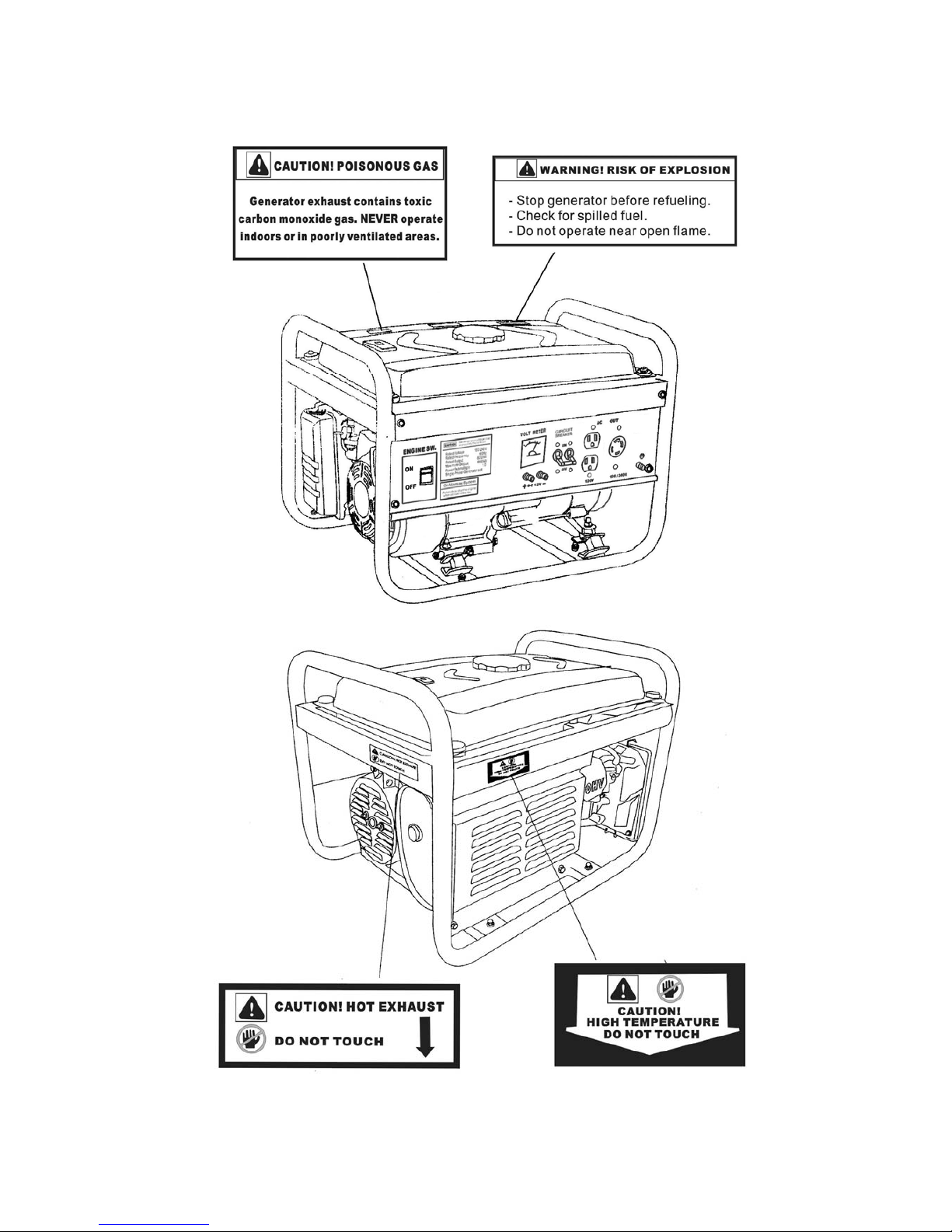
In addition to the above safety notices, please familiarize yourself with the safety and
hazard markings on the generator.
PACKAGE CONTENTS
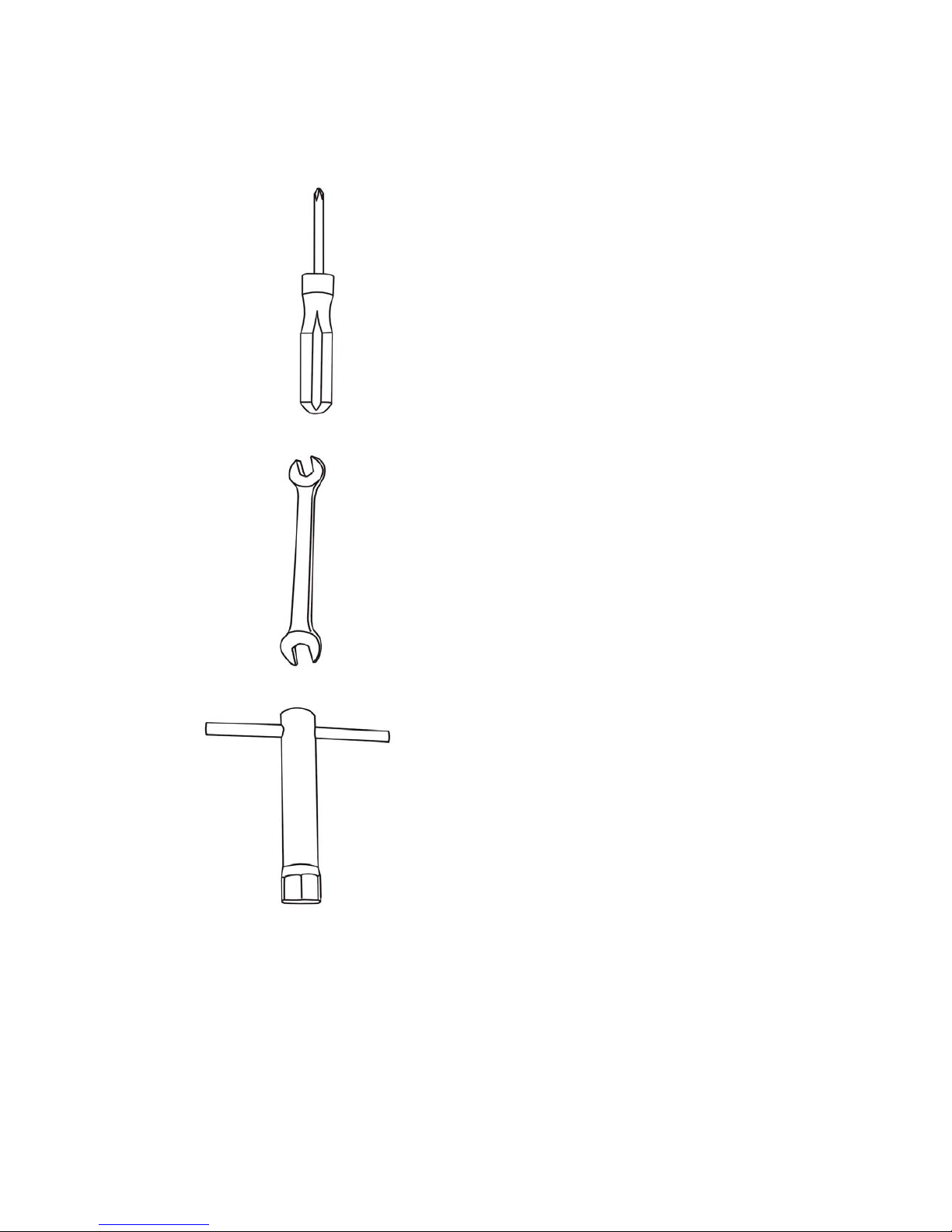
Your generator comes with the items listed below. Please check to see that all of the
following items may be included with your generator, depending on your generator model.
Screwdriver
Spanner
Spark plug wrench
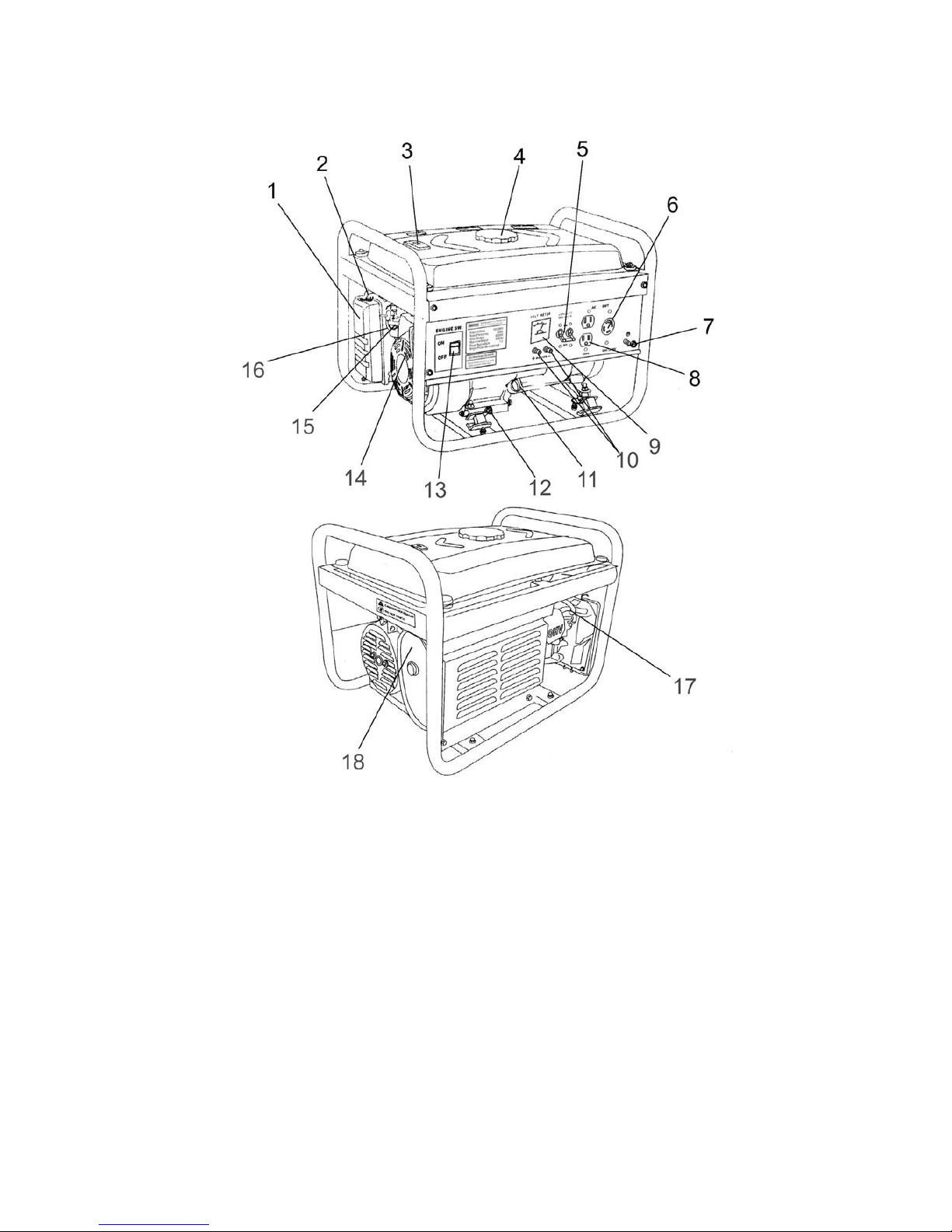
GENERATOR COMPONENTS
Please familiarize yourself with the locations and functions of the various components and
controls of your generator.
(1) Air cleaner- a removable, cleanable, sponge-like element that limits the amount of dirt
pulled into the engine.
(2) Choke lever- Adjusts the amount of air let into the engine.
(3) Fuel Gauge- Indicates the amount of fuel in the tank.
(4) Fuel Cap- Access to the fuel tank for adding fuel.
(5) Circuit Breaker- Reset switch that protects the generator from electrical overload.
(6) 120/ 240 Volt AC Receptacle- Use to connect electrical devices that run 120 and/or
240 Volt, 60Hz, single phase, AC current (NEMA L14-30).
(7) Ground Terminal- Connect grounding wires here to properly ground unit.
(8) 120 Volt AC Receptacle- Use to connect electrical devices that run 120 Volt, 60 Hz,
single phase, AC current (2×duplex GFCI).
(9) Volt Meter- Provides reading of voltage output.
(10) l2V DC Receptacle- Use for charging 12 Volt automotive-type batteries only.
(11) Oil Filler Cap- Use to Add oil or checking the oil.
(12) Oil Fill and Dipstick- Location for checking and filling engine oil.
(13) Engine Switch- Used to start/stop engine.
(14) Recoil Starter- Pull-cord for starting engine.
(15) Fuel Filter Cup- Traps dirt and water from fuel before it enters the engine.
(16) Fuel valve- Allows fuel to enter engine.
(17) Spark plug- Provides proper engine ignition.
(18) Muffler- Reduces engine noise.
PREPARING THE GENERATOR FOR USE
Using the Generator for the First Time
If you are using the generator for the first time, there are a few steps you must take to prepare
it for operation.
Step 1- Add oil
The generator requires engine oil to operate properly. The generator, when new from the
package, contains no oil in the crankcase. You must add the proper amount of oil before
operating the generator for the first time. This amount, which is equal to the oil capacity of the
engine crankcase, can be found on the chart in figure 1. When filling the engine with oil in the
future, please refer to this chart.
Model number PD4000
Engine oil capacity 20 fluid oz.
Figure 1- Generator Oil Capacity
CAUTION:
·Do not apply engine oil with additives or
2-stroke gasoline engine oil, as they haven’t
enough lubrication, which may shorten the
engine’s service life.
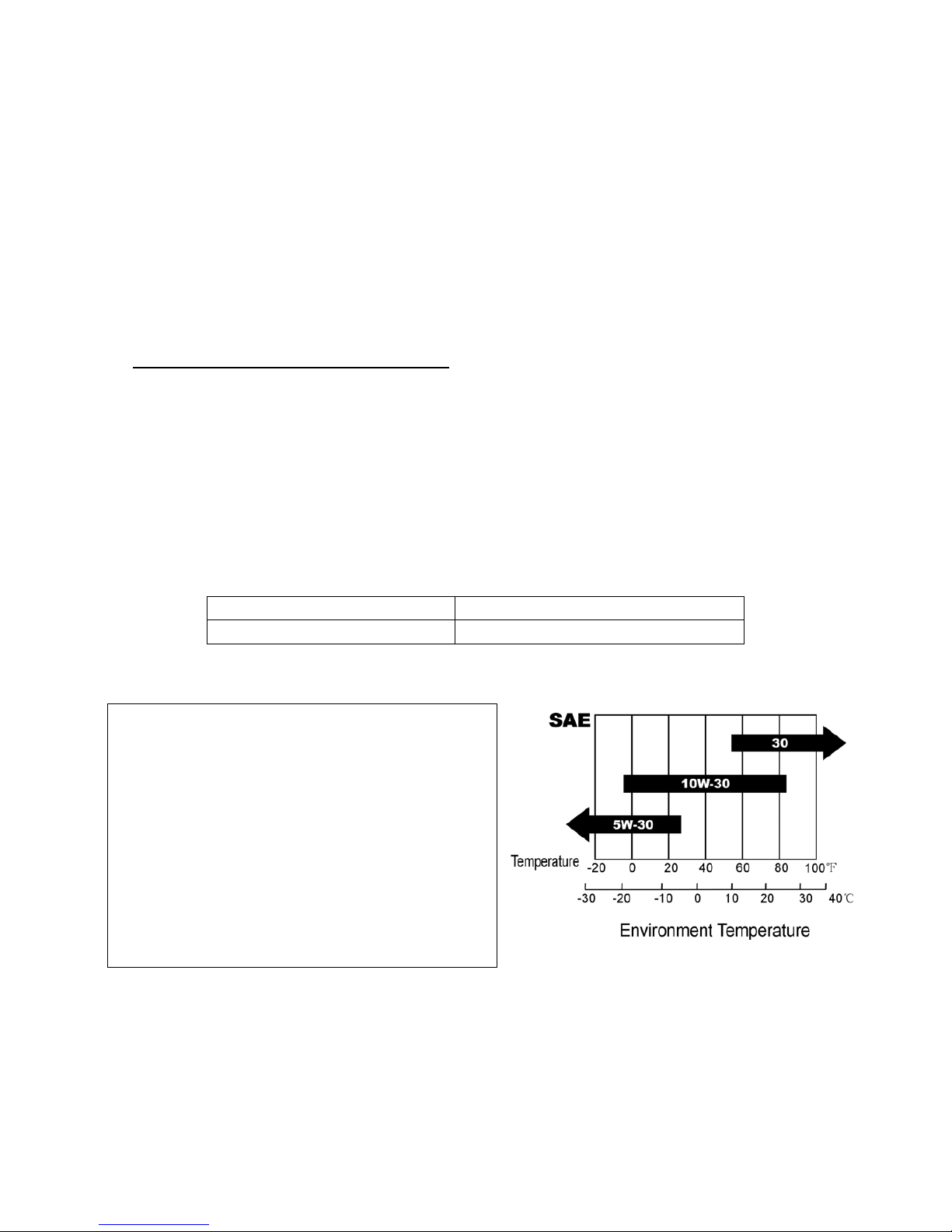
·Engine oil recommended: SAE 10W-30.
As viscosity varies with regions and
temperatures, so the lubricant has to be
selected in accordance with our
recommendation.
To add oil, follow these steps:
l. Make sure the generator is on a level surface.
2. Unscrew the oil filler/dipstick cap from the engine as shown in figure 2.
3. Using a funnel, add the appropriate amount of oil, as found in figure 1, into the crankcase.

You will know the crankcase is full when the oil level has reached the lower lip of the
opening you have just poured the oil into (see figure 3).
4. Replace oil filler cap.
Figure 2- Unscrewing the oil cap Figure 3 - Adding oil
Step 2- Add Gasoline
WARNING: Gasoline and gas fumes are highly flammable.
·Do not fill tank near an open flame.
·Do not overfill. Always check for fuel spills.
To ensure that the generator runs smoothly use only FRESH, UNLEADED GAS WITH AN
OCTANE RATING OF 87 OR HIGHER. To add gasoline:
1. Make sure the generator is on a level surface.
2. Unscrew gas cap and set aside (NOTE: the gas cap may be tight and hard to
unscrew).
3. Slowly add unleaded gasoline to the fuel tank. Be careful not to overfill. Please refer to
the chart in figure 4 to find the gas capacity of your generator model. The fuel gauge on
the top of the generator indicates how much gasoline is in the generator gas tank.
NOTE: Gas can expand. Do not fill the gas tank to the very top.
4. Replace fuel cap and wipe up any spilled gasoline with a dry clothe.
IMPORTANT:
·Never use an oil/gasoline mixture.
·Never use old gas.
·Avoid getting dirt or water in the fuel tank.
·Gas can age in the tank and make it hard to start up the generator in the future.
Never store generator for extended periods of time with fuel in the tank.
Model number PD4000
Gas tank capacity 15L(3.96 us. gallons)
Figure 4 - Gas Tank Capacity
Step 3- Ground the Generator
WARNING: Failure to properly ground the generator can result in electrocution.
Ground the generator by tightening the grounding nut against a grounding wire (see figure
Tabla de contenidos
Otros manuales de Generador portátil de PowerLand


