
P.I.T. PBH20H-22B/1 Manual de usuario
Cordless Hammer Drill
1
Cordless Hammer Drill
2
Cordless Hammer Drill
3
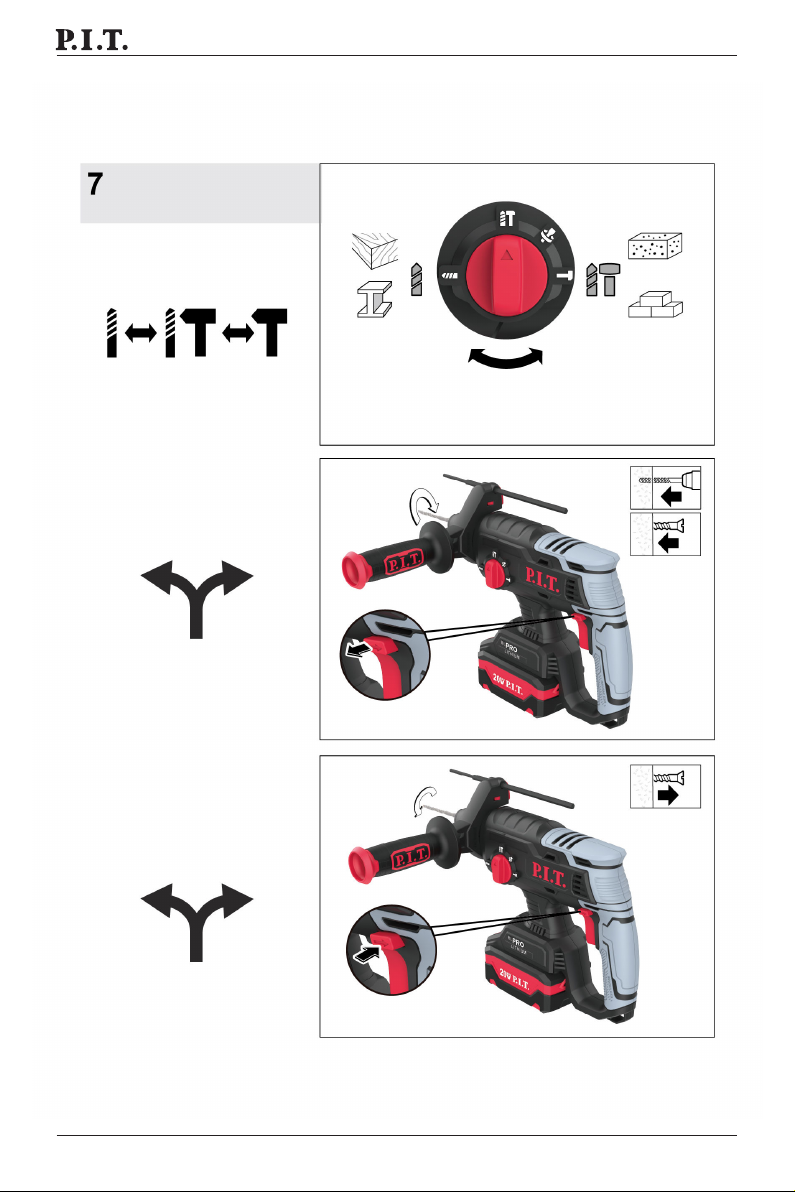
Cordless Hammer Drill
4
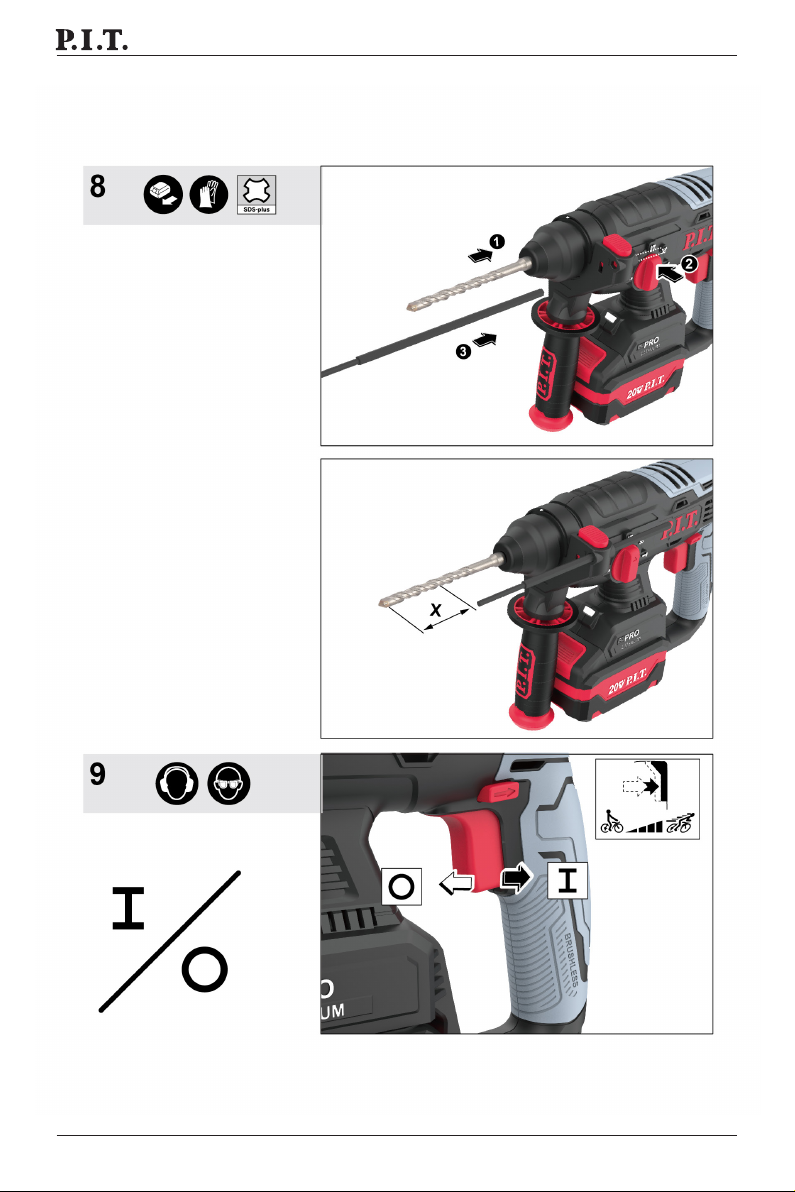
Cordless Hammer Drill
5

Cordless Hammer Drill
6
English
Safety Notes
General Power Tool Safety Warnings
WARNING Read all safety warn-
ings and all instructions.
Failure to follow the warnings and
instructions may result in electric shock, fire
and/or serious injury.
Save all warnings and instructions for
future reference. The term “power tool” in
the warnings refers to your mains- operated
(corded) power tool or battery-operated (cord-
less) power tool.
Work area safety
►Keep work area clean and well lit. Clut-
tered or dark areas invite accidents.
►Do not operate power tools in explosive
atmospheres, such as in the presence of
flammable liquids, gases or dust. Power
tools create sparks which may ignite the
dust or fumes.
►Keep children and bystanders away while
operating a power tool. Distractions can
cause you to lose control.
Electrical safety
►Power tool plugs must match the outlet.
Never modify the plug in any way. Do
not use any adapter plugs with earthed
(grounded) power tools. Unmodied plugs
and matching outlets will reduce risk of
electric shock.
►Avoid body contact with earthed or ground-
ed surfaces, such as pipes, radiators,
ranges and refrigerators. There is an in-
creased risk of electric shock if your body
is earthed or grounded.
►Do not expose power tools to rain or wet
conditions. Water entering a power tool will
increase the risk of electric shock.
►Do not abuse the cord. Never use the
cord for carrying, pulling or unplugging the
power tool. Keep cord away from heat, oil,
sharp edges and moving parts. Damaged
or entangled cords increase the risk of
electric shock.
►When operating a power tool outdoors,
use an extension cord suitable for outdoor
use. Use of a cord suitable for outdoor use
reduces the risk of electric shock.
►If operating a power tool in a damp loca-
tion is unavoidable, use a residual current
device (RCD) protected supply. Use of an
RCD reduces the risk of electric shock.
Personal safety
►Stay alert, watch what you are doing and
use common sense when operating a
power tool. Do not use a power tool while
you are tired or under the influence of
drugs, alcohol or medication. A moment
of inattention while operating power tools
may result in serious personal injury.
►Use personal protective equipment. Always
wear eye protection. Protective equipment
such as dust mask, nonskid safety shoes,
hard hat, or hearing protection used for
appropriate conditions will reduce personal
injuries.
►Prevent unintentional starting. Ensure the
switch is in the o-position before connect-
ing to power source and/or battery pack,
picking up or carrying the tool. Carrying
power tools with your nger on the switch
or energising power tools that have the
switch on invites accidents.
►Remove any adjusting key or wrench be-
fore turning the power tool on. A wrench or
a key left attached to a rotating part of the
power tool may result in personal injury.
►Do not overreach. Keep proper footing and
balance at all times. This enables better
control of the power tool in unexpected sit-
uations.
►Dress properly. Do not wear loose clothing
or jewellery. Keep your hair, clothing and
gloves away from moving parts. Loose
clothes, jewellery or long hair can be
caught in moving parts.
►If devices are provided for the connection
of dust ex- traction and collection facilities,
ensure these are connected and properly
used. Use of dust collection can reduce
dust-related hazards.
Power tool use and care
►Stay alert, watch what you are doing and
use the power tool wisely. Do not use a
power tool when you are tired or under the
influence of drugs, alcohol or medicines.
One moment of inattention while operating
a power tool can result in serious injury.
►Use personal protective equipment.
Always wear safety goggles. The use of
personal protective equipment such as a
face shield, non-slip shoes, a hard hat or
hearing protection, depending on the type
of power tool operation, reduces the risk of
injury.
►Prevent the power tool from being switched
on unintentionally. Before connecting the

Cordless Hammer Drill
7
power tool to the mains and/or battery,
or lifting or carrying the power tool, make
sure that it is turned off. Holding your
nger on the switch while transporting the
power tool and connecting the power tool
to the mains while the power tool is on can
cause an accident.
►Remove the setting tool or wrenches
before turning on the power tool. A tool or
wrench placed in a rotating part of a power
tool can cause injury.
►Do not assume an unnatural body position.
Always take a stable position and keep
your balance. This gives you better control
of the power tool in unexpected situations.
►Wear suitable work clothes. Do not wear
loose clothing or jewelry. Keep hair and
clothing away from moving parts. Loose
clothes, jewelry or long hair can be caught
in rotating parts.
►If it is possible to install dust extraction
and dust collection devices, check their
connection and correct use. The use of
a dust extractor can reduce the danger
posed by dust.
►Good knowledge of power tools, gained as
a result of their frequent use, should not
lead to self-confidence and disregard for
safe handling of power tools. One careless
action in a fraction of a second can result
in serious injury.
ATTENTION! In the event of an interruption
in the operation of the power tool due to a
complete or partial loss of power supply or
damage to the power control circuit, set the
switch to the o position, making sure that it
is not blocked (if any). Disconnect the mains
plug from the socket or remove the removable
battery. This prevents an uncontrolled restart.
Power tool use and handling
►Do not overload the power tool. Use the
appropriate special power tool for the job.
With the right power tool, you work better
and more reliably in the specified power
range.
►Do not operate a power tool with a faulty
switch. A power tool that cannot be turned
on or off is dangerous and must be
repaired.
►Before setting up the power tool, changing
accessories, or storing the power tool,
unplug the power tool from the wall outlet
and/or remove the battery if possible. This
precaution prevents the power tool from
being switched on unintentionally.
►Keep power tools out of the reach of
children. Do not allow anyone who is
not familiar with it or who has not read
these instructions to use the power tool.
Power tools are dangerous in the hands of
inexperienced persons.
►The appliance is not intended for use by
persons (including children) with reduced
physical, sensory or mental capabilities,
or lack of experience or knowledge,
unless they have been given supervision
or instruction regarding the use of the
appliance by a person responsible for their
safety.
►Take good care of power tools and
accessories. Check the function and
running of the moving parts of the power
tool for perfect function, for breakage or
damage that would impair the function of
the power tool. Damaged parts must be
repaired before using the power tool. Poor
maintenance of power tools is the cause of
a large number of accidents.
►Keep cutting tools sharp and clean.
Carefully maintained cutting tools with
sharp cutting edges are less likely to jam
and are easier to guide.
►Use power tools, accessories, work tools,
etc. in accordance with these instructions.
Consider the working conditions and the
work to be done. Use of power tools for
unintended work can lead to dangerous
situations.
►Keep handles and gripping surfaces dry
and clean and free from oil or grease.
Slippery handles and gripping surfaces
prevent safe handling of the tool and
prevent reliable control in unforeseen
situations.
Application and maintenance of
cordless tools
►The battery is not fully charged
when shipped. To ensure full battery
performance, fully charge the battery
before rst use.
►Use the battery only in combination with
your P.I.T. This is the only way to prevent
dangerous battery overload.
►Charge batteries only with chargers
recommended by the manufacturer. A
charger designed for certain types of
batteries may present a re hazard when
used with other batteries.
►Only use the batteries specified for this
purpose in power tools. Use of other

Cordless Hammer Drill
8
batteries may result in personal injury and
re hazard.
►Make sure the tool is turned off before
inserting the battery. Inserting a
rechargeable battery into a powered tool
may result in an accident.
►Check the battery for firm seating. It has
two levels of xation.
Important safety instructions for
working with the battery pack.
WARNING: Use only original P.I.T. Use
of batteries not manufactured by P.I.T. or
batteries that have been modied may result
in battery explosion, fire, personal injury or
property damage. It will also automatically
void the P.I.T. on the P.I.T. tool and charger.
►Before using the battery pack, read all
instructions and warning labels on the
charger, battery pack, and tool powered by
the battery pack.
►Do not disassemble the battery pack.
►Do not drop or hit the battery pack.
►Do not use a damaged battery pack
►If the operating time of the battery pack
becomes significantly shortened, stop
using it immediately. Otherwise, the unit
may overheat, resulting in burns and even
an explosion.
►If electrolyte gets into your eyes, rinse with
plenty of clean water and seek medical
attention immediately. This can lead to
vision loss.
►Do not short the contacts of the battery
pack with each other:
(1) Do not touch the contacts with any con-
ductive objects.
(2) Do not store the battery pack in a con-
tainer with other metal objects such as nails,
coins, etc.
(3) Do not expose the battery pack to water or
rain. Shorting the contacts of the battery pack
together can cause high current, overheating,
possible burns, and even breakage of the
pack.
►Do not store the tool and battery pack
where the temperature can reach or
exceed 50°C (122°F).
►Do not throw the battery pack into a
fire, even if it is severely damaged or
completely out of order. The battery pack
may explode if exposed to re.
►If the battery is damaged or misused, gas
may be released. Provide fresh air and if
you have any complaints, consult a doctor.
Gases can cause respiratory irritation.
►Clean the battery vents from time to time
with a soft, dry, and clean brush.
►Charge the battery pack without
completely discharging it. Be sure to stop
using the tool and charge the unit if you
notice a decrease in tool power.
►Never recharge a fully charged battery
pack. Overcharging shortens battery life.
►Charge the battery pack at room
temperature. Allow a hot battery pack to
cool before charging.
►Charge the lithium-ion battery pack if you
will not be using the tool for a long time
(more than six months).
►Do not open the battery. Doing so may
cause a short circuit.
►Protect the battery from high temperatures
such as prolonged exposure to the sun,
re, water and moisture. There is a risk of
explosion.
►Store the battery within the temperature
range of 0 to 45°C. Do not leave the
battery in the car in summer.
►The supplied lithium-ion batteries must be
used in accordance with the requirements
of the dangerous goods laws. For
commercial shipments, such as by a
third party or freight forwarder, special
warnings and labels must be applied to
the packaging. Be sure to consult with
a Hazardous Materials Specialist when
preparing your device for shipping.
Also observe local requirements and
regulations. They may be stricter. Cover or
secure open contacts and pack the battery
so that it does not move around in the
package.
►Follow local regulations regarding disposal
of the battery pack.
Safety instructions for rotary ham-
mers
►Wear hearing protection. Noise exposure
can cause hearing loss.
►When performing work in which the tool
or screw may touch hidden electrical
wiring, hold the power tool by the insulated
handles. Contact with live wiring can
charge metal parts of the power tool and
result in electric shock.
►Use appropriate metal detectors to locate
hidden electrical, gas, and water systems,
or contact your local utility company for
help. Contact with electrical wiring can
cause re and electric shock. Damage to

Cordless Hammer Drill
9
the gas pipeline can lead to an explosion.
Damage to the water supply leads to
material damage.
►When jamming the working tool, turn off
the power tool. Eliminate the cause of
jamming of the working tool.
►Before switching on the power tool, make
sure that the tool can turn freely. When
turning on a power tool with a jammed
working tool, large reaction moments
occur.
►For impact-free drilling in wood, metal,
ceramics and plastics, as well as for
screwdriving, use tools without SDS-plus
(eg drills with cylindrical shank). These
tools require a keyless, chuck or gear
chuck.
►If the dust cap is damaged, it must be
replaced immediately. The dust cap
prevents drilling dust from entering the
chuck. When installing the operating tool,
be careful not to damage the dust cap.
►Always hold the power tool during
operation with both hands, having
previously taken a stable position. With
two hands you work more reliably with the
power tool.
►Fix the workpiece. A workpiece placed in
a jig or vise is held more securely than in
your hand.
►Wait until the power tool has come to a
complete stop before releasing it from your
hands. The work tool may jam and this
may result in loss of control of the power
tool.
►When transporting and storing the tool,
set the rotation direction switch to the
middle position. If the switch is actuated
unintentionally, there is a risk of injury.
►When turning on a power tool with a
jammed working tool, high reaction
moments occur.
►Prevent unintentional activation. Make
sure the switch is in the o position before
installing the battery. Carrying the power
tool with your finger on the switch, or
inserting the battery into the power tool
while it is on, may cause accidents.
►Installing the SDS-plus working tool:
Check the xation by trying to pull out the
working tool.
►Dust from materials such as lead-based
paint, certain types of wood, minerals and
metals can harm your health and cause
allergic reactions, respiratory problems
and/or cancer. Have asbestos-containing
material handled only by specialists.
– If possible, use a dust extractor suitable for
the material.
– Ventilate the work area well.
– It is recommended to use a respiratory
mask with a class P2 filter. Observe the
regulations valid in your country for the
materials to be processed.
►Avoid dust accumulation in the workplace.
Dust can be easily ignited.
►To save energy, switch on the power tool
only when you intend to use it.
Product Description and Specifi-
cations
Read all safety warnings and all in-
structions. Failure to follow the
warnings and instructions may result
in electric shock, re and/or serious injury.
Intended Use
The machine is intended for hammer drilling
in concrete,brick and stone. It is also suitable
for drilling without impact in wood, metal, ce-
ramic and plastic. Machines with electronic
control and right/left rotation are also suitable
for screwdriving.
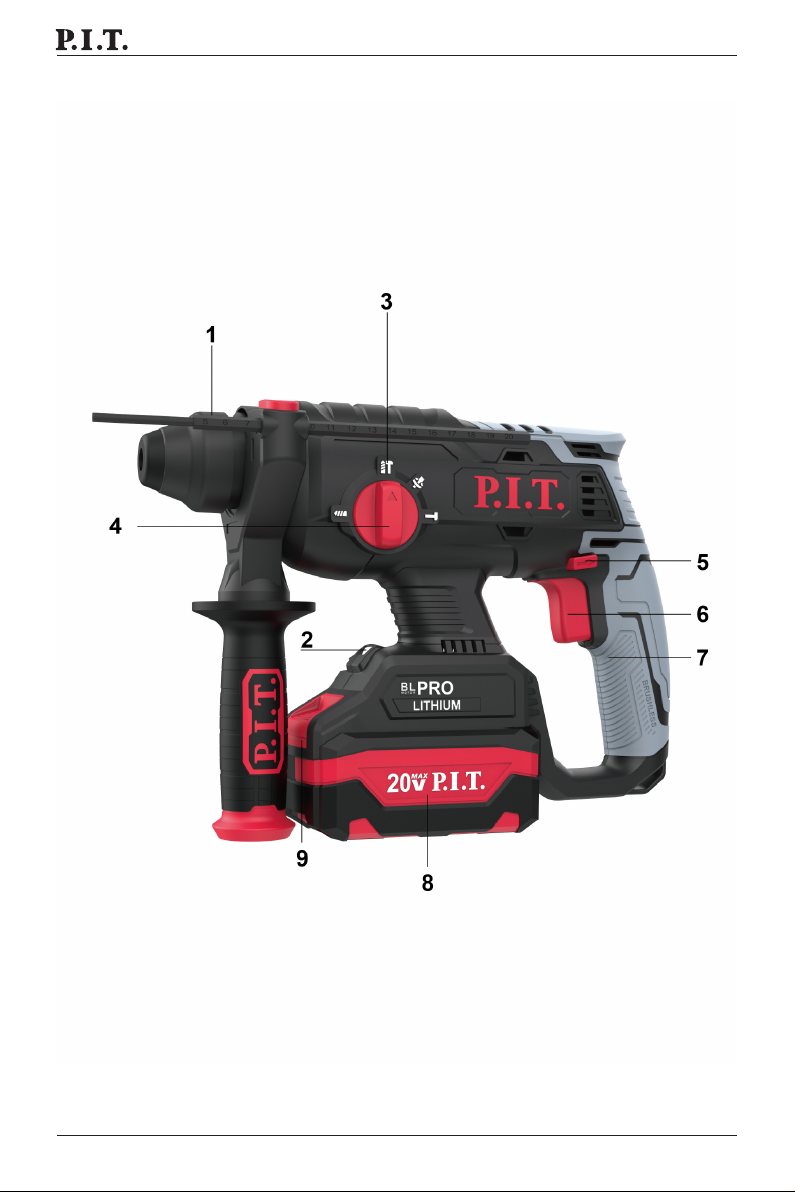
Product Features
The numbering of the product features refers
to the illustration of the machine on the graph-
ics page.
(1) SDS-plus quick change chuck
(2) LED workinglight
(3) Designation of operating modes
(4) Selector switch for drilling/hammer drilling
(5) Rotational direction switch
(6) On/O switch
(7) Handle (insulated gripping surface)
(8) Rechargeable battery
(9) Battery release button
Technical Parameters
Model PBH20H-22B
Rated voltage DC 20V
No-load speed 0-1350 r/min
Impact frequency 0-4700 ipm
Max. drilling diameter
(concrete) Ø22 mm
Impact 1.8 J
Weight 2.3 kg
Compatible battery
(availability varies by
package)
PH20-3.0 (3 Аh)
PH20-4.0 (4 Аh)
PH20-5.0 (5 Аh)
PH20-6.0 (6 Аh)
Tabla de contenidos
Idiomas:
Otros manuales de Perforar de P.I.T.

P.I.T.
P.I.T. PSB16-C Manual de usuario

P.I.T.
P.I.T. PBH32-C5 Manual de usuario

P.I.T.
P.I.T. PBH26-C5 Manual de usuario

P.I.T.
P.I.T. PBH40-C2 Manual de usuario

P.I.T.
P.I.T. PSB13-C2 Manual de usuario

P.I.T.
P.I.T. PROFESSIONAL PSB20H-10C Manual de usuario

P.I.T.
P.I.T. PBH24-C2 Manual de usuario

P.I.T.
P.I.T. PSB13-C4 Manual de usuario

P.I.T.
P.I.T. E-PSR18-D4-A1 Manual de usuario

P.I.T.
P.I.T. PSB13-C5 Manual de usuario


