
Nipon Optics F300X70M Manual de usuario

NIPON F300X70M
Astronomical and
Terrestrial
Telescope
Instruction Manual
2
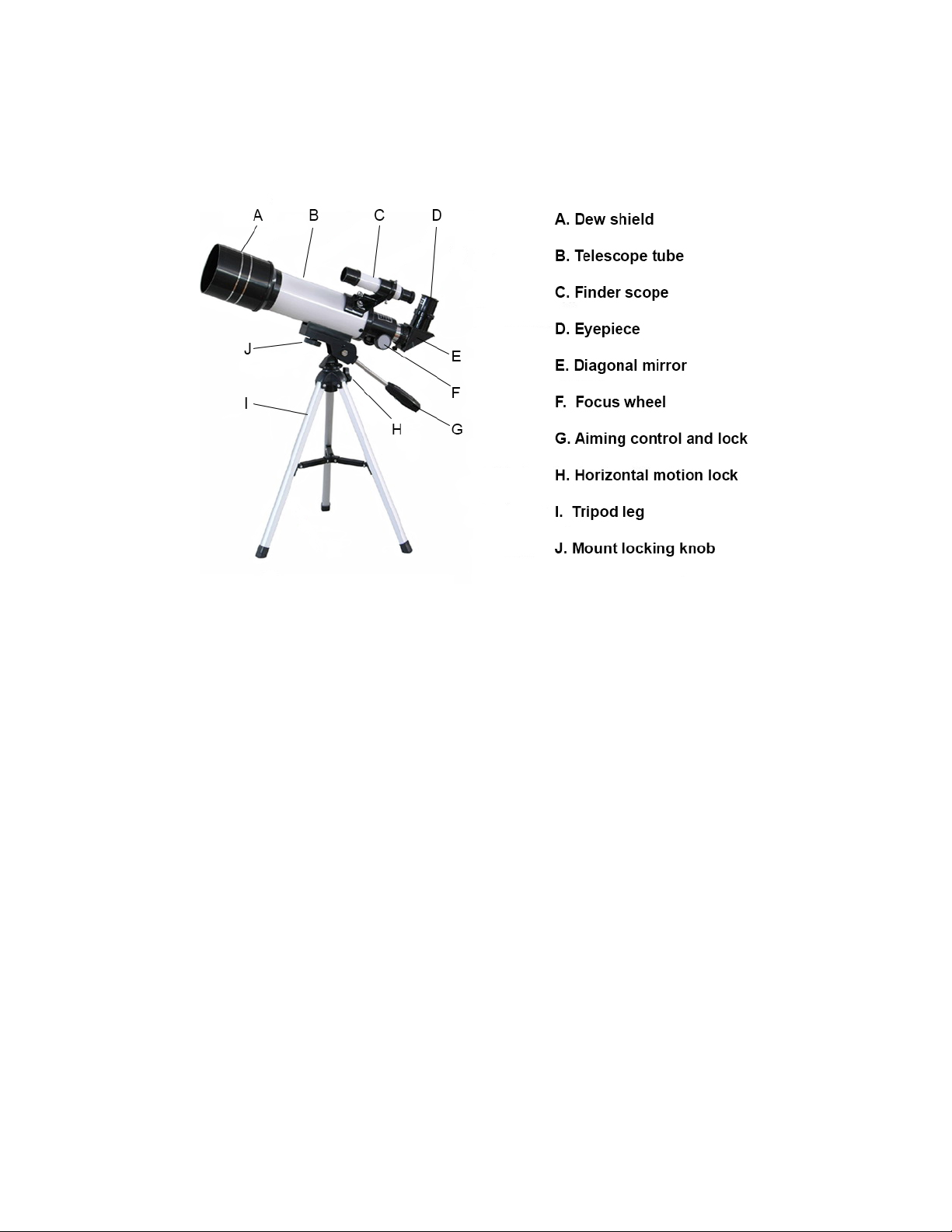
Main parts of your telescope:
WARNING
Never look directly at the Sun or anywhere near the Sun with a telescope, or
permanent and irreversible eye damage may occur!
Do not let children use a telescope without adult supervision at any time when the
Sun is above the horizon.

3
Introduction
Congratulations on purchasing your new
telescope. We hope it will give you many
years of enjoyment as it opens your eyes
to some nature’s most wondrous sights.
Please read this manual carefully as it
contains the information you will need to
know in order to obtain the best results
from your telescope.
If you have not read the
warning message
on the previous page, please go back and
read it now.
Please contact us if you need assistance
in assembling or operating your telescope.
Good luck with your new hobby!
NIPON SCOPE & OPTICS
www.ni
pon-scope.com
CONTENTS
Telescope parts . . . . . . . . . . 2
Warning . . . . . . . . . . . . . . . . 2
Introduction . . . . . . . . . . . . . 3
Assembly . . . . . . . . . . . . . . . 4
Using your telescope . . . . . . 4
Astronomical use . . . . . . . . . 5
Terrestrial use . . . . . . . . . . . . 5
Care & cleaning of optics . . . 5
What to look for in the sky . . 6
4
Assembly
Remove all of the items from the box and lay them out so that you can clearly identify each part.
Check that you have all the parts in the package. Keep the box for storage, or if you ever need to
return the telescope for service.
1) Gently pull the aluminum tripod legs apart as far as they will go until the center leg braces sit
flat, in a horizontal position.
2) Put the Finder Scope (C) on the main telescope tube and tighten the screws.
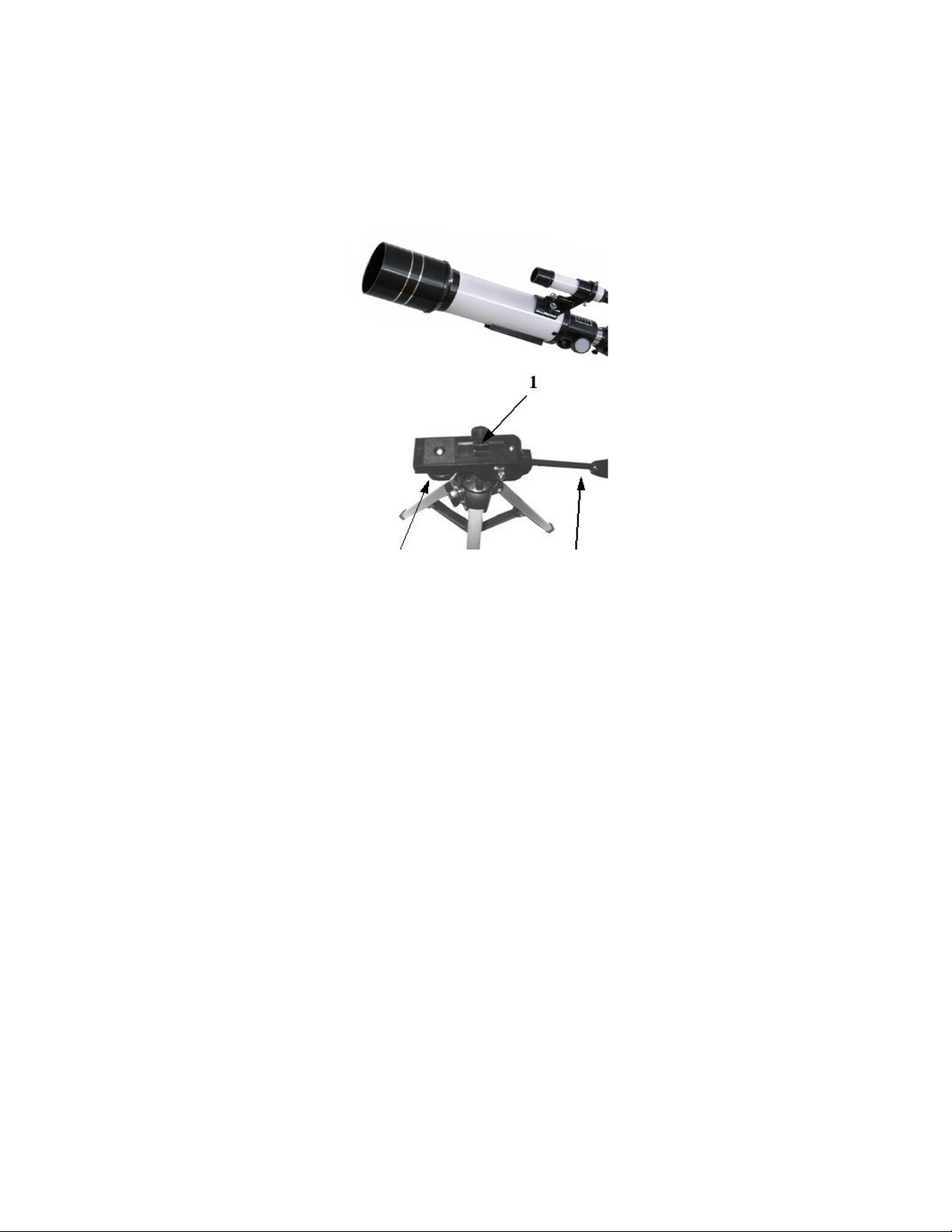
3) The telescope tube has a mounting tab on its underside. Place this tab into the slot (1) on top
of the tripod.
4) Tighten the knurled knob (2) on the tripod head to hold the telescope tube tightly to the tripod.
5) Screw the aiming control arm into the threaded socket at the rear of the mount.
6) Insert the diagonal mirror into the end (focuser) of the telescope tube.
7) Insert the 20mm eyepiece into the diagonal tube.
8) Remove the dust cap from the large end of the telescope.
9) Your NIPON F30070 is now ready for use.
Using your telescope
1) Take your telescope outside. Do not try to use it by looking through a window. If the window is
closed the window glass will introduce light reflections and distortions. If the window is open the
moving air currents of different temperatures may also cause distortions.

5
2) Let your telescope adjust to the outside temperature. The telescope will perform much better if
the lenses and the air inside the tube are all the same temperature as the outside environment.
This process may take up to 1/2 hour if there is a huge difference between the temperature inside
and outside the telescope.
3) Try to find a location that is away from glaring lights. Using a telescope in the skyglow of a town
or city can reduce its ability by half.
Astronomical Use:
1) Always start viewing with your 20mm eyepiece. This is your low power eyepiece and its wide
viewing field will make it easier to locate objects. You may also notice that stars, when seen
through your telescope, still look like points of light. This is because they are so far away. Even
the largest telescopes show stars only as bright points.
2) Once you have located an object and the view is clear, you may wish to change to the high
power eyepiece. You will notice that your object looks bigger, but not as bright as seen with the
20mm eyepiece. This is normal. If the viewing conditions are not good the high power image may
not appear sharp or stable. If this happens, switch back to the 20mm eyepiece and try the high
power eyepiece another night. You can also achieve higher power by inserting the 3X Barlow lens
between the telescope and either eyepiece. This triples the available power.
Terrestrial Use:
Your telescope is a dual purpose model. It can be used for astronomy, as well as for viewing
objects on land. When viewing terrestrial object, you will want the objects to appear both right-side
up and correctly oriented left to right, just as you see them with your eyes.
To achieve correct image orientation you can use the Image Erector that is supplied with your
telescope.
1) Remove the diagonal from your telescope.
2) Insert the Image Erector into the focuser. Then insert the 20mm eyepiece into its open end.
When you look through the telescope you will find that the image you see is right-side up
and properly oriented. Keep your eye as close to the eyepiece as possible and adjust the
image erector tube when necessary to make it in line with the telescope.
3) For more magnification remove the 20mm eyepiece and replace it with a higher power
eyepiece.
Care and cleaning of optics
Optical components of a telescope will get dirty over time. The amount of dirt or dust collected
onto a lens or mirror should only be removed with the utmost care and this is at times best left to
people with experience in this procedure. A considerable amount of dirt or dust must be present
on the optical surface before one will notice the effect visually.

6
1. Keeping the dust caps on during storage of the telescope will reduce the amount of dust
collected.
2 After using the telescope there might be dew condensation on the optical surfaces. When
the telescope is brought inside remove the dust caps and allow the moisture to evaporate
naturally. Point the telescope downwards so as to minimize the collection of airborne dust.
3. Once the moisture is gone then replace the dust caps.
4. If you wish to remove dust from the lenses or mirrors you should first try to use a can of
filtered compressed air, or a rubber air blower. Remove the dust cap and the dew shield in
the case of the refractor type of telescope, or take the mirror cell out for the reflecting type
scope. Once you are able to freely blow across the surface of the optics then begin by first
pointing the can away from the optical surface and gently expel some air. This will remove
any condensate in the air can lines and clear off dust that may have accumulated on the
discharge tube. Next using short quick bursts of air to carefully remove the dust particles.
DO NOT HOLD THE TRIGGER OF THE COMPRESSED AIR FOR TOO LONG AS
CONDENSATE MIGHT BE BLOWN OUT ACROSS THE OPTICAL SURFACE.
The optics of your telescope should last a long time before they generally require major cleaning.
By keeping the dust caps on and avoiding the temptation to handle the lenses or mirrors you will
find that very little is needed in terms of optical maintenance.
What to look for in the sky
WARNING: NEVER LOOK DIRECTLY AT THE SUN OR ANYWHERE NEAR THE SUN WITH A
TELESCOPE! PERMANENT AND IRREVERSIBLE EYE DAMAGE MAY OCCUR!
DO NOT LET CHILDREN USE A TELESCOPE WITHOUT ADULT SUPERVISION AT ANY TIME
WHEN THE SUN IS ABOVE THE HORIZON.
There is a whole universe of objects to be seen in the night sky, so where does one start? Well,
let’s examine the most visible objects first.
The Moon
The Moon is the easiest target to find in the night sky. When it is in full Moon and its entire face is
lit, then it bathes the night with a silvery light washing out the rest of the sky for all but the brightest
objects. The best time to view the Moon is actually not when it is full but rather anytime up to the
first quarter, this is when the face appears to be half lit-up. The terminator of the Moon, the
dividing line between dark and light, shows the best features such as craters and mountains.

7
The Planets
The planets are our solar system companions. These range in size from the Moon size rocky
bodies to giant gas balls which could hold 1000 Earths. To find the planets requires some
information as to when they are visible. An astronomy magazine such as Sky at Night, Space, or
Astronomy, will give you the locations of the planets from month to month. Most people who have
looked up at night have probably seen some planets but did not realize it. A planet, when it is well
clear of the horizon will not twinkle as do the stars. They are resolved by the eye as tiny balls as
opposed to the stars which are infinitely small points of light. The easiest planets to view, when
they are visible, are Venus, Mars, Jupiter, Saturn, Uranus and Neptune. Mercury is an object to
look for but it is usually below the horizon and often is a challenge to find. Pluto is too small for
most telescopes below 10" so do not worry about finding it at this time.
Each of the planets has its own interesting views. Venus is covered with clouds so all we see is an
extremely bright light, the brightest next to the Moon; however it’s like our Moon goes through
phases. In other words the planet surface will, as it travels around the Sun, appear to have
different amount of lit-up. This gives the planet varying crescent shapes, as if a bite were taken
out of it. Mars is the red planet. It is very noticeably red when rising above the horizon and stands
out like a beacon in the night sky. The apparent brightness of Mars varies as the planet orbits
around the sun so throughout its time being visible to us it will brighten and dim depending on how
our two planets are aligned relative to each other.
Jupiter is the largest planet in our solar system. It is the second brightest planet next to Venus.
Jupiter also has moons of which 4 are easily visible through a telescope. In fact as you watch
them throughout the evening you will see that they change their positions relative to each other
and to Jupiter. It is possible with careful planning to actually see one of the moons disappear
either in front of, or behind Jupiter as they travel around their planet. Another great feature of
Jupiter is the cloud belt pattern. Jupiter is alive with weather activity and the planet’s clouds have
formed in time into belts which are visible to telescopes, when the sky is clear.
Saturn, the second largest planet, is not as bright as Jupiter and its moons are not as visible
through small telescopes. However it has very large rings that encircle the planet which are
spectacular. The planet appears as a pale yellow, as do the rings but one can spend hours
looking at these. The major division in the rings, the Cassini division, is possible to see in a small
telescope if the viewing condition is steady.
Uranus and Neptune are the last of the solar system gas giants. They do not yield up spectacular
sights like Jupiter or Saturn, but they are part of our family and are rewarding to see as they can
be a challenge to find.
Beyond our solar system there lies a multitude of objects to be found. Galaxies, nebulae and star
clusters abound.
-------------------------------------
NIPON SCOPE & OPTICS
www.nipon-scope.com
Copyright ©2012 NOL. All rights reserved.
Tabla de contenidos
Otros manuales de Telescopio de Nipon Optics


