
Le Panyol LIBERTE Series Manual de usuario
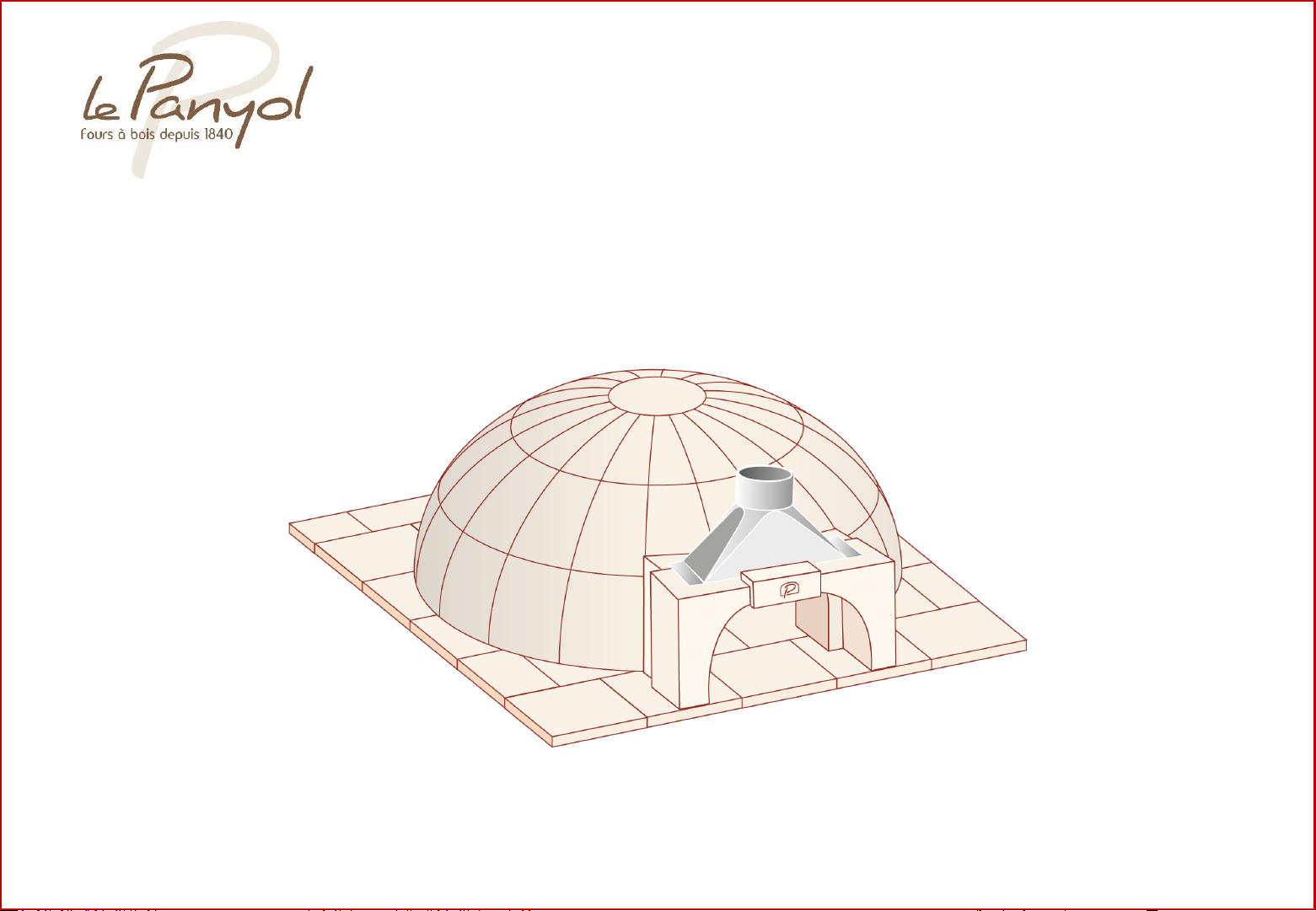
14/01/2020
LIBERTE RANGE
Model 120
ASSEMBLY INSTRUCTIONS

OVEN PARTS LIST
Basic Formula
Model 120
Refractory
terracotta tiles 33x33x6cm –Stone color 5
Refractory
terracotta tiles 33x33x6cm –White color 25
Oven
-entry 1 in 2 parts (left and right)
Smoke
throat 1 in 3 parts (left, central, right)
Pediment
Le Panyol 1
Voussoirs n
°1 (120N1) 14
Voussoirs n
°2 (120N2) 14
Voussoirs n
°3 (120N3) 14
Voussoirs n
°3A (120N3A) 3
Wood
templates to place the voussoirs 14
Bevel
wood templates to place the voussoirs 3
Wooden
disc to place the templates 1
Keystone
1
Smoke
adaptor Ø180 mm + Hadware 1
Refractory
mortar for the oven dome –bags 25 kg 3
Grog
to place under the tiles –bags 25 kg 4
Insulated
door 1
Oven
peel 1
Assembly
instructions 1
Warranty
1
Complete Formula Grog
Basic
Formula
+ Grog to insulate the oven dome- bags 25kg 35
+ Essential accessories kit
(1 laser
thermometer + 1 brush + 1 scraper + 1 wood peel)
1
Complete
Fortmula Blanket
Basic Formula
+ Refractory Insulating Blanket –Roll 3m² - thichness 38mm 2
+ Essential accessories kit
(1 laser
thermometer + 1 brush + 1 scraper + 1 wood peel)
12

TOOLS
•Spirit level
•Tape mesure
•Spatula
•Trowel
•Rubber Mallet
•Jack
•Wood specer
•Iron wire
•Drill
•Gloves
3

FOREWORD
Le Panyol ovens are made exclusively of Refractory White Earth, a 100% natural clay from our own quarry.
As the material is irregular by nature and the production methods are based partly on craft skills, you may find that there
are gaps between the parts when it comes to assembling them. These will be filled in when you apply the refractory
mortar.
These gaps allow the oven to expand.
The keystone may be slightly higher or lower than the dome of the oven.
The edges of the parts may crumble slightly if they are handled repeatedly.
THESE DIFFERENCES WILL IN NO WAY IMPAIR THE OPERATION OF YOUR OVEN OR SHORTEN ITS LIFE
The oven must be built under cover.

1. Choose a site for the oven
2. Build a base on which to sit the oven
3. Insulate the base
4. Assemble the oven floor –see also the video
5. Assemble the oven dome - see also the video
6. Apply the mortar
7. Insulate the oven dome
8. Connect the oven to a chimney pipe
9. Surround / decorate the oven
THE KEY STAGES OF ASSEMBLY

Before you start to assemble the oven, you’ll need to decide where you’re going to place it and work out exactly how much
space you’ll need to install it.
Check in particular that the floor can bear the weight of the finished oven (base + oven + insulation + surround + roof). The floor
must be flat and should not subside under the weight of the construction.
The oven may be installed indoors or outdoors, stand-alone or incorporated into an existing building, near the pool, under a
veranda or in the kitchen. A wide range of installations are possible. See our “Gallery” page on our website or ask the retailer in
your region.
Outdoor Installation
The Le Panyol oven must be protected against bad weather by a roof wide enough to prevent the oven and hearth tiles from
getting wet. It must be kept dry in winter as, if it absorbs water, frost would make it unusable. If the oven is stand-alone, the
pipe must be approximately 1m long. However, if the oven is backed on to a wall or built into the home, the pipe must be long
enough to go 40cm beyond the roof ridge (in accordance with DTU standard 24.1).
Indoor Installation
The Le Panyol oven must be connected to an existing or future-build chimney pipe, in accordance with DTU standard 24.1
(Unified Technical Document). Do not connect more than one apparatus to the same chimney pipe.
The pipe should be:
•180 mm in diameter (the stainless steel smoke adaptor supplied with the oven is 180mm in diameter)
•Made up of a maximum of 2 x 45° bends
•Removable
•With a double skin if an indoor installation
To prevent moisture and rainwater from getting into the pipe, you’ll need to fit a rain cap on the top of the stack.
STEP 1 : Choosing a site

7
STEP 1 : Choose the final shape of the oven
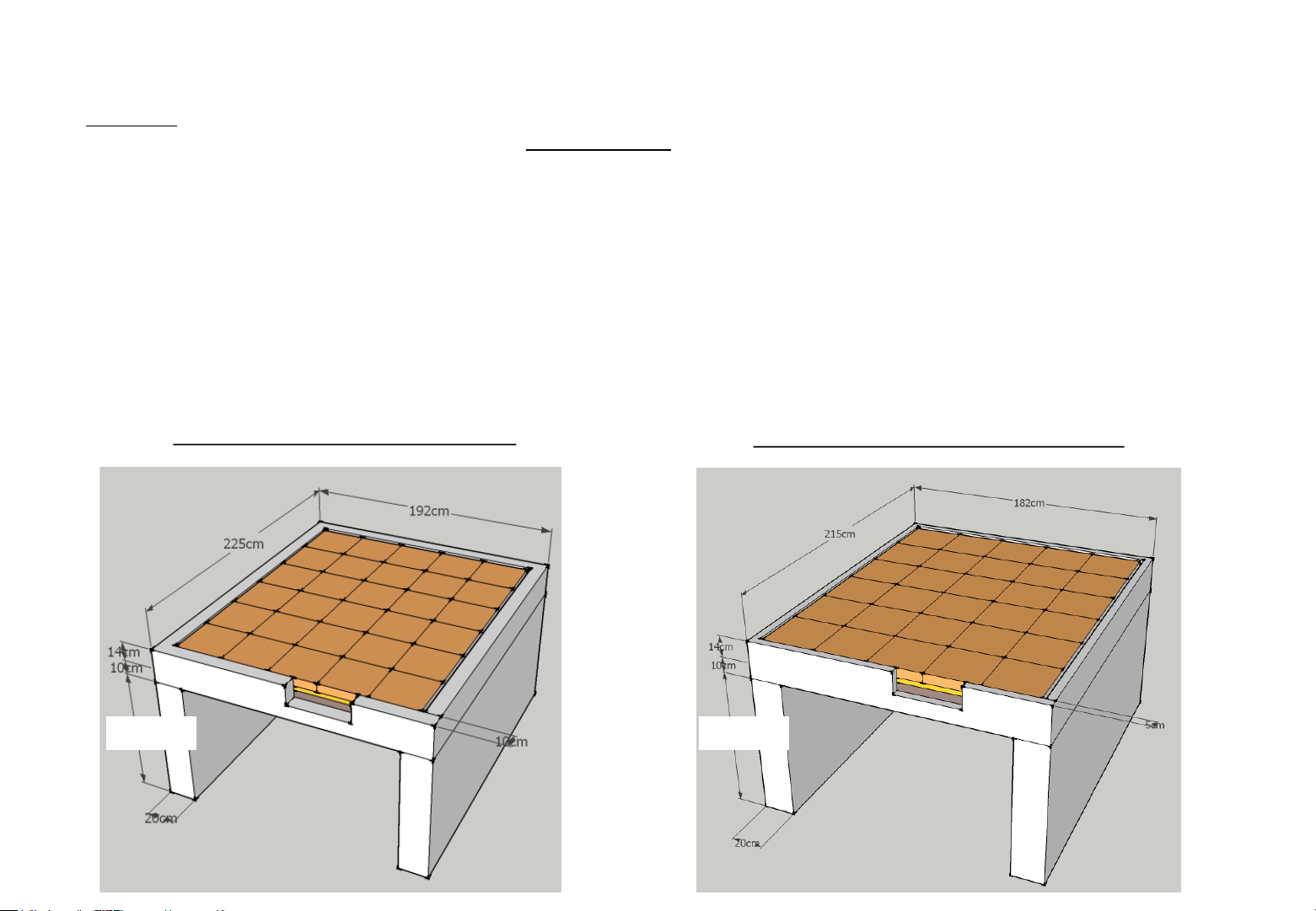
There are 2 kinds of shape for the oven : cubic and rounded. In terms of the shape, the insulation materials and the size of the base
are different. For a rounded shape, there’s no need to build a surrounding wall and therefore the size of the base is smaller.
Cubic shape Rounded shape
8
variable variable
Foreword :
Before building the base, it is important to define the oven floor height (where the fire will be laid and the cooking done). This height
defines the pillars’ height of the base.
The oven floor is generally between 100 and 120 cm high, depending on the user’s height and comfort requirements.
To calculate the pillars’ height, subtract 24 cm to the oven floor height :
•the oven tiles : 6 cm thick
•the grog insulation under the oven tiles (included with the oven) : 3 cm thick
•The insulating plates (not provided with the oven) : 5 cm thick
•Reinforced concrete slab: 10 cm thick
Example : you want an oven floor height equal to 118 cm; then the pillars’ height will be equal to 118-24=94 cm
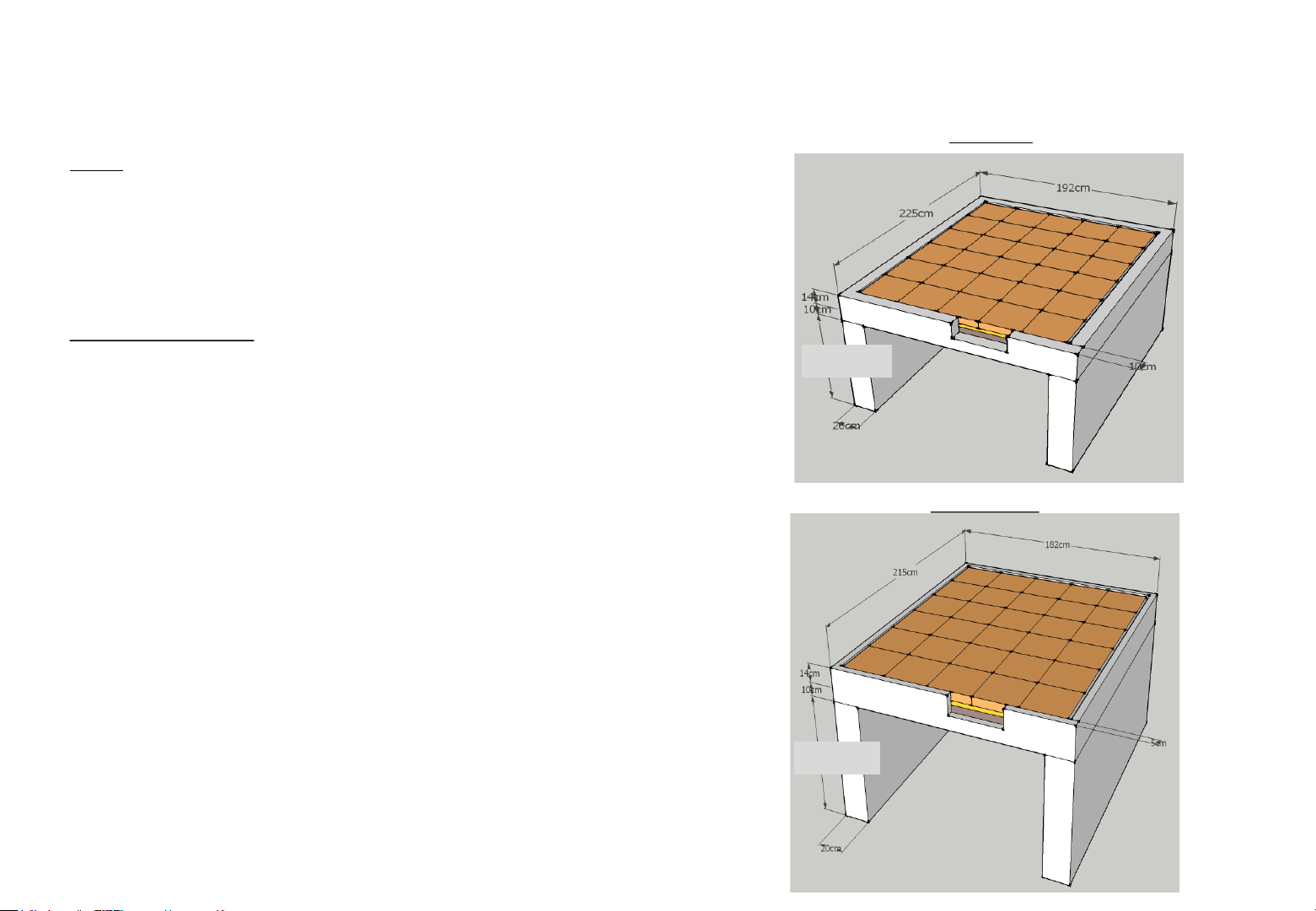
Dimensions of the base for a cubic shape Dimensions of the base for a rounded shape
STEP 2 : Building a base to support the oven
9
variable
variable
Build :
•3 breeze-block pillars 20 cm thick
•1 reinforced concrete slab 10 cm thick
•1 level (14 cm) of surrounding wall on the 3 sides using Siporex-
type insulation blocks 10 cm thick if cubic shape and 5 cm thick if
rounded shape. This wall will stem the grog under the floor tile.
Base width and depth
The dimensions include:
•Dimensions of the oven
•Thickness of the insulation
•Thickness of the surrounding wall
•Surround : rendering (i.e. a few millimeters thick)
If the surround material is much thicker (bricks, stones,), you must
add this thickness to the above dimensions
Warning:
These dimensions are minimum for a simple standard installation.
These dimensions are calculated with specific materials.
If you make any changes, you will have to calculate the dimensions of your
base in terms of your choices.
STEP 2 : Building a base to support the oven
Cubic shape
Rounded shape

STEP 3 : Insulating the base
Once you have built the base :
1/ Insulate the reinforced concrete slab using dry Siporex-type insulation blocks 5 cm thick. Do not seal.
2/ Draw a line at 21 cm from the edge of the base and place siporex block 3 cm thick in order to contain the grog. Cut properly
because the tiles will be put on these blocks.
21 cm
Pour out one bag of grog.
First, spread with the trowel to get an homogeneous bed of grog.
Check that the thickness is between 2 and 3 cm. Level.
10
Warning :
The photos are matching the model 83. For the model 120 there are 30 tiles but the process is exactly the same.
Otros manuales para LIBERTE Series
1
Este manual sirve para los siguientes modelos
5
Tabla de contenidos
Otros manuales de Horno de Le Panyol


