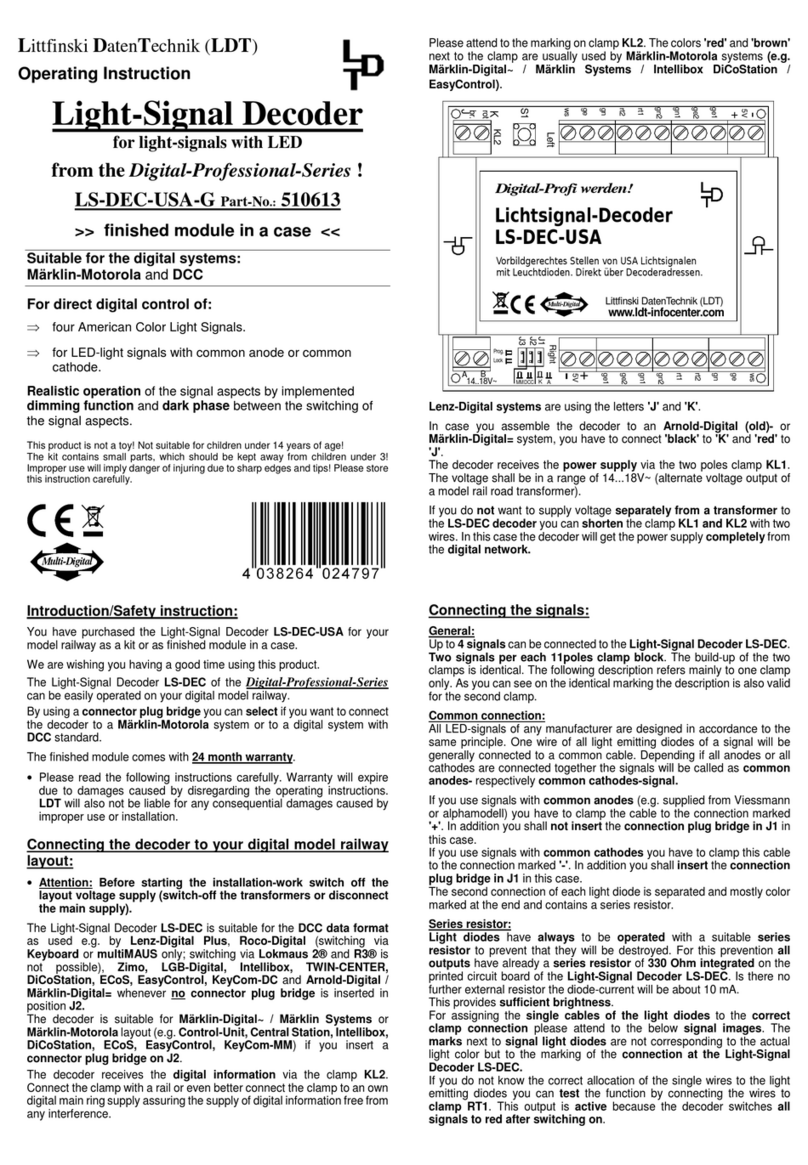
1. Home signal with 5 or 7 lamps:
GN1
RT1
GE1
GN2
GE
WS
GE1
GN2
RT1
GN1
RT1
WS
GE1
GN2
GE
GN1
home signal with 5 or 7 lamps
H 2 3
train stop 40km/h 65km/h
round/red/- round/red/- round/red/- round/red/-
1 2 3 4
straight/green/+ straight/green/+ straight/green/+ straight/green/+
proceed 95km/h 40km/h
1 5 6
2. Advance signal with 5 lamps:
WS
GN1 oder GN
RT1GE1 oder GE2
RT2 oder GN2
There are three wire bridges required. Connect GN1 with GN, RT2 with
GN2 and GE1 with GE2.
advance signal with 5 lamps
H 2 3
train stop 40km/h 65kmh (dark switch)
round/red/- round/red/- round/red/- round/red/-
1 2 3 4
straight/green/+ straight/green/+ straight/green/+ straight/green/+
proceed 95km/h 40km/h
1 5 6
Further sample connections are available at the internet on our Web-
Site (www.ldt-infocenter.com) at the section “Sample Connections”.
Additionally you can find detailed information about the Light-Signal
Decoder LS-DEC-SBB at our Web site within the section “Digital-
Compendium”.
Programming the decoder address:
•The jumper J3 has to be inserted for the programming of the decoder
addresses.
•Switch on the power supply of your model rail way.
•Activate the programming key S1.
•At least two light emitting diodes on a signal connected to the left
clamp block (on this decoder side is the programming key S1) will
be automatically switched over every 1.5 seconds in a flashing
mode. This indicates that the decoder is in the programming mode.
•The decoder addresses for magnet accessories also to be used for
switching the signal-aspects are combined into groups of four. The
address 1 to 4 build the first group. The address 5 to 8 build the
second group etc. In accordance to the operation mode 4 or 8
addresses will be assigned to the decoder. At the mode "single
function" both signals connected to the Light-Signal Decoder can
be operated absolute independent. The decoder requires for the
operation mode 8 addresses (4 addresses for each clamp bar).
At the "master/slave-function" both signals will be switched with
one command. Therefore will it be possible e.g. to switch home- and
advance signals together. In this operation mode the Light-Signal
Decoder requires only 4 addresses.
The operation mode has to be entered together with the decoder
address. If you activate during address-programming a key of the
required group of four which would switch a turnout straight or a
signal to green the decoder will go into the "single function mode".
If you activate a key which would switch a turnout round or switch a
signal to red you choose therefore the "function master/slave".
•If the decoder has recognized the assignment correctly the
connected light emitting diode will flash a little faster. Afterwards
the flashing slows down to the initial 1.5 seconds again.
In case the decoder will not recognize the address it could be that the
two digital information connections (clamp2) are wrong connected.
For testing this, switch off thepower supply, exchange the connection
on KL2 and start addressing again.
•Press now the programming key S1 again. Have you chosen the
operation mode "master/slave function" the decoder will leave the
programming mode because the programming of the group of four
has been completed. All signals will be automatically switched to
stop. The "master/slave function"has now been completed.
Have you chosen the operation mode "single function" you have
assigned the address group of the left clamp bar with the first
programming step. Therefore two light emitting diodes will flash
at the signal connected to the right clamp bar. Now activate any
key of the address group assigned for this signal. The decoder will
confirm the programming with a faster flashing.
Then press the programming key S1 again. The programming for
the "single function" has now been completed. Both connected
signals will switched to STOP by the decoder.
Signal switching:
The opposite sample connections show how the fourfold address-
group can be set by use of 8 keys of the push button panel for setting
the turnouts or signals. Between each pair of keys are e.g. the addresses
1 to 4. The two keys red and green for each address are assigned to
the turnout position round or straight respectively the corresponding
signal aspect which is indicated above or below key.
The actual address section is related to which fourfold address-group
has been selected during the programming.
If you use a remote control LH100 of Company Lenz Elektronik then
red will be the minus key and green the plus key.
If you have connected an advance- and an exit-signal to one of the two
clamp bars (as shown at the first sample) you can switch with the address
1 and the key green the exit signal to proceed (1).
The light emitting diode marked with GN will now indicate this at the
signal.
Dark switching:
In case a home- and an advance-signal are on one common signal
post the advance-signal can remain dark if the home-signal indicates
H or 6.
To activate the dark-switching-mode switch the home signal to Hor 6.
If you press now thekey 4 'red'you can switch the advance-signal-aspect
to 'on' respectively to 'off' with each keystroke. If the advance-signal is in
'off' position the dark-switching mode is activated.
The Light-Signal Decoder stores this mode permanently as well as
the programmed addresses. All programmed modes can be changed
at any time. The dark switchingcan be activated or deactivated only if the
jumper J3 has been inserted.
Advance signal aspects received during the signal has been switched to
dark will be indicated whenever the exit signal has been switched to 1, 2,
3 or 5.
Accessory:
For easy assemblyof the printed circuit board below your model rail road
layout base plate we offer a set of assembly material under the order
identification: MON-SET. Under LDT-01 you can purchase a low priced
durable suitable case for the LS-DEC.
Attention:
The Light-Signal Decoder LS-DEC switches the signal aspect not just
quickly on and off but is dimming the light emitting diodes realistic up and
down. Even between the signal aspects a short off-phase is provided.
Further digital commands received during this switch-over-time of about
0.4 seconds will not be taken up from the decoder. Please take care that
the switching-commands are not in a to fast sequence. The impression
is absolutely realistic if the switching is considerable slow.
If the jumper J3 will be removed after programming of the decoder
addresses and after adjusting the dark switching mode the memory
storage of the Light-Signal Decoder LS-DEC will be protected against
any alteration.
Made in Europe by
Littfinski DatenTechnik (LDT)
Bühler electronic GmbH
Ulmenstraße 43
15370 Fredersdorf / Germany
Phone: +49 (0) 33439 / 867-0
Internet: www.ldt-infocenter.com
Subject to technical changes and errors. 05/2019 by LDT
Märklin and Motorola are registered trade marks.