
King Pigeon PIR-100B Manual de usuario

User
Manual
PIR-100B
Ver 1.00
Date Issued: 2010-06-08
All rights reserved by
King Pigeon Hi-Tech.
Co., Ltd.
WirelessPassiveInfraredMotionDetector

ATop Safety and Protection Solution In The Worldwide! www.GSMalarmsystem.com
King Pigeon Hi-Tech. Co., Ltd. Page 1of 13 Ver 1.0 File No.: PIR-100B201006
Table of Contents
1. Brief introduction -----------------------------------------------------2
2. Background ------------------------------------------------------------2
3. Common Situations For PIR Motion Sensor-------------------2
4. Effects of Temperature Changes On PIR Sensors-----------4
5. Typical Construction Of A PIR Motion Sensor-----------------5
6. Mounting the PIR Motion Sensor---------------------------------6
7. Physical Layout of the PIR -100B -------------------------------8
8. PIR-100B PIR Motion Sensor Features ----------------------10
9. Technical specifications -------------------------------------------11
10. Important information ----------------------------------------------12
11. Maintenance----------------------------------------------------------12
12. Quality Warranty ----------------------------------------------------12
This handbook has been designed as a guide to the installation and operation of
PIR-100B Wireless Passive Infra-Red Sensors.
Statements contained in the handbook are general guidelines only and in no way are
designed to supersede the instructions contained with each model of sensor.
The instructions with every sensor should always be followed.
We recommend that the advice of a registered electrician be sought before any
Installation work commences.
King Pigeon Hi-Tech.Co., Ltd, its employees and distributors, accept no liability for
any loss or damage including consequential damage due to reliance on any material
contained in this handbook.

ATop Safety and Protection Solution In The Worldwide! www.GSMalarmsystem.com
King Pigeon Hi-Tech. Co., Ltd. Page 2of 13 Ver 1.0 File No.: PIR-100B201006
1. Brief Introduction
This handbook has been produced to assist contractors and wholesalers in
selecting the best location for a sensor and it explains how to installation and
sensitivity controls to appropriate settings to get the best performance from the
unit.
The PIR-100B is a wireless PIR motion sensor, it equipped with Microcontroller
and internal wireless Antenna inside, with low power consumption.
2. Background
Passive Infra-Red Sensors have been around since the 1940s, originally being
used for military and scientific applications.
Now the technology is being used in a wide range of products designed
specifically for commercial and domestic security applications.
The PIR-100B is special for indoor applications, eg.: house, office, shop, store
and so on.
3. How Passive Infra-red sensors work
All PIR sensors detect changes in infra-red radiation, in the form of heat emitted
by a number of bodies including people, cars and, to a lesser extent, dogs or
other small animals. The bigger the body, the more infra-red radiation is emitted
and the easier it is for a PIR sensor to detect.
The field of view is the area in which changes in infra-red radiation can be
detected. The field of view can alter with changes in temperature and the size of
the heat source.
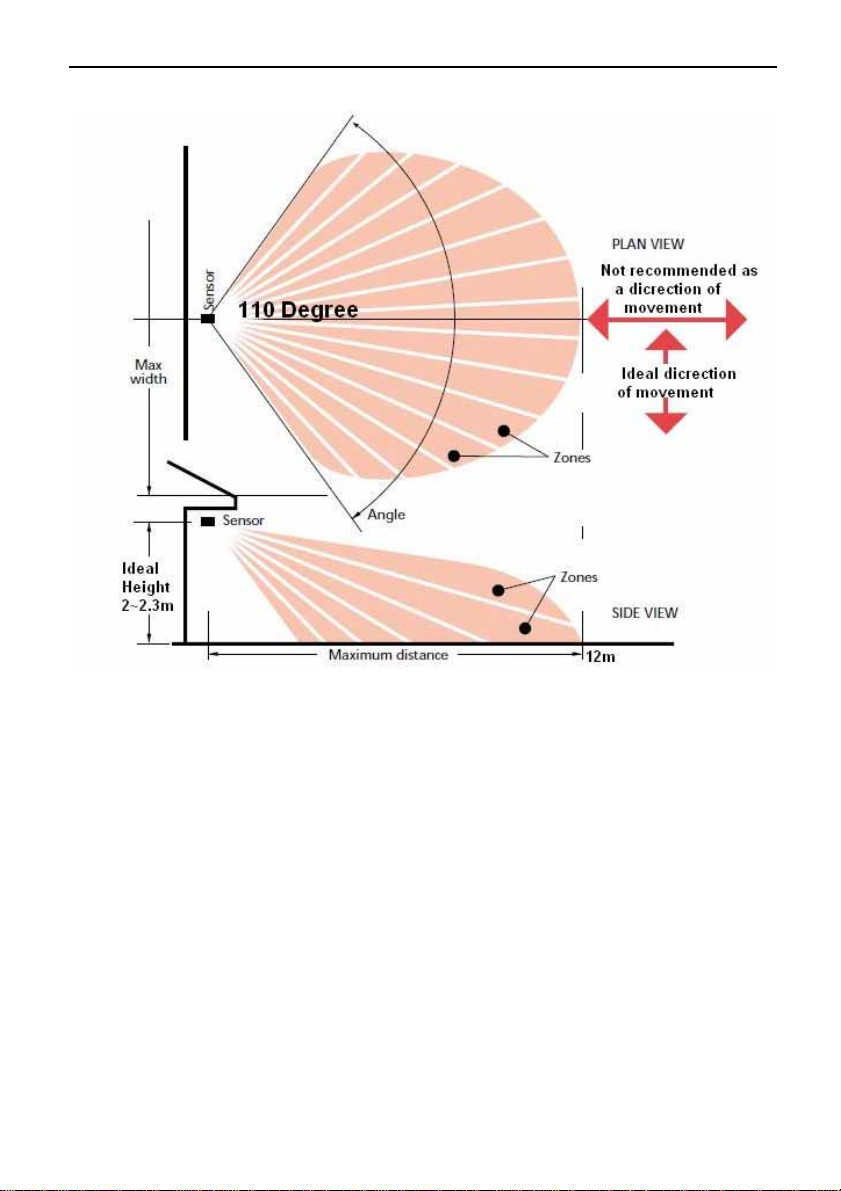
The construction of the PIR and the Fresnel Lens divide the field of view into a
number of zones both vertically and horizontally, as shown in the diagram
overleaf.
ATop Safety and Protection Solution In The Worldwide! www.GSMalarmsystem.com
King Pigeon Hi-Tech. Co., Ltd. Page 3of 13 Ver 1.0 File No.: PIR-100B201006
Each zone is constantly monitored by the sensor. When a person or other heat
source enters any zone, the level of infra-red radiation in that zone increases.
This change is detected and processed by the sensor, switching on the
microcontroller to process.
Providing the heat source (person) continues to move in the field of view, the
PIR sensor will keep processing the changes in infra-red radiation. If a person
stands still in the field of view or moves out of the detection area, the sensor will
not detect any changes in infra-red radiation between the zones after the ‘Time’
period is complete. In order for the sensor to most effectively detect changes in
heat between zones, it is advisable to walk across the zones not up or along a
zone. PIR sensors are passive devices; they do not emit or radiate any energy
or beams.
In order to save the power consumption, in the PIR-100B, we reserved two

ATop Safety and Protection Solution In The Worldwide! www.GSMalarmsystem.com
King Pigeon Hi-Tech. Co., Ltd. Page 4of 13 Ver 1.0 File No.: PIR-100B201006
optional for users. One is the Time Span=4 minutes, another is Time Span
=8 minutes. Means once the sensor triggered, then will not trigger again
within 4(8) minutes, after 4(8) minutes, if triggered, then will trigger the
alarm again.
4. Effects of Temperature Changes On PIR Sensors
All PIRs operate by detecting the temperature difference between the ambient
air temperature and a moving heat source (person).
Outside air temperature changes have the greatest effect on the operating
performance of PIRs. The sensitivity of the sensor will increase in cold nights
and decrease in hot nights.
On cold nights, the difference in temperature between a person (normal body
temperature is 37℃) and the outside air temperature, is relatively large, giving
an apparent increase in performance of the sensor. On hot nights, this
difference in temperature is relatively small and a decrease in performance of
the sensor can be expected.
At 15℃ – 20℃, the sensor should perform according to the stated specifications.
If the ambient temperature increases to 30℃or more, the following changes
occur:
ATop Safety and Protection Solution In The Worldwide! www.GSMalarmsystem.com
King Pigeon Hi-Tech. Co., Ltd. Page 5of 13 Ver 1.0 File No.: PIR-100B201006
1) The maximum distance and field of view significantly decrease (up to as
much as 50%).
2) The distance a heat source has to move across the zones to activate the
sensor increases.
3) The size of the heat source required to activate the sensor increases.
At an ambient temperature of 10℃or less, the opposite occurs:
1) The maximum distance and field of view increases.
2) The distance a heat source has to move across the zones to activate the
sensor decreases.
3) The size of the heat source required to activate the sensor decreases.
Tips:
1) Nuisance tripping is usually more prevalent in winter. In the summer, problems of
short detection distance and reduced field of view occur more often.
2) The effect of temperature on range and field of view is easily corrected by changing
the angle of the sensor head. eg angle up for summer or angle down for winter.
Alternatively, if the unit has a sensitivity adjustment feature, increase the sensitivity
during summer and decrease the sensitivity during winter.
5. Typical Construction of PIR Motion Sensor

ATop Safety and Protection Solution In The Worldwide! www.GSMalarmsystem.com
King Pigeon Hi-Tech. Co., Ltd. Page 6of 13 Ver 1.0 File No.: PIR-100B201006
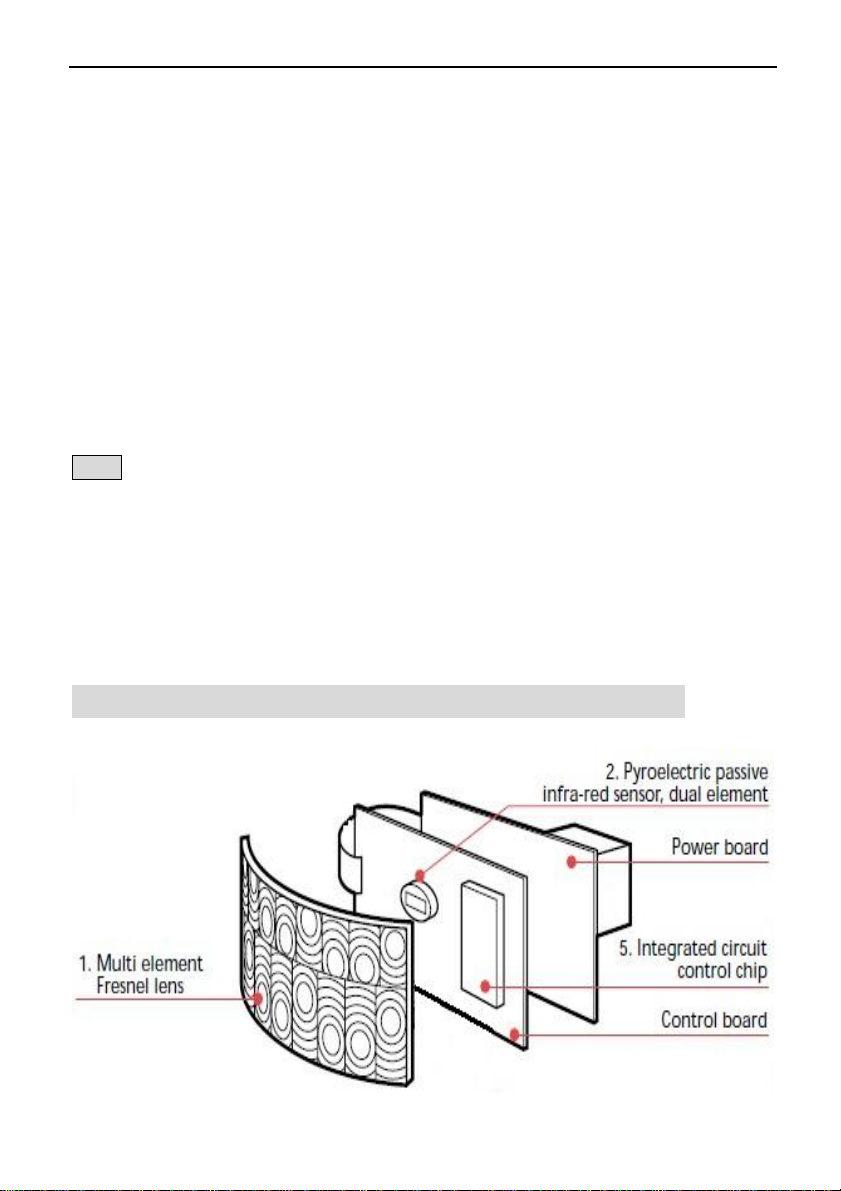
1) Multi Element Fresnel Lens
The lens focuses the infra-red radiation given out by a heat source (person) on
to the Pyroelectric sensor. The different elements or facets of the lens divide the
incoming infrared radiation into vertical and horizontal zones.
2) Pyroelectric Passive Infra-Red Sensor
The dual element Pyroelectric sensor receives the incoming infra-red radiation
from the various zones. The two elements of the sensor receive varying
amounts of infra-red radiation and this difference is amplified, turning into a
signal via the IC. This signal activates the microcontroller. The sensor detects
infra-red radiation in the wave length range of 8 to 14 m.
3) Integrated Circuit Control Chip (IC)
This is a customised chip which controls the various modes of operation, timing
functions and the processing of the signal from the sensor to drive wireless
alarm signal to alarm panel.
6. Mounting the PIR Sensor
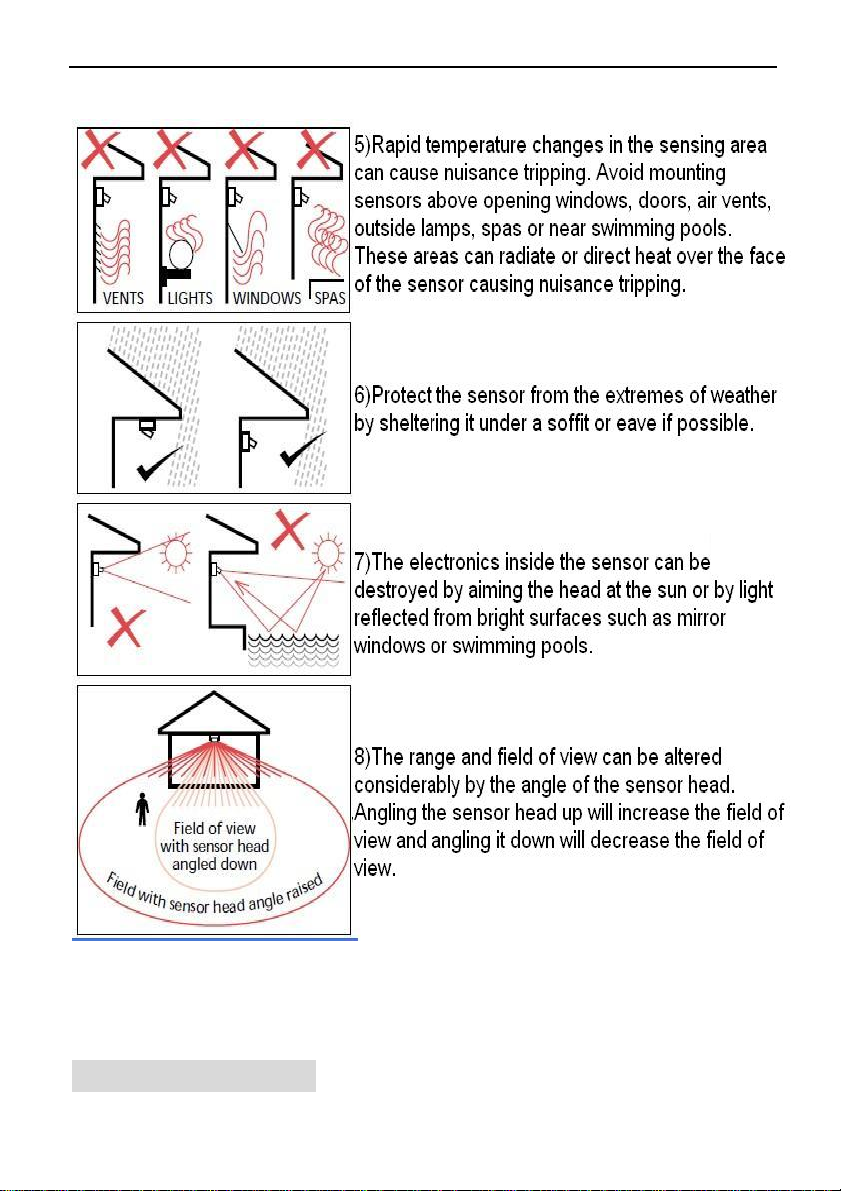
The key to successful operation of any PIR sensor is choosing the correct
location. A sensor mounted in an unsuitable location has the potential to cause
nuisance tripping and reduced performance. The main rules that should be
followed to ensure trouble-free operation are:

ATop Safety and Protection Solution In The Worldwide! www.GSMalarmsystem.com
King Pigeon Hi-Tech. Co., Ltd. Page 7of 13 Ver 1.0 File No.: PIR-100B201006
ATop Safety and Protection Solution In The Worldwide! www.GSMalarmsystem.com
King Pigeon Hi-Tech. Co., Ltd. Page 8of 13 Ver 1.0 File No.: PIR-100B201006
The key to successful operation of any PIR sensor is choosing the correct
location.The greater the field of view, the greater the chance of nuisance
tripping.
7. Physical Layout

ATop Safety and Protection Solution In The Worldwide! www.GSMalarmsystem.com
King Pigeon Hi-Tech. Co., Ltd. Page 9of 13 Ver 1.0 File No.: PIR-100B201006
Instruction of the Level Jumpers
L1 Recommend Level, for normal application in house.
L2 When the environment is bad, we suggest use L2, e.g.:
electromagnetic effect, temperature changes quickly and so on.
Instruction of the Mode Jumpers
Tabla de contenidos


